恒生电子

Search documents
规模突破6万亿元 ETF下一步如何走?
Shang Hai Zheng Quan Bao· 2026-01-05 18:56
Core Insights - The ETF market is experiencing significant growth, with total assets expected to reach 6.02 trillion yuan by the end of 2025, an increase of 2.29 trillion yuan from the end of 2024 [2] - The competition among fund companies is intensifying, focusing on scale, innovation, and ecosystem development as the ETF market matures [1][2] Growth and Market Dynamics - As of December 2025, there are 128 ETFs with assets exceeding 100 billion yuan, up from 66 at the end of 2024, with 17 surpassing 500 billion yuan [2] - The rapid growth of ETFs is closely linked to policy support, including the China Securities Regulatory Commission's initiatives to enhance the index fund product system and reduce investment costs [2][3] Trading Activity and New Products - The trading volume of stock ETFs reached a new high on January 5, 2026, with a total transaction amount of 186.11 billion yuan, indicating strong market activity [4] - There are currently 11 ETFs in the issuance process and 7 more set to launch, focusing on niche industry themes such as battery, photovoltaic, and food ETFs [4] Competitive Landscape - The ETF market is characterized by a "head concentration" effect, with major players like Huatai-PB, E Fund, and China Asset Management leading the market [7] - New entrants are increasingly attracted to the ETF space, with several fund companies, including Chuangjin Hexin and Xinyuan, making their first forays into ETF products [7] Future Outlook - Analysts predict that the demand for stable and transparent returns will drive ETFs to evolve from trading tools to fundamental investment vehicles, especially in a low-interest-rate environment [8] - Innovations in ETF product types, such as equity-bond constant ETFs and strategy ETFs, are expected to attract more long-term capital [8]
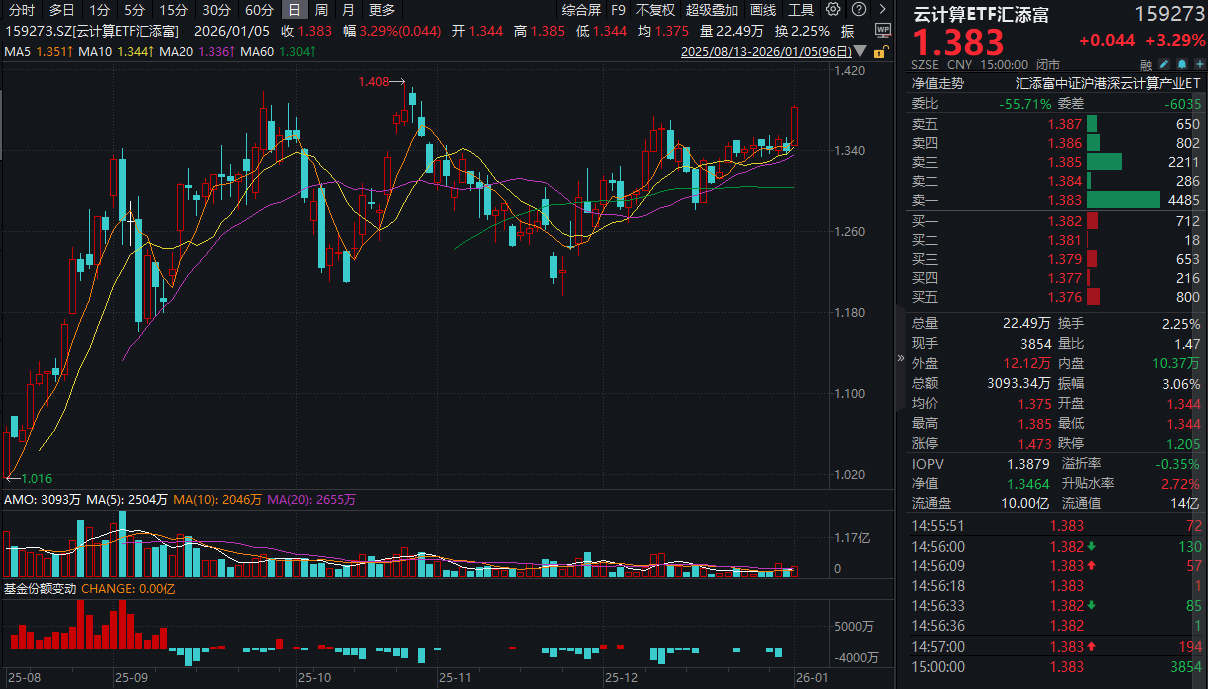
AI叙事不断递进,阿里巴巴、中际旭创双双涨超2%!云计算ETF汇添富(159273)大涨超3%!机构:2026拥抱“AI+”投资主线!
Sou Hu Cai Jing· 2026-01-05 09:46
Group 1: Market Performance - The Shanghai Composite Index accelerated its rise by over 1%, returning to the 4000-point mark, with the computing power sector showing strong performance [1] - The cloud computing ETF Huatai-PineBridge (159273) saw a significant increase of over 3%, with a total trading volume exceeding 30 million yuan, representing a 33% increase compared to the previous period [1] Group 2: Stock Performance of Key Companies - Most of the weighted stocks in the cloud computing ETF Huatai-PineBridge closed in the green, with Kingsoft Office rising over 6%, and Alibaba-W, Zhongke Shuguang, and others increasing by over 2% [2] - The estimated weight and performance of key stocks include: - Zhongbiao Chuang (11.14% weight, +2.21% change) - Alibaba-W (9.52% weight, +2.55% change) - Kingsoft Office (3.97% weight, +6.49% change) [3] Group 3: Industry Trends and Projections - Guosen Securities reviewed the trends in AI model development, noting that the narrative around AI has evolved, with significant advancements expected in reasoning capabilities and application companies [4] - The capital expenditure (Capex) of major tech giants is projected to grow by over 50% year-on-year in 2025, with expectations of continued growth of over 30% in 2026 [5] - The demand for data center capacity is expected to increase significantly, with a projected shortfall in power supply due to the retirement of coal power and long construction cycles for supporting infrastructure [5] Group 4: Technological Developments - The evolution of model architecture continues, with a focus on addressing computational and memory consumption bottlenecks during training, as well as enhancing reasoning capabilities [5][7] - The emergence of AI agents is supported by improvements in model capabilities and efficiency, which are expected to drive significant growth in applications such as AI programming and content creation [8] Group 5: Investment Opportunities - The cloud computing ETF Huatai-PineBridge (159273) is positioned to capture the historical opportunities presented by AI-driven computing power, covering a wide range of sectors including hardware, cloud services, and data center operations [10]


恒生电子(600570.SH):公司没有投资沐曦股份
Ge Long Hui· 2026-01-05 09:04
格隆汇1月5日丨恒生电子(600570.SH)在投资者互动平台表示,公司没有投资沐曦股份。 ...
恒生电子:公司未投资沐曦股份
Mei Ri Jing Ji Xin Wen· 2026-01-05 08:54
(记者 王晓波) 每经AI快讯,有投资者在投资者互动平台提问:请问贵公司是否持有沐曦股份的股份? 恒生电子(600570.SH)1月5日在投资者互动平台表示,公司没有投资沐曦股份。 ...
软件ETF(159852)涨超3%! DeepSeek近日发布论文,开启架构新篇章!
Jin Rong Jie· 2026-01-05 06:39
资讯所属栏目还有更多独家策划、专家专栏,免费查阅>> 软件ETF(159852)跟踪中证软件服务指数,前十大权重股分别为科大讯飞、金山办公、同花顺、指南 针、恒生电子、拓维信息、润和软件、三六零、软通动力、深信服,权重合计超60.89%。 软件ETF(159852)当前管理费率为0.50%(每年),托管费率为0.10%(每年),没有股票账户的投资 者还可以通过联接基金(012619.OF,012620.OF,021861.OF)布局板块投资机遇。 声明:市场有风险,投资需谨慎。本文为AI基于第三方数据生成,仅供参考,不构成个人投资建议。 市场1月5日消息,据上交所数据显示,今日上证指数再度站上4000点,截至14:05,上证指数上涨 1.32%,中证软件指数上涨3.41%,个股方面,合合信息涨超7%,科大讯飞涨超6%,指南针、同花顺等 涨超3%。热门ETF方面,软件ETF(159852)涨3.36%。 消息面上,DeepSeek近日发布论文,阐述了一种更为高效的人工智能开发方法。该论文由创始人梁文 锋参与撰写,提出了名为"流形约束超连接"(mHC)的框架。作者称,该框架旨在提升可扩展性,同 时降低训练先进人工 ...

东吴证券:数字人民币新方案 机制+技术架构双重升级
智通财经网· 2026-01-05 01:34
Core Viewpoint - The upgrade of digital RMB from a "pilot product" to a "core liability and infrastructure" of banks will lead to an "order-driven + long-term penetration" impact on A-shares, rather than a simple thematic trade [1][2]. Group 1: Digital RMB Upgrade - The People's Bank of China will officially launch a new generation of digital RMB measurement framework and management system starting January 1, 2026, transitioning from "cash-type 1.0" to "deposit currency-type 2.0" [2]. - The core of the 2.0 mechanism is the redefinition of liability attributes and the inclusion of a macro framework, where balances in real-name wallets at commercial banks will be treated as "account-based commercial bank liabilities" [3]. Group 2: Financial IT Impact - Financial IT companies are likely to benefit from the need for banks to transform their core systems, accounting, channels, and data governance as the digital RMB infrastructure is implemented [1]. - The digital RMB will enhance the willingness of users to hold and use it by providing interest payments on wallet balances, similar to traditional deposits, thus creating a manageable asset-liability space for banks [3]. Group 3: Technical Architecture - The proposed digital path includes an "account system + currency string + smart contracts," which aims to standardize the wallet system and enhance the resilience of the system while ensuring compatibility with distributed ledger technology (DLT) [4]. - The smart contract ecosystem will facilitate programmable digital payments, reducing misuse risks and compliance costs across various scenarios such as supply chain finance and fiscal subsidies [4]. Group 4: Investment Recommendations - Companies such as Hengsheng Electronics, Jingbeifang, Changliang Technology, and Yuxin Technology are recommended for their potential in payment acceptance and terminal expansion [5]. - Communication operators like China Telecom, China Unicom, and China Mobile are expected to benefit directly from capabilities related to SIM hard wallets and cross-border connections [5].

2025全球资管深研报告:全球智能投顾全景图
Sou Hu Cai Jing· 2026-01-04 13:39
Core Insights - The rise of robo-advisors is driven by the integration of financial technology and traditional wealth management, offering low-cost, accessible, and user-friendly investment services, thereby democratizing finance [1][7] - The global robo-advisory market is expected to grow significantly, reaching over $100 billion by 2033, with the U.S. holding a dominant position [2][18] - The business model of robo-advisors has evolved from serving individual clients to a platform-based and ecosystem-oriented approach, diversifying revenue streams [3][4] Market Overview - The global robo-advisory market is projected to grow from $7.7 billion in 2023 to approximately $116.4 billion by 2033, with a compound annual growth rate (CAGR) of 31.2% from 2024 to 2033 [18] - The U.S. accounts for 81% of the global robo-advisory assets under management (AUM), with major players including Vanguard, Schwab, and Betterment [23][24] - The European market is smaller but shows potential, particularly in Germany, which has over 2 million robo-advisory users due to its unique ETF savings plan culture [25][28] Business Model Evolution - Robo-advisors have transitioned from a simple individual client model to a multi-faceted platform approach, including B2B services and diverse revenue models [3][4] - Revenue models have diversified from asset management fees to tiered subscription fees and technology-enabled service fees, reflecting a shift from scale expansion to value extraction [3][4] - Key competitive advantages for leading platforms include strong overall performance, superior digital experiences, and user-friendly interfaces [3][4] Investment Strategies - The industry is witnessing a nuanced debate between "active" and "passive" investment philosophies, with different platforms adopting varied strategies based on market understanding and client needs [3][4] - Some platforms adhere strictly to modern portfolio theory, while others incorporate active management elements or innovative techniques like smart beta to achieve excess returns [3][4] Future Outlook - The robo-advisory industry is moving away from rapid growth towards deeper integration and iteration, with ongoing consolidation expected [4] - The application of artificial intelligence, particularly large language models, is anticipated to enhance the personalization of robo-advisory services, transforming them into intelligent financial partners [4][7] - The industry is likely to see a shift from mere algorithmic recommendations to more human-like, personalized financial advisory interactions [4][7]

更猛“激战”要引爆?多家公司摩拳擦掌 ETF市场有望迎来更多新力军杀入
Sou Hu Cai Jing· 2026-01-04 00:15
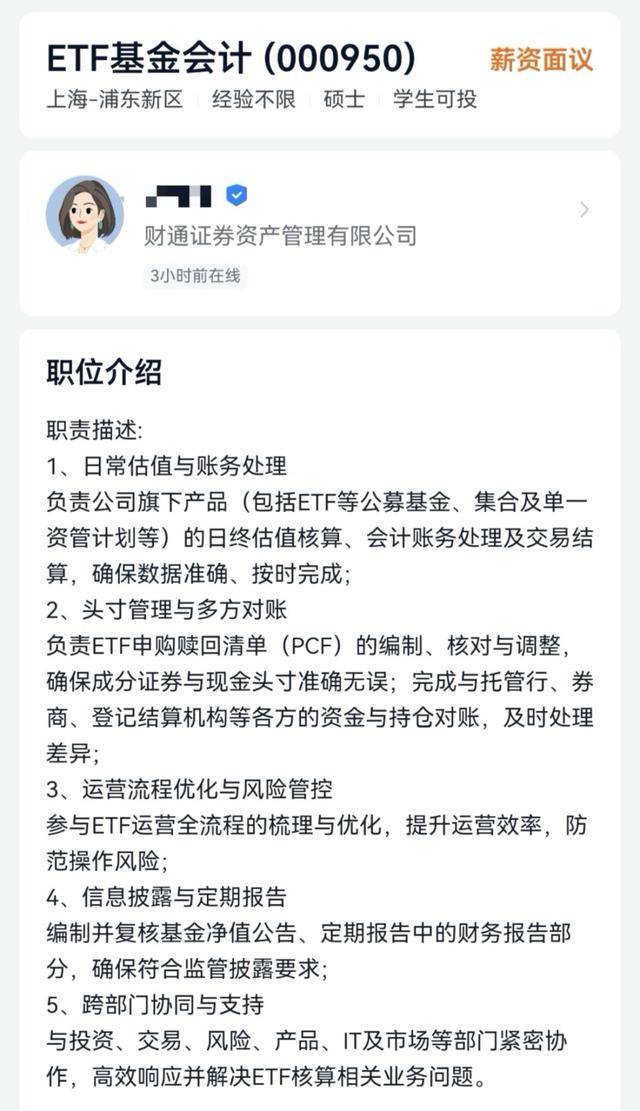
Core Insights - The ETF market in China has seen significant growth, with an increase of over 2 trillion yuan in 2025, making it a crucial growth area for the public fund industry [1][2] - Numerous fund companies, including newly established ones and traditional securities asset management institutions, are actively recruiting talent and preparing to enter the ETF market [1][2] Industry Trends - The ETF market, valued at approximately 6 trillion yuan, is attracting more institutions, leading to increased competition and potential for product innovation [2][10] - The entry of new players is driven by a combination of policy support, market demand, and the advantages of passive investment strategies [13][14] Recruitment and Talent Acquisition - Fund companies are intensifying their recruitment efforts for ETF-related positions, such as fund accountants and system operation roles, to support their ETF initiatives [2][5][10] - Positions require specific expertise in ETF operations, accounting, and system management, indicating a focus on building a skilled workforce for ETF management [4][7] Challenges for New Entrants - New entrants face challenges such as resource allocation, liquidity management, and brand building in a market dominated by established players [15][16] - Strategic focus on long-term goals and differentiation in product offerings is essential for new companies to succeed in the competitive ETF landscape [15][16] Market Dynamics - The ETF market is evolving towards a more balanced structure and deeper services, driven by the influx of new institutions [17] - The demand for low-cost, transparent, and liquid investment products is increasing among both institutional and individual investors, further supporting the growth of ETFs [14][15]
更猛“激战”要引爆?6万亿“蓝海”,更多新力军杀入
Zhong Guo Ji Jin Bao· 2026-01-03 14:40
Core Insights - The ETF market is experiencing significant growth, with an increase of over 2 trillion yuan in 2025, attracting more institutions to enter the space [1][2] - Many fund companies, including newly established ones and traditional brokerage asset management firms, are ramping up recruitment for ETF-related positions in preparation for 2026 [2][3] - The entry of more institutions into the ETF market is expected to intensify competition while also fostering product innovation [1][4] Group 1: Market Dynamics - The ETF market, valued at approximately 6 trillion yuan, is becoming increasingly competitive as more institutions vie for a share [2] - New entrants are focusing on hiring talent with experience in ETF operations, indicating a strategic shift towards this growing segment [3][4] - The rapid development of passive equity funds, particularly ETFs, is attributed to the increasing effectiveness of markets and the challenges faced by actively managed funds in generating excess returns [5][6] Group 2: Opportunities and Challenges - The convergence of policy, market, and demand factors is driving the influx of fund institutions into the ETF space, highlighting the potential for growth [4][6] - New entrants face challenges such as resource allocation, liquidity management, and brand building, necessitating a long-term strategic approach [7][8] - Differentiation in product offerings and collaboration with related sectors can enhance the acceptance and recognition of ETF products among investors [8][9] Group 3: Future Outlook - The entry of more institutions is expected to optimize the industry ecosystem, transitioning the market from mere scale expansion to a more balanced structure and deeper service offerings [9]
更猛“激战”要引爆?6万亿“蓝海”,更多新力军杀入
中国基金报· 2026-01-03 14:22
Core Viewpoint - The ETF market in China is experiencing significant growth, with over 2 trillion yuan added in 2025, attracting numerous new entrants from various sectors, including banks and newly established fund companies [2][4]. Group 1: Market Dynamics - The ETF market is now valued at approximately 6 trillion yuan, leading to increased competition as more institutions seek to enter this space [4]. - Many fund companies are ramping up recruitment for ETF-related positions in preparation for 2026, indicating a strategic shift towards ETF offerings [4][5]. - New entrants, such as Peng'an Fund and Caifeng Securities Asset Management, are actively hiring for roles that require expertise in ETF operations and accounting [4][5][10]. Group 2: Motivations for Entry - The influx of fund companies into the ETF market is driven by a combination of policy support, market demand, and the advantages of passive investment strategies [14][15]. - The increasing effectiveness of the market has made passive investment through ETFs more appealing, as active management yields diminishing returns [14]. - Institutions are recognizing the potential for growth in the ETF sector, with a focus on expanding their product lines to capture market share during this growth phase [14][15]. Group 3: Challenges and Strategies for New Entrants - New entrants face significant challenges, including competition from established players, resource allocation, and brand recognition [18][19]. - To succeed, new fund companies must adopt a long-term perspective, focusing on differentiation and strategic investment in talent and technology [18][20]. - Emphasizing product innovation and enhancing service quality will be crucial for new entrants to carve out a niche in the competitive ETF landscape [20].