Nestle

Search documents
谁在“改造”雀巢?
3 6 Ke· 2025-10-23 00:06
Core Insights - The food and beverage industry is undergoing a deep adjustment as consumer preferences shift from large brands and standardized products to functional, health-oriented, and localized options, leading to a decline in traditional growth strategies [1][10] Company Performance - Nestlé's CEO announced a global layoff plan affecting approximately 16,000 employees, including 12,000 white-collar jobs and 4,000 in production and supply chain roles, as part of a strategy to address declining sales and growth [2][11] - For the first nine months of 2025, Nestlé reported global sales of CHF 65.9 billion, a year-on-year decline of about 1.9%, with an organic growth rate of 3.3%, primarily driven by price increases rather than volume growth [2][6] - The organic growth rate in emerging markets was 5.2%, mainly attributed to pricing, while developed markets saw a lower organic growth rate of 2.1%, indicating a slowdown compared to long-term targets [2][6] Strategic Adjustments - The new CEO emphasized the need for actual internal growth as a primary goal and announced comprehensive measures including personnel optimization, process reengineering, and divesting inefficient businesses [3][11] - Nestlé has restructured its organization from five regions to three, indicating a strategic shift to allocate more resources to faster-growing and more profitable segments such as premium coffee, pet care, and health nutrition [5][11] Market Dynamics - Nestlé's growth is increasingly reliant on price increases rather than volume expansion, with coffee and candy being the strongest performing segments, although their growth is also driven by pricing strategies [6][7] - The pet food segment has shown resilience, achieving an organic growth rate of approximately 1.6%, indicating a stable market demand despite overall challenges [9][11] Consumer Trends - The company faces challenges from changing consumer preferences towards personalization, health consciousness, and emotional value, which are impacting brand loyalty and traditional business models [10][11] - The shift in consumer behavior, particularly in markets like China, where demand for high-sugar and high-fat products is declining, poses significant challenges for Nestlé's traditional product lines [11][13] Future Outlook - Nestlé is in a deep adjustment phase, with the layoffs being just the beginning of a broader strategic overhaul aimed at innovating its business model to align with new consumer demands [11][13] - The company's ability to adapt and innovate in response to market changes will be crucial for its future growth, as traditional strategies are becoming less effective [13][14]



巨头雀巢要裁员一万六千人?如此大裁员究竟想干啥?
3 6 Ke· 2025-10-22 04:04
Group 1 - Nestlé plans to lay off approximately 16,000 employees globally over the next two years, with around 12,000 of these being white-collar professionals [3][6] - The company's sales for the first nine months of 2025 amounted to 65.87 billion Swiss francs, reflecting a 1.9% decline, while organic growth was reported at 3.3% [3] - The restructuring aims to save 1 billion Swiss francs annually by 2027, doubling the initial target of 500 million Swiss francs, with one-time restructuring costs expected to be twice the annual savings [3][9] Group 2 - The layoffs are a response to ongoing global economic pressures, including weak consumer demand and intensified competition in the consumer goods sector [6][8] - The focus of the layoffs on white-collar positions indicates a shift towards automation and digital transformation, as these roles are more susceptible to being replaced by technology [8] - By reducing workforce costs, Nestlé aims to free up cash flow for core business investments, such as new product development and market expansion [9] Group 3 - The situation highlights the increasing importance of building "risk resilience" among employees, as job security in even major corporations like Nestlé is not guaranteed [11] - The demand for versatile talent is expected to rise, emphasizing the need for continuous learning and skill enhancement among workers to remain competitive [11]
雀巢,要背水一战了
3 6 Ke· 2025-10-20 07:40
Core Viewpoint - Nestlé announced a significant restructuring plan, aiming to cut nearly 6% of its workforce, equating to 16,000 jobs globally, to save 1 billion Swiss francs annually by 2027, raising its total cost-saving target to 3 billion Swiss francs [1][30]. Financial Performance - In the first nine months of the year, Nestlé reported sales of 65.87 billion Swiss francs, with an actual growth rate of only 0.6% [1]. - The organic growth rate for the third quarter reached 4.3%, largely due to a low base from the previous year, indicating structural issues in growth quality [13][14]. Market Challenges - Sales in China, Nestlé's second-largest market, declined by 6.4%, prompting a reorganization of the Greater China region into the Asia division [1]. - The company faces a dual challenge in China, where consumers are increasingly divided into two categories: those seeking value for money and those desiring premium products [15][16][18]. Leadership Changes - The sudden appointment of a new CEO, Philippe Naouri, and the early departure of the board chairman, Paul Bulcke, indicate internal governance concerns and a need for decisive action [2][3][4]. Strategic Shift - The restructuring plan reflects a shift towards a more agile and data-driven organizational structure, aiming to reduce internal management costs and enhance market responsiveness [39][40]. - Nestlé's strategy includes a thorough review of its business segments, focusing on divesting underperforming assets while investing in high-potential areas like Nespresso and PetCare [45][49]. Consumer Behavior - The current inflationary environment has led to a reliance on price increases for revenue growth, raising concerns about the sustainability of this model as consumer price sensitivity increases [12][14]. - The shift in consumer purchasing habits towards e-commerce and social media platforms necessitates a complete overhaul of Nestlé's marketing and distribution strategies [21][22][24].
雀巢前三季度有机增长率为3.3% 公司拟在两年内裁员1.6万人
Zheng Quan Ri Bao· 2025-10-19 14:10
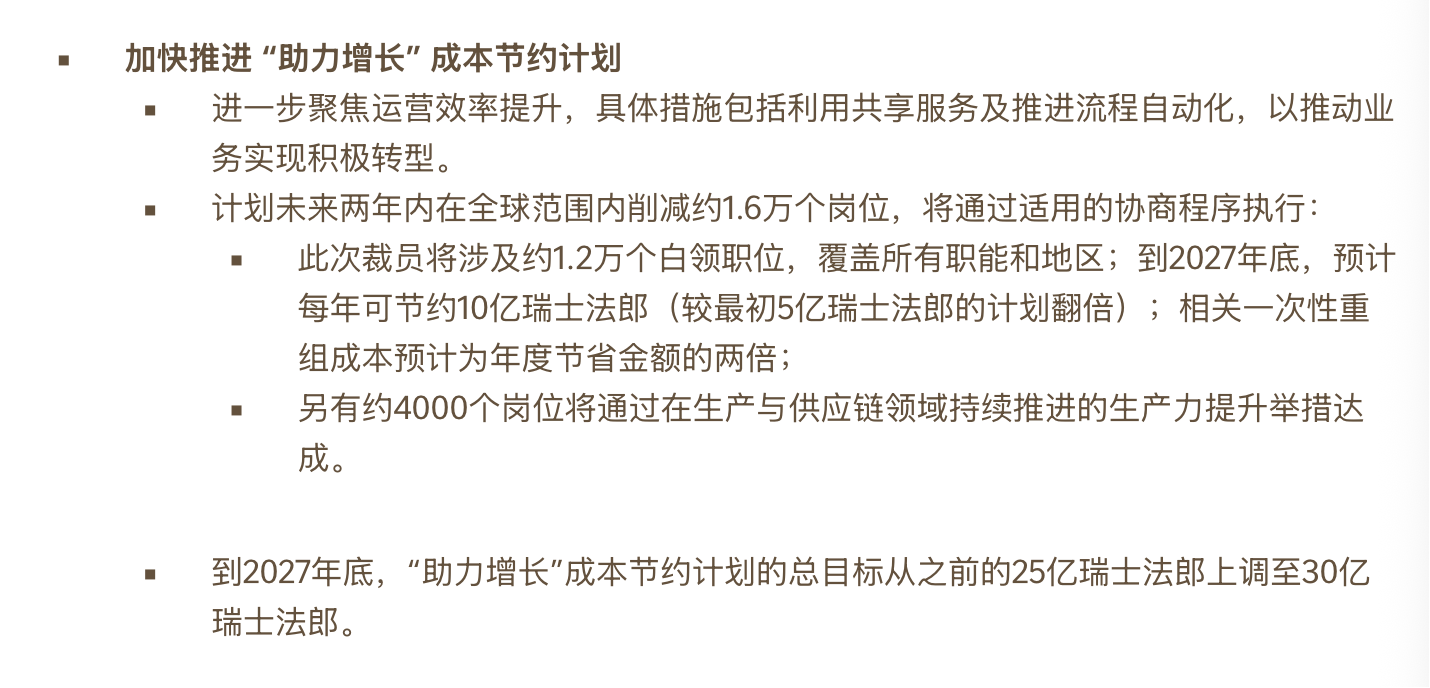
Core Insights - Nestlé reported an organic growth rate of 3.3% for the first three quarters of 2025, with a significant increase to 4.3% in the third quarter, driven by pricing strategies and low year-on-year comparisons [1] - The company plans to cut approximately 16,000 jobs globally over the next two years, including 12,000 white-collar positions, as part of a strategy to enhance productivity and reduce costs [5] Financial Performance - The organic growth rate for the third quarter was 4.3%, with internal growth at 1.5% and pricing contribution at 2.8% [1] - Coffee and confectionery were the main contributors to organic growth, with some markets experiencing double-digit growth [1] - Developed markets showed an organic growth rate of 2.1%, while emerging markets achieved 5.2%, primarily driven by pricing [1] Regional Performance - The Greater China region experienced a significant decline, with an organic growth rate of -10.4% in the third quarter and -6.1% for the first nine months of the year [2] - The decline in the Greater China region is a key factor affecting the overall performance of the company [1][2] Strategic Initiatives - The new CEO, Philipp Navratil, emphasized a cautious approach to resource allocation, focusing on high-potential opportunities and bold investments to drive innovation and growth [5] - The company aims to achieve a cost-saving target of 3 billion Swiss francs by the end of 2027, alongside other initiatives to enhance overall business performance [5][6] - Nestlé is reducing excess inventory and refocusing on demand creation to improve market performance [6]
新帅刚上任,雀巢宣布裁员1.6万人,1.2万白领面临失业!新任CEO:树立绩效导向思维;前任CEO上月因“办公室恋情”被解雇
Sou Hu Cai Jing· 2025-10-18 06:25
Core Viewpoint - Nestlé plans to cut approximately 16,000 jobs, equivalent to 6% of its total workforce, as part of a strategy to accelerate corporate transformation amid performance pressures [1][3][4]. Group 1: Job Cuts and Corporate Strategy - The job cuts will affect around 12,000 white-collar positions across all functions and regions, along with about 4,000 roles in production and supply chain [1][4]. - The announcement coincides with Nestlé's third-quarter sales exceeding expectations, indicating a push for transformation under new CEO Philippe Navratil [1][3]. - Navratil emphasizes the need for Nestlé to adapt more quickly to changing market conditions, which includes making difficult decisions like layoffs [6][10]. Group 2: Financial Performance - Nestlé's total sales for the first nine months of 2023 were 65.9 billion Swiss francs, a decline of 1.9%, but organic growth was reported at 3.3% [3][4]. - The company experienced a negative impact of 5.4% from currency fluctuations, while net acquisitions contributed positively by 0.1% [3]. - The Greater China region continues to struggle, with an organic growth rate of -10.4% in Q3, contributing to overall sales declines [4]. Group 3: Leadership Changes - The recent leadership changes at Nestlé include the dismissal of former CEO Laurent Freixe and the appointment of Navratil, who is the youngest CEO in nearly 60 years [8][9]. - Navratil's management philosophy focuses on performance culture, transparency, and urgency, aiming to prevent market share loss and prioritize high-potential opportunities [9][10]. - The company aims to save 3 billion Swiss francs (approximately 3.77 billion USD) by 2027, an increase from the previous target of 2.5 billion Swiss francs [4][9].

雀巢,蓄力“加速增长”
Sou Hu Cai Jing· 2025-10-17 19:30
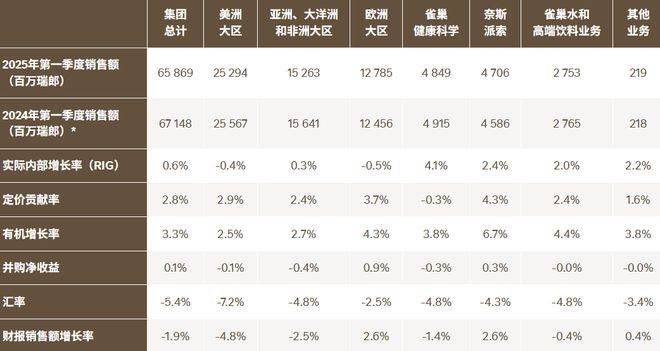
Core Insights - Nestlé Group reported total sales of 65.9 billion Swiss francs for the first nine months of 2025, with an organic growth rate of 3.3%, indicating accelerating growth momentum [1][2] - The new management team has implemented a "4D strategy" to enhance localization efforts in the Chinese market, focusing on long-term recovery despite short-term challenges [1][8] - The company aims to transform its business structure to ensure growth efficiency through cost reduction and targeted investments [1][14] Regional Performance - All regions and global management businesses achieved positive growth, with a real internal growth (RIG) of 0.6% and stable pricing contribution at 2.8% [2][3] - The organic growth rate for the third quarter reached 4.3%, the highest in recent times, showcasing strong internal business momentum [2] - Developed markets showed an organic growth rate of 2.1%, while emerging markets achieved 5.2%, primarily driven by pricing [3] Business Unit Performance - Coffee and confectionery businesses are the main growth drivers, with the confectionery segment showing significant resilience [4] - Most product categories achieved positive organic growth, indicating overall business health [4] Digital Transformation - Significant progress in digital transformation was noted, with e-commerce sales growing by 13.2%, accounting for 20.2% of total sales [6] - The company has increased investment in key business opportunities, doubling growth rates in some areas [6] Focus on China Market - The Greater China region contributed 80 basis points to the group's organic growth, with a third-quarter organic growth of -10.4% due to inventory reduction efforts [6][8] - The new management team is focusing on demand creation and inventory optimization to prepare for future market recovery [8][9] Long-term Strategy - Nestlé is committed to long-term value creation rather than short-term performance, emphasizing the need for correct long-term decisions [11] - The company plans to accelerate business structure changes and allocate resources to high-potential areas [11][14] Cost Reduction and Efficiency - The cost-saving target has been raised from 2.5 billion to 3 billion Swiss francs, expected to be achieved by the end of 2027 [14] - The company will optimize 16,000 positions over the next two years, focusing on enhancing human efficiency [16]
两年内裁员1.6万人!雀巢回应
Sou Hu Cai Jing· 2025-10-17 19:14
Core Viewpoint - Nestlé has announced a plan to cut approximately 16,000 jobs globally as part of its "Growth Acceleration" cost-saving initiative, aiming to enhance operational efficiency and drive business transformation [1][2]. Group 1: Job Cuts and Cost-Saving Measures - The job cuts will include around 12,000 white-collar positions across all functions and regions, with an additional 4,000 positions being eliminated through productivity improvements in production and supply chain [2]. - The company expects to save CHF 1 billion annually by the end of 2027, doubling its initial target of CHF 500 million, with total cost-saving goals raised from CHF 2.5 billion to CHF 3 billion [2]. Group 2: Financial Performance and Growth - For the first nine months of 2025, Nestlé reported an organic growth rate (OG) of 3.3%, with a real internal growth rate (RIG) of 0.6% and a pricing contribution of 2.8%. The organic growth rate for Q3 reached 4.3% [2][3]. - Coffee and confectionery segments were the main contributors to organic growth, driven primarily by pricing strategies, with some markets experiencing double-digit growth [3]. Group 3: Regional Performance - All regions contributed positively to organic growth, with developed markets showing an organic growth rate of 2.1% and emerging markets at 5.2%, mainly driven by pricing [3]. - The Greater China region underperformed, with a Q3 organic growth rate of -10.4%, continuing a downward trend from Q2, and a nine-month organic growth rate of -6.1% [3]. Group 4: Future Outlook and Leadership Changes - Nestlé anticipates that organic sales growth for 2025 will outperform 2024, despite challenges from high year-on-year comparisons in Q4 [4]. - The new CEO, Philipp Navratil, emphasizes the importance of driving business growth through real internal growth rates, with ongoing investments aimed at achieving this goal [4].

Wall Street's top analysts calls, gold continues its record run, and consumers under pressure
Youtube· 2025-10-17 17:49
Market Overview - Gold continues its record run, trading around $4,300 an ounce, up approximately 60% year-to-date, as investors seek safety amid market volatility [5][90] - The Dow is up around 70 points, while the Nasdaq has also turned positive, indicating a recovery from earlier losses [2][3] - Concerns over fraudulent loans have led to a significant selloff in regional bank stocks, which lost over $100 billion in market value [8][4] Consumer Spending Trends - Discretionary spending has slowed, particularly among lower-income households facing inflation and stagnant wage growth, while higher-income consumers continue to spend robustly [34][36] - American Express reported a 9% increase in card member spending, driven by wealthier customers [34] - The bifurcation in consumer spending is evident, with lower-income consumers visiting more outlets to find better deals [38][39] Banking Sector Insights - Concerns about a broader credit crisis have emerged following reports of losses from regional banks due to alleged fraudulent loans [8][4] - Moody's Analytics chief economist noted that while there are idiosyncratic issues, the banking system does not currently show signs of systemic problems [9][10] - Net interest margins are improving, and credit quality remains generally good despite some weaknesses in consumer finance [10][11] Housing Market Dynamics - Builder confidence has increased, with future sales expectations surpassing 50, indicating optimism despite current challenges [51][53] - Mortgage rates are expected to remain between 6% and 6.5% for the next year, with builders offering discounts to attract buyers [55][57] - Regulatory burdens are cited as a significant challenge for builders, contributing to high costs and delays in housing production [61][62] Analyst Calls and Stock Recommendations - Bank of America raised AMD's price target to $300, citing greater visibility into its AI hardware platform [68] - HSBC upgraded Freeport McMoran to buy, raising its price target to $50, benefiting from current gold market conditions [69] - Deutsche Bank upgraded Intuitive Machines, viewing it as a strong player in the space exploration market [70] Cryptocurrency Market Movements - Bitcoin has fallen to its lowest level since June, with significant outflows from Bitcoin and Ethereum ETFs totaling nearly $600 million [108] - The crypto market is experiencing profit-taking as investors shift towards safer assets like gold [109][110] - The total industry market cap for cryptocurrencies is around $3 trillion, with Bitcoin and Ethereum leading the market [112]

雀巢四款广州“老朋友”,入选“食在广州”榜单
Nan Fang Du Shi Bao· 2025-10-17 13:50
Core Insights - The "Eat in Guangzhou" brand event highlights the recognition of Nestlé Ice Cream's classic products, which have been integrated into local culture and consumer preferences over the past two decades [1][4][5] Group 1: Brand Recognition - Nestlé Ice Cream's four classic products were officially certified by the "Eat in Guangzhou" initiative, which evaluates food safety, consumer feedback, and brand innovation [1][2] - This certification marks Nestlé Ice Cream as one of the first foreign food brands to receive the "Eat in Guangzhou" title, indicating a successful blend of global quality and local culinary culture [2][5] Group 2: Quality Assurance - The production of Nestlé Ice Cream products involves nearly 200 inspections covering materials, processes, and final products to ensure high quality [2] - Nestlé employs a smart transport management system to address logistics challenges, ensuring that products maintain their quality during distribution [2] Group 3: Cultural Integration - Nestlé Ice Cream has been a part of Guangdong's market for over 20 years, evolving from a simple product to a significant cultural symbol for generations [4][5] - The classic products not only represent nostalgic memories for consumers but also reflect the international resonance of Cantonese lifestyle and cuisine [5][6] Group 4: Historical Context - The Guangzhou factory, established in 1986, has been pivotal in creating iconic ice cream products that resonate with local consumers [7] - Since 1999, the factory has focused on developing flavors that cater to local tastes, contributing to its longstanding popularity among consumers [7]

雀巢:两年裁员16000人
Guo Ji Jin Rong Bao· 2025-10-17 11:27
Core Insights - Nestlé is undergoing significant changes, including a global workforce reduction of 16,000 employees, approximately 6% of its total workforce, as part of a cost optimization plan initiated by the new CEO, Philipp Navratil [1][4] Financial Performance - For the first nine months of the year, Nestlé reported global sales of CHF 65.9 billion, a year-on-year decline of 1.9%. Excluding currency fluctuations, the organic growth rate was 3.3% [4] - The Greater China region, which is Nestlé's second-largest market, faced notable challenges, with an organic growth rate of -6.1% and a pricing contribution rate of -3.2%, indicating a decline in both volume and price [4] - In contrast, the Asia, Oceania, and Africa (AOA) region, excluding Greater China, showed a healthier performance with an organic growth rate of 5.3% and a pricing contribution rate of 4% [4] Management Changes - Following the dismissal of former CEO Laurent Freixe due to a breach of conduct, Philipp Navratil took over on September 1 [4] - The CEO of Nestlé China, Zhang Xiqiang, resigned in April for personal reasons, and was succeeded by Kais Marzouki, who has made swift adjustments to the team, including the departure of key personnel in the pet food and coffee divisions [6] - Strategic adjustments are being made in the Chinese market, including a reduction in SKU and a focus on eliminating inefficient product categories and investments [6]