技术性失业

Search documents
“硅谷教父”马克·安德森:AI不会导致大规模失业,但有个前提
阿尔法工场研究院· 2026-02-06 09:38
Core Insights - Marc Andreessen, co-founder of a16z, provided a comprehensive assessment of the AI industry during a 100-minute podcast discussion, highlighting its significant implications for the future of work and productivity [1] Group 1: AI and Employment - Andreessen emphasized the need to reevaluate the concept of technological unemployment, suggesting that AI will lead to the dissolution of traditional job boundaries, particularly in software engineering and product development [2] - He argued that the scarcity of aesthetic and versatile skills will create a competitive advantage in the AI era, making certain talents irreplaceable [2]


马斯克最新预言:20 年后不用上班,财富人人有份一位硅谷归来、身家百亿的投资大佬,在闭门分享会上说:“未来二十年,工作本身会消失。但记住,真正的危机不在于没有工作,而在于你如何定义自己的价值。当财富像空气一样普及时,最昂贵的,将是那些无法被AI复制的‘人性瞬间’。”那时我刚被大...
Sou Hu Cai Jing· 2026-01-31 10:16
Core Viewpoint - The article discusses the potential future where traditional jobs may disappear due to advancements in AI, leading to a society where wealth is more evenly distributed, but also highlights the challenges and risks associated with this transition [1][6]. Group 1: Future of Work - A prominent investor predicts that in twenty years, work as it is known today will cease to exist, and the real challenge will be how individuals define their value in a world where wealth is ubiquitous [1]. - The emergence of AI has already begun to replace many basic jobs, including UI design, and pilot programs for Universal Basic Income (UBI) have started in several cities [2][3]. Group 2: Personal Experience and Consequences - The narrator's investments in virtual real estate and AI-related assets have drastically lost value, shrinking by 95%, while UBI barely covers basic living expenses [3]. - The narrator's family faces financial difficulties, with the wife resorting to delivering food due to the affordability of AI for certain tasks, and their child attending an expensive private school due to lack of a school district home [3]. Group 3: Reflection and Realization - The narrator reflects on the investor's warning about the dangers of the transition period, emphasizing that the collapse of the old system may outpace the establishment of new structures [6]. - The realization that the idea of not needing to work was mistaken as an endpoint, and that survival skills and creativity are essential for navigating the challenges of technological unemployment [6][9]. Group 4: New Opportunities - The narrator receives a job offer from a former colleague, indicating a shift towards roles that require imagination and understanding of new technologies, despite being a step down from previous positions [5]. - The importance of adapting to the new landscape by engaging in work that builds bridges to the future, rather than relying solely on the promise of a utopian society [7][9].

图灵奖大佬痛心:有人千万年薪,有人惨遭失业,25年全美疯狂裁员117万
3 6 Ke· 2025-12-22 23:11
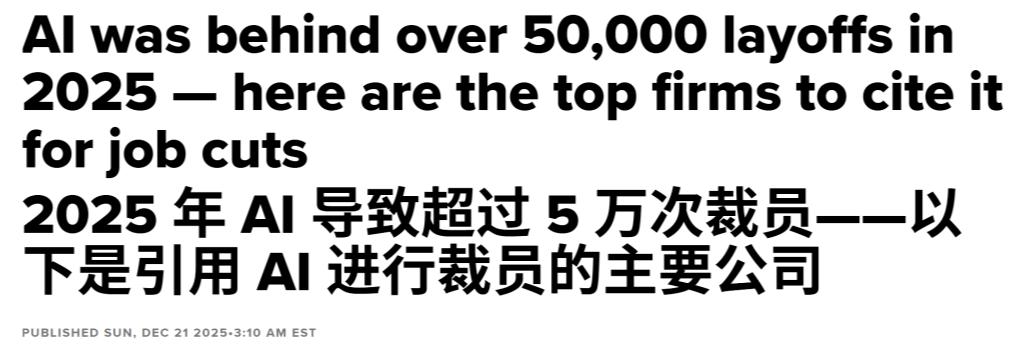
Group 1 - In 2025, approximately 55,000 jobs in the U.S. will be replaced by AI, contributing to a total of 1.17 million layoffs throughout the year, marking the highest level since 2020 [1][13] - Companies like Amazon and Microsoft are significantly reducing their workforce, with Amazon cutting 14,000 positions and Microsoft planning to lay off 15,000 employees, citing AI as a key factor in these decisions [15][17] - AI is predicted to automate 11.7% of jobs in the U.S. labor market, potentially saving up to $1.2 trillion in wages across various sectors [21] Group 2 - Experts, including Turing Award winner Yoshua Bengio and Anthropic CEO Dario Amodei, express concerns that AI will lead to widespread unemployment, as new jobs created by AI will not compensate for those lost [5][22] - The job market is expected to undergo a transformation where traditional roles diminish, and new positions such as AI collaboration designers and digital ethics interpreters emerge [24] - The narrative suggests that individuals should adapt by learning AI tools and focusing on uniquely human skills that require creativity and interpersonal communication [25][26]
蔡昉:人机互补是AI时代劳动力市场的唯一出路
和讯· 2025-12-15 09:14
Core Viewpoint - The article discusses the "Alignment Problem" in AI, emphasizing the need to ensure AI systems align with human values and intentions, particularly in the context of labor market impacts and the necessity for proactive measures to address potential inequalities [2][3]. Group 1: AI and Labor Market Dynamics - AI is expected to exacerbate structural employment contradictions, necessitating effective policy responses to address these challenges [3]. - The relationship between AI development and employment must be managed carefully, focusing on complementarity between human capital and AI skills rather than competition [2]. - The "Solow Paradox" is referenced, highlighting the potential for AI to improve productivity without immediate visible benefits, suggesting that the distribution of productivity gains may not be equitable [5][6]. Group 2: Employment Characteristics and Challenges - The current labor market is characterized by three main features: new employment forms, localized labor mobility, and age-related disparities in the workforce [12]. - The rise of new employment forms may lead to increased informal employment, which poses risks to social security and worker rights [12]. - Labor mobility is decreasing, with workers increasingly remaining in local areas, which could hinder productivity improvements and wage growth [13]. Group 3: Policy Recommendations and Future Directions - Proactive measures are needed at various stages (preemptive, during, and post-implementation) to address the alignment of AI with employment priorities [7][14]. - Education and vocational training must evolve to meet the demands of the AI era, promoting lifelong learning and adaptability in the workforce [14]. - The importance of sharing productivity gains through reforms and social safety nets is emphasized to ensure equitable benefits from AI advancements [8][15].

Anthropic嘲讽奥特曼:我们从不玩 “红色警报”,CEO放话:Claude更赚钱,流量仅GPT 1%敢冲3500亿IPO?
3 6 Ke· 2025-12-04 09:05
Core Insights - Anthropic, the maker of the Claude chatbot, is preparing for an IPO with a potential valuation exceeding $300 billion, aiming for a launch as early as next year [1] - The company is currently pursuing a private funding round with a target valuation of $350 billion, while also negotiating with major investment banks [1] - Anthropic's CEO, Dario Amodei, has expressed skepticism about competitors' strategies, particularly OpenAI's aggressive funding approach [2][11] Financial Performance - Anthropic has experienced a tenfold revenue growth annually over the past three years, projecting revenues to reach between $8 billion and $10 billion by the end of 2024 [4] - The company expects to generate approximately $26 billion in annual revenue by next year, with over 300,000 enterprise clients [3] - By 2028, Anthropic's sales could potentially reach $70 billion, indicating a proposed valuation of five times its sales [4] Competitive Landscape - Anthropic's focus is on enterprise applications rather than consumer markets, which differentiates it from competitors like OpenAI and Google [14] - The company has captured a 32% share of the enterprise AI market, indicating strong demand from business clients [14] - OpenAI is also preparing for a potential IPO, with a current valuation of $500 billion, which is expected to be five times its projected sales by 2028 [13] Strategic Direction - Anthropic aims to create a safer alternative to OpenAI, emphasizing the development of "useful, honest, and harmless" AI [4] - The company is expanding its focus to various industries, including finance, healthcare, retail, and energy, while optimizing its models for enterprise needs [8] - Amodei has highlighted the importance of maintaining a competitive edge in model development while managing the risks associated with resource procurement [11][12] Societal Impact - Amodei has raised concerns about "technological unemployment," suggesting that up to half of entry-level jobs could disappear due to AI advancements [17] - The company is exploring strategies to mitigate job losses, advocating for a balance between efficiency gains and job creation [18] - Amodei envisions a future where work may not dominate people's lives, suggesting a need for societal adaptation in the post-AGI era [19]
Anthropic嘲讽奥特曼:我们从不玩 “红色警报”!CEO放话:Claude更赚钱!流量仅GPT 1%敢冲3500亿IPO?
AI前线· 2025-12-04 07:22
Core Viewpoint - Anthropic, the maker of the Claude chatbot, is preparing for an IPO with a potential valuation exceeding $300 billion, aiming to capitalize on the booming AI industry and compete with rivals like OpenAI [2][5]. IPO Preparation - Anthropic has engaged Wilson Sonsini, a law firm experienced in tech IPOs, to assist with its public offering, which could occur as early as next year [2]. - The company is also pursuing a private funding round with a target valuation of $350 billion, indicating strong investor interest [2][5]. - Anthropic's IPO could be one of the largest in history, with the company only five years old at the time of the offering [5]. Revenue Growth - CEO Dario Amodei reported that Anthropic's revenue has grown tenfold annually over the past three years, projecting a rise from $1 billion in 2023 to between $80 billion and $100 billion by the end of 2024 [6]. - The company expects to serve over 300,000 enterprise clients, with annual revenue projected to exceed $26 billion [5][6]. - Anthropic's subscription revenue has surged nearly sevenfold this year, contrasting with OpenAI's slower growth rate of 18% [19]. Competitive Landscape - Anthropic aims to differentiate itself from OpenAI by focusing on enterprise applications rather than consumer markets, capturing a 32% share in the enterprise AI market [18]. - The company emphasizes a responsible approach to AI development, contrasting with competitors' aggressive funding strategies [14][18]. - Amodei criticized OpenAI's management style and spending habits, suggesting that Anthropic's focus on enterprise needs provides a competitive edge [10][14]. Addressing Job Displacement - Amodei highlighted the potential for significant job losses due to AI, estimating that half of entry-level jobs could disappear [21]. - The company advocates for a balanced approach where AI enhances productivity without solely replacing human jobs, encouraging businesses to create new value through AI [21][22]. - Amodei proposed a multi-layered strategy involving private sector initiatives, government collaboration, and societal restructuring to address the challenges posed by AI-induced job displacement [22][23][24].

机器换人:我们需要怎样的技术未来?
3 6 Ke· 2025-11-24 03:05
Core Insights - The rise of automation and robotics is fundamentally changing the labor landscape, leading to a shift in human roles from primary operators to auxiliary supporters [1][2][3] - The concept of "technological unemployment" has resurfaced, with workers expressing anxiety over job security as machines increasingly replace human labor [3][11] - Different age groups of workers exhibit varying attitudes towards automation, influenced by their life stages and responsibilities [5][10] Group 1: Automation and Its Impact - Automation is not just enhancing production efficiency but is also reshaping daily life and work practices, with technologies like self-service kiosks and AI-driven services becoming commonplace [2] - The introduction of industrial robots and CNC machines in factories is leading to a significant reduction in the need for human labor, raising concerns about job displacement [2][3] Group 2: Worker Perspectives - Younger workers tend to be less concerned about job loss due to automation, viewing it as an opportunity to explore different roles, while middle-aged workers prioritize job stability and express more anxiety [5][10] - Older workers nearing retirement often show indifference to automation trends, as they have fulfilled their primary responsibilities and are less likely to be affected by job displacement [5][10] Group 3: Case Studies of Worker Experiences - In a case study of a Japanese automotive seat manufacturing company, the introduction of welding robots led to significant job losses among skilled welders, who faced reduced wages and job security [11][12] - Despite initial resistance, workers ultimately had to negotiate reduced benefits and accept the reality of job cuts, highlighting the challenges of collective action in the face of automation [12][13] Group 4: Opportunities and Challenges - Some workers embrace technological advancements, believing that acquiring new skills in automation and robotics can lead to better job prospects and upward mobility [16][18] - However, the rapid pace of technological change means that workers must continuously invest in their education and skills to remain competitive, as knowledge can quickly become obsolete [18][19]

40岁失业,66岁退休:中间25年无工可打
3 6 Ke· 2025-11-18 23:10
Group 1 - The article discusses the increasing vulnerability of middle-aged individuals in the job market, highlighting the stark reality of unemployment among those who once held prestigious positions [1][3][12] - It emphasizes the collapse of the "American Dream" and the myth of meritocracy, where hard work no longer guarantees success, particularly for highly educated individuals facing long-term unemployment [3][6][32] - The stigma associated with long-term unemployment is a significant theme, illustrating how societal perceptions can lead to a sense of shame and self-doubt among those affected [19][21][31] Group 2 - The research by Ofer Sharone reveals the harsh realities faced by highly educated individuals who find themselves unemployed, often leading to economic and psychological distress [4][6][9] - The article presents case studies of individuals, such as Larry, who despite having advanced degrees and extensive work experience, end up in low-paying jobs after prolonged unemployment [7][9][12] - It highlights the systemic issues contributing to unemployment, including age discrimination and the impact of economic cycles, which disproportionately affect older job seekers [16][18][32] Group 3 - The narrative reflects a broader societal anxiety about job security, where even those in higher economic strata fear falling from success [12][14][32] - The article suggests that the myth of meritocracy creates unrealistic expectations, leading to a cycle of blame and shame for those who become unemployed [11][19][31] - It calls for a shift in perspective, advocating for a supportive community that recognizes the systemic nature of unemployment rather than attributing it solely to individual failure [26][27][29]

技术革命会导致大规模失业吗?|《财经》书摘
Sou Hu Cai Jing· 2025-11-01 08:36
Group 1 - The 2025 Nobel Prize in Economic Sciences was awarded to Joel Mokyr, Philippe Aghion, and Peter Howitt for their contributions to understanding innovation-driven economic growth [3] - Philippe Aghion's work emphasizes the central role of innovation in economic development, highlighting the dual nature of technological revolutions as both a threat and an opportunity [3] - The article discusses the characteristics of general-purpose technologies, which include the generation of secondary innovations, gradual cost improvements, and widespread diffusion across economic sectors [4] Group 2 - Secondary innovations are crucial for adapting general-purpose technologies to specific sectors, leading to productivity improvements and long-term growth, although they may initially slow GDP growth [5] - There are instances where society may not optimally adopt new technologies due to a lack of secondary innovations or widespread acceptance, leading to the persistence of suboptimal standards [6] - The adoption of new general-purpose technologies requires time for users to learn efficient usage, which can lead to price reductions for older technology as newer versions become more efficient [7] Group 3 - Households exhibit similar delays in adopting new technologies as businesses, primarily influenced by price declines [8] - Delays in the spread of technological waves, such as the electricity revolution, can be attributed to infrastructure and institutional deficiencies in other countries [9] - Measuring productivity gains from new general-purpose technologies can be challenging, particularly in the service sector, where improvements may not be well reflected in productivity statistics [10] Group 4 - Automation and artificial intelligence are increasingly impacting production activities, yet the expected surge in growth rates in developed countries has not materialized, possibly due to the continued necessity of labor in key processes [11] - Historical perspectives reveal that fears of job loss due to automation have existed for centuries, but technological advancements have often led to positive employment outcomes [12] - Studies indicate that increased automation in factories correlates with job creation, particularly in non-skilled manufacturing roles, challenging the notion that automation solely destroys jobs [12][13] Group 5 - Industries with higher levels of automation tend to experience job growth, suggesting a positive relationship between automation and employment [13] - Measures to slow down automation, such as taxing robots, may hinder productivity and innovation, ultimately harming job creation [14] - The article concludes that while technological revolutions may initially present challenges, they do not necessarily lead to widespread unemployment and can create net job gains in automated environments [15]

巨头雀巢要裁员一万六千人?如此大裁员究竟想干啥?
3 6 Ke· 2025-10-22 04:04
Group 1 - Nestlé plans to lay off approximately 16,000 employees globally over the next two years, with around 12,000 of these being white-collar professionals [3][6] - The company's sales for the first nine months of 2025 amounted to 65.87 billion Swiss francs, reflecting a 1.9% decline, while organic growth was reported at 3.3% [3] - The restructuring aims to save 1 billion Swiss francs annually by 2027, doubling the initial target of 500 million Swiss francs, with one-time restructuring costs expected to be twice the annual savings [3][9] Group 2 - The layoffs are a response to ongoing global economic pressures, including weak consumer demand and intensified competition in the consumer goods sector [6][8] - The focus of the layoffs on white-collar positions indicates a shift towards automation and digital transformation, as these roles are more susceptible to being replaced by technology [8] - By reducing workforce costs, Nestlé aims to free up cash flow for core business investments, such as new product development and market expansion [9] Group 3 - The situation highlights the increasing importance of building "risk resilience" among employees, as job security in even major corporations like Nestlé is not guaranteed [11] - The demand for versatile talent is expected to rise, emphasizing the need for continuous learning and skill enhancement among workers to remain competitive [11]