南京银行

Search documents
银行业周度追踪2025年第26周:如何展望银行中报业绩?-20250706
Changjiang Securities· 2025-07-06 09:42
Investment Rating - The industry investment rating is "Positive" and maintained [12]. Core Insights - The Yangtze Bank Index increased by 3.8% this week, outperforming the CSI 300 Index by 2.2% and the ChiNext Index by 2.3%. The bank index has accelerated its rise since July, indicating that the brief adjustment at the end of June was mainly due to institutional rebalancing, with solid fundamentals and core investment logic for bank stocks [2][6][18]. - The performance of city commercial banks exceeded expectations, primarily due to improved net interest margins and stable non-interest income amid bond market impacts. Overall, bank performance is expected to remain stable, with narrowing declines in net interest margins being a key highlight [8][36]. Summary by Sections Market Performance - The Yangtze Bank Index has shown a significant increase, reflecting a strong market sentiment towards bank stocks, particularly those with low price-to-book ratios such as Zheshang Bank, Minsheng Bank, and Pudong Development Bank [2][6][18]. - As of July 4, the average dividend yield of the five major state-owned banks' A-shares has decreased to 3.94%, with a spread of 229 basis points over the 10-year government bond yield. The average dividend yield for H-shares is 5.08%, indicating a more pronounced advantage for H-shares [20][23]. Earnings Outlook - The overall performance of banks is expected to remain stable, with city commercial banks maintaining their strong performance due to improved net interest margins and stable non-interest income. The decline in net interest margins is anticipated to narrow, supporting stable or improved interest income in the first half of the year [8][36][37]. - The asset quality of listed banks is expected to remain stable, with the overall non-performing loan ratio stabilizing due to rapid balance sheet expansion and write-offs. The retail loan non-performing pressure is expected to remain stable compared to last year [9][39][42]. Trading Dynamics - The trading congestion indicators for bank stocks have remained stable compared to the previous week, with a notable rotation towards low PB valuation stocks. The market's overall risk appetite has strengthened compared to previous quarters, indicating a recognition of the core investment logic [28][29].
全市场发行超6200亿元 中小银行加速入局科创债
经济观察报· 2025-07-05 08:34
Core Viewpoint - The issuance of technology innovation bonds (科创债) has gained momentum, with various banks participating actively, indicating a strong market response to the supportive policies introduced for these bonds [2][6][12]. Group 1: Issuance Overview - As of July 3, 2025, a total of 419 technology innovation bonds have been issued, with an aggregate issuance scale exceeding 620 billion yuan, highlighting the growing interest in this financial instrument [2]. - Among the issuers, banks have emerged as the main players, having issued 27 bonds with a total scale of over 220 billion yuan [2][3]. Group 2: Bank Participation - Large banks lead in issuance scale, while small and medium-sized banks are also entering the market, with 11 banks participating in the issuance process [3][4]. - The issuance scale of city commercial banks and rural commercial banks collectively reached 391 billion yuan, with notable contributions from banks like Beijing Bank (80 billion yuan) and Shanghai Bank (50 billion yuan) [6][7]. Group 3: Interest Rates and Credit Ratings - The credit ratings of the issuers are predominantly high, with most banks rated AAA, except for one rated AA+ [3][7]. - The interest rates for technology innovation bonds vary, with large banks offering rates between 1.17% and 1.65%, while small and medium-sized banks have higher rates, with some reaching up to 1.95% [3][10]. Group 4: Fund Utilization - The funds raised through technology innovation bonds are primarily directed towards supporting technology loans and investing in bonds issued by technology innovation enterprises, creating a synergistic effect [11]. - Major banks have consistently used the proceeds for "issuing technology loans," while some also invest in technology innovation enterprises' bonds [11]. Group 5: Future Trends - The market is expected to see innovations in bond products and an expansion of issuing entities, with banks likely to introduce more flexible bond terms to cater to the specific needs of technology enterprises [12]. - There is a growing emphasis on technology finance as a strategic focus for banks, particularly among small and medium-sized banks, which may accelerate their participation in the technology innovation bond market [12].






又一银行可转债,触发强赎!
券商中国· 2025-07-04 23:08
Core Viewpoint - The article discusses the recent triggering of mandatory redemption for convertible bonds issued by Qilu Bank, highlighting the impact of rising bank stock prices on convertible bond mechanisms [1][2][3]. Summary by Sections Qilu Bank Convertible Bond Redemption - On July 4, Qilu Bank's stock price closed at 6.52 yuan per share, triggering the mandatory redemption of its convertible bond "Qilu Convertible Bond" due to the stock price exceeding the redemption conversion condition for five consecutive trading days [1][2]. - The bond's conversion price was adjusted to 5.00 yuan per share, and the stock price had to be at least 130% of this conversion price for the redemption to be triggered [2][4]. Stock Performance and Redemption Mechanism - Qilu Bank's stock has seen a significant increase of 22.08% year-to-date, which directly contributed to the triggering of the mandatory redemption mechanism for the convertible bonds [3][4]. - The bank's board approved the early redemption of the "Qilu Convertible Bond," with the redemption price set at 100.4932 yuan per bond, and the redemption date scheduled for July 7 [1][4]. Market Context and Trends - The article notes that several banks, including Chengdu Bank and Suzhou Bank, have also triggered mandatory redemptions of their convertible bonds, with a total issuance amount of 480 billion yuan involved [11]. - The trend of mandatory redemptions is attributed to the overall rise in A-share bank stocks since September of the previous year [11][12]. Capital Supplementation - Convertible bonds are seen as a favorable tool for banks to supplement their core Tier 1 capital, especially when stock prices are low [15]. - The article emphasizes that successful conversion of these bonds into equity is crucial for banks to count them towards their core capital, otherwise, they must repay the principal and interest at maturity [8][15].

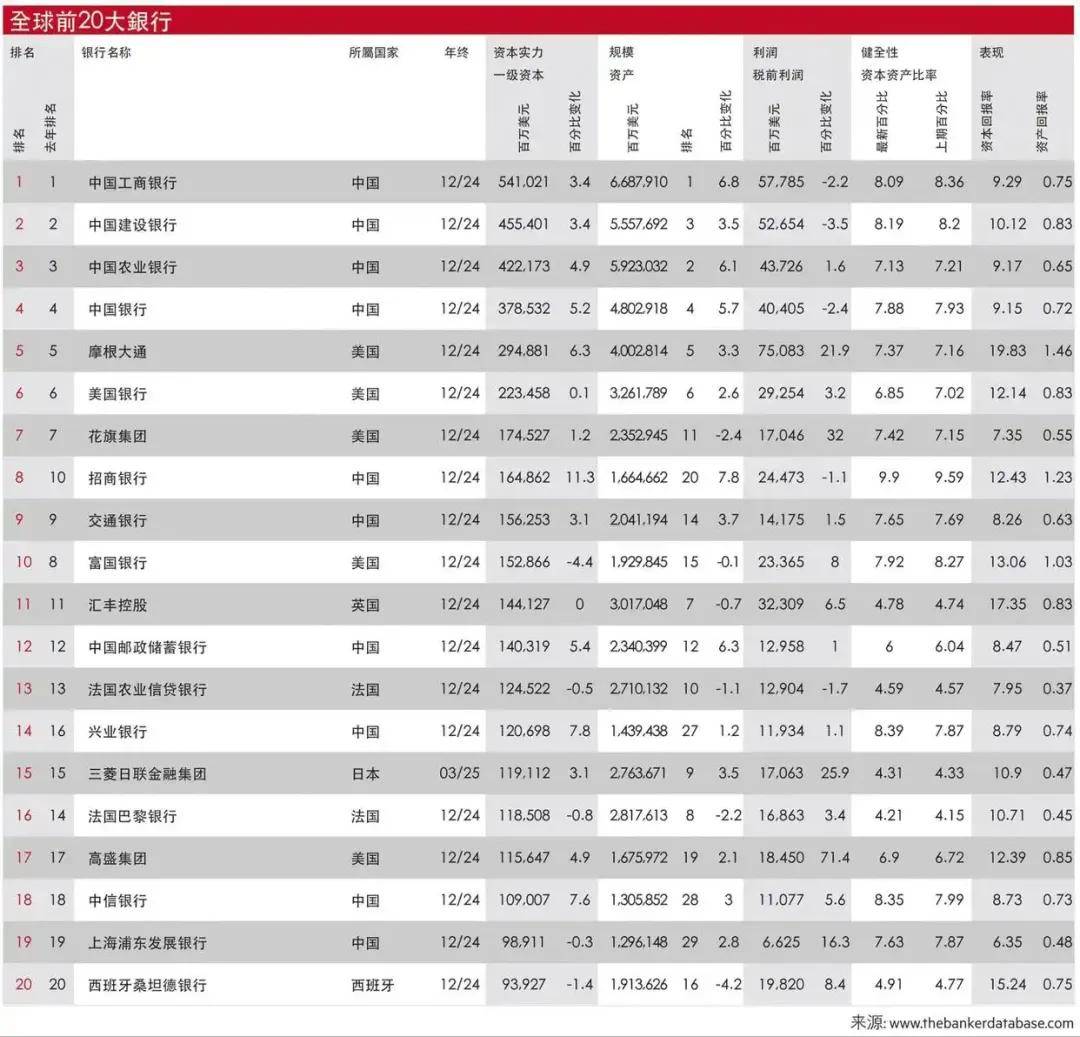
江苏“金融强省”有多强?13家银行跻身全球1000强榜单,头部两家“好着呢”
Sou Hu Cai Jing· 2025-07-04 13:55
Core Insights - The 2025 World Bank 1000 ranking, published by The Banker, highlights the capital strength and profitability growth of banks, serving as a key indicator of global competitiveness in the banking sector [1] Group 1: Overall Performance - Chinese banks continue to dominate the top ranks, with six positions in the top ten, including the top four spots held by Industrial and Commercial Bank of China, China Construction Bank, Agricultural Bank of China, and Bank of China [3][4] - The ranking reflects a consistent trend, as these four banks have maintained their positions for eight consecutive years, reinforcing their leading status [3][4] Group 2: Jiangsu Province Banks - Jiangsu Province has 13 banks listed in the ranking, showcasing a strong performance with a characteristic of "leading quantity and improving quality" [1][5] - Jiangsu Bank ranks 56th, improving by 10 places from the previous year, with total assets exceeding 4 trillion yuan and a year-on-year revenue growth of 6.21% [5][6] - Nanjing Bank ranks 86th, having improved by 5 places, with total assets surpassing 2.7 trillion yuan and revenue and net profit growth of 6.53% and 7.06%, respectively [6][7] Group 3: Agricultural Commercial Banks - Jiangsu Province has the highest number of agricultural commercial banks on the list, with 9 out of 35 nationwide, and most of them have improved their rankings [8] - Specific improvements include Zhangjiagang Rural Commercial Bank rising 28 places to rank 502nd and Jiangyin Rural Commercial Bank climbing 26 places to 506th [8]


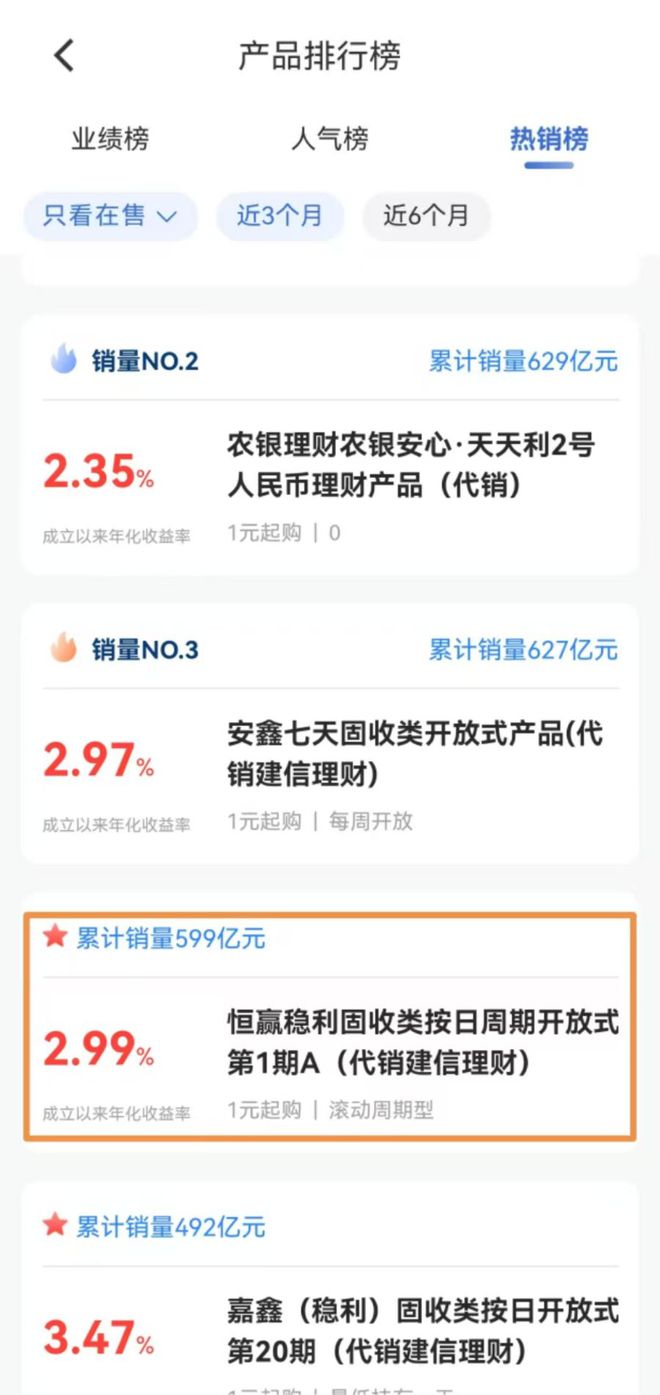
狂吸金近600亿元!建行APP热销产品为何收益得分低?
2 1 Shi Ji Jing Ji Bao Dao· 2025-07-04 11:18
Core Viewpoint - The bond market has experienced significant fluctuations, with a focus on the strong sales performance of fixed-income products, particularly the "Hengying Stable Profit Fixed Income Daily Open 1st Phase A" product, which has accumulated sales of 599 billion yuan over the past three months [1][5]. Group 1: Product Performance - The "Hengying Stable Profit Fixed Income Daily Open 1st Phase A" product has shown a notable increase in net value in mid-March, but the growth rate has slowed since April [4]. - Despite its strong sales, the product's performance in terms of returns is average compared to similar products, particularly over the last three months and one month [4][5]. Group 2: Product Features - The product's appeal lies in its flexible holding period, allowing investors to choose their investment duration from 1 day up to 365 days, which can be adjusted after purchase [5]. - The product maintains a 0 drawdown, attributed to its low volatility strategy, primarily investing in deposits and bonds from high-quality financial institutions [5]. Group 3: Evaluation Metrics - The product received a score of 7 for returns, 100 for risk control, 27 for risk-adjusted returns, and 71 for comprehensive fees, ranking 373rd, 1st, 424th, and 41st respectively among 499 similar products, achieving an overall score that surpasses 42.28% of its peers [5]. - The evaluation process considers four dimensions: return performance (40% weight), risk control (30% weight), risk-adjusted return (20% weight), and comprehensive fees (10% weight), with the aim of identifying relatively strong products in the market [6].
浦发等9只银行股再创新高 年内板块涨幅达到17.7%
2 1 Shi Ji Jing Ji Bao Dao· 2025-07-04 10:36
Core Viewpoint - The banking sector has shown strong performance, with multiple banks reaching historical highs and a total market capitalization of 15.7 trillion yuan, driven by favorable macroeconomic conditions and investor sentiment [1][2][4]. Group 1: Market Performance - On July 4, nine banks, including Industrial and Commercial Bank of China and Shanghai Pudong Development Bank, reached historical highs, contributing to a 1.86% increase in the China Securities Banking Index, which has risen 17.7% year-to-date [1][2]. - All 42 stocks in the banking sector closed in the green, with 37 stocks increasing by over 10%, and 17 stocks rising by more than 20% [2]. - Shanghai Pudong Development Bank led the gains with a year-to-date increase of 41.69%, making it the only stock in the sector to exceed a 40% rise [2]. Group 2: Factors Driving Performance - Analysts attribute the strong performance to a combination of low interest rates, high dividend yields, and improved asset quality, which have made bank stocks attractive to long-term investors [4][5]. - The banking sector's price-to-book (PB) ratio stands at 0.68, indicating potential for valuation recovery after being undervalued for an extended period [3][4]. - The recent changes in public fund management and performance evaluation are expected to lead to increased bank stock holdings by active funds, further supporting the sector's growth [5]. Group 3: Dividend Announcements - Several banks have announced significant dividend payouts, with China CITIC Bank declaring a cash dividend of 0.1722 yuan per share, and China Merchants Bank announcing a cash dividend of 2.000 yuan per share, totaling approximately 504.40 billion yuan [6][7]. - As of now, around 30 banks have finalized their 2024 profit distribution plans, with total cash dividends reaching 427.38 billion yuan, indicating a trend of increasing dividend payouts across the sector [7]. Group 4: Future Outlook - Analysts predict that the decline in net profit and revenue for listed banks is expected to stabilize, with a projected year-on-year revenue decrease of 0.9% and a net profit decrease of 0.5% [8]. - The current market conditions are viewed as the beginning of a long-term bullish trend for bank stocks, driven by low interest rates and the revaluation of RMB assets [8].



科创债全市场发行超6200亿元 中小银行加速入场
Jing Ji Guan Cha Wang· 2025-07-04 09:54
Core Insights - The launch of the Science and Technology Innovation Bonds (科创债) has attracted various participants, with a total issuance of 419 bonds amounting to over 620 billion yuan as of July 3, 2025 [2] - Large banks are leading the issuance, while small and medium-sized banks are also entering the market, increasing the number of issuers to 11 [2] - The credit ratings of the issuers are predominantly high, with most rated AAA, and the interest rates for small and medium-sized banks are higher compared to large banks [2][4] Issuance Overview - As of June 30, 2025, policy banks and state-owned banks are the main issuers, with the China Development Bank issuing 3 bonds totaling 20 billion yuan, and major state-owned banks collectively issuing 1.1 billion yuan [4] - The issuance scale of various banks includes 550 billion yuan from joint-stock banks and 391 billion yuan from city and rural commercial banks [4][5] - The issuance of floating-rate bonds has also been noted, with Sichuan Bank issuing the first floating-rate 科创债 [5] Interest Rates - The overall interest rates for 科创债 are relatively low, with the weighted average interest rate for commercial banks decreasing by 5 basis points [6] - The lowest rates are observed in the China Development Bank's bonds, with rates as low as 1.17% for short-term bonds [6] - Small and medium-sized banks face higher issuance rates, with some reaching up to 1.95% [6] Fund Utilization - The funds raised through 科创债 are primarily directed towards supporting technology loans and investing in bonds issued by technology innovation enterprises [7] - Major banks have a consistent focus on issuing 科创债 for technology loan disbursement, while some joint-stock and city commercial banks also invest in technology innovation bonds [7] Future Trends - There is potential for innovation in bond products and expansion of issuers in the 科创债 market, with banks likely to introduce more flexible bond terms [8] - Small and medium-sized banks are expected to design issuance plans that align with local industry characteristics and technology enterprise funding needs [8]



南京银行(601009) - 南京银行股份有限公司关于实施“南银转债”赎回暨摘牌的第十四次提示性公告
2025-07-04 09:01
| 证券简称: | 南京银行 | 证券代码: | 601009 | 编号: | 2025-045 | | --- | --- | --- | --- | --- | --- | | 优先股简称:南银优 | 1 | | | 优先股代码:360019 | | | 南银优 | 2 | | | 360024 | | | 可转债简称:南银转债 | | | | 可转债代码:113050 | | 南京银行股份有限公司 关于实施"南银转债"赎回暨摘牌的 第十四次提示性公告 特别提示: 本公司董事会及全体董事保证本公告内容不存在任何虚假记载、误导性陈述或 者重大遗漏,并对其内容的真实性、准确性和完整性承担法律责任。 重要内容提示: 截至 2025 年 7 月 4 日收市后,距离 2025 年 7 月 14 日("南银转债"最后交易 日)仅剩 6 个交易日,2025 年 7 月 14 日为"南银转债"最后一个交易日。 最后转股日:2025 年 7 月 17 日 截至 2025 年 7 月 4 日收市后,距离 2025 年 7 月 17 日("南银转债"最后转股 日)仅剩 9 个交易日,2025 年 7 月 17 日为"南银转债" ...
科创债发行规模超6200亿元 逾七成评级AAA
Zheng Quan Shi Bao· 2025-07-03 18:52
Core Viewpoint - The issuance of technology innovation bonds (referred to as "Sci-Tech Bonds") has seen a significant increase since the policy was implemented in May, with a total issuance exceeding 620 billion yuan by early July, primarily driven by state-owned enterprises [1][2]. Group 1: Issuance Overview - As of July 3, a total of 419 Sci-Tech Bonds have been issued, with a total issuance scale surpassing 620 billion yuan [1]. - Central state-owned enterprises (SOEs) and local SOEs are the main issuers, accounting for 49.90% and 36.18% of the total issuance, respectively [1]. - The average rating of issuers has remained high, with 74.70% of the bonds rated AAA since May 7 [1]. Group 2: Industry Participation - Banks have emerged as the primary issuers of Sci-Tech Bonds, with 23 banks issuing a total of 224.1 billion yuan [1]. - Notable issuers include China Construction Bank with 30 billion yuan, and several other major banks each issuing 20 billion yuan [1]. Group 3: Expansion to Smaller Banks - In June, smaller banks such as Chongqing Bank and Nanjing Bank began participating in the issuance of Sci-Tech Bonds [2]. - Various private equity investment institutions have also started issuing Sci-Tech Bonds, supported by recent credit enhancement measures [2]. Group 4: Interest Rates and Comparisons - The issuance rates for many Sci-Tech Bonds have reached historical lows for the issuers, benefiting from a low-interest-rate environment and policy support [2]. - AAA-rated Sci-Tech Bonds have a weighted average issuance rate significantly lower than that of non-Sci-Tech bonds of the same rating, with differences ranging from 2 to 47 basis points across various issuer types [2]. Group 5: Market Support for SMEs - The Sci-Tech Bond market indirectly supports small and medium-sized technology enterprises through funding from financial institutions and large SOEs [3]. - The long-term health of the bond market will require a more diversified range of issuers and enhanced credit accessibility for lower-rated entities [3].

超千家机构调研上市银行 宁波银行是“人气王”
Zheng Quan Ri Bao· 2025-07-03 16:28
Core Viewpoint - The surge in institutional research on listed banks in the first half of the year indicates a significant increase in market interest in bank stocks, particularly focusing on credit issuance, dividend plans, and asset quality [1][2]. Group 1: Institutional Research Trends - In the first half of the year, 19 A-share listed banks received over 1,000 institutional research visits, with Ningbo Bank, Changshu Bank, and Hangzhou Bank being the most popular [1][2]. - The focus of institutional research has been on key operational areas of banks, especially credit allocation and dividend strategies [2][3]. Group 2: Credit Issuance and Dividend Plans - Ningbo Bank, Changshu Bank, and Hangzhou Bank were the top three banks in terms of research visits, with 235, 192, and 153 visits respectively [2]. - Hangzhou Bank reported that its credit issuance has improved compared to the previous year, with a focus on strategic sectors such as technology and manufacturing [2]. - Chongqing Bank has maintained a high cash dividend level for 11 consecutive years since its H-share listing, with plans for a sustainable dividend strategy [3][4]. Group 3: Asset Quality and Net Interest Margin - Many banks expressed confidence in maintaining stable asset quality throughout the year, with measures in place to enhance risk management [5][6]. - Suzhou Bank reported a net interest margin of 1.34% at the end of Q1, which is a slight decrease compared to the end of 2024, but better than the industry average [6]. - The overall expectation is for a marginal improvement in asset quality, supported by policy measures and digital risk management [5][6].