
盖世食品

Search documents
食品加工板块1月29日涨1.22%,三全食品领涨,主力资金净流入1.09亿元
Zheng Xing Xing Ye Ri Bao· 2026-01-29 09:03
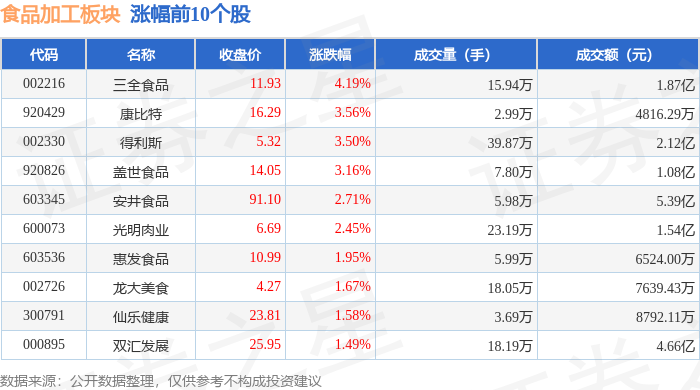
Group 1 - The food processing sector increased by 1.22% on January 29, with Sanquan Foods leading the gains [1] - The Shanghai Composite Index closed at 4157.98, up 0.16%, while the Shenzhen Component Index closed at 14300.08, down 0.3% [1] - Key stocks in the food processing sector showed significant price increases, with Sanquan Foods rising by 4.19% to a closing price of 11.93 [1] Group 2 - The food processing sector experienced a net inflow of 1.09 billion yuan from institutional investors, while retail investors saw a net outflow of 5457.21 million yuan [2] - Major stocks like Anjuke Foods and Sanquan Foods had substantial net inflows from institutional investors, with Anjuke Foods receiving 57.76 million yuan [3] - Retail investors showed a negative trend, with significant outflows from stocks such as Sanquan Foods and Guangming Meat Industry [3]


食品加工板块1月22日涨0.41%,交大昂立领涨,主力资金净流出2882.63万元
Zheng Xing Xing Ye Ri Bao· 2026-01-22 09:01
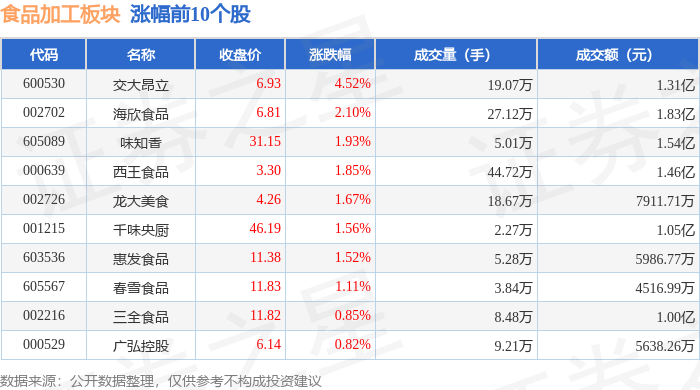
Group 1 - The food processing sector increased by 0.41% on January 22, with Jiaoda Onlly leading the gains [1] - The Shanghai Composite Index closed at 4122.58, up 0.14%, while the Shenzhen Component Index closed at 14327.05, up 0.5% [1] - Key stocks in the food processing sector showed various performance, with Jiaoda Onlly closing at 6.93, up 4.52%, and Hai Xin Food at 6.81, up 2.10% [1] Group 2 - The food processing sector experienced a net outflow of 28.83 million yuan from main funds, while retail investors saw a net inflow of 51.78 million yuan [2] - The trading volume and turnover for key stocks varied, with Jiaoda Onlly having a trading volume of 190,700 shares and a turnover of 131 million yuan [1][2] - The stock performance of several companies showed mixed results, with some stocks like ST Chuntian and Xianle Health declining by 1.39% and 1.27% respectively [2] Group 3 - Main fund inflows were observed in stocks like Jiaoda Onlly with a net inflow of 14.38 million yuan, while retail investors showed a net inflow of 11.80 million yuan [3] - Stocks such as Shuanghui Development and Jinzi Ham also saw significant main fund inflows of 11.39 million yuan and 10.64 million yuan respectively [3] - The overall sentiment in the food processing sector appears mixed, with some stocks attracting retail interest despite main fund outflows [3]


股东回馈“太卷了”,实物送礼与分红规划双管齐下
Huan Qiu Wang· 2026-01-18 01:53
Core Viewpoint - A-share listed companies are increasingly engaging in shareholder return activities, combining "creative" physical gifts with systematic cash dividend plans, reflecting a new trend in the market [1][6]. Group 1: Shareholder Return Activities - Companies like Haoxiangni are offering exclusive purchasing rights for holiday gift boxes at 50% off retail prices, leading to a stock price increase of over 20% since January 8 [1]. - In 2025, over 40 companies are expected to disclose shareholder return or gifting activities, marking a historical high and indicating a growing emphasis on sharing development results with investors [1][2]. - Industries most active in these activities include food and beverage, basic chemicals, pharmaceuticals, and home appliances, with notable companies like Qianwei Yangchun and Northeast Pharmaceutical participating [2]. Group 2: Market Reactions - The market has responded positively to these "creative" gifting activities, with average stock price increases outpacing the CSI 300 index following announcements [3]. - Companies such as Rongtai Health and Emei Mountain A experienced significant stock price surges post-announcement, with Huada Gene seeing a cumulative increase of over 70% within ten trading days [3]. - However, some companies like Bona Film Group and Innotech saw stock price declines after their announcements, indicating that while these activities can boost short-term sentiment, long-term performance will revert to fundamentals [3]. Group 3: Financial Performance and Dividend Plans - Many companies engaging in shareholder returns are showing strong financial performance, with Lianhua Holdings projecting a net profit of 290 million to 330 million yuan in 2025, a year-on-year increase of 43.15% to 62.9% [5]. - Approximately 60% of the 40 companies involved in return activities are expected to see growth or turnaround in 2025, with 90% projected to have net profit growth exceeding 10% in 2026 [5]. - Some companies have established long-term cash dividend plans, with 10 companies committing to distribute at least 10% of their distributable profits over the next three years, signaling a commitment to shareholder returns [6].
2026年中国学生营养配餐行业政策、市场现状、重点企业及未来展望研判:政策支持与居民生活水平提升共同发力,促进学生营养配餐市场规模有序扩张[图]
Chan Ye Xin Xi Wang· 2026-01-17 23:24
Core Insights - The student nutrition catering industry is rapidly growing, with the market size expected to increase from 381.1 billion yuan in 2015 to 609.5 billion yuan in 2024, reflecting a compound annual growth rate (CAGR) of 5.36% [1][14] - By 2025, the market size is projected to reach 642.1 billion yuan, driven by rising living standards and increasing parental awareness of children's health [1][14] Industry Overview - Student nutrition catering aims to provide balanced meals that support the physical development and learning activities of students, ensuring they receive essential nutrients like vitamins, minerals, and proteins [1][14] - The market is segmented into various educational levels, including university, high school, primary, middle school, and special education [3] Industry Policies - The government has implemented several policies to promote student nutrition catering, including guidelines for food safety and management in schools [8] - Local governments are also taking initiatives to improve nutrition among students, particularly in rural areas [8] Industry Chain - The industry chain consists of three main segments: upstream (food ingredient procurement), midstream (meal preparation), and downstream (delivery services) [10][11] - Upstream suppliers provide fresh and safe ingredients, while midstream companies focus on processing these ingredients into nutritious meals [10][11] Key Ingredients - Essential food categories for student nutrition include vegetables, grains, fruits, and meats, which collectively provide critical nutrients for students' growth [12] - In 2024, China's vegetable production is expected to reach 86.1 million tons, with grain production at 70.6 million tons and fruit production at 33.9 million tons [12] Competitive Landscape - The industry is characterized by regional concentration with local stronghold companies dominating specific areas, while some larger firms are exploring national expansion [15] - Key players include companies like Guangming Food Group, Hebei Qianxihe, and Dongguan Hongjun Catering Management [15][16] Future Trends - The focus of student nutrition catering is shifting towards personalized nutrition management based on individual health data [19] - Integration of the supply chain, including agricultural bases, central kitchens, and logistics, is expected to enhance food safety and quality [19][20] - Advanced technologies like AI and IoT will play a significant role in optimizing meal planning and ensuring food safety [20]

太卷了!上市公司“花式”回馈股东,10家公司同时明确分红规划
Zheng Quan Shi Bao· 2026-01-17 01:22
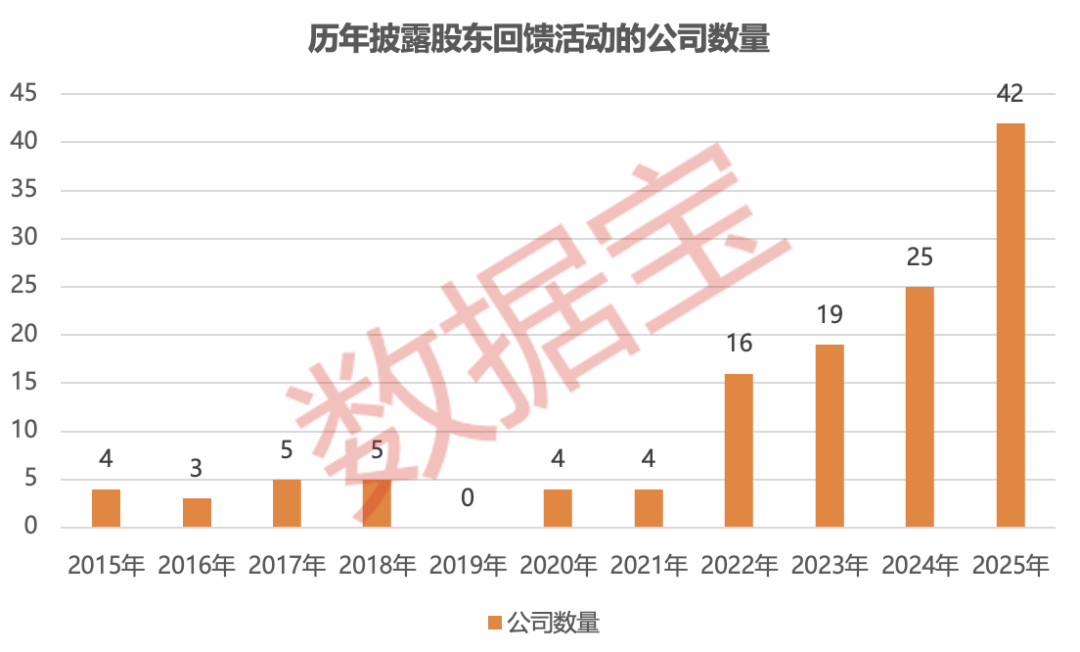
Group 1 - A-share listed companies are actively engaging in shareholder reward activities, with "Hao Xiang Ni" announcing a voluntary information disclosure regarding exclusive purchasing rights for shareholders at discounted prices [1] - Since January 8, "Hao Xiang Ni" has seen its stock price increase by over 20% [1] - The number of companies engaging in shareholder reward activities has reached a historical high, with over 40 companies reported in 2025 alone [2] Group 2 - From 2015 to 2025, nearly 130 companies have disclosed over 140 reward activity announcements, with a noticeable increase since 2022 [2] - The majority of these companies are in the food and beverage, basic chemicals, pharmaceutical and biological, and home appliance industries [2] - In 2025, companies like "Dongbei Pharmaceutical" and "He Shi Eye Hospital" offered exclusive benefits related to their products and services to shareholders [4] Group 3 - The market response to these reward activities has been mixed, but overall, companies involved have outperformed the CSI 300 index [5] - Average stock price increases for companies engaging in reward activities from 2015 to 2025 were 0.8% on the announcement day, with subsequent increases of 0.23%, 0.44%, and 0.47% over the following days [6] - In 2025, companies like "Rongtai Health" and "Emei Mountain A" experienced significant stock price increases following their announcements [7] Group 4 - Companies that have conducted shareholder reward activities since 2025 have seen an average stock price increase of nearly 25%, with some companies like "Haoen Automotive" and "Tian Chuang Fashion" exceeding 100% [8] - Financial forecasts indicate that many companies are expected to achieve profit growth in 2025 and 2026, with some companies like "Xiangyuan Culture" and "Shuiyang Co." projected to have net profit increases exceeding 45% [8] - Ten companies have established future dividend plans, with "Haoen Automotive" committing to distribute at least 10% of their annual distributable profits in cash from 2025 to 2027 [9][10]
上市公司“花式”回馈股东!10家公司同时明确分红规划(附股)
Zheng Quan Shi Bao Wang· 2026-01-17 00:22
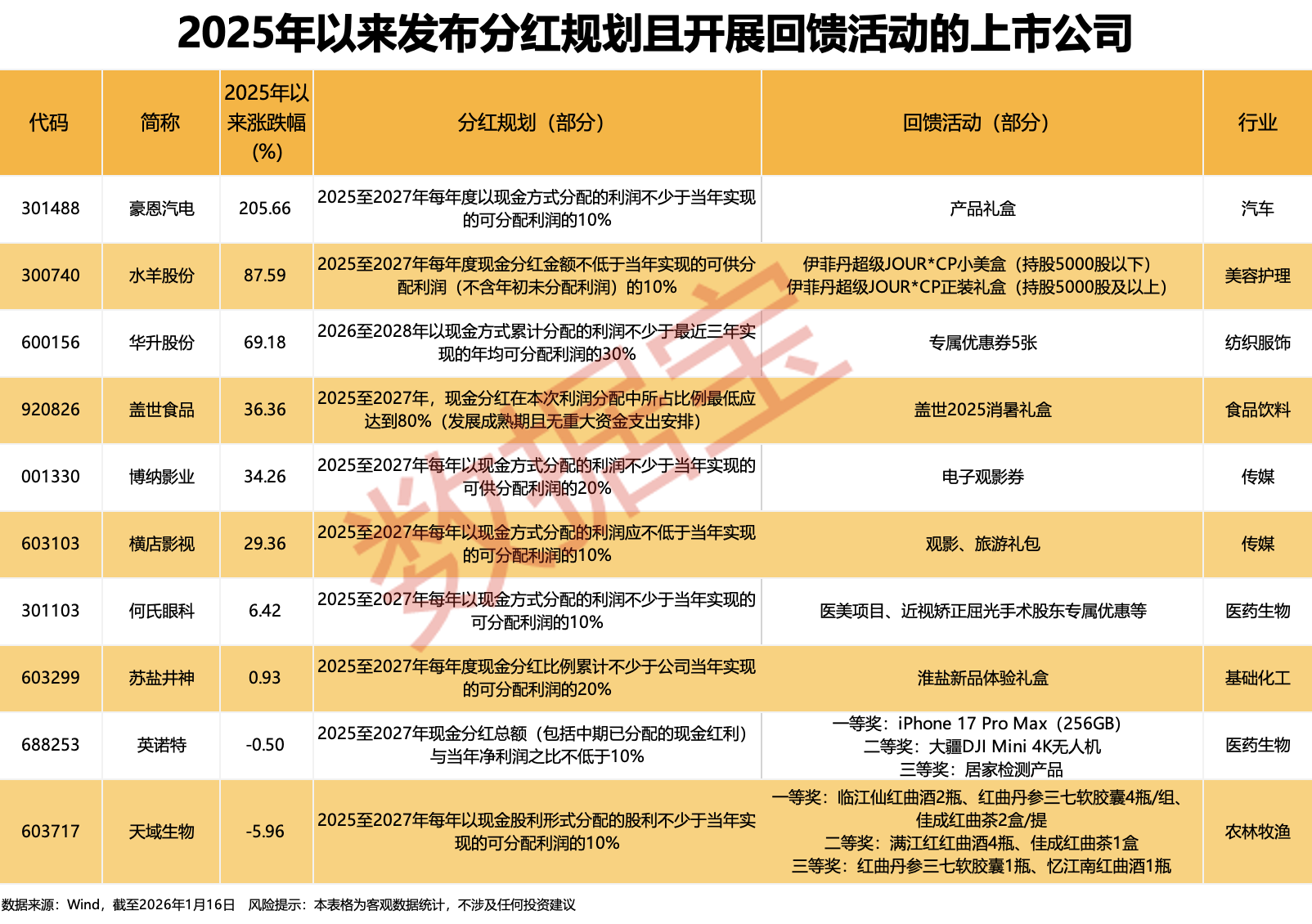
Core Viewpoint - A-share listed companies are actively engaging in shareholder return activities, utilizing methods beyond cash dividends, such as offering products, services, discount coupons, or exclusive rights, with mixed market performance but overall outpacing the CSI 300 index [1] Group 1: Shareholder Return Activities - Approximately 130 companies have shown varied market performance, with some adopting creative ways to reward shareholders [1] - Companies are not only providing gifts but are also formulating future dividend plans, with 10 companies announcing shareholder return strategies for the next three years [1] Group 2: Dividend Plans and Performance - The top performers in terms of stock price increase since 2025 include Haoen Qidian (301488) with a rise of 205.66%, Shuiyang Co. (300740) at 87.59%, and Huasheng Co. (600156) at 69.18% [3] - Specific dividend plans include: - Haoen Qidian: Minimum 10% of distributable profit annually from 2025 to 2027 [3] - Shuiyang Co.: Cash dividends not less than 10% of distributable profit annually from 2025 to 2027 [3] - Huasheng Co.: Cumulative cash distribution of at least 30% of the average distributable profit over the last three years from 2026 to 2028 [3] - Other companies like Gais Food (36.36%) and Bona Film (34.26%) also have significant dividend commitments [3]


食品加工板块1月12日涨0.28%,海欣食品领涨,主力资金净流出1.31亿元
Zheng Xing Xing Ye Ri Bao· 2026-01-12 09:04
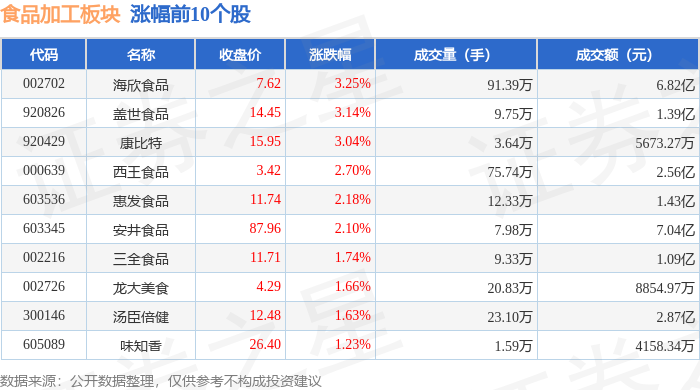
Market Overview - The food processing sector increased by 0.28% on January 12, with Hai Xin Food leading the gains [1] - The Shanghai Composite Index closed at 4165.29, up by 1.09%, while the Shenzhen Component Index closed at 14366.91, up by 1.75% [1] Top Performers - Hai Xin Food (002702) closed at 7.62, up by 3.25% with a trading volume of 913,900 shares and a transaction value of 682 million [1] - Other notable gainers include: - Gai Shi Food (920826) at 14.45, up by 3.14% [1] - Kang Bi Te (920429) at 15.95, up by 3.04% [1] - Xi Wang Food (000639) at 3.42, up by 2.70% [1] - Hui Fa Food (603536) at 11.74, up by 2.18% [1] Underperformers - Qian Wei Yang Chu (001215) closed at 45.60, down by 3.33% with a trading volume of 62,200 shares and a transaction value of 286 million [2] - Other notable decliners include: - Ba Bi Food (605338) at 31.39, down by 2.52% [2] - Xian Le Health (300791) at 24.39, down by 1.45% [2] Capital Flow - The food processing sector experienced a net outflow of 131 million from institutional investors, while retail investors saw a net inflow of 111 million [2] - Notable capital flows include: - Anjiu Food (603345) had a net inflow of 62.62 million from institutional investors [3] - Gai Shi Food (920826) saw a net inflow of 24.97 million from institutional investors [3] - Tang Chen Bei Jian (300146) had a net inflow of 14.78 million from institutional investors [3]

北交所新消费产业研究系列(四):政策与需求共振,健康食品迈向精准与日常
Hua Yuan Zheng Quan· 2026-01-12 09:02
Group 1 - The "Healthy China" strategy is driving an increase in residents' health literacy, with a projected level of 31.87% by 2024, up 2.17 percentage points from 2023 [6][10][11] - The silver economy is expected to exceed 9 trillion yuan by 2025, accounting for 6% of GDP, and reach 30 trillion yuan by 2035, indicating significant growth potential [6][11] - The Z generation has integrated health into their fixed living expenses, with 47.0% of young people frequently purchasing health products/services, leading to a high penetration rate of 84.3% in health consumption [19][21][22] Group 2 - The nutritional functional food market in China is projected to reach 233.1 billion yuan in 2024, with an annual compound growth rate (CAGR) of 8.5% expected from 2024 to 2029 [28][38] - The market for special medical foods is expected to grow at a CAGR of 26% from 2019 to 2024, with the market size increasing from 7.3 billion yuan in 2019 to 23.2 billion yuan in 2024 [28][15] - The konjac food market has shown a CAGR of 20% from 2014 to 2023, with consumption trends on the rise, particularly among younger demographics [28][39] Group 3 - The nutritional functional food industry is characterized by a diverse range of subcategories, including weight management, sports nutrition, beauty nutrition, gut health, healthy snacks, and basic nutrition, with sports nutrition being the fastest-growing segment [30][39] - The contract manufacturing market for nutritional functional foods is expected to grow from 25.3 billion yuan in 2024 to 44.1 billion yuan by 2029, with a CAGR of 11.8% [42][38] - The health snack segment is the largest application scenario within the nutritional functional food market, projected to reach 97.1 billion yuan in 2024 [38][41] Group 4 - Companies like Kangbiter, a leading brand in sports nutrition, and Hengmei Health, a contract manufacturer of nutritional functional foods, are positioned to benefit from the growing health consumption trend [28][46][48] - The nutritional functional food industry is experiencing rapid development, with increasing competition among brands and a focus on product innovation to meet diverse consumer demands [30][38] - The overall market for nutritional health foods is expected to reach 522.3 billion yuan in 2024, with a forecasted growth to 720.3 billion yuan by 2029, driven by rising consumer health awareness and regulatory improvements [30][34]
水产概念震荡反弹,中水渔业午后涨停
Mei Ri Jing Ji Xin Wen· 2026-01-07 05:43
Group 1 - The aquaculture sector experienced a rebound on January 7, with notable stocks such as Zhongshui Fisheries hitting the daily limit up [1] - Other companies in the sector, including Guolian Aquatic Products, Kaichuang International, ST Jiawo, Dahu Co., Zhangzidao, and Gais Food, also saw increases in their stock prices [1]

食品加工板块1月6日涨0.15%,盖世食品领涨,主力资金净流入2284.36万元
Zheng Xing Xing Ye Ri Bao· 2026-01-06 08:56
Core Viewpoint - The food processing sector experienced a slight increase of 0.15% on January 6, with Gai Shi Food leading the gains. The Shanghai Composite Index rose by 1.5%, while the Shenzhen Component Index increased by 1.4% [1]. Group 1: Market Performance - Gai Shi Food closed at 13.85, up by 2.82%, with a trading volume of 59,000 shares and a transaction value of 81.20 million yuan [1]. - Other notable performers included Jiao Da Ang Li, which rose by 2.17% to close at 6.58, and De Li Si, which increased by 1.65% to close at 4.94 [1]. - The overall trading volume in the food processing sector showed varied performance, with significant transactions recorded for companies like Anjiu Food and Xiwang Food [1]. Group 2: Capital Flow - The food processing sector saw a net inflow of 22.84 million yuan from institutional investors, while retail investors experienced a net outflow of 15.49 million yuan [2]. - The main capital inflows were observed in companies like Anjiu Food, which had a net inflow of 39.28 million yuan, and Sanquan Food, with a net inflow of 10.55 million yuan [3]. - Conversely, companies like Xiwang Food and Tang Chen Bei Jian faced significant net outflows from retail investors, indicating a shift in investor sentiment [3].


