
创想三维

Search documents
计算机行业点评报告:消费级3D打印迎来奇点时刻,关注产业投资机会
Soochow Securities· 2025-06-18 10:04
Investment Rating - The report maintains an "Overweight" rating for the industry [1] Core Insights - The consumer-grade 3D printing market is experiencing rapid growth, with a 40% year-on-year increase in production as of May 2025 [4][9] - In April 2025, the entry-level market for consumer-grade 3D printers was the only segment to show growth, with a 26% increase in shipments, driven by strong performances from brands like TuoZhu and ChuangXiang SanWei [4][9] - Chinese manufacturers dominate the global consumer-grade 3D printer market, supplying 96% of entry-level printers worldwide in 2024 [12] - The cultural and creative industries are driving demand for consumer-grade 3D printers, allowing users to create unique DIY products [15] - The introduction of advanced products like TuoZhu's H2D printer, which can achieve speeds of over 1000 mm/s, is expected to enhance market growth [19][23] Summary by Sections 1. Consumer-grade 3D Printing Demand and Global Leadership - Consumer-grade 3D printers are designed for home or small studio use, offering advantages in size, cost, and ease of operation compared to industrial models [9] - The production of 3D printing equipment in China reached 3.778 million units in 2024, with a total export value of 8.16 billion yuan [9][12] 2. Transition from B2B to B2C in 3D Printing - The consumer-grade 3D printing sector is transitioning from a productivity tool to a consumer product, similar to the impact of Douyin on video creation [15] - The emotional value provided by 3D printing, allowing for the creation of unique items, is a key driver of demand [15] 3. Investment Recommendations - The report suggests that the rapid development of the cultural and creative industries will sustain high demand for consumer-grade 3D printers [23] - Key investment targets include JinChengZi (mirror and laser controllers), HaiZheng ShengCai (consumables), and HuiNa Technology (potential injection of 3D printing assets) [23]
专访九位出海人:出海,在不确定性中找确定性
3 6 Ke· 2025-04-29 11:07
Core Insights - The article highlights the success of various Chinese companies in the international market, showcasing their innovative products and strategies that have led them to become leaders in their respective fields, such as AI business cards, smart glasses, adult AI toys, and cleaning robots [1][2]. Group 1: Market Positioning and Achievements - A metal chip that facilitates business card exchanges has become the second-largest AI business card globally within a year [1]. - The company specializing in photochromic sunglasses has emerged as the number one exporter in Europe and the United States [1]. - The adult AI toy company has positioned itself as a global leader by integrating emotional value into its products [1]. - A cleaning robot startup has seen nearly a sevenfold increase in overseas revenue in the past year, expanding its market to over 30 countries [1][2]. Group 2: Challenges and Responses to Tariffs - Tariffs have prompted companies to explore new markets beyond the U.S., such as Europe, the Middle East, and Southeast Asia, as a strategic response [3][5]. - Companies are adapting by optimizing local supply chains and establishing overseas manufacturing facilities to mitigate the impact of tariffs [8][10]. - The adult toy company has noted that its high-end products are less affected by tariffs due to their target demographic being less price-sensitive [10]. Group 3: Importance of Product Innovation - High-tech and innovative products are crucial for competitiveness in international markets, with a focus on product quality and consumer preferences [12][14]. - Companies are leveraging AI to enhance user experience and product functionality, making their offerings more appealing to consumers [17][19]. - The adult toy company has integrated AI to provide emotional companionship, enhancing the product's value proposition [22]. Group 4: Localization Strategies - Effective localization involves understanding and adapting to local consumer needs and cultural preferences, which is essential for market penetration [23][25]. - Companies are employing local teams to bridge cultural gaps and ensure that their products resonate with local consumers [27]. - The Middle Eastern market presents unique challenges due to cultural and religious considerations, necessitating a respectful approach to localization [27].


激发内需力 贡献“圳”能量
Sou Hu Cai Jing· 2025-04-15 00:20
Group 1 - The fifth China International Consumer Products Expo (CICPE) opened in Hainan, featuring over 1,700 enterprises and 4,100 brands from more than 70 countries and regions, with Shenzhen showcasing over 20 companies in key sectors like new energy vehicles and AI [2][3] - In the first quarter, China's total goods trade reached 10.3 trillion yuan, a 1.3% increase year-on-year, with exports at 6.13 trillion yuan (up 6.9%) and imports at 4.17 trillion yuan (down 6%), indicating a stable start despite external challenges [2] - China is leveraging its robust manufacturing supply chain, which has ranked first globally for 14 consecutive years, to stimulate domestic demand and transition towards a consumption-driven economy [2][3] Group 2 - The Ministry of Commerce has organized discussions with trade associations and major retailers to enhance domestic sales channels for foreign trade enterprises, with e-commerce platforms like JD, Alibaba, and Pinduoduo announcing measures to promote "export to domestic sales" [3] - The "Buy in China" series of activities was launched alongside the expo, aiming to enhance consumption quality and upgrade through nearly 30 events throughout the year, focusing on shopping, food, tourism, and performances [3] - Shenzhen's enterprises demonstrated significant strength in emerging consumption sectors, showcasing advanced technologies and innovative products that are reshaping the local consumption structure and contributing to Shenzhen's status as a trillion-yuan consumption city [4]
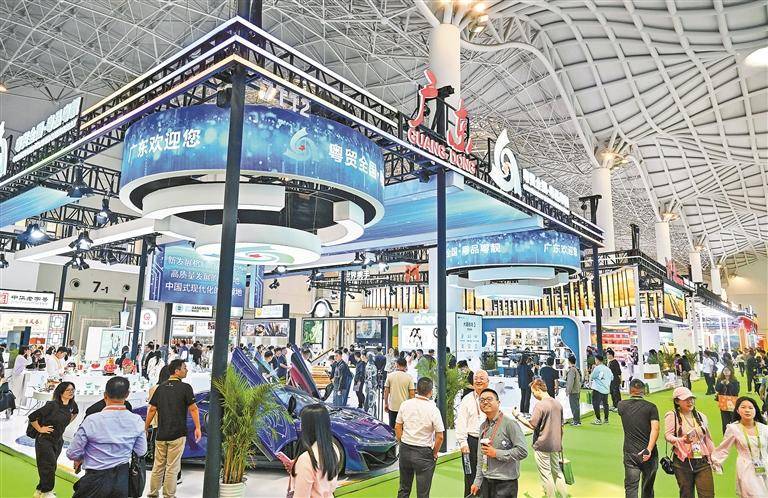
AI机器人、AI宠物、AI眼镜……集体出圈 深圳“AI+”闪耀消博会
Shen Zhen Shang Bao· 2025-04-13 17:49
Core Insights - The fifth China International Consumer Products Expo (CICPE) is being held from April 13 to 18 in Hainan, featuring over 1,700 consumer enterprises and more than 4,100 brands from 71 countries and regions, showcasing emerging consumer sectors such as fashion, technology, health, and services [1][2] Group 1: Shenzhen Pavilion Highlights - The Shenzhen Pavilion, themed "Shenzhen Intelligent Manufacturing Global Sharing," showcases 15 well-known companies including BYD, DJI, and Honor, with over 100 exhibits demonstrating Shenzhen's technological and innovative capabilities [2][3] - The pavilion covers an area of 900 square meters, featuring more than 200 exhibits across key industries such as new energy vehicles, smart manufacturing, consumer electronics, fashion, and health [1][2] Group 2: AI Robotics and Smart Retail - AI robots are a key highlight at the expo, with Anno Robotics presenting three main products: an AI coffee art robot, an AI cocktail robot, and an AI ice cream robot, all targeting the ready-to-drink beverage market [3][4] - The AI coffee art robot allows consumers to customize their coffee preferences and produces drinks in an average of 90 seconds, while the cocktail robot can serve drinks in 45 seconds and the ice cream robot in 30 seconds [3] Group 3: Innovations in Consumer Technology - Yuntian Lifei, a first-time participant, showcases several consumer-oriented smart hardware products, including the first domestically produced AI pet and new AI audio glasses, emphasizing the integration of large models with hardware [5][6] - The AI audio glasses, developed in collaboration with Flash and LoHo, feature capabilities such as photography, video recording, voice interaction, and smart translation, positioning them as both a fashion item and a personal assistant [6]


奥比中光获华夏、兴全两只公募基金重仓:位列前十大股东行列 去年四季度或进入盈亏平衡边缘
Cai Jing Wang· 2025-04-13 12:50
Group 1 - The announcement on April 11 revealed that major shareholders such as Xingquan Fund, Huaxia Fund, and Shenzhen Futian Guidance Fund have significantly increased their stakes in Aobi Zhongguang, entering the top ten shareholders list [1] - Xingquan's two funds hold approximately 6.252 million shares and 3.324 million shares, representing 1.56% and 0.83% of the total share capital, ranking as the 8th and 9th largest shareholders respectively [1] - Huaxia's fund holds about 3.9293 million shares, accounting for 0.98% of the total share capital, making it the 10th largest shareholder [1] Group 2 - Aobi Zhongguang's fundamentals are showing significant improvement, with a reported revenue of 560 million yuan for 2024, reflecting a year-on-year growth of approximately 55.55% [1] - The company's losses have narrowed considerably, with a total loss of 60 million yuan in 2024 compared to a loss of 276 million yuan in 2023 [1] - Projections based on the company's performance data indicate that Aobi Zhongguang reached the breakeven point in the fourth quarter of last year [1] Group 3 - Aobi Zhongguang has deepened its collaboration with global consumer-grade 3D scanner brand Chuangxiang Sanwei over the past year [2] - Chuangxiang Sanwei recently launched two new scanning products, OtterLite and RaptorPro, both utilizing Aobi Zhongguang's self-developed multi-core heterogeneous 3D reconstruction chip technology [2] - The partnership now encompasses a comprehensive range of 3D printing and scanning products [2]
