
爱旭股份

Search documents
光伏业又一家!晶科能源子公司欲引入战投还债,增资不超30亿元
Bei Jing Shang Bao· 2026-01-20 12:05
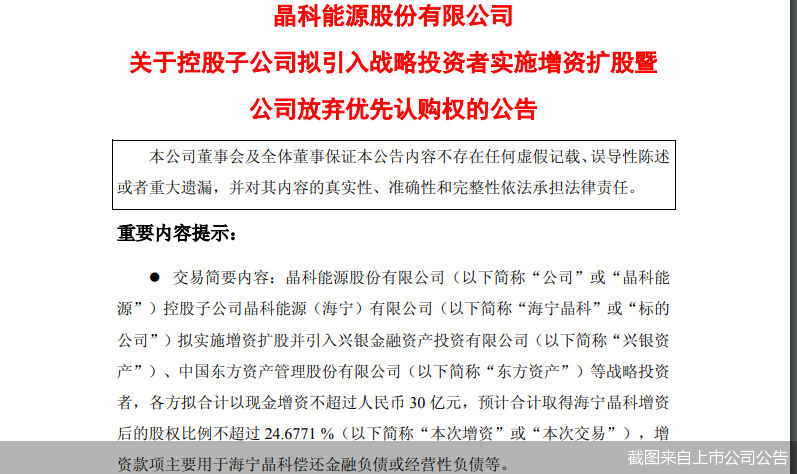
Core Viewpoint - JinkoSolar is planning to raise up to 3 billion yuan through its subsidiary, JinkoSolar (Haining) Co., Ltd., to improve its financial structure and reduce debt levels amid a challenging solar industry environment [1][2]. Group 1: Financing and Investment - JinkoSolar's subsidiary, Haining Jinko, aims to introduce strategic investors, including Xingyin Financial Asset Investment Co., Ltd. and China Orient Asset Management Co., Ltd., with a total cash investment not exceeding 3 billion yuan, potentially acquiring up to 24.6771% equity post-investment [2]. - The funds raised will primarily be used to repay financial and operational debts, addressing the high debt levels of Haining Jinko, which has a debt ratio of approximately 58.73% as of September 30, 2025 [1][3]. Group 2: Financial Performance - As of September 30, 2025, Haining Jinko reported total assets of approximately 20.537 billion yuan and total liabilities of about 12.061 billion yuan, resulting in a debt ratio of 58.73% [3]. - For the first three quarters of 2025, JinkoSolar reported a revenue of approximately 47.986 billion yuan, a year-on-year decline of 33.14%, and a net profit attributable to shareholders of approximately -3.92 billion yuan, indicating a significant loss [3]. - The company anticipates a challenging year in 2025 due to overcapacity and intense competition in the solar industry, alongside rising raw material costs and policy changes [3]. Group 3: Industry Context - Other leading solar manufacturers in the A-share market, such as Longi Green Energy and Aiko Solar, have also announced expected losses, reflecting a broader trend of financial difficulties within the solar industry [4]. - JinkoSolar's debt ratio reached 74.48% as of the end of the third quarter of 2025, highlighting the need for ongoing financial optimization [5]. - The company plans to focus on its core business and leverage its technological and market advantages to improve its financial situation, including the potential conversion of approximately 10 billion yuan in convertible bonds to enhance its financial structure [5].


爱旭股份(600732) - 关于为子公司提供担保的进展公告
2026-01-20 08:15
证券代码:600732 股票简称:爱旭股份 编号:临 2026-003 近日,上海爱旭新能源股份有限公司(以下简称"公司")签署的担保合同 情况如下: 上海爱旭新能源股份有限公司 关于为子公司提供担保的进展公告 本公司董事会及全体董事保证本公告内容不存在任何虚假记载、误导性陈述或者重大遗 漏,并对其内容的真实性、准确性和完整性承担法律责任。 重要内容提示: 担保对象及基本情况 担保对象 被担保人名称 珠海富山爱旭太阳能科技有限公司 (以下简称"珠海爱旭")、天津爱 旭太阳能科技有限公司(以下简称 "天津爱旭") 本次担保金额 1.00 亿元 实际为其提供的担保余额 118.58 亿元(含本次) 是否在前期预计额度内 是 □否 □不适用:_________ 本次担保是否有反担保 □是 否 □不适用:_________ 累计担保情况 | 对外担保逾期的累计金额(万元) | 0.00 | | --- | --- | | 截至本公告日上市公司及其控股 子公司对外担保总额(亿元) | 242.21 | | 对外担保总额占上市公司最近一 期经审计净资产的比例(%) | 681.46 | | 特别风险提示 产 | 对外担 ...

爱旭股份:为子公司提供1亿元担保,累计担保242.21亿元
Xin Lang Cai Jing· 2026-01-20 07:56
Core Viewpoint - The company has signed supplementary agreements with Agricultural Bank of China and Bank of China to provide guarantees for its subsidiaries, indicating a strategic move to secure financing and support operations [1] Group 1: Agreements and Guarantees - The company signed a supplementary agreement with a branch of Agricultural Bank of China to add Zhuhai Doumen branch as a creditor [1] - A maximum guarantee contract was signed with Bank of China Tianjin Beichen branch to provide a joint liability guarantee of 100 million yuan for Tianjin Aishu [1] Group 2: Financial Position - As of the announcement date, the company has provided a total of 24.221 billion yuan in guarantees for its subsidiaries, which accounts for 681.46% of the most recent audited net assets [1] - The actual debt balance stands at 14.078 billion yuan, with no overdue guarantees reported [1] Group 3: Future Guarantee Limits - The company has set a maximum external guarantee limit of 36.2 billion yuan for the year 2025, and the current guarantees fall within the authorized limit, thus no further approval is required [1]
爱旭股份股价跌5.07%,银华基金旗下1只基金重仓,持有122.62万股浮亏损失87.06万元
Xin Lang Cai Jing· 2026-01-20 06:52
Group 1 - The core point of the news is that Aishuo Co., Ltd. experienced a 5.07% drop in stock price, closing at 13.30 yuan per share, with a trading volume of 581 million yuan and a turnover rate of 2.36%, resulting in a total market capitalization of 28.159 billion yuan [1] - Aishuo Co., Ltd. is primarily engaged in the research, production, and sales of solar cells, with its main revenue sources being solar modules (74.44%), solar cells (18.58%), entrusted processing (5.63%), technical consulting services (0.69%), and other (0.65%) [1] Group 2 - From the perspective of major fund holdings, one fund under Yinhua Fund holds a significant position in Aishuo Co., Ltd., specifically the Yinhua New Energy New Materials Quantitative Stock Fund A (005037), which holds 1.2262 million shares, accounting for 2.77% of the fund's net value, making it the sixth-largest holding [2] - The Yinhua New Energy New Materials Quantitative Stock Fund A (005037) has a current scale of 419 million yuan, with a year-to-date return of 6.99%, ranking 2156 out of 5542 in its category, and a one-year return of 68.45%, ranking 504 out of 4235 [2] Group 3 - The fund managers of Yinhua New Energy New Materials Quantitative Stock Fund A (005037) include Zhang Kai, Yang Teng, and Li Yixuan, with respective cumulative management tenures of 13 years and 71 days, 4 years and 54 days, and 8 years and 29 days [3] - Zhang Kai's fund has a total asset scale of 1.992 billion yuan, with the best return during his tenure being 130.54% and the worst being -43.75% [3] - Yang Teng manages assets totaling 2.753 billion yuan, with a best return of 40.8% and a worst return of -36.85% during his tenure [3] - Li Yixuan oversees assets of 9.722 billion yuan, achieving a best return of 122.96% and a worst return of -36.17% during his management period [3]
爱旭股份跌2.07%,成交额1.17亿元,主力资金净流出2492.26万元
Xin Lang Zheng Quan· 2026-01-20 02:41
Core Viewpoint - Aishuo Co., Ltd. has experienced fluctuations in stock price and trading volume, with a recent decline of 2.07% and a total market capitalization of 29.049 billion yuan. The company primarily focuses on the research, production, and sales of solar energy products, with significant revenue contributions from solar modules and cells [1]. Financial Performance - For the period from January to September 2025, Aishuo Co., Ltd. achieved a revenue of 11.597 billion yuan, representing a year-on-year growth of 46.86%. However, the company reported a net profit attributable to shareholders of -532 million yuan, which is an increase of 81.20% compared to the previous period [2]. Shareholder and Market Activity - As of September 30, 2025, the number of shareholders for Aishuo Co., Ltd. was 70,700, a decrease of 9.57% from the previous period. The average number of circulating shares per shareholder increased by 10.58% to 22,418 shares [2]. - The company has distributed a total of 9.21 billion yuan in dividends since its A-share listing, with 7.15 billion yuan distributed over the past three years [3]. - Notable institutional shareholders include Hong Kong Central Clearing Limited, which increased its holdings by 3.733 million shares, and Invesco Great Wall New Energy Industry Fund, which also increased its holdings [3].
去年中国GDP增长5%,多家手机厂商下调出货预期 | 财经日日评
吴晓波频道· 2026-01-20 00:30
Economic Overview - In 2025, China's GDP reached 1401879 billion yuan, growing by 5% year-on-year, with quarterly growth rates of 5.4%, 5.2%, 4.8%, and 4.5% respectively [2] - The industrial added value increased by 5.9%, while the service sector grew by 5.4%. Retail sales totaled 501202 billion yuan, up by 3.7% [2] - Fixed asset investment decreased by 3.8%, with a notable decline in real estate investment [3] Trade and Investment - Canada has reduced the import tax on Chinese electric vehicles to 6.1%, allowing an annual quota of 49,000 vehicles, which is a significant policy shift aimed at filling market gaps [4][5] - The adjustment in tariffs is expected to enhance the competitiveness of Chinese electric vehicles in the Canadian market, which has seen a decline in sales due to high costs and tariffs [5] Real Estate Market - In December 2025, new home prices in first-tier cities fell by 0.3%, with a notable increase in Shanghai, while overall new home sales area decreased by 8.7% year-on-year [6] - The real estate market is still in a bottoming phase, with a significant reduction in new supply and ongoing inventory pressure [7] Mobile Phone Industry - Several smartphone manufacturers, including Xiaomi and OPPO, have lowered their annual shipment forecasts due to rising storage costs, with reductions exceeding 20% for some brands [8] - The impact of rising storage prices is uneven across manufacturers, with larger firms like Apple and Samsung less affected [9] Solar Industry - Nine leading solar companies, including LONGi Green Energy and Tongwei Co., have announced expected losses for 2025, with Tongwei projecting a loss of 90 to 100 billion yuan [10] - The solar industry is facing significant challenges, including high inventory levels and price competition, leading to a prolonged period of losses [11] Wealth Disparity - The global wealth of billionaires reached a record 18.3 trillion USD in 2025, with a 16% increase in total wealth, highlighting a growing wealth gap amid stagnant poverty reduction efforts [12][13] - The AI sector's growth has significantly contributed to the increase in billionaire wealth, while ordinary residents face declining purchasing power due to inflation [13] Space Tourism - A startup has announced the opening of reservations for the world's first lunar hotel, aiming to begin operations by 2032, although the feasibility of such a project remains uncertain [14][15]




白银价格再创新高 光伏行业成本攀升
Xin Lang Cai Jing· 2026-01-19 18:12
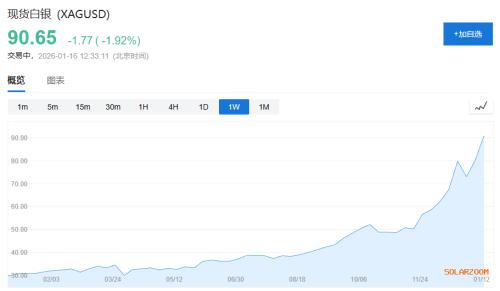
Core Viewpoint - The surge in silver prices is significantly impacting the photovoltaic (PV) industry, leading to increased operational pressures and projected losses for major companies in the sector [1][2]. Group 1: Silver Price Impact - International silver prices have recently surpassed $94 per ounce, contributing to heightened costs for PV companies already facing two years of losses [1]. - The cost of silver has increased over threefold in the past year, now accounting for 29% of the total cost of solar panels, compared to 3.4% in 2023 and 14% last year [2]. Group 2: Company Performance Forecasts - Tongwei Co. anticipates a net loss of approximately 9 billion to 10 billion yuan for 2025, citing rising silver prices and declining product prices as key factors [1]. - TCL Zhonghuan, a leading PV silicon wafer manufacturer, expects a net loss between 8.2 billion to 9.6 billion yuan, attributing this to ongoing supply-demand imbalances despite growth in new installations [2]. - Longi Green Energy forecasts a net loss of 6 billion to 6.5 billion yuan for 2025, with significant cost increases in silver paste and silicon materials further straining operations [2]. Group 3: Industry Response - Some component manufacturers have raised prices to reflect the increased costs of silver, while the industry is also exploring technological adjustments to mitigate these pressures [2]. - Longi Green Energy has completed pilot tests for replacing silver paste with cheaper materials and is beginning large-scale production of these alternatives [2].
白银暴涨,光伏流泪
Hua Er Jie Jian Wen· 2026-01-19 03:02
Core Insights - The cost of silver paste in photovoltaic (PV) modules has surged from 3.4% of total costs in 2023 to 29% currently, making it the largest cost component, surpassing silicon materials [1][3] - The rising silver prices have forced PV manufacturers to increase prices and accelerate plans to replace silver with cheaper materials like copper, with an expected 17% reduction in silver usage this year [1][7] Group 1: Cost Impact - A rise of 1000 yuan per kilogram in silver price increases the cost of solar cells by 0.01 yuan per watt, which is critical for the already thin profit margins in the PV industry [2] - The current silver consumption for TOPCon cells is approximately 10-13 mg/W, and if silver prices remain high, the cost from silver paste alone could reach 0.1-0.13 yuan per watt [3] Group 2: Price Adjustments - Chinese module manufacturers have raised prices by 1.4% to 3.8%, with mainstream 500W modules now priced around 400 yuan (approximately 57 USD) [3] - Leading companies like Longi Green Energy and Aiko Solar have recently increased their shipping prices, citing rising raw material costs [3] Group 3: Industry Challenges - Mid-tier companies are facing more severe challenges compared to leading firms, with some forced to halt production due to cash flow issues, financing difficulties, and inventory buildup [4][5] - A notable example includes a battery manufacturer in Hunan that ceased operations, stating there are currently no alternative solutions [6] Group 4: Supply and Demand Dynamics - The surge in silver prices is attributed to a supply-demand imbalance, with industrial demand, including solar energy, accounting for 65% of total silver demand [6] - The silver usage in the PV industry represents over 15% of global silver production, with a projected supply-demand gap of 5,000 tons by 2025 [6] Group 5: Material Substitution Efforts - Companies like Longi Green Energy are accelerating the replacement of silver with cheaper metals, with predictions that the PV industry could reduce silver usage by 17% this year [7] - Some technological routes have the potential to lower silver content to 25%, theoretically achieving a 90% reduction [7] Group 6: Risks of Substitution - The aggressive substitution strategy carries significant risks, as the stability of copper is inferior to silver, leading to potential long-term liabilities for manufacturers if panels fail before the warranty period [8] - Current substitution methods face challenges such as unstable printing of paste and suboptimal yield rates [8]


两大光伏龙头去年预亏超150亿,“亏损王”开盘大跌
Di Yi Cai Jing Zi Xun· 2026-01-19 02:48
Core Viewpoint - Two major photovoltaic companies, Tongwei Co., Ltd. and Longi Green Energy, are expected to report significant net losses for the year 2025, with Tongwei projected to lose between 9 billion to 10 billion yuan and Longi between 6 billion to 6.5 billion yuan, totaling a maximum of 16.5 billion yuan in losses for both companies [2][3]. Company Performance - Tongwei Co., Ltd. anticipates a net loss due to a combination of factors including a slowdown in new installations, an industry-wide supply surplus, and rising costs of core raw materials [3][4]. - Longi Green Energy cites ongoing supply-demand mismatches, low operating rates, and increased costs of silver paste and silicon materials as key reasons for its expected losses [2][3]. - TCL Zhonghuan also reported a projected loss of 8.2 billion to 9.6 billion yuan, attributing it to insufficient market demand and price declines [3]. Industry Trends - The photovoltaic industry is experiencing a prolonged period of losses, with many leading companies reporting negative earnings for nine consecutive quarters [4]. - The average market transaction price for photovoltaic modules is expected to remain low, around 0.6 yuan per watt by mid-2025, due to intense competition and insufficient end-user demand [2]. - The industry is witnessing a significant decline in production volumes, with polysilicon output down by 29.6% and silicon wafer production down by 6.7% year-on-year [5]. Financial Implications - Tongwei Co., Ltd. has reported asset impairment provisions of approximately 1.5 billion to 2 billion yuan, primarily due to technological changes and market demand fluctuations [3][4]. - Companies like Yijing Photovoltaic have warned that their net assets may turn negative, which could lead to delisting risks if confirmed [4].
西部证券晨会纪要-20260119
Western Securities· 2026-01-19 02:39
Group 1: Commercial Aerospace - The commercial aerospace sector is transitioning from "single satellite testing" to "constellation networking," with significant growth expected as China develops reusable rocket technology and increases satellite launches [5][6][7] - The "Zhuque-3" rocket has a launch capacity of 21.3 tons, surpassing the Falcon 9's initial recovery capacity, indicating a strong foundation for future satellite launches [6] - The market potential for domestic satellite launches is substantial, with an estimated annual demand for approximately 4,000 satellites, suggesting a significant growth trajectory for the industry [6][7] Group 2: Automotive Industry - Spring Power (603129.SH) is projected to achieve net profits of 1.907 billion, 2.371 billion, and 2.805 billion yuan from 2025 to 2027, with a target market capitalization of 49.8 billion yuan based on a 21x PE ratio for 2026 [2][13] - The company is positioned as a leader in all-terrain vehicles and large-displacement motorcycles, with competitive advantages in performance and cost-effectiveness compared to international competitors [13][14] - The electric two-wheeler segment is expected to contribute significantly to revenue growth, with sales reaching 250,500 units and revenue of 872 million yuan in the first half of 2025, reflecting a year-on-year increase of 652.06% [15] Group 3: Financial Sector - The introduction of the "Derivatives Trading Supervision Management Measures" aims to regulate the derivatives market, enhancing the legal framework and promoting the development of the derivatives business [32][33][34] - The measures emphasize the importance of derivatives in managing risks and supporting the real economy, indicating a growing focus on regulatory oversight in the financial sector [32][34] - Major securities firms are expected to benefit from the regulatory changes, particularly those with strengths in derivatives trading, as the market becomes more structured and opportunities for growth arise [34] Group 4: Macro Financial Data - In December, new loans totaled 910 billion yuan, with a year-on-year decrease compared to the previous year, while corporate loans showed signs of recovery [18][19] - The social financing growth rate slowed, primarily due to government financing constraints, indicating a need for policy adjustments to stimulate economic activity [19][20] - The central bank's recent rate cuts and liquidity measures suggest a continued effort to support economic growth and maintain stable financing conditions [20][40]