
雷鸟创新

Search documents
资本奔涌入局 成本贵上天的Micro LED如何走向商业化
2 1 Shi Ji Jing Ji Bao Dao· 2025-11-06 09:03
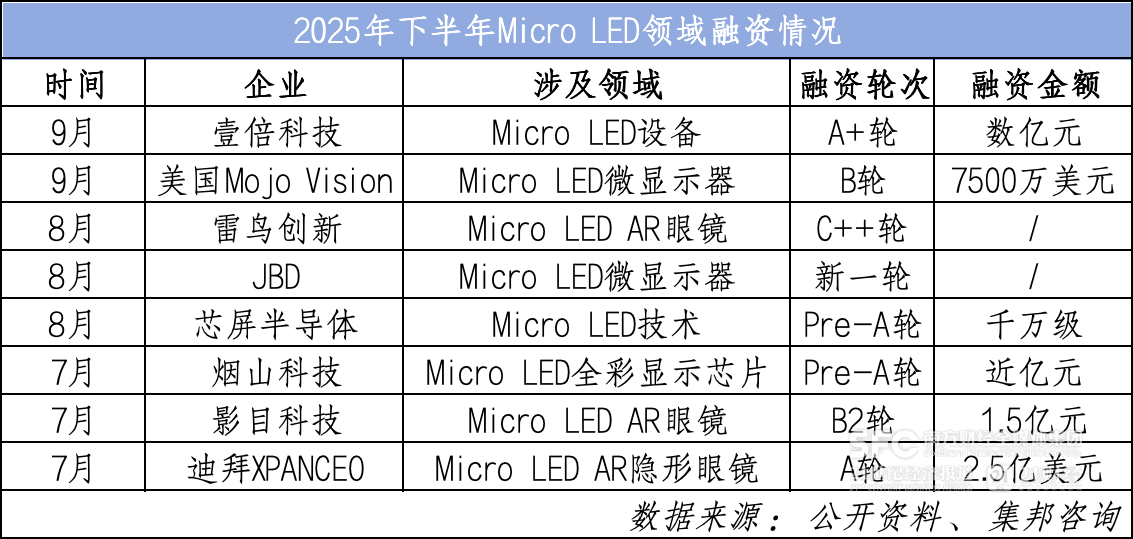
Core Insights - Micro LED technology is gradually developing a significant market, with expectations for the chip market to exceed $461 million by 2029 due to cost reductions, design optimizations, and application expansions [2][7]. Industry Developments - The Micro LED industry has seen dynamic advancements in technology research, product development, capacity planning, and capital investment, attracting considerable market attention [3]. - Meta's launch of the Meta Ray-Ban Display AR glasses in September sparked a global buying frenzy, highlighting the AR segment of the Micro LED field as a focal point for capital investment [4]. - Despite challenges in cost control and yield improvement, the commercial pathway for Micro LED technology is becoming clearer [5]. Market Opportunities - Micro LED technology is recognized as the next-generation display technology, offering advantages such as high pixel density, ultra-high brightness, low response time, low power consumption, long lifespan, high color saturation, high reliability, and small size [6]. - The technology is penetrating various fields, including near-eye displays, micro-projection, automotive displays, and optical communication, with significant applications in AR/VR and smartwatches [6]. Capital Investment Trends - The capital market's enthusiasm for Micro LED technology is high, with several companies securing substantial financing. For instance, JBD completed a financing round exceeding 1 billion RMB, setting a record for single financing in the Micro LED micro-display sector [7][8]. - Various companies, including Rokid and Yingmu Technology, have also completed significant financing rounds to support their Micro LED AR glasses initiatives [8]. Production Capacity and Challenges - Major panel manufacturers like BOE, TCL, and Visionox are actively investing in Micro LED production, with some projects entering the product delivery phase [9]. - The industry faces challenges in scaling production, particularly regarding yield and cost, with chip costs accounting for over 80% of total expenses [10]. Technological Advancements - Innovations in production efficiency and cost reduction are critical, with a focus on larger sizes to lower costs and improve compatibility with CMOS processes [11]. - Micro LED technology is expected to enhance product lifespan and reduce maintenance costs, particularly in niche markets beyond consumer displays [12]. AR Glasses Market Dynamics - AR glasses are seen as a primary battleground for Micro LED technology, with significant cost contributions from optical display modules [12]. - Companies are competing to develop high-brightness, full-color, high-pixel-density, and miniaturized technologies for AR applications [12]. Recent Product Launches - The second half of the year has seen multiple new products featuring Micro LED technology, including AI glasses and various AR glasses targeting different markets [13]. - Companies like Guozhao Optoelectronics and Xingyao Semiconductor are expanding their production capabilities, with significant investments in Micro LED production lines [14][15]. Supply Chain Integration - China's AR glasses supply chain is rapidly evolving, with numerous companies involved in various components, indicating a trend towards horizontal cooperation and vertical integration [16].

数板块已处底部,把握局机遇
SINOLINK SECURITIES· 2025-11-02 11:23
Investment Rating - The report indicates that most sectors are at the bottom, suggesting opportunities for alpha layout [2] Core Viewpoints - The home furnishing sector is experiencing pressure in domestic sales, while export performance shows resilience. The overall revenue for the domestic home furnishing sector in Q1-Q3 2025 decreased by 0.96% year-on-year, and the net profit attributable to the parent company fell by 23.80% [10][12] - In the paper packaging sector, upstream pulp mills are reducing supply due to profit pressures, while downstream paper demand is gradually recovering, leading to a stabilization in prices [2][10] - The personal care sector is facing challenges in online sales, but offline performance remains stable, with major companies adjusting their marketing strategies to improve profitability [2][10] - The new consumption sector, driven by IP and AI glasses, is showing growth potential, with companies like Pop Mart and Meta launching new products [2][10] Summary by Sections Home Furnishing - Domestic sales in Q3 2025 are under pressure, with revenue down 1.19% year-on-year and net profit down 15.79%. The external sales sector shows resilience with a 1.91% increase in revenue [10][12] - The performance of soft furniture companies is better than that of custom furniture companies, attributed to faster product iteration and successful online channel strategies [10][12] Paper Packaging - The paper sector is stabilizing, with net profit margins for pulp, waste paper, and specialty paper showing slight improvements. The packaging sector is experiencing stable growth, particularly in plastic and paper packaging [2][10] Personal Care - The sector is facing pressure from online competition, but offline sales remain steady. Major companies are focusing on brand and channel management to enhance profitability [2][10] New Consumption - The sector is driven by IP and AI glasses, with significant growth in emotional consumption. Companies are actively launching new products to capture market share [2][10]




智能眼镜会取代手机吗?
Ren Min Ri Bao· 2025-10-30 22:49
Core Insights - The global smart glasses market has seen significant growth, with shipments reaching 4.065 million units in the first half of the year, marking a year-on-year increase of 64.2% [6][7] - Raybird Innovation, a Shenzhen-based company, has emerged as a leader in the AR glasses segment, capturing a 39% market share in Q2, becoming the first globally [2][6] - The company aims to transition smart glasses from a niche product for tech enthusiasts to a consumer necessity, addressing the challenge of competing with smartphones [2][11] Company Overview - Raybird Innovation was established four years ago and has quickly positioned itself in the smart glasses industry, focusing on technological advancements and user experience [2][8] - The company's flagship product, the X3 Pro, is priced around 9,000 yuan and is designed for tech enthusiasts, while other models like V3 and Air 3s target broader markets with lower price points [7][8] - The company is developing a comprehensive application ecosystem to enhance the functionality of smart glasses, aiming to replicate popular smartphone applications [6][8] Product Features - The X3 Pro offers various functionalities, including real-time navigation, video recording, and live translation in 14 languages, showcasing its versatility [6][8] - The glasses utilize advanced optical technology, featuring a compact optical engine that enables full-color display, a significant breakthrough in the industry [8][9] - Weight optimization is a focus, with the X3 Pro weighing 76 grams, while the V3 model is lighter at 39 grams, enhancing user comfort [9] Market Potential - The smart glasses market is expected to drive new growth in the consumer electronics sector as product innovation and application scenarios expand [7][11] - The company believes that the increasing number of players in the market will lead to better resource allocation in the supply chain, ultimately reducing costs [10][11] - The potential for smart glasses to become a mainstream product is supported by a growing consumer acceptance, as evidenced by the emergence of dedicated sales categories on e-commerce platforms [13] Industry Challenges - Despite the promising outlook, smart glasses face challenges such as limited hardware capabilities, short battery life, and user experience issues that need to be addressed for broader adoption [12][11] - The industry is currently in a "technology climbing phase," where early-stage products often have rough user experiences, similar to the early days of computers and smartphones [12][14] - The need for a robust underlying support system for software and hardware is critical for the expansion of the smart glasses ecosystem [12]
博士眼镜(300622) - 2025年10月30日投资者关系活动记录表
2025-10-30 10:00
Group 1: Financial Performance - In the first three quarters of 2025, the company achieved a revenue of 1.08 billion yuan, representing a year-on-year growth of 18.05% [2] - The net profit attributable to shareholders was approximately 87.83 million yuan, with a year-on-year increase of 5.21% [2] - For Q3 2025, the company reported a revenue of approximately 394 million yuan, showing a year-on-year growth of 25.39% [2] - The net profit for Q3 2025 was about 31.80 million yuan, reflecting a year-on-year increase of 2.24% [2] Group 2: Product Sales and Market Share - The sales volume of functional lenses increased by 20.55% year-on-year, accounting for 39.49% of total lens sales [3] - Sales of adult progressive lenses grew by 37.69% year-on-year [3] - Sales of defocus lenses increased by 13.95% year-on-year [3] - Sales of fatigue-relief lenses rose by 23.12% year-on-year [3] Group 3: Strategic Partnerships and Innovations - The company has partnered with leading smart glasses brands including Starry Meizu, Thunder Innovation, XREAL, and others [3] - Over 150 retail stores have been upgraded to include smart glasses display cabinets, creating an immersive shopping experience to enhance customer conversion rates [3]

中国成智能眼镜增长最快市场,谁能成为扛旗者?
3 6 Ke· 2025-10-29 09:59
Core Insights - Meta's AI glasses have sold out again, indicating strong demand for its products, including the Oakley Meta Vanguard and upgraded Ray-Ban Meta AI glasses [1] - The overall smart glasses market in China is still in its early stages, with no clear leading brand yet, suggesting potential for various brands to emerge as market leaders [2] - The Chinese smart glasses market is experiencing significant growth, with a reported 116.1% year-on-year increase in shipments [4] Group 1: Meta's Performance - Meta's smart glasses series sold approximately 750,000 units in Q2, a 50% increase from Q1, with total sales for the first half of the year reaching 1.26 million units [1] - The total sales of Meta's smart glasses are nearing 3 million units, showcasing the brand's strong market presence [1] Group 2: Competitor Landscape - Domestic brands like Alibaba, Baidu, and Xiaomi are entering the smart glasses market, with Xiaomi's AI glasses achieving 30,000 activations in the first week, setting a record for sales speed [2][3] - Rokid announced a sales figure of 300,000 units for its Rokid Glasses, although this figure has been met with skepticism due to lack of transparency in actual sales data [3] Group 3: Market Dynamics - The smart glasses market in China is characterized by rapid growth, with a reported 82.3% increase in global shipments, and a 145.5% increase in China's shipments in Q2 [4] - Despite the growth, the overall scale of the smart glasses market remains small compared to smartphones, indicating that it is still a niche market [4] Group 4: Supply Chain Challenges - The industry faces supply chain issues, with manufacturers inflating sales figures to gain leverage in negotiations, which complicates the development and production processes [5][7] - Companies like Rokid are experiencing delays and price increases, attributed to supply chain problems and the inability to meet production standards [10] Group 5: Future Outlook - The smart glasses industry lacks a clear development path, with questions about whether products will focus on high-performance hardware or serve as ecosystem platforms [11] - The entry of larger companies into the market may lead to a reshuffling of existing players, with smaller brands potentially facing challenges in maintaining market share [11]



多款智能眼镜推出市场,关注产业链机会
Jianghai Securities· 2025-10-28 07:15
Investment Rating - The industry rating is maintained at "Overweight" [4] Core Insights - The global smart glasses market saw a shipment volume of 4.065 million units in the first half of 2025, representing a year-on-year growth of 64.2% [4] - The growth in the smart glasses market is driven by various factors including AI technology empowerment, supply chain optimization, optical solution development, and the entry of major players into the ecosystem [4] - The report highlights the launch of multiple new products in the smart glasses category, indicating a rapid promotion and popularization phase for smart glasses as an important carrier of AI at the edge [5] Summary by Sections Industry Performance - The electronic industry has shown relative returns of 0.16% over one month, 27.29% over three months, and 38.97% over twelve months compared to the CSI 300 index [2] - Absolute returns for the same periods are 3.8%, 41.56%, and 58.17% respectively [2] Market Developments - The report notes the release of the Galaxy XR by Samsung, which is the first product based on the Android XR platform, integrating multi-modal AI capabilities [4] - The report also mentions the launch of the Thunder Air 4 series AR glasses and the INMO GO3 smart glasses, showcasing the innovation in the smart glasses market [4] Future Outlook - The smart glasses industry is expected to enter a rapid development phase, with a focus on related companies such as Xiaomi Group-W, Hengxuan Technology, Allwinner Technology, GoerTek, and Crystal Optoelectronics [5]


超10亿元,JBD刷新Micro LED微显示最高融资纪录
WitsView睿智显示· 2025-10-27 10:10
Core Viewpoint - Shanghai JBD Display Technology Co., Ltd. has successfully completed a B2 round financing exceeding 1 billion RMB, setting a new record for single financing in the global MicroLED micro-display sector [2][3]. Financing Details - The B2 round was led by Chaos Investment and CITIC Jinshi, with participation from various investors including CITIC Securities International Capital, CITIC Securities Investment, and others [5]. - This financing follows a previous B1 round completed in August, which raised several hundred million RMB for R&D, capacity expansion, talent acquisition, and ecosystem collaboration [6]. Use of Funds - The funds from the B2 round will primarily accelerate innovation and product iteration in Micro LED micro-display technology, and promote the co-construction of a consumer-grade AR ecosystem [6]. Technological Advancements - JBD has over ten years of experience in the Micro LED micro-display field and is one of the early companies to achieve large-scale production of this technology [6]. - The company has made significant technological progress this year, including the launch of the new generation color light engine "Hummingbird II," which is compact and lightweight, overcoming traditional design limitations for AR glasses [6]. - In October, JBD released the flagship platform "Roadrunner," achieving a breakthrough in pixel pitch at 2.5 micrometers, enhancing light efficiency, energy consumption ratio, and image quality [8]. Market Application - JBD's Micro LED products are currently used in nearly 50 models of smart glasses globally, indicating a strong market presence [6].

三星发布首款XR头显、夸克AI眼镜开启预售、雷鸟创新推出“雷鸟Air 4系列”…… 智能眼镜上新 百镜大战开打
Shen Zhen Shang Bao· 2025-10-27 02:03
Core Insights - The smart glasses industry is experiencing explosive growth, with multiple new product launches from major companies indicating a rapid development phase [1][6] - Innovations in display technology and AI capabilities are central to the new offerings, enhancing user experience and functionality [2][3] - Market segmentation is becoming evident, with different brands targeting various consumer needs and price points [4][5] Group 1: Product Launches and Innovations - Samsung launched the "Galaxy XR," a collaboration with Google and Qualcomm, marking its entry into the XR headset market [1] - Quark AI glasses achieved top sales on Tmall during the pre-sale period, indicating strong consumer interest [1] - The "Thunder Air 4 series" features HDR technology and a peak brightness of 1200 nits, enhancing visual detail [2] Group 2: AI Integration and Market Growth - AI capabilities are being integrated into smart glasses, with Quark using Alibaba's Qwen model and Galaxy XR utilizing the Gemini model [3] - Reports suggest that the global AI glasses market will see growth rates exceeding 100% by 2025, indicating a robust future for the industry [3] Group 3: Market Segmentation and Pricing - Different brands are positioning their products across various price points, with Thunder Air 4 priced at approximately 1599 RMB and Galaxy XR at around 13,000 RMB [4][5] - The market is seeing a shift from basic functionalities to more complex interactions, such as real-time translation and AI assistance [4][5] Group 4: Competitive Landscape - The smart glasses market is becoming increasingly competitive, with players from various sectors, including mobile manufacturers and internet giants, entering the space [6] - The industry is transitioning from concept validation to large-scale implementation, driven by technological advancements and consumer demand for hands-free solutions [6]
OpenAI推出ChatGPTAtlas,重视端侧AI流量入口价值
Tianfeng Securities· 2025-10-26 12:43
Investment Rating - Industry Rating: Outperform the Market (Maintained Rating) [12] Core Insights - The report emphasizes the potential of edge AI, predicting a significant growth year in 2026, with a focus on supply chain opportunities and key players like Luxshare Precision in the edge AI supply chain [1][5][6] - Apple is set to launch AI features in the Chinese market, with the iPhone 17 series performing well, reaching a market cap of $3.89 trillion on October 21 [2][20] - The consumer-grade AR industry is entering a new phase with the launch of Thunderbird's Air 4 series AR glasses, which feature advanced technology and aim to make AR accessible to the general public [3][26] - Meta's AI glasses have seen sales exceed expectations, with a projected shipment of 4-5 million units in 2025, indicating strong market demand [4][34][37] - OpenAI's launch of ChatGPT Atlas is expected to lead to the development of new edge AI devices by the end of 2026 or early 2027, enhancing the consumer electronics ecosystem [5][38][39] - Luxshare Precision is showcasing its leadership in AR technology and AI interconnect solutions, indicating its strong position in the consumer electronics sector [6][40] Summary by Sections Edge AI Developments - Apple is advancing its AI capabilities in China, with plans to release the iPhone Air and M5 chip, enhancing AI processing and graphics performance significantly [2][21] - Thunderbird Innovation has launched the Air 4 series AR glasses, featuring the world's first AR quality chip, Vision 4000, which supports HDR10 and aims to democratize AR technology [3][26] - Meta's Ray-Ban smart glasses have seen a sales increase of over 200% year-on-year, with strong market performance expected to continue [4][34][36] OpenAI and New Technologies - OpenAI's ChatGPT Atlas is a new AI browser that redefines web browsing experiences, integrating AI functionalities directly into the browsing process [5][38] - OpenAI is also developing various hardware devices, including a screenless smart speaker, with a target release date in late 2026 or early 2027 [39] Luxshare Precision's Innovations - Luxshare Precision is showcasing multiple AR technology products and advanced optical interconnect solutions, reinforcing its leadership in the consumer electronics industry [6][40]


3C设备周观点:三星Galaxy XR头显正式发布,阿里夸克AI眼镜开启预售-20251026
Huafu Securities· 2025-10-26 06:03
Investment Rating - The industry rating is "Outperform the Market" [6][13] Core Insights - Samsung has officially launched its first native AI headset, the Galaxy XR, marking its entry into the extended reality (XR) field. This product is the first in the Android XR ecosystem and signifies a long-term collaboration between Samsung, Google, and Qualcomm, aiming to deeply integrate AI technology into immersive computing [1] - Alibaba's Quark AI glasses have begun pre-sales, featuring a sleek black design and integration with various applications such as Amap, Alipay, Taobao, and Fliggy. Future plans include opening API interfaces to attract more developers [2] - Meta's smart glasses, Ray-Ban Display, have seen strong market demand, with nearly all retail locations sold out and trial appointments fully booked before November [3] - Apple is reportedly prioritizing the development of AI glasses to compete with Meta, with plans to preview the first model in 2025 and release it in 2027, while an originally planned display version has been accelerated [3] Summary by Sections - **Smart Glasses Market**: The report highlights the active participation of major players like Samsung, Alibaba, Meta, and Apple in the smart glasses market, indicating a growing trend and competition in this sector [1][2][3] - **Product Launches**: New products such as Samsung's Galaxy XR and Alibaba's Quark AI glasses are set to enhance the XR ecosystem and attract consumer interest [1][2] - **Market Dynamics**: The report suggests a robust demand for smart glasses, with significant sales and pre-orders indicating a positive market outlook [3] - **Investment Opportunities**: The report recommends focusing on companies involved in smart glasses, silicon-based OLED screens, panel equipment, automation assembly, and 3D printing applications, suggesting potential investment opportunities in these areas [4]