
中央汇金

Search documents
中央汇金万亿重仓名单,6大低价股!
Sou Hu Cai Jing· 2025-03-25 11:39
Core Viewpoint - Central Huijin has allocated over 1 trillion yuan to invest in six low-priced stocks, signaling a strong bullish sentiment in the A-share market, with potential for significant returns for retail investors [1][2][3] Group 1: Investment Details - Central Huijin has heavily invested in six companies, all priced around 2 yuan, indicating a strategic move to capitalize on undervalued stocks [1] - The companies include: - China Railway Construction, with 55 million shares purchased, a leader in infrastructure projects [1] - Hefei Department Store, with 23 million shares purchased, a key player in retail in the Hefei region [1] - Financial Street, with 40 million shares purchased, a prominent commercial real estate developer [1][2] - Yunnan Baiyao, with 52 million shares purchased, a well-known traditional Chinese medicine brand [2] - Maanshan Iron & Steel, with 85 million shares purchased, a significant steel producer in East China [3] - A data center construction company, with 310 million shares purchased, involved in major projects worth 45 billion yuan [3] Group 2: Historical Context and Market Trends - Historical precedents show that Central Huijin's past investments, such as in Luzhou Laojiao and Northern Huachuang, have led to substantial stock price increases, suggesting a potential for similar outcomes with current investments [3] - The narrative of low-priced stocks achieving remarkable growth is supported by examples like Shanxi Fenjiu and Yingke Medical, which started around 2 yuan and later surged to over 100 yuan [3] - Government policies aimed at stabilizing the stock market, as highlighted in the 2025 work report, further bolster the investment environment [3]




汇金、证金持仓维持稳健
Shen Zhen Shang Bao· 2025-03-24 06:18
Core Insights - Central Huijin and the Securities Finance Corporation have maintained a stable holding position since the fourth quarter of last year, with no significant changes observed in their portfolios [1] - Analysts suggest that there are substantial opportunities for valuation reconstruction in the A-share market, recommending the selection of "new core assets" [2] Holdings Overview - As of the end of last year, the Securities Finance Corporation's holdings in companies such as Sinopec, Bank of Communications, Zijin Mining, China Shenhua, and Ping An remained unchanged both quarter-on-quarter and year-on-year [1] - Central Huijin's holdings in companies like Ping An, Sinopec, Dongfang Securities, China Shenhua, and China Coal Energy also showed no changes in the same time frame [1] Market Outlook - The transfer of shares from the Ministry of Finance to Central Huijin, which includes significant stakes in China Cinda, China Orient, and China Great Wall, is seen as a precursor to potential mergers and acquisitions in the brokerage industry [2] - Analysts predict that the "national team" funds will act as a stabilizing force in the market, potentially leading to a slow bull market driven by Central Huijin [2] Investment Strategy - Analysts recommend focusing on three perspectives for selecting "new core assets": technological innovation driving industrial value reconstruction, supply-side reforms guiding industry supply and demand clearing, and institutional optimization releasing consumption potential [3] - Investment themes include technology innovation based on self-control logic, and the "two new" and "two重" themes under the guidance of expanding domestic demand [3]
[3月13日]指数估值数据(推动中长期资金入市,对A股有何作用;红利指数估值表更新;指数日报更新)
银行螺丝钉· 2025-03-13 13:58
今天大盘整体下跌,到下午跌幅缩小,还在4.9星。 不同风格品种分化比较厉害。 沪深300下跌少一些。 前几天上涨较多的小盘股今天下跌较多。 小盘股弹性大,上涨下跌都更猛烈。 成长风格下跌。 之前比较低迷的价值风格,例如红利、价值、银行等整体上涨。 文 | 银行螺丝钉 (转载请注明出处) 价值风格通常比较抗跌,下跌阶段比较稳定,上涨的时候弹性会比成长风格弱一些。 1. 在最近的政府工作报告中,提到了一个对A股等市场影响比较深远的事情: 深化资本市场投融资综合改革,大力推动中长期资金入市。 其实类似的政策,在过去1年已经出来了不少。 (1)去年中央汇金等国家队,买入数千亿沪深300、中证500等指数基金。 并持有至今。 指数基金这几年很火,不过投资的主力,暂时还不是个人。 国家队等机构,成为A股指数基金的最大净买入方和持有方。 (2)提升商业保险投资A股资金的比例。 保险配置债券资产比较多。 但这几年存款、债券收益率降低,部分保险机构,将部分长期债券资金,投入到了股息率比较高的股票资产上。 | 指数代码 | 指数名称 | | 近十年市盈率 盈利收益率 市盈率 市净率 股息率% ROE% | | 近十年市净率 近十 ...
中金银河,两大券商合并疑云
虎嗅APP· 2025-03-01 09:32
Core Viewpoint - The article discusses the speculation surrounding the potential merger between China International Capital Corporation (CICC) and China Galaxy Securities, highlighting the market's strong expectations despite repeated denials from both companies and their major shareholder, Central Huijin Investment [1][2][3]. Group 1: Merger Speculation - CICC and China Galaxy's stock prices surged due to merger rumors, with CICC's A-shares rising by 6.7% and China Galaxy's by 10% on February 27 [1]. - The merger rumors have circulated since November 2023, leading to multiple instances of stock price increases based on speculation [3]. - The market's optimism is fueled by the broader trend of consolidation in the brokerage industry, with several successful mergers in recent years [4][5]. Group 2: Reasons for Strong Expectations - The expectation for a merger is influenced by the regulatory environment, as the China Securities Regulatory Commission (CSRC) has expressed support for mergers and acquisitions among leading institutions [4]. - Both CICC and China Galaxy are subsidiaries of Central Huijin, making integration easier from a shareholder perspective [5]. - The complementary business structures of the two firms could theoretically enhance their competitive positioning in the market [5]. Group 3: Challenges to Merger - Despite the speculation, both companies have issued clarifications denying any ongoing merger discussions, indicating a low likelihood of a merger in the short term [2][8]. - Historical examples show that successful mergers often occur under conditions of operational distress or significant challenges within the companies involved [10][11]. - The cultural and operational integration challenges between CICC's elite investment banking culture and China Galaxy's more traditional brokerage model could complicate any potential merger [14][15]. Group 4: Central Huijin's Role - Central Huijin's primary responsibility is to enhance the competitiveness of its subsidiaries without directly intervening in their daily operations, which may reduce the impetus for a merger [12][19]. - The leadership changes within Central Huijin and its subsidiaries may lead to a cautious approach regarding any potential mergers, as new leaders typically require time to assess the situation [15][16]. - The focus of Central Huijin is on maintaining the value of state-owned financial assets rather than pursuing aggressive consolidation strategies [19].

2024年金融控股类企业发债回顾
Lian He Zi Xin· 2025-03-01 04:40
Investment Rating - The report indicates a positive investment outlook for financial holding companies, highlighting their increased activity in the bond market and improved credit ratings [1][31]. Core Insights - In 2024, financial holding companies significantly increased their bond issuance, with a total issuance scale of 6,415.90 billion, representing a year-on-year growth of 55.92% [8][31]. - Central enterprise financial holding companies benefited from strong shareholder support and business resources, leading to higher credit ratings and larger issuance scales [1][31]. - Local financial holding companies also saw steady growth in issuance, primarily supported by local government backing, with credit ratings predominantly at AAA and AA+ [1][31]. - The overall bond financing was mainly used for refinancing maturing debts and supplementing liquidity, with a long-term bond structure that keeps short-term repayment pressure manageable [1][31]. Summary by Sections 1. Credit Status of Financial Holding Companies - As of the end of 2024, 76 financial holding companies were analyzed, with 72.37% holding AAA ratings [3][4]. - Five companies experienced credit rating changes, with three upgrades to AAA and one downgrade to AA+ [3][4]. 2. Bond Issuance Analysis - In 2024, 383 bonds were issued by the sample companies, with a total issuance scale of 6,415.90 billion, marking a 55.92% increase year-on-year [8][10]. - Central enterprise financial holding companies accounted for 46.58% of the issuance, while local financial holding companies made up 51.70% [8][10]. - The average issuance size for central, local, and other financial holding companies was 14.84 billion, 7.65 billion, and 6.10 billion, respectively [9][10]. 3. Central Enterprise Financial Holding Companies - Central enterprise financial holding companies issued 111 bonds totaling 1,646.90 billion, a 44.21% increase from the previous year [12][14]. - The bond types primarily included medium-term notes, corporate bonds, and short-term financing [12][14]. 4. Local Financial Holding Companies - Local financial holding companies issued 228 bonds totaling 1,833.00 billion, a 13.02% increase year-on-year [18][21]. - The issuance was diversified, with a significant portion coming from provincial-level companies [18][21]. 5. Other Financial Holding Companies - Other financial holding companies issued bonds totaling 61.00 billion, with a focus on corporate bonds and medium-term notes [23][24]. 6. Spread Analysis - The report indicates that the spread for central enterprise financial holding companies is generally low, with AAA-rated companies having spreads between 30BP and 50BP [25][26]. - Local financial holding companies' spreads align with their credit ratings, although some exhibit higher spreads due to regional economic weaknesses [28][29]. - Other financial holding companies have higher average spreads of 147.70BP, reflecting their weaker credit profiles [30].
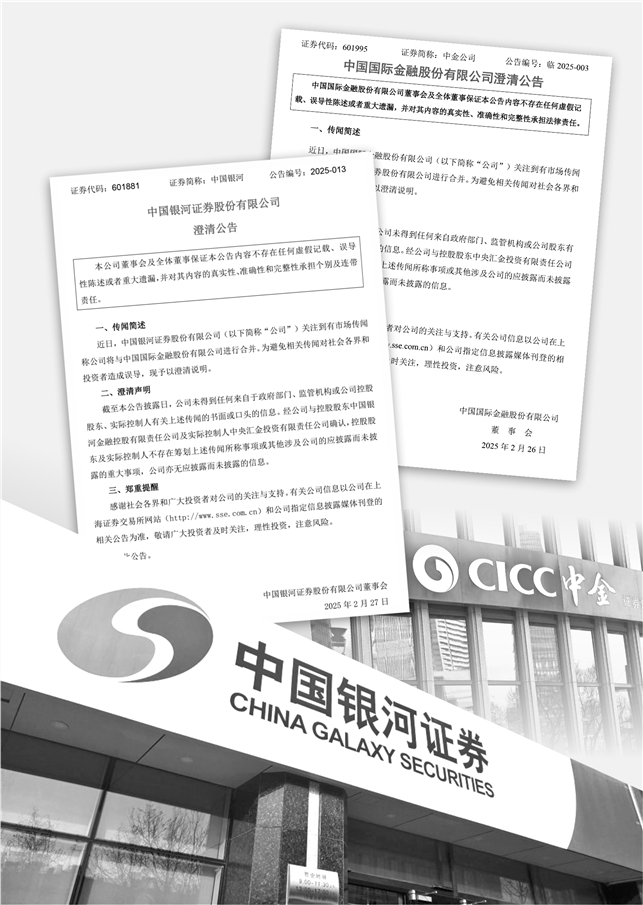
市场传闻搅动股价 中金公司中国银河紧急澄清
Zheng Quan Shi Bao Wang· 2025-02-26 22:46
Core Viewpoint - The recent rumors regarding the merger between China International Capital Corporation (CICC) and China Galaxy Securities have stirred market sentiments, leading to significant stock price increases for both companies, but both firms have quickly issued clarifications denying any such plans [1][2][3] Group 1: Company Responses - On February 26, both CICC and China Galaxy experienced stock price surges, with CICC's A-shares hitting the daily limit and its H-shares rising over 19%, while China Galaxy's A-shares also reached the limit and its H-shares increased by 17.11% [1][2] - CICC announced that it had confirmed with its controlling shareholder, Central Huijin, that there were no plans for a merger or any undisclosed significant matters [2][3] - China Galaxy similarly clarified that it had not received any information regarding the merger from government departments or its controlling shareholders [2][3] Group 2: Market Context - The securities industry is currently experiencing a wave of mergers and acquisitions, with notable examples including the rapid completion of the merger between Guotai Junan and Haitong Securities, and the acquisition of Guodu Securities by Zheshang Securities [3][4] - Following the stock price movements of CICC and China Galaxy, several other brokerage stocks also saw significant increases, indicating a broader market reaction to the merger rumors [3][4] Group 3: Central Huijin's Role - The rumors surrounding the merger are partly attributed to the increasing number of brokerages under Central Huijin, which directly holds 40.11% of CICC and indirectly holds 47.43% of China Galaxy [5][6] - Analysts suggest that the recent transfer of shares from state-owned asset management companies to Central Huijin has opened up possibilities for further consolidation among brokerages [5][6] Group 4: Financial Comparisons - As of the third quarter of 2024, China Galaxy outperformed CICC in key financial metrics, with total assets of 747.918 billion yuan and net profit of 6.964 billion yuan, while CICC reported total assets of 655.38 billion yuan and a net profit of 2.858 billion yuan [6][7] - The combined financial strength of CICC and China Galaxy, if merged, would significantly narrow the gap with leading firms like CITIC Securities and Guotai Junan [6][7] Group 5: Business Complementarity - Market expectations for a merger are high due to the complementary nature of the two firms' businesses, with CICC excelling in investment banking and China Galaxy having a strong foothold in wealth management [7] - Both companies have been actively enhancing their capabilities, with China Galaxy expanding its investment banking presence in Southeast Asia and CICC increasing its offerings in retail financial products [7]
国新证券每日晨报-20250319
Guoxin Securities Co., Ltd· 2025-02-17 02:49
Investment Rating - The report does not explicitly state an investment rating for the industry Core Views - The domestic market experienced a low open followed by a high close, with the Shanghai Composite Index closing at 3346.72 points, up 0.43%, and the Shenzhen Component Index closing at 10749.46 points, up 1.16% [1][4] - Among 30 first-level industries, 16 saw an increase, with notable gains in the computer, pharmaceutical, and automotive sectors, while comprehensive finance, real estate, and retail sectors faced significant declines [1][4] - The total trading volume for the A-share market was 17448 billion, showing a slight decrease compared to the previous day [1][4] Domestic Market Overview - The Shanghai Composite Index closed at 3346.72 points, increasing by 14.24 points or 0.43% [4] - The Shenzhen Component Index closed at 10749.46 points, increasing by 122.83 points or 1.16% [4] - The ChiNext Index rose by 1.8%, and the STAR Market 50 Index increased by 0.53% [4] - The trading volume for the entire A-share market was 17448 billion, slightly down from the previous day [4] Overseas Market Overview - The three major U.S. stock indices closed mixed, with the Dow Jones down 0.37%, the S&P 500 down 0.01%, and the Nasdaq up 0.41% [2][4] - Notable declines were seen in Procter & Gamble, which fell over 4%, and Travelers Group, which dropped nearly 2% [2] - Chinese concept stocks generally rose, with notable increases in companies like WeRide, which surged 83.46%, and Kingsoft Cloud, which rose about 20% [2][4] Key Economic Data - In January, M2 grew by 7% year-on-year, while M1 increased by 0.4% [10][13] - New RMB loans in January amounted to 5.13 trillion, with a total social financing scale increase of 7.06 trillion, which is 583.3 billion more than the same period last year [10][13] - The total social financing scale stock reached 415.2 trillion, reflecting an 8% year-on-year growth [10][13]