
成都银行

Search documents
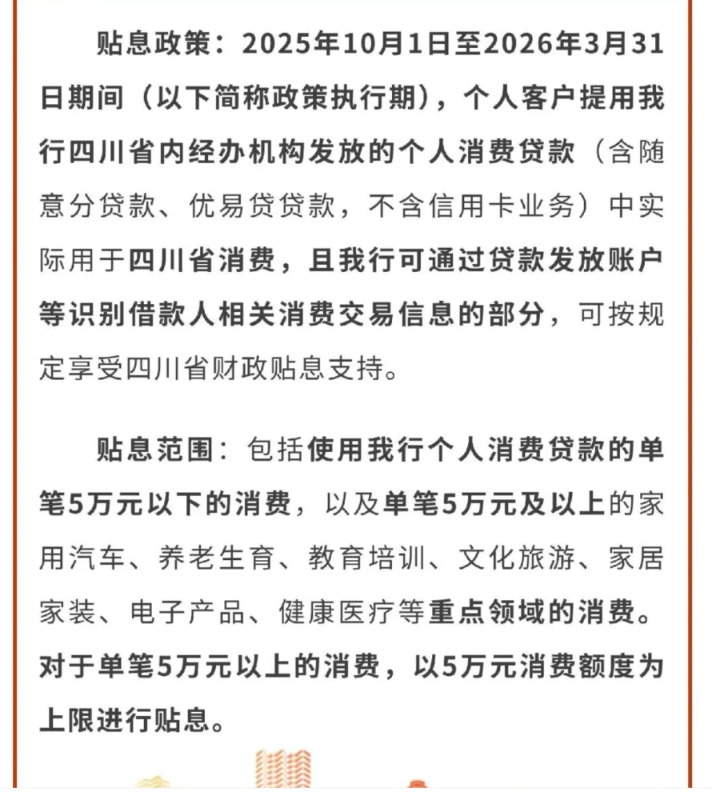
从“国补”到“地补” 消费贷贴息迎来新军
Zhong Guo Zheng Quan Bao· 2025-12-10 22:31
Core Viewpoint - Regional banks in China are leveraging local fiscal support to introduce consumer loan subsidy programs, aiming to reduce the cost of consumer credit and stimulate consumer spending potential [1][2]. Group 1: Introduction of Consumer Loan Subsidies - Since December, banks such as Guizhou Bank and Guiyang Bank have announced personal consumer loan interest subsidy programs to lower residents' credit costs [2]. - The subsidy program is based on guidelines from multiple departments, effective from December 1, targeting eligible consumer loan clients [2]. Group 2: Details of Subsidy Programs - Guizhou Bank and Guiyang Bank's subsidies apply to loans for comprehensive consumption and service industry loans, with specific eligibility criteria tied to the borrower's registered business location [2]. - Chengdu Bank and Chengdu Rural Commercial Bank have also released their subsidy details, with the subsidy period set from October 1, 2025, to March 31, 2026 [2]. Group 3: Subsidy Limits and Application Process - The maximum subsidy for each borrower at Guizhou Bank and Guiyang Bank is capped at 3,000 yuan, with specific limits for smaller loans [3]. - The application process is voluntary and operates on a first-come, first-served basis, with a clear requirement for supporting documentation [3]. Group 4: Benefits for Local Economies - The subsidy initiative is viewed as a "triple win" for local economies, effectively utilizing fiscal resources to stimulate consumer spending while allowing banks to expand their customer base [4][5]. - Industry experts anticipate that more regions will adopt similar consumer loan subsidy policies tailored to their fiscal conditions and market characteristics [5].
从“国补”到“地补”消费贷贴息迎来新军
Zhong Guo Zheng Quan Bao· 2025-12-10 20:17
Core Viewpoint - Regional banks in China are leveraging local fiscal support to introduce consumer loan subsidy programs, aiming to reduce the cost of consumer credit and stimulate consumer spending [1][4]. Group 1: Consumer Loan Subsidy Programs - Since December, banks such as Guizhou Bank and Guiyang Bank have announced consumer loan interest subsidy initiatives to help lower residents' credit costs and boost consumption potential [1]. - The consumer loan "local subsidy" program offers more regional flexibility compared to the broader "national subsidy," providing new growth opportunities for regional banks and stimulating local consumption markets [1][4]. Group 2: Specifics of the Subsidy Programs - Guizhou Bank and Guiyang Bank have set a subsidy cap of 3,000 yuan per borrower, with a maximum of 1,000 yuan for small loans under 50,000 yuan [2]. - Chengdu Bank and Chengdu Rural Commercial Bank have a lower cap of 1,500 yuan for total consumer loan subsidies, with a maximum of 500 yuan for small loans [3]. Group 3: Application Process and Impact - The subsidy application process is voluntary and operates on a first-come, first-served basis, with limited funding available based on provincial fiscal allocations [3]. - The implementation of these subsidy programs is seen as a "triple win" for local governments, banks, and consumers, effectively utilizing fiscal resources to stimulate consumption and enhance banking business [4].
探寻利率方向(4):从M2看2026年债市流动性
GF SECURITIES· 2025-12-10 11:48
Investment Rating - The report assigns a "Buy" rating for the banking sector, indicating an expectation that stock prices will outperform the market by more than 10% over the next 12 months [40]. Core Insights - The growth of M2 is primarily driven by government and corporate leverage, with government leverage's contribution increasing from 23.9% in 2015 to 45.5% in 2025, while corporate leverage is expected to contribute 63.6% to M2 growth in 2025 [5][14]. - The report highlights a divergence between the social financing (社融) and M2 growth rates, indicating a liquidity accumulation in the financial system when the demand for financing from the real economy is insufficient, which can lead to a decline in bond yields [5][19]. - The expected social financing-M2 differential for 2026 is projected to be 0.56%, with a quarter-on-quarter increase of 33 basis points [32]. Summary by Sections M2 and Liquidity Analysis - M2 includes cash, personal deposits, corporate deposits, non-bank deposits, and deposits from non-deposit financial institutions. The main contributors to M2 growth are government and corporate leverage [5][13]. - The report discusses the relationship between the social financing-M2 differential and bond market performance, noting a shift in correlation since the second half of 2022 [5][19]. Social Financing Projections - For 2026, the report forecasts a total of 16.3 trillion yuan in new loans under the social financing framework, with a growth rate of 8.11% [32][34]. - The report anticipates that the net issuance of government bonds will reach 14.8 trillion yuan in 2026, with a focus on maintaining a proactive fiscal policy [34]. M2 Growth Forecast - The M2 growth rate for 2026 is projected at 7.55%, influenced by factors such as net fiscal deposits, the strengthening of the equity market, and cross-border capital flows [32][36].




银行行业2026年年度策略报告-20251210
Ping An Securities· 2025-12-10 10:38
Group 1 - The banking industry in 2026 will face a mixed external environment with strong macroeconomic resilience but insufficient effective demand, leading to continued moderate monetary policy and challenges in asset allocation due to a low interest rate environment [4][10] - The "14th Five-Year Plan" emphasizes the construction of a financial powerhouse, urging banks to leverage their resource endowments and deepen their strategic initiatives over the next five years [4][10][22] - The overall financial performance of listed banks is expected to improve in 2026, driven by the recovery of net interest income and non-interest income, with a projected net profit growth of 2.4% year-on-year [4][27] Group 2 - The net interest margin is expected to narrow by 6 basis points in 2026, with net interest income growth projected to rise to 4% compared to 0.3% in 2025 [4][27] - Non-interest income is anticipated to continue improving due to the recovery of wealth management opportunities and the fading impact of fee reductions from previous years [4][27] - The overall asset quality of the banking sector is expected to remain stable, with a focus on monitoring risks in the retail sector [4][27] Group 3 - The investment strategy emphasizes high dividend yields as a protective measure, with the banking sector's average dividend yield at 3.94%, providing a significant premium over ten-year government bonds [4][27] - Specific banks such as Chengdu Bank, Jiangsu Bank, and Shanghai Bank are highlighted for their strong regional advantages and potential for continued dividend growth [4][27][34] - The report suggests that the active capital market will provide a potential boost to quality retail banks, enhancing their recovery prospects [4][27]




地方消费贷“红包”来了,川贵渝多家银行已发公告
Bei Jing Ri Bao Ke Hu Duan· 2025-12-10 08:52
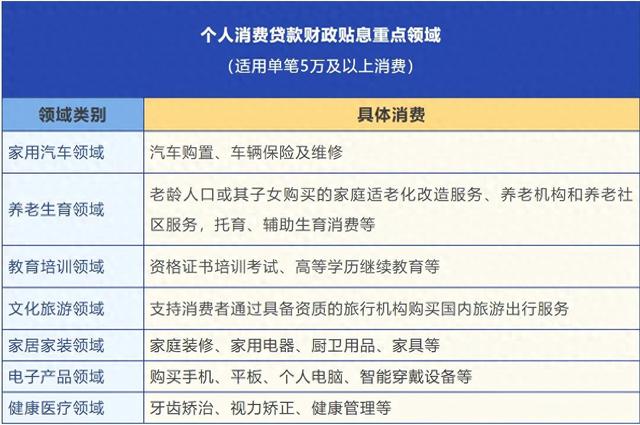
转自:北京日报客户端 继消费贷"国补",近日四川省、贵州省以及重庆市相继落地个人消费贷款财政贴息政策,三地均设定1 个百分点的年贴息比例,且该比例不超过贷款合同利率的50%。 据中新经纬不完全统计,截至发稿时,贵州银行、贵阳银行、成都银行、成都农商行等银行已发布相关 业务受理公告,重庆银行、重庆三峡银行也表示,正在制定贴息细则、实施系统改造。这也意味着,消 费贷贴息的主体进一步扩容至区域性银行。 地方接力消费贷补贴 今年8月,财政部、中国人民银行、国家金融监督管理总局联合印发《个人消费贷款财政贴息政策实施 方案》(下称实施方案),也被称为金融领域的"国补"。自9月1日正式落地以来,已实施三个月有余。近 期,多地跟进出台地方个人消费贷款贴息政策。 12月3日,重庆市财政局、中国人民银行重庆市分行、国家金融监督管理总局重庆监管局联合发布《关 于做好个人消费贷款财政贴息工作的通知》(下称通知)。其中提到,2025年9月1日至2026年8月31日期 间,居民个人使用贷款经办机构发放的个人消费贷款(不含信用卡业务)中实际用于消费,且贷款经办机 构可通过贷款发放账户等识别借款人相关消费交易信息的部分,可按规定享受贴息政策 ...


“国补”引路,“地补”接力!个人消费贷财政贴息精准扩围
2 1 Shi Ji Jing Ji Bao Dao· 2025-12-10 08:36
Core Viewpoint - The personal consumption loan interest subsidy policy is accelerating from a national level to local implementation, with regions like Sichuan, Guizhou, and Chongqing actively rolling out their own subsidy measures to stimulate consumption and reduce financing costs for residents [1][2][7]. Group 1: Policy Implementation - The "local subsidy" policies in Sichuan, Guizhou, and Chongqing have been rapidly launched since December, creating a regional synergy effect [2]. - Chongqing's policy emphasizes broad coverage and a long execution period, with a subsidy cap of 3,000 yuan for eligible cumulative consumption of 300,000 yuan [3]. - Sichuan's approach focuses on short-term precision, with a subsidy cap of 1,500 yuan for the same cumulative consumption amount, and funds must be used within the province [4]. - Guizhou's policy offers high subsidies, matching the national standard with a cap of 3,000 yuan, but has a shorter execution period [5]. Group 2: Market Impact - The collaboration between national and local subsidy policies is expected to enhance the competitiveness of regional banks, stimulate local consumption, and lower financing costs for residents [7][9]. - The introduction of local policies is anticipated to create structural changes in the consumer finance market, leading to a reduction in consumer loan interest rates and stimulating demand [10]. - Local banks are expected to leverage the policy to attract price-sensitive customers and expand their coverage in the inclusive finance sector [8]. Group 3: Risk Management - Financial institutions are advised to implement multiple risk control measures to prevent potential arbitrage, including automatic identification of eligible transactions and setting limits on subsidy amounts [5][6]. - The operational guidelines for subsidy agreements emphasize the need for borrowers to provide valid proof of consumption transactions to ensure compliance [6].
多项重点业务管控失序?成都银行725万罚单敲响内控警钟
Nan Fang Du Shi Bao· 2025-12-10 08:33
Core Viewpoint - Chengdu Bank and its 15 branches were fined a total of 7.25 million yuan due to multiple core business management violations, highlighting vulnerabilities in its management system [2][3] Summary by Sections Regulatory Actions - Chengdu Bank's main issues were identified as imprudent management in loan, deposit, discount, and bill businesses, with the total fine amounting to 7.25 million yuan, including 900,000 yuan for the head office and 6.35 million yuan for 15 branches [3] - The penalties also included warnings and fines for 13 responsible individuals, totaling 730,000 yuan, indicating a shift towards personal accountability in regulatory enforcement [3][4] Financial Performance - Chengdu Bank, established in 1996, is the largest legal bank in Sichuan Province, achieving record performance in 2024 with total assets of 1.25 trillion yuan, deposits of 880 billion yuan, and loans of 740 billion yuan, marking four consecutive years of over 100 billion yuan growth [5] - However, the bank faces challenges such as slowing growth and imbalanced business structure, with revenue growth rates declining from 22.54% in 2021 to 5.9% in 2024 [5][6] Risk Management and Compliance - The bank's high customer concentration is concerning, with the top ten loan clients accounting for 38.31% of net capital, significantly higher than peers like Jiangsu Bank and Nanjing Bank [6] - The regulatory environment is tightening, with nearly 1,000 fines issued to banks in 2025 alone, emphasizing the need for improved internal controls and compliance mechanisms [7][8]
现货黄金站上4200美元/盎司;区域性银行加入消费贷贴息阵营| 金融早参
Mei Ri Jing Ji Xin Wen· 2025-12-10 00:57
| 2025年12月10日星期三 | 12月9日,中国再保险发布公告,公司于近日收到国家金融监督管理总局关于庄乾志先生任职资格的批 复。根据该批复,国家金融监督管理总局于2025年12月8日正式核准庄乾志先生担任董事会董事长的任 职资格,庄乾志先生自该日起正式履行董事长职务,任期至第五届董事会任期届满为止,任期届满可以 连选连任。 NO.4区域性银行加入消费贷贴息阵营 据证券日报,12月份以来,个人消费贷款财政贴息政策在四川、贵州、重庆加速落地。川黔渝三地相继 发布省级贴息实施细则,贵阳银行、贵州银行、成都银行、成都农商行等区域头部城商行、农商行同步 启动业务受理。这标志着此前未被纳入"国补"经办体系的区域性银行,正式加入消费贷补贴阵营,"国 补+地补"的协同发力格局初步形成。 NO.1央行开展1173亿元7天期逆回购操作 12月9日,央行公开市场开展1173亿元7天期逆回购操作,操作利率1.40%。Wind数据显示,当日有1563亿 元逆回购到期。 点评:央行今日开展1173亿元7天期逆回购操作的举措显示出其维持市场流动性稳定的意图。逆回购作 为短期的市场操作工具,能够有效缓解市场资金紧张状况,降低市场利率 ...
上市银行超2600亿元分红在途
2 1 Shi Ji Jing Ji Bao Dao· 2025-12-09 23:28
Core Viewpoint - The announcement of mid-term dividends by major state-owned banks indicates a robust financial performance and a commitment to returning value to shareholders, with a total cash dividend distribution of approximately 762 billion yuan planned for December 15, 2025 [1][2]. Group 1: Dividend Announcements - Industrial and Commercial Bank of China (ICBC) plans to distribute a cash dividend of 0.1414 yuan per share, totaling approximately 503.96 billion yuan, with A-shares accounting for about 381.23 billion yuan [1]. - Agricultural Bank of China (ABC) will distribute a cash dividend of 0.1195 yuan per share, amounting to approximately 418.23 billion yuan, with A-shares also around 381.50 billion yuan [1]. - As of now, 32 listed banks have announced mid-term dividends, an increase of 8 banks compared to 2024, with an average dividend payout ratio of 24.9% and a total dividend amount of 264.57 billion yuan, reflecting a 2.55% increase from last year [2][3]. Group 2: Market Trends and Analyst Insights - The mid-term dividend distribution by state-owned banks is occurring earlier this year, with four major banks having already announced their plans, compared to the previous year [2][3]. - Analysts indicate that the increase in the number of banks planning to distribute dividends and the stability of dividend rates reflect the banking sector's solid dividend value, which is expected to attract long-term capital [3]. - The average dividend yield for listed banks is currently 4.48%, with 12 banks yielding over 5% and 26 banks exceeding 4% [3]. Group 3: Shareholder and Executive Actions - There have been 15 instances of share buyback plans disclosed by 13 banks this year, indicating strong confidence from major shareholders and executives in the banks' strategic direction and long-term value [6][7]. - Notable buybacks include Nanjing Bank, which saw an increase of over 1.28 billion shares by foreign shareholder BNP Paribas, raising its stake to 18.06% [7]. - The banking sector has attracted significant buyback amounts, totaling approximately 90.30 billion yuan, ranking first among 31 industries [7][8].


成都银行 书写“十四五”特色金融答卷
Si Chuan Ri Bao· 2025-12-09 20:35
业绩增长突飞猛进 万亿规模筑牢发展基石 "十四五"期间,成都银行始终以"稳健经营、高质量增长"为导向,交出一份亮眼的经营业绩答 卷,实现历史性跨越,资产规模从2020年末的6524.34亿元跃升至万亿级别,一举成为西部城商行 中首个迈入"万亿俱乐部"的成员。截至2025年9月末,该行总资产规模已达1.38万亿元,较年初增 长10.81%,继续保持稳健的增长步伐。 在资产规模稳步扩张的同时,成都银行的存贷款业务连续4年呈现千亿级增长态势。截至2024年 末,存款总额8859亿元,较上年末新增1054.38亿元,同比增幅13.51%;贷款总额达到7426亿元, 较上年末新增1168.26亿元,同比增幅18.67%,存贷比达到83.8%,资产结构进一步优化。该行持 续加大信贷投放力度,为区域实体经济注入强劲的金融动能。 □金宇杏 "十四五"以来,扎根巴蜀二十七载的成都银行,始终锚定国家战略与区域发展脉搏,坚守"服务地 方经济、服务小微企业、服务城乡居民"初心,深耕科技金融、绿色金融、普惠金融、养老金融、 数字金融"五篇大文章",实现规模、效益、质量三维跃升。其间,该行连续跻身英国《银行 家》"全球银行1000强"与 ...