
永辉超市

Search documents
1月28日增减持汇总:暂无增持 中新集团等9股减持(表)
Xin Lang Zheng Quan· 2026-01-28 14:41
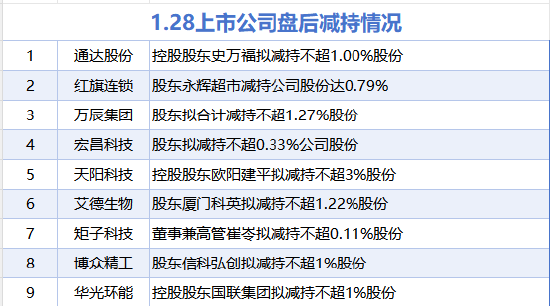
Core Viewpoint - On January 28, no A-share listed companies disclosed any increase in shareholding, while nine companies announced share reductions, indicating a trend of shareholder divestment in the market [1]. Group 1: Share Reduction Details - Tongda Co., Ltd. plans to reduce its shareholding by no more than 1.00% [2] - Hongqi Chain's shareholder Yonghui Supermarket has reduced its stake by 0.79% [2] - Wancheng Group's shareholders intend to collectively reduce their holdings by no more than 1.27% [2] - Hongchang Technology's shareholders plan to reduce their holdings by no more than 0.33% [2] - Tianyang Technology's controlling shareholder Ouyang Jianping intends to reduce his stake by no more than 3% [2] - Aide Biology's shareholder Xiamen Keying plans to reduce its holdings by no more than 1.22% [2] - Juzitech's director and executive Cui Cen intends to reduce his stake by no more than 0.11% [2] - Bozhong Precision's shareholder Xinke Chuang plans to reduce its holdings by no more than 1% [2] - Tianyang's controlling shareholder Guolian Group intends to reduce its stake by no more than 1% [2]



红旗连锁:持股5%以上股东永辉超市减持股份达0.79%
Xin Lang Cai Jing· 2026-01-28 12:36
红旗连锁公告称,持股5%以上股东永辉超市于2026年1月23日至1月28日期间减持公司股份。其中,集 中竞价减持112.2万股,占总股本0.08%;大宗交易减持964.92万股,占总股本0.71%,合计减持1077.12 万股,占总股本0.79%。本次权益变动后,永辉超市持股降至9305.86万股,占比由7.63%降至6.84%。此 次减持系履行此前计划,且未超计划数量,不会导致公司控制权变更。 ...

永辉超市关店+预亏,胖东来改造真的有用吗
Di Yi Cai Jing Zi Xun· 2026-01-28 11:47
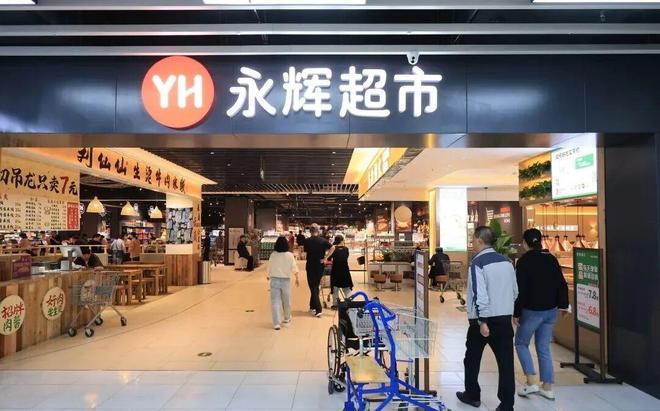
Core Viewpoint - Yonghui Supermarket is facing significant challenges, including a wave of store closures due to operational losses and issues with property management, leading to a projected reduction in store count from 1,000 in 2023 to approximately 400 by the end of 2025 [2][3] Group 1: Store Closures - Yonghui Supermarket has announced the closure of 225 stores in 2024 and 381 stores in 2025, resulting in a total of about 400 stores remaining by the end of 2025, which is less than half of its peak number [2] - The closures are attributed to losses, poor management, and property issues, with the company rationalizing its operations by retaining profitable stores and eliminating underperforming ones [2] Group 2: Financial Performance - The company is expected to incur a net loss of 2.14 billion yuan in 2025, with a total loss exceeding 11.6 billion yuan over the past five years [3] - High costs, intense market competition, and significant operational pressure are identified as the main challenges affecting financial performance [3] Group 3: "Fat Reform" Initiative - In May 2024, Yonghui Supermarket initiated a "Fat Reform" to learn from the successful model of the regional retailer, Fat Donglai, which is known for its high-quality private label products and employee benefits [3][4] - The reform involves restructuring store layouts, introducing Fat Donglai's private label products, and retraining employees to enhance service quality [4] Group 4: Challenges of Implementation - The adaptation of Fat Donglai's model may face challenges due to differences in scale, as Fat Donglai operates only a few stores while Yonghui has hundreds, making nationwide implementation difficult [4] - Increasing employee compensation and benefits to match Fat Donglai's standards could lead to substantial costs for Yonghui, given its larger workforce [4] Group 5: Uncertain Outcomes - While some stores have seen improved foot traffic and revenue post-reform, the retail industry is characterized by low margins and long payback periods, leading to uncertainty about the long-term success of the initiative [6] - The push for "new concepts" in retail may drive companies to adopt reforms like "Fat Reform" to attract investor interest, despite the potential mismatch with their operational realities [6]
永辉超市关店+预亏,胖东来改造真的有用吗?
Di Yi Cai Jing· 2026-01-28 09:54
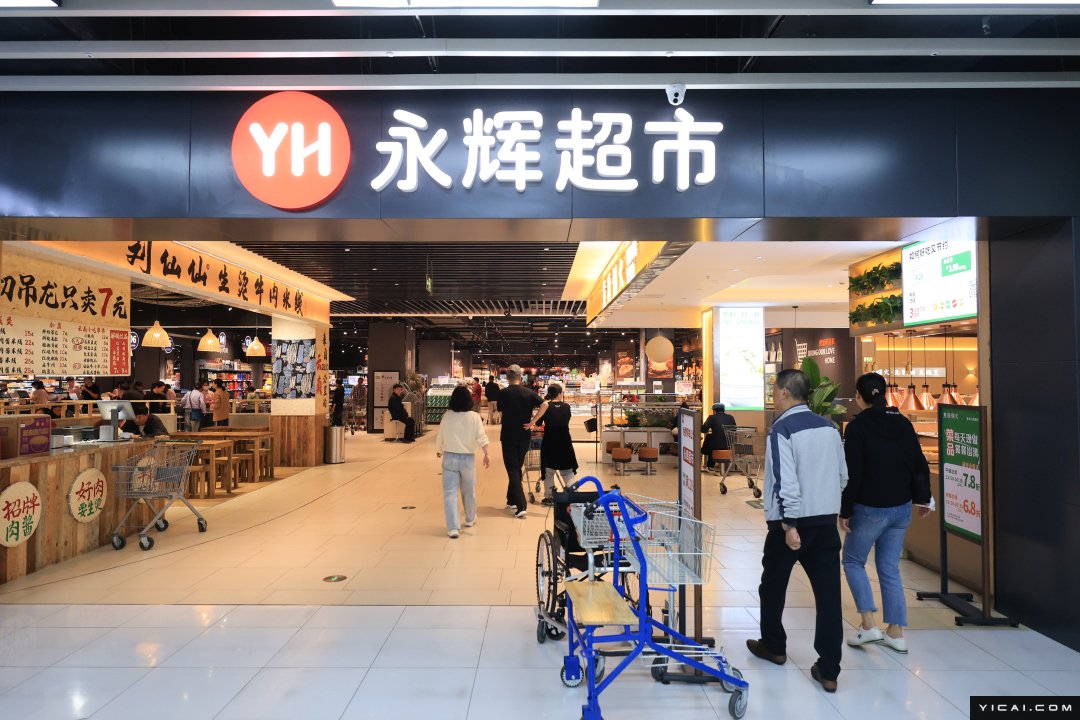
Core Viewpoint - Long-term development is what retailers should focus on, rather than short-term fixes or trends [14] Group 1: Store Closures and Financial Performance - Yonghui Supermarket is currently facing challenges, including a wave of store closures, with plans to close 225 stores in 2024 and 381 stores in 2025, reducing the total number of stores to approximately 400 by the end of 2025, which is less than half of its peak [1][8] - The reasons for these closures include losses and operational inefficiencies, as well as issues with property management that hinder normal operations [1][8] - Financially, Yonghui is projected to incur a net loss of 2.14 billion yuan in 2025, with cumulative losses exceeding 11.6 billion yuan over the past five years, attributed to high costs and intense market competition [2][9] Group 2: "Fat Reform" Initiative - In May 2024, Yonghui initiated a "Fat Reform" to learn from the successful model of the regional retailer, Fat Donglai, which is known for its high-quality private label products and employee benefits [4][11] - The reform involves restructuring stores to align with Fat Donglai's model, including product categorization and employee training, aiming to enhance customer experience [4][11] - However, the applicability of Fat Donglai's model to a large-scale national retailer like Yonghui is questionable, as regional preferences and supply chain challenges may hinder uniform implementation across all locations [12][13] Group 3: Cost Implications and Market Dynamics - The "Fat Reform" is expected to incur significant costs, including asset write-offs and losses from store closures, estimated to impact profits by approximately 910 million yuan and an additional 300 million yuan in gross profit losses from renovations [13] - While some stores have seen improved foot traffic and revenue post-reform, the retail industry is characterized by thin margins and long payback periods, leading to uncertainty regarding the overall effectiveness of such initiatives [7][14] - The push for "new concepts" in retail may be driven by the need to attract investor interest in a highly competitive market, but blindly following trends without understanding core business capabilities may not yield sustainable results [14]
永辉超市关店+预亏,胖东来改造真的有用吗?|乐言商业
Di Yi Cai Jing· 2026-01-28 09:37
Core Viewpoint - Long-term development should be the focus for retailers, as evidenced by the challenges faced by Yonghui Supermarket, which is undergoing significant store closures and financial losses [1][2][6] Group 1: Store Closures - Yonghui Supermarket is experiencing a wave of store closures, with plans to close 225 stores in 2024 and 381 stores in 2025, reducing its total store count to approximately 400 by the end of 2025, which is less than half of its peak number [1] - The closures are attributed to direct reasons such as losses and operational inefficiencies, alongside issues with property management that hinder normal operations [1] Group 2: Financial Performance - Yonghui Supermarket is projected to incur a net loss of 2.14 billion yuan in 2025, with a cumulative loss exceeding 11.6 billion yuan over the past five years [2] - The company faces high costs, intense market competition, and significant operational pressure, which are identified as primary challenges [2] Group 3: "Fat Reform" Initiative - In May 2024, Yonghui Supermarket initiated a "Fat Reform" to learn from the successful model of the regional retailer, Fat Donglai, which is known for its high-quality private label products and employee benefits [4] - The reform involves restructuring stores to align with Fat Donglai's model, including product categorization and employee training, aiming to enhance customer experience [4] Group 4: Challenges of Implementation - The applicability of Fat Donglai's model to a large-scale retailer like Yonghui is questioned, as the regional success may not translate nationally due to differences in market dynamics and supply chain complexities [5] - Implementing the "Fat Reform" may incur significant costs, including asset write-offs and losses from store closures, estimated to impact profits by approximately 910 million yuan [5][6] Group 5: Market Dynamics and Future Outlook - While some stores have seen improved foot traffic and revenue post-reform, the retail industry is characterized by thin margins and long payback periods, leading to uncertainty in achieving desired outcomes [7] - Retailers are motivated to adopt new concepts to attract investor interest, but blindly following trends without understanding their own positioning may not yield sustainable results [7]
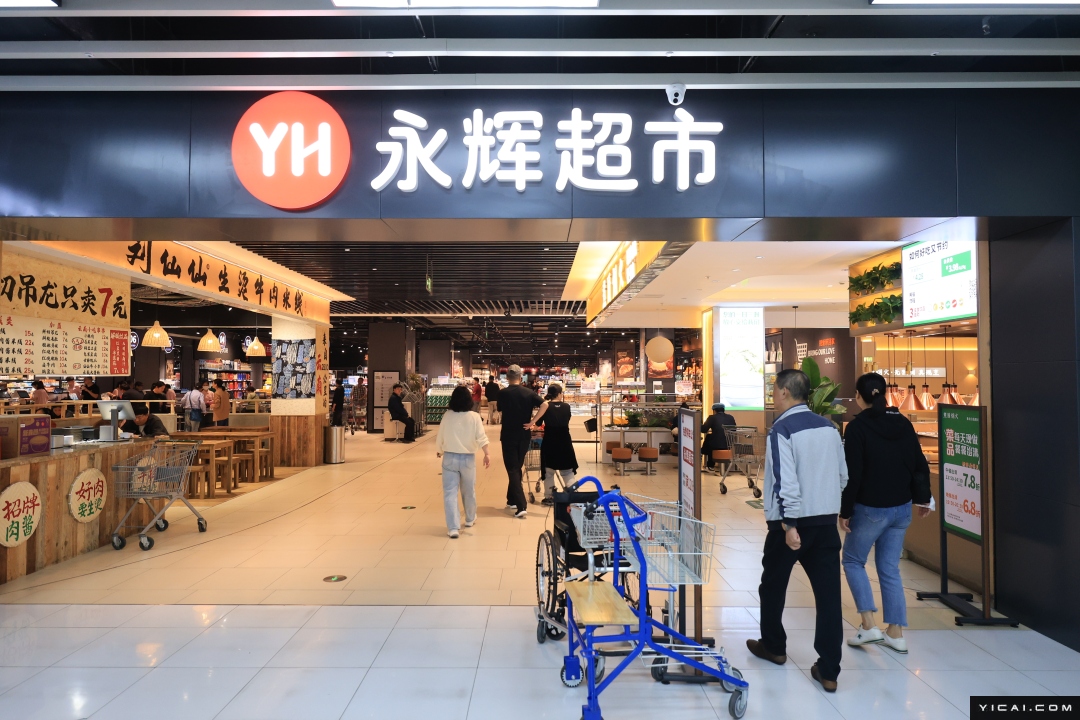
果然财经 | 欠房租关店?胖东来调改的永辉超市5年亏损破百亿
Qi Lu Wan Bao· 2026-01-28 09:27
果然财经 | 欠房租关店?胖东来调改的永辉超市5年亏损破百亿 近日,永辉超市北京鸿坤广场门店突然停业引发关注。就在停业消息传出不久前,永辉超市刚刚宣布其 去年归母净利润预计亏损21.4亿元,同比扩大45.6%。算下来,最近5年永辉超市累计亏损已突破百亿 元。 果然财经 | 欠房租关店?胖东来调改的永辉超市5年亏损破百亿 大众报业·齐鲁壹点40分钟前 热门评论我要评论 微信扫码 移动端评论 暂无评论 鲁ICP备15022957号-13 鲁公网安备 37010202002220号 鲁新网备案号201000101 电信增值业务许可证: 鲁B2-20120085 齐鲁晚报·齐鲁壹点 版权所有(C) All Rights Reserved 联系电话:0531-82625462邮箱: 1790179766@qq.com ...

中国零售渠道变革跟踪系列报告(一):中国硬折扣零售的行业“奇点”已至?
GF SECURITIES· 2026-01-28 05:09
Investment Rating - The industry investment rating is "Buy" [2] Core Insights - The hard discount market in China is entering a golden development period with significant growth potential, as the penetration rate is only about 8%, compared to 42% in Germany and 31% in Japan. The expected compound annual growth rate (CAGR) for the next decade is 5.6%, significantly higher than traditional retail formats like hypermarkets [6][35]. - The essence of hard discounting lies in the deep restructuring of the supply chain, focusing on a limited number of SKUs (1500-2000 core items) and a high proportion of private label products (up to 90%) to achieve structural cost reductions [6]. - The domestic operational model is evolving from the "631" model, which emphasizes fresh produce, to the "523" model, which balances product effectiveness and consumer scenarios, optimizing profitability by increasing the share of ready-to-eat (3R) foods [6]. - Local players are leveraging digital empowerment and scalable replication, with companies like Super Box NB utilizing Alibaba's ecosystem to achieve structural cost reductions and increase private label share to over 60% [6]. - Global giants like Aldi are adapting their strategies to the Chinese market, maintaining high private label ratios and efficient management, achieving a gross margin of around 20% and daily sales per store of 105,000 to 110,000 yuan [6]. - Investment recommendations focus on retail companies that return to the essence of retail, emphasizing supply chain sovereignty, operational efficiency, and consumer trust. Key recommendations include Yonghui Supermarket, Huijia Times, and Chongqing Department Store, with a watch on Bubu Gao and Jiajiayue [6]. Summary by Sections Industry Background - Discount retail is not merely a price war; it aims to provide quality products at lower prices by stripping away brand premiums and reducing unnecessary costs in traditional retail channels [15]. - Hard discounting is characterized by a systematic restructuring of the traditional retail value chain, focusing on high cost-performance ratios [19]. Development History of Hard Discount Supermarkets - The hard discount model originated in post-war Germany, with Aldi establishing the low-price principle in 1948, leading to the emergence of a dual oligopoly in the German market [22]. - The U.S. market saw the rise of membership warehouse stores like Costco, which integrated low-price strategies with membership fees [23]. Market Landscape - Hard discounting has become a significant force in global retail, with a projected 12.6% share in the top 50 global retailers by 2025, indicating its growth momentum [31]. - In China, the hard discount market is expected to exceed 200 billion yuan by 2024, with a penetration rate of only 8%, highlighting substantial growth potential compared to mature markets [35]. Competitive Landscape - Local players like Super Box NB and Happy Monkey are emerging as strong competitors, leveraging supply chain efficiencies and digital tools to enhance their market positions [44]. - Global benchmarks like Aldi and Sam's Club are adapting their models to the Chinese market, focusing on high private label ratios and efficient operations [6][43].


联名款香菜味酸奶,能帮沃尔玛在小红书捞到年轻人吗?
3 6 Ke· 2026-01-28 03:49
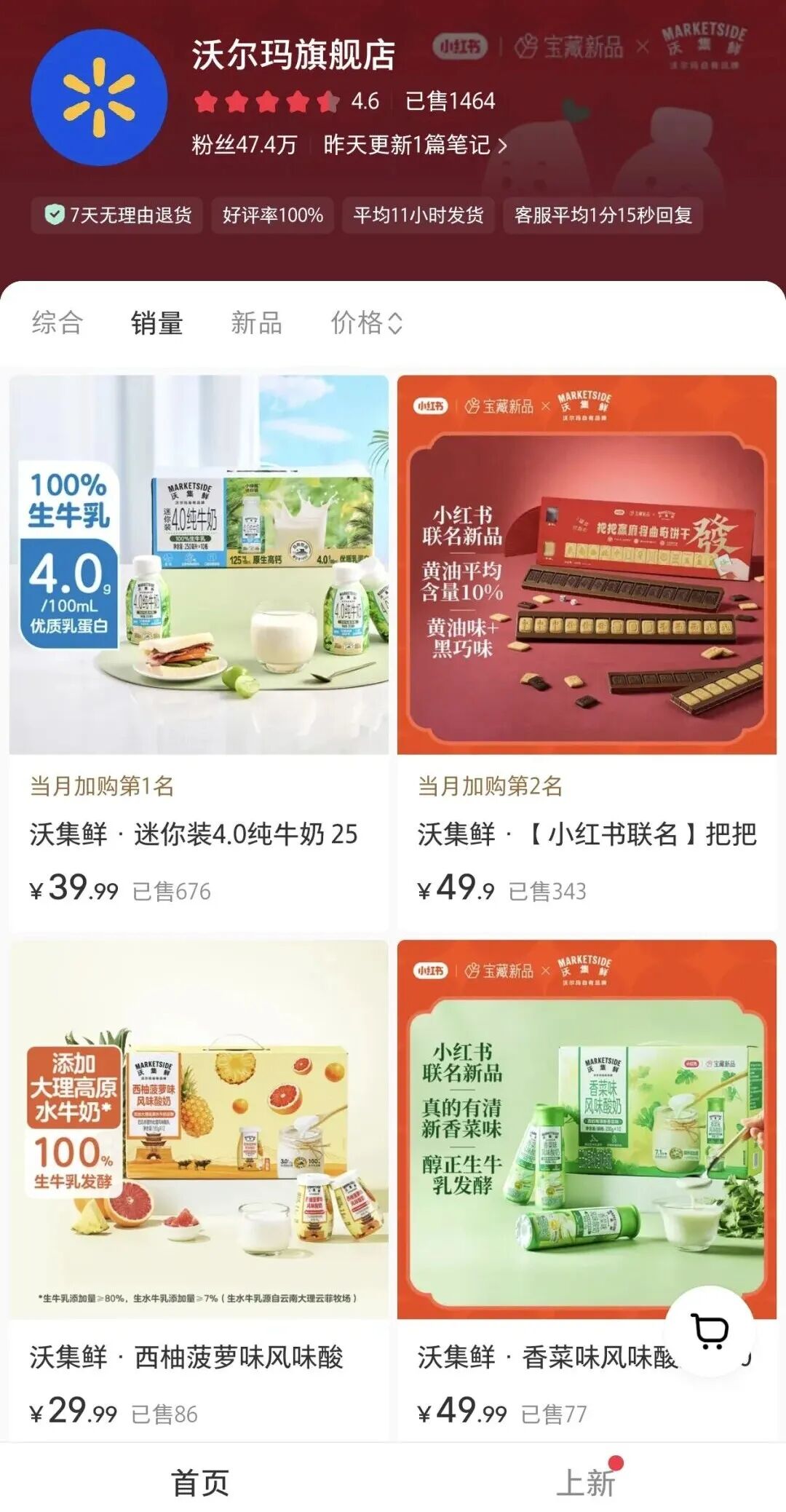
Core Insights - Walmart has partnered with Xiaohongshu to launch its first official flagship store on the platform, marking a significant move to attract younger consumers and enhance brand visibility [1][7] - The collaboration aims to promote Walmart's private label "Wojixian," which has seen rapid SKU expansion from dozens to nearly a thousand in the past year [7][11] - Despite a notable revenue increase in Walmart China, primarily driven by Sam's Club, the effectiveness of the Xiaohongshu partnership in driving sales remains uncertain, with initial product performance being underwhelming [7][20] Group 1 - Walmart's flagship store on Xiaohongshu is part of a broader strategy to rejuvenate its brand image and connect with younger consumers [1][7] - The partnership is seen as a way to leverage Xiaohongshu's large user base, which exceeds 300 million monthly active users, to build brand awareness for "Wojixian" [9][10] - Walmart's revenue in China is projected to grow from 99 billion yuan in FY2021 to 147.3 billion yuan in FY2025, reflecting a nearly 50% increase, largely attributed to Sam's Club [7][20] Group 2 - The "Wojixian" brand is positioned to cater to a broader market, especially in lower-tier cities, contrasting with Sam's Club's focus on higher-end consumers [9][10] - Walmart's strategy includes developing health-oriented products, such as various herbal drinks, to align with current consumer trends [15][20] - The initial reception of the Xiaohongshu collaboration, particularly the "cilantro-flavored yogurt," has generated buzz, indicating that even negative feedback can enhance brand recognition [29]

商社美护行业周报:泡泡玛特3.5亿港元连续回购,黄金价格连续上涨
Guoyuan Securities· 2026-01-28 02:45
Investment Rating - The industry maintains a "Recommended" rating, with a focus on service consumption, beauty care, IP derivatives, and gold jewelry as new consumption sectors [6][30]. Core Insights - The total retail sales of social consumer goods in 2025 reached 50.12 trillion yuan, a year-on-year increase of 3.69%. In December, the retail sales totaled 4.51 trillion yuan, growing by 0.9% year-on-year, which was below the consensus expectation of 1.5% [3][24]. - The report highlights significant growth in specific retail categories, with home appliance retail sales increasing by 11%, and retail sales of communication equipment, cultural and office supplies, and furniture growing by 20.9%, 17.3%, and 14.6% respectively [3][24]. - The beauty care sector is seeing innovation, with Proya launching a new PROYA MED series aimed at specific skin repair needs, and Langzi Co. forecasting a net profit of 2.2 to 2.9 billion yuan for 2025, marking a year-on-year growth of 1.09% to 33.25% [27][28]. Summary by Sections Market Performance - From January 19 to January 23, 2026, the trade retail, social services, and beauty care sectors increased by 2.16%, 3.20%, and 1.98% respectively, ranking 16th, 12th, and 17th among 31 primary industries [15][20]. Key Industry Data and News - The report notes that the retail sales of consumer goods in 2025 were driven by the replacement of old appliances, with significant growth in various categories. The retail sales of cosmetics grew by 5.1%, while gold and jewelry retail sales increased by 12.8% [24]. - Notable company activities include Bubble Mart's share repurchase of approximately 3.5 billion Hong Kong dollars and the expected profitability turnaround for Guilin Tourism, projecting a net profit of 11 million yuan in 2025 [4][28]. Investment Recommendations - The report emphasizes a focus on service consumption and highlights specific companies such as Ruoyuchen, Maogeping, Shangmei Co., Bubble Mart, Chaohongji, and Laopu Gold as key investment targets [6][30].
商社美护行业周报:泡泡玛特3.5亿港元连续回购,黄金价格连续上涨-20260128
Guoyuan Securities· 2026-01-28 02:12
Investment Rating - The industry maintains a "Recommended" rating, with a focus on service consumption, beauty care, IP derivatives, and gold jewelry as new consumption sectors [6][30]. Core Insights - The total retail sales of social consumer goods in 2025 reached 50.12 trillion yuan, a year-on-year increase of 3.69%. In December, the retail sales totaled 4.51 trillion yuan, growing by 0.9% year-on-year, which was below the consensus expectation of 1.5% [3][24]. - The report highlights significant growth in specific retail categories, with home appliance retail sales increasing by 11%, and retail sales of communication equipment, cultural and office supplies, and furniture growing by 20.9%, 17.3%, and 14.6% respectively [3][24]. - The beauty care sector is seeing innovation, with Proya launching a new PROYA MED series aimed at specific skin repair needs, and Langzi Co. forecasting a net profit of 2.2 to 2.9 billion yuan for 2025, marking a year-on-year increase of 1.09% to 33.25% [27][28]. Summary by Sections Market Performance - From January 19 to January 23, 2026, the trade retail, social services, and beauty care sectors increased by 2.16%, 3.20%, and 1.98% respectively, ranking 16th, 12th, and 17th among 31 primary industries [15][18]. Key Industry Data and News - The report notes that the retail sales of consumer goods in 2025 were driven by the replacement of old appliances, with significant growth in various categories, including a 15.7% increase in sports and entertainment products [3][24]. - The beauty care sector is highlighted with new product launches and positive earnings forecasts from companies like Langzi and Meili Tianyuan, which expects a revenue of at least 30 billion yuan in 2025, growing by no less than 16% [27][28]. Investment Recommendations - The report suggests focusing on companies such as Ruoyu Chen, Mao Ge Ping, Shangmei Co., Pop Mart, Chao Hong Ji, and Lao Pu Gold as potential investment targets within the recommended sectors [6][30].