
硬折扣零售

Search documents
福建万辰食品集团股份有限公司 (前称為福建万辰生物科技集团股份有限公司)(H0478) - 申请版本(第一次呈交)
2026-03-29 16:00
香港聯合交易所有限公司與證券及期貨事務監察委員會對本申請版本的內容概不負責,對其準確性或完整 性亦不發表任何意見,並明確表示概不就因本申請版本全部或任何部分內容而產生或因倚賴該等內容而引 致的任何損失承擔任何責任。 FUJIAN WANCHEN FOOD GROUP CO., LTD. 福建萬辰食品集團股份有限公司 (「本公司」) (於中華人民共和國註冊成立的股份有限公司) 的申請版本 警告 本申請版本乃根據香港聯合交易所有限公司(「聯交所」)與證券及期貨事務監察委員會(「證監會」)的要求 而刊發,僅用作提供資訊予香港公眾人士。 本申請版本為草擬本,其內所載資料並不完整,亦可能會作出重大變動。 閣下閱覽本文件,即代表 閣 下知悉、接納並向本公司、其保薦人、整體協調人、顧問或包銷團成員表示同意: 本公司招股章程根據香港法例第32章公司(清盤及雜項條文)條例與香港公司註冊處處長登記前,本公司 不會向香港公眾人士提出要約或邀請。倘於適當時候向香港公眾人士提出要約或邀請,有意投資者務請僅 依據呈交香港公司註冊處註冊的本公司招股章程作出投資決定;有關文本將於發售期內向公眾刊發。 聯席保薦人、 [編纂] (a) 本文件僅 ...
东吴证券:食品饮料行业渠道变革大时代 优质连锁零售业态蓬勃发展
Zhi Tong Cai Jing· 2026-02-11 03:24
Core Insights - The retail industry is shifting towards a buyer's market driven by rational consumer behavior, excess capacity, and technological advancements, leading to the rise of high-cost performance retail formats such as hard discount stores [1] - The growth of high-cost performance and essential high-frequency chain formats is notable, with snack wholesale stores experiencing significant market expansion [2] - The decline in rental prices and the slowdown of online growth have opened new opportunities for quality chain formats, particularly community-based essential businesses [3] - Leading companies are adopting a common strategy of expanding store size and product categories to enhance operational efficiency in response to lower rental costs [4] Group 1 - The retail landscape is undergoing a transformation with a focus on community, small-scale, specialized, and discount-oriented formats, with hard discount retail being a prominent global trend [1] - Snack wholesale stores have seen their market size surge from 10.9 billion yuan in 2020 to 129.7 billion yuan by 2024, with leading companies like Mingming Hen Mang and Wancheng Group surpassing 10,000 stores [2] - The rental market is under pressure, particularly in third-tier cities, providing cost advantages for offline chain formats, while online penetration rates are stabilizing between 24%-26% [3] Group 2 - Companies are leveraging the opportunity of declining rents by increasing store sizes and expanding product offerings, which enhances overall operational efficiency [4] - The investment outlook remains positive for snack wholesale industries, with recommendations for companies like Wancheng Group and Mingming Hen Mang due to their high certainty and growth potential [5] - Companies like Guoquan and Babi Food are highlighted for their innovative strategies and potential for expansion, particularly in the small dumpling store format [5]


食品饮料行业:2026量贩零食市场简析报告
Jia Shi Zi Xun· 2026-02-10 14:23
Investment Rating - The report does not explicitly state an investment rating for the snack retail industry Core Insights - The snack retail industry is characterized as a "hard discount" retail format that significantly reduces prices compared to traditional supermarkets, achieving approximately 25% lower prices through direct sourcing and streamlined supply chains [4][6] - The industry is rapidly penetrating lower-tier markets, capturing market share from traditional small stores and outdated supermarkets, driven by a flat supply chain and digital management capabilities [4][41] - Future developments in the industry will see the evolution from single snack stores to comprehensive "community discount supermarkets," expanding product categories to include daily necessities and providing a one-stop shopping experience [4][42] Summary by Sections Industry Definition - The snack retail industry is defined as a vertical "hard discount" retail format that separates and revolutionizes traditional supermarket snack sales through concentrated procurement and operational efficiency [5][7] Business Model - The core business model of the snack retail industry is based on "high turnover, low margin," creating a win-win ecosystem through operational efficiency [12][13] Industry History - The development of the snack retail industry can be divided into four stages: exploration (2010-2020), expansion (2021-2022), integration (2023-2024), and quality and efficiency (2025-present) [10][11] Demand Analysis - The Chinese snack and beverage retail market is projected to grow from CNY 3,171.2 billion in 2019 to CNY 4,044.9 billion by 2024, with the snack retail channel being one of the fastest-growing segments [32][34] - Lower-tier cities are expected to be the main growth drivers for the snack retail market, contributing 62% of the GMV by 2024 [34] Competitive Landscape - The industry has formed a dual oligopoly with major players like "Mingming Hen Mang" and "Wancheng Group" controlling over 70% of the market share [23][24] - The competitive focus has shifted from store quantity to supply chain efficiency and brand development [29][30] Future Opportunities - The industry is expected to continue its deep penetration into lower-tier markets, leveraging the combination of brand and low prices to capture market share from traditional stores [41] - The transition to "community discount supermarkets" will create new growth opportunities by expanding product offerings [42][44] Supply Chain Efficiency - The industry's competitive advantage lies in its streamlined supply chain, which significantly reduces markup rates compared to traditional retail formats [45]
物美调改后岗位调整幅度大吗?业态扩容+技能升级,调整只为员工与门店双成长
Jin Rong Jie· 2026-02-05 09:10
Core Viewpoint - Wumart's recent adjustments are characterized as "quality expansion" rather than traditional "downsizing," focusing on enhancing employee skills and creating new positions to meet the demands of new retail formats [1][2]. Group 1: Nature of Adjustments - The adjustments initiated by Wumart are not aimed at reducing workforce but rather at upgrading positions and expanding roles to align with new business formats [2]. - CEO Qiao Hongbing emphasized that the essence of the adjustments is the "upgrade of personnel," ensuring that no layoffs occur and that employees are empowered through training [2]. Group 2: Job Creation and Structure Optimization - The dual business formats, AI new retail stores and hard discount stores, have led to significant job creation across the entire supply chain, with positions doubling in some locations [3][4]. - In AI new retail stores, the number of employees increased from 130 to 260, with new roles such as food safety inspectors and bakers being created to meet service demands [3]. - Hard discount stores have optimized their job structures by training existing employees to become versatile "multi-skilled" workers, reducing the number of required staff while enhancing operational efficiency [4]. Group 3: Quality of Positions - Wumart is focusing on upgrading traditional roles by adding customer service and product recommendation responsibilities, enhancing the value of positions like stock clerks and cashiers [5]. - New technical and service-oriented roles have been introduced, such as AI operations assistants and food safety inspectors, to fill gaps in the new retail landscape [5]. Group 4: Employee Benefits and Training - Employee compensation has increased by 30%-50% post-adjustment, with minimum monthly salaries reaching 6,000 yuan, alongside enhanced benefits like paid annual leave and profit-sharing opportunities [7]. - Comprehensive training programs are in place to support employees in adapting to new roles, ensuring that both new and existing staff can quickly acquire necessary skills [7]. Group 5: Strategic Foundations of Adjustments - The adjustments are driven by the rigid demand for new roles to support upgraded business formats and the efficiency gains from technology integration [8]. - Wumart's strategy emphasizes viewing employees as core assets, aiming to create a positive cycle of employee satisfaction leading to improved service and customer loyalty [8]. Group 6: Outcomes of Adjustments - The adjustments have resulted in a high retention rate of over 95% for existing employees, with new roles attracting a significant number of young job seekers [9]. - Sales performance has improved significantly, with daily sales at some stores increasing from 200,000 yuan to 700,000 yuan, demonstrating the effectiveness of the adjustments [9]. Group 7: Future Prospects - The adjustments represent a proactive transformation from traditional supermarket roles to new retail positions, indicating a commitment to continuous improvement and employee development [9].
鸣鸣很忙:立量贩潮头,盈利和业态持续进阶-20260204
Soochow Securities· 2026-02-04 00:24
Investment Rating - The report maintains a "Buy" rating for the company [1] Core Insights - The company is a leader in the snack retail sector, with a significant market presence and a strong growth trajectory. The merger of its two brands has positioned it as the largest snack retail chain in China by GMV as of 2024 [8][14] - The industry is experiencing rapid growth, with the market size projected to increase from 73 billion in 2019 to 1,297 billion by 2024, reflecting a CAGR of 77.8% [8] - The company's revenue is primarily generated through a franchise model, with over 98.5% of sales coming from franchise stores, allowing for rapid expansion and high operational efficiency [23][27] Summary by Sections 1. Company Overview - The company operates under two main brands, providing a wide range of snack products and has established a robust supply chain to ensure competitive pricing and product availability [14] - As of November 2025, the company had 21,041 stores across 28 provinces in China, with 59% located in county and town areas [14][18] 2. Industry Dynamics - The snack retail sector is characterized by a dual oligopoly, with the company and its main competitor expected to hold approximately 75.6% of the market share by 2024 [8] - The shift towards discount retailing is driven by consumer demand for value and the inefficiencies of traditional retail channels [8] 3. Financial Performance - Revenue projections for 2025-2027 are 645 billion, 822 billion, and 944 billion respectively, with adjusted net profits of 26 billion, 32 billion, and 39 billion [8] - The company has shown a significant improvement in profitability, with net profit margins increasing from 1.7% in 2022 to 3.4% in 2025 [48] 4. Operational Efficiency - The company has a high inventory turnover rate, significantly outperforming its peers, which contributes to its operational efficiency [50] - The gross margin has improved from 7.5% in 2022 to 9.7% in 2025, reflecting enhanced supply chain integration and cost management [42][48] 5. Future Outlook - The company is exploring new store formats, including discount supermarkets, to enhance revenue streams and improve profitability [8][14] - The management team is stable and experienced, with a focus on strategic planning and operational execution [58]
诺德基金姜禄彦:消费板块呈现企稳复苏态势
Xin Lang Cai Jing· 2026-02-02 19:04
Core Viewpoint - Traditional consumption sector has undergone adjustments since 2023, with supply-demand structures gradually aligning and inventory depletion being relatively sufficient. Signs of recovery are expected to emerge from Q3 2025, with a potential revival in 2026 driven by policy support, cyclical patterns, and a low base effect [1] Group 1: Market Trends - Offline payment data from internet giants is expected to turn positive in Q2 and Q3 of 2025, with accelerated growth in Q3 [1] - The dining sector shows signs of recovery, with the turnover rate of leading hot pot brands narrowing its decline and stabilizing after August 2025 [1] - Major hotel groups have seen their Average Daily Rate (ADR) turn positive since September 2025, with a continuous narrowing of RevPAR decline [1] - Major airlines have experienced a narrowing decline in ticket prices, turning positive in September and maintaining growth in Q4 [1] Group 2: Investment Opportunities - The consumption goods investment sector presents numerous structural investment opportunities in 2026, driven by new industrial trends such as hard discount retail, which offers lower prices through direct sourcing and reduced channel costs [2] - The snack category is highlighted as a strong candidate for hard discount models due to its impulsive consumption nature and high channel markup [2] - New product cycles are emerging as leading companies continue consumer education and product innovation, with significant scale effects expected from flagship products [2] Group 3: Alcohol Sector Insights - The alcohol sector exhibits a pyramid structure with clear brand positioning, indicating substantial market share growth potential for top-tier brands [3] - The demand for alcohol is expected to recover during the 2026 Spring Festival, with a likelihood of positive sales growth in the second half of the year due to a low base effect [3] - Leading alcohol companies are undergoing significant reforms at the cycle's bottom, focusing on product concentration and channel improvements, which are expected to enhance consumer reach and drive incremental demand [3] - Current valuations of leading companies are at historical lows, suggesting potential for performance and valuation recovery [3]
诺德基金:消费板块或呈现触底信号,复苏态势渐明
Xin Lang Cai Jing· 2026-02-02 02:44
Core Viewpoint - The traditional consumer sector is expected to show signs of recovery in 2026 after a three-year adjustment period, supported by policy measures, cyclical patterns, and a low base effect from 2025 [1][3][7] Industry Overview - Since 2023, various segments of the consumer market, including liquor, beer, condiments, frozen foods, dining, travel, and hotels, have undergone adjustments to achieve supply-demand balance and inventory reduction [2][10] - By the third quarter of 2025, signs of bottoming out in the consumer sector were observed across multiple dimensions [2][11] Consumer Trends - High-end consumption is showing signs of recovery, with brands like Hermès and Prada reporting continuous same-store sales growth, while Louis Vuitton and Burberry have seen a narrowing of same-store sales declines [2][12] - The restaurant sector is also improving, with major hot pot brands experiencing a reduction in turnover rate declines, returning to stable levels by late 2025 [2][12] - The travel sector has seen positive trends, with major hotel groups reporting a turnaround in average daily rates (ADR) and revenue per available room (RevPar) since September 2025 [2][12] Economic Indicators - The Consumer Price Index (CPI) remained low from February to September 2025 but returned to positive growth in October, reaching 0.7-0.8% in November and December, the highest since the pandemic [3][13] Investment Directions - The investment landscape for consumer goods in 2026 presents numerous structural opportunities, focusing on new industry trends, new product cycles, and investments in companies at the bottom of the cycle [4][14] - A new industry trend, "hard discount retail," is emerging, characterized by direct sourcing and reduced channel costs, particularly in the snack food category [4][14] - New product cycles are being driven by innovative items like electrolyte water and konjac snacks, which are gaining popularity and market share [5][15] - The liquor sector remains a focal point for investors due to its strong brand positioning and potential for market share growth, especially as demand is expected to recover in 2026 [6][16][17]
中国零售渠道变革跟踪系列报告(一):中国硬折扣零售的行业“奇点”已至?
GF SECURITIES· 2026-01-28 05:09
Investment Rating - The industry investment rating is "Buy" [2] Core Insights - The hard discount market in China is entering a golden development period with significant growth potential, as the penetration rate is only about 8%, compared to 42% in Germany and 31% in Japan. The expected compound annual growth rate (CAGR) for the next decade is 5.6%, significantly higher than traditional retail formats like hypermarkets [6][35]. - The essence of hard discounting lies in the deep restructuring of the supply chain, focusing on a limited number of SKUs (1500-2000 core items) and a high proportion of private label products (up to 90%) to achieve structural cost reductions [6]. - The domestic operational model is evolving from the "631" model, which emphasizes fresh produce, to the "523" model, which balances product effectiveness and consumer scenarios, optimizing profitability by increasing the share of ready-to-eat (3R) foods [6]. - Local players are leveraging digital empowerment and scalable replication, with companies like Super Box NB utilizing Alibaba's ecosystem to achieve structural cost reductions and increase private label share to over 60% [6]. - Global giants like Aldi are adapting their strategies to the Chinese market, maintaining high private label ratios and efficient management, achieving a gross margin of around 20% and daily sales per store of 105,000 to 110,000 yuan [6]. - Investment recommendations focus on retail companies that return to the essence of retail, emphasizing supply chain sovereignty, operational efficiency, and consumer trust. Key recommendations include Yonghui Supermarket, Huijia Times, and Chongqing Department Store, with a watch on Bubu Gao and Jiajiayue [6]. Summary by Sections Industry Background - Discount retail is not merely a price war; it aims to provide quality products at lower prices by stripping away brand premiums and reducing unnecessary costs in traditional retail channels [15]. - Hard discounting is characterized by a systematic restructuring of the traditional retail value chain, focusing on high cost-performance ratios [19]. Development History of Hard Discount Supermarkets - The hard discount model originated in post-war Germany, with Aldi establishing the low-price principle in 1948, leading to the emergence of a dual oligopoly in the German market [22]. - The U.S. market saw the rise of membership warehouse stores like Costco, which integrated low-price strategies with membership fees [23]. Market Landscape - Hard discounting has become a significant force in global retail, with a projected 12.6% share in the top 50 global retailers by 2025, indicating its growth momentum [31]. - In China, the hard discount market is expected to exceed 200 billion yuan by 2024, with a penetration rate of only 8%, highlighting substantial growth potential compared to mature markets [35]. Competitive Landscape - Local players like Super Box NB and Happy Monkey are emerging as strong competitors, leveraging supply chain efficiencies and digital tools to enhance their market positions [44]. - Global benchmarks like Aldi and Sam's Club are adapting their models to the Chinese market, focusing on high private label ratios and efficient operations [6][43].


平价超市奥乐齐南京四店齐发,加速布局长三角硬折扣零售市场
Sou Hu Cai Jing· 2026-01-25 06:40
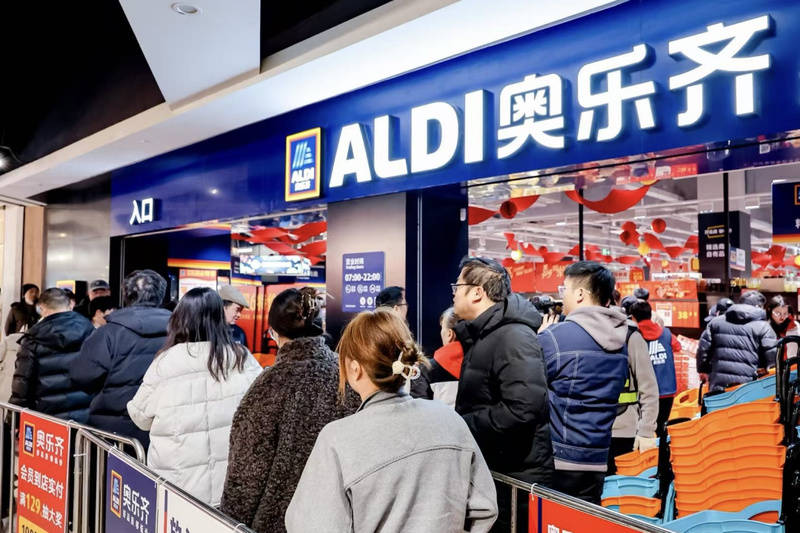
Core Viewpoint - ALDI has officially opened four stores in Nanjing, aiming to cater to local consumers' daily grocery needs while promoting its low-cost, high-quality offerings [1][5]. Group 1: Store Openings and Promotions - The four new ALDI stores are located in key districts of Nanjing, attracting a large number of local shoppers on opening day [1] - ALDI launched various promotional activities for consumers, including discounts and giveaways, such as a 10 yuan coupon for first-time members spending over 99 yuan and a chance to win prizes with a minimum purchase [3] - Special offers included a limited-time price of 88 yuan for 2.5 kg of Chilean cherries, showcasing ALDI's commitment to local consumer preferences [3] Group 2: Business Strategy and Market Position - ALDI, a global discount supermarket chain from Germany, has over 13,000 stores worldwide and has been operating in China since 2019, focusing on local market needs [5] - The company has expanded its presence in Jiangsu province, with the recent openings increasing its total number of stores in China to 95 [5] - ALDI emphasizes a "good quality, low price" brand proposition, offering a high percentage of private label products (90%), which enhances its reputation as a leader in the hard discount model [5][6] Group 3: Product Offerings and Local Adaptation - ALDI has introduced several local specialty products in Nanjing, such as salted duck and local radishes, to cater to regional tastes [8] - The company is committed to providing high-quality, affordable products that align with health trends and local preferences, launching new private label series focused on quality and lifestyle [6] - ALDI's product range includes 14 private brands tailored for the Chinese market, ensuring that essential daily grocery needs are met efficiently [5][6] Group 4: Future Expansion Plans - ALDI plans to continue expanding its service network in Jiangsu and the broader Yangtze River Delta region, aiming to become the preferred choice for daily grocery shopping among local residents [8]

未知机构:华源新消费新零售硬折扣龙头鸣鸣很忙预计1月28日挂牌上市-20260121
未知机构· 2026-01-21 02:05
Company and Industry Summary Company: Mingming Hen Mang (鸣鸣很忙) Industry Overview - The hard discount retail channel is rapidly emerging in response to the trend of consumer downtrading, focusing on cost control and efficient operations to meet the demand for quality-price ratio among consumers [1] - The Chinese leisure food and beverage retail market is projected to grow at a CAGR of 5.8% from 2024 to 2029 [1] - By 2024, chain retailers are expected to account for 57.1% of the total GMV in the Chinese leisure food and beverage retail industry [1] Key Financial Metrics - For the first three quarters of 2025, the company reported revenue of 46.37 billion yuan, representing a year-over-year increase of 75% [2] - The adjusted net profit for the same period was 1.81 billion yuan, showing a year-over-year increase of 241% [2] Market Position - Mingming Hen Mang holds a market share of 1.5% in the industry, positioning itself among the leading players [1] Product Strategy - The company has diversified its product offerings, with 34% of its SKUs being customized products and 38% available for bulk purchase [1] - The ongoing exploration of the "snack+" strategy includes the introduction of a dual-brand 3.0 store model [1] Store Network - As of Q3 2025, Mingming Hen Mang operates a network of 19,517 stores across 28 provinces and all tiered cities in China, with approximately 59% of the stores located in county and town areas [2] Additional Insights - The company is expanding its product range to include categories such as daily necessities, stationery, baking products, and fresh and frozen items [2]