
亿帆医药

Search documents
特朗普要对药品加征100%关税,国产创新药将受什么影响?
Xin Lang Cai Jing· 2025-09-26 10:16
Core Viewpoint - The U.S. plans to impose a 100% tariff on all branded and patented drugs starting October 1, 2023, with exemptions for companies building drug manufacturing plants in the U.S. [1][12] Drug Tariff Impact - The proposed tariff primarily targets branded pharmaceutical products and patented drugs, likely excluding generic drugs and biosimilars [2][4] - Branded drugs are typically sold under trademark names and can include both patented and off-patent products, which are often more expensive than generics [2][4] - Patented drugs are those still under patent protection, allowing only the original developer to produce and sell them [3][4] Export Data and Structure - In 2024, China's pharmaceutical exports to the U.S. are projected to reach $19.047 billion, with $6.425 billion in Western medicines and $0.87 billion in traditional Chinese medicine [4][5] - Raw materials account for 70.35% of China's pharmaceutical exports to the U.S., with $4.52 billion in raw material exports [4][5][6] Impact on Chinese Innovative Drugs - Several Chinese innovative drugs sold in the U.S. may be affected by the new tariffs, including products from companies like BeiGene and Legend Biotech [7][8] - The number of affected drugs is currently limited, with only a few Chinese companies having received FDA approval for their products [7][8] Global Manufacturing Trends - The new tariff policy is seen as an attempt to encourage pharmaceutical manufacturing to return to the U.S., with exemptions for companies already investing in U.S. production [11][12] - Major pharmaceutical companies have announced plans to increase investments in U.S. manufacturing, including companies like Eli Lilly, Novartis, and Roche [12][15] Global Supply Chain Dynamics - The global pharmaceutical manufacturing landscape has been shaped by cost-saving measures, with China and India becoming key players in raw material production [15][16] - The U.S. relies heavily on imports for raw materials, with 80% of its raw materials sourced from China and India [18] - The geopolitical climate is prompting a shift towards localized production, as companies seek to mitigate tariff and geopolitical risks [19]

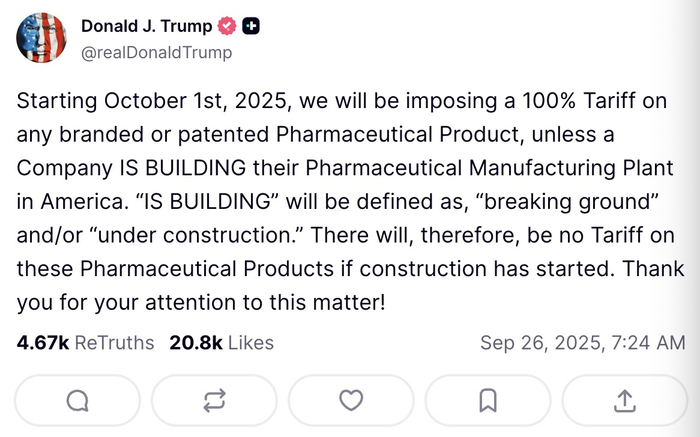
特朗普宣布将对专利及品牌药品加征100%关税,对国内药企影响几何?
财联社· 2025-09-26 07:06
Core Viewpoint - The article discusses the announcement by President Trump regarding a new round of high tariffs on various imported products, particularly focusing on the pharmaceutical industry, which will see a 100% tariff on patented and branded drugs starting October 1, 2023, significantly higher than the previous 15% agreement with Europe [1][2]. Group 1: Tariff Details and Market Reaction - The new tariffs include a 50% tariff on kitchen cabinets and bathroom sinks, a 30% tariff on imported furniture, and a 100% tariff on patented and branded drugs, with exemptions for companies that have manufacturing facilities "under construction" in the U.S. [1][2] - Following the announcement, the innovation drug index and various biotech ETFs saw declines of over 1%, with specific companies like Huahai Pharmaceutical and Baiyue Shenzhou experiencing stock price drops [2][3]. Group 2: Company Responses and Strategies - Many domestic pharmaceutical companies are assessing the impact of the new tariffs, with some indicating that their production capabilities in the U.S. may mitigate the effects. For instance, Huahai Pharmaceutical is evaluating whether its facilities meet the criteria for exemption [4][5]. - Major U.S. pharmaceutical companies like Johnson & Johnson and Eli Lilly have already invested significantly in expanding their domestic production capabilities, with Johnson & Johnson planning to invest approximately $20 billion in North Carolina and Eli Lilly announcing a $270 billion investment for new factories [3][4]. Group 3: Expert Opinions and Future Outlook - Industry experts suggest that the 100% tariff is politically motivated and may not significantly impact domestic innovative drug companies, as many already have manufacturing in the U.S. and the majority of their sales are through partnerships with multinational corporations [6][7]. - The anticipated implementation of a global drug pricing model by the U.S. government could further influence drug pricing and market dynamics, but experts believe that the overall impact on the domestic pharmaceutical industry will be limited [6][7].




亿帆医药:公司创新药F-627最快明年在美国本土实现直接发货
Xin Lang Cai Jing· 2025-09-26 02:34
Core Viewpoint - The U.S. will impose a 100% tariff on patented and branded drugs starting October 1, which may impact pharmaceutical companies' operations and supply chains in the U.S. market [1] Company Response - Yifan Pharmaceutical has been monitoring U.S. tariff policies and is optimizing the supply chain and cost strategies for its innovative drug F-627 [1] - The company plans to shift the production and shipping of F-627 to the U.S. to mitigate the impact of tariffs, with the potential for local dispatch as early as next year [1] - Yifan Pharmaceutical asserts that the tariff policy will not have a significant adverse effect on the sales of F-627 in the U.S. market [1]
当创新药成为共识,下一个10倍股在哪?
券商中国· 2025-09-24 23:38
Core Viewpoint - The Chinese pharmaceutical industry is experiencing a significant transformation driven by technological breakthroughs and demographic changes, leading to a shift from a reliance on license-in to license-out strategies, positioning Chinese companies as key players in the global market [2][4][11]. Group 1: Industry Trends - The Hong Kong pharmaceutical sector is witnessing a surge, with ETFs tracking the Hang Seng Biotechnology Index showing strong performance, indicating a structural change in the industry [1][3]. - Innovation drugs are becoming a major investment theme for 2025, with significant year-to-date gains in related indices, highlighting the leading role of companies like WuXi Biologics and BeiGene [4][5]. - The Chinese pharmaceutical industry now ranks second globally, with approximately 30% of innovative drugs under development worldwide, and a notable increase in the approval rate of new drugs [8][9]. Group 2: Technological Advancements - The advent of CRISPR gene editing and AI technologies is revolutionizing drug development, significantly reducing research and development cycles and enhancing the capabilities of Chinese pharmaceutical companies [2][7]. - The emergence of platform technologies such as ADCs, bispecific antibodies, and cell therapies is opening new avenues for drug development, contributing to the increased competitiveness of domestic biotech products [7]. Group 3: Market Dynamics - The market is currently experiencing a revaluation of innovative drug companies, with many leading firms turning profitable and their valuations being reassessed positively [7][11]. - The increase in license-out transactions indicates a shift in the global innovation chain, with Chinese companies now accounting for over 51% of the total transaction value in the BD market [11]. Group 4: Policy and Financial Environment - Supportive policies, including stable medical insurance negotiations and expedited drug approval processes, are fostering an environment conducive to innovation [8]. - The easing of monetary policy, including interest rate cuts by the Federal Reserve, is providing a favorable financing environment for biotech companies, further enhancing their growth prospects [8]. Group 5: Investment Opportunities - The Hang Seng Medical ETF and the Hong Kong Stock Connect Medical ETF are emerging as attractive investment vehicles, providing exposure to core assets in the Hong Kong pharmaceutical sector [3][15]. - The recent restructuring of the Hang Seng Biotechnology Index has improved its focus on leading companies in the biotech field, enhancing its investment appeal [14][15].

亿帆医药:截至2025年9月19日公司股东人数为46838户
Zheng Quan Ri Bao Wang· 2025-09-24 09:13
证券日报网讯亿帆医药(002019)9月24日在互动平台回答投资者提问时表示,截至2025年9月19日公司 股东人数为46838户。 ...
亿帆医药:柯泰亚是公司合成生物项目研发的重要战略合作伙伴之一
Mei Ri Jing Ji Xin Wen· 2025-09-24 07:44
Core Viewpoint - The company is focusing on developing synthetic biological products and has made significant investments in its production capabilities, indicating a strategic shift towards in-house manufacturing and innovation [2]. Group 1: Investment and Production - The company has invested 1 billion yuan in building a new factory in Qidong City, which suggests a potential decision to move away from collaboration with Xinfu [2]. - The company aims to provide natural, green, and sustainable innovative products across various markets, including healthcare, human and animal nutrition, and pharmaceuticals [2]. Group 2: Collaboration and Future Plans - There are questions regarding the future of existing collaborations on products such as Ectoin, Farnesol, and Fucoidan, particularly whether these partnerships will end after their current terms [2].
创新药研究框架深度解析
2025-09-23 02:34
Summary of Key Points from the Conference Call on China's Innovative Drug Industry Industry Overview - The Chinese innovative drug industry is transitioning from a follower to a leader, showcasing significant advantages in R&D efficiency and cost control, particularly in popular technology areas such as bispecific antibodies (双抗) and antibody-drug conjugates (ADC) [1][2][3] - The approval speed of innovative drugs directly impacts market volume and competitive landscape, with early market entry being crucial [1][6] Core Insights and Arguments - **Market Dynamics**: The Chinese innovative drug sector is experiencing a shift in underlying logic, with improved liquidity in the Hong Kong stock market and increased risk appetite expected to boost the pharmaceutical sector, especially innovative drugs [1][8] - **International Recognition**: Chinese innovative drugs are gaining international recognition, exemplified by the $1.25 billion upfront payment for the PD-1 VGF bispecific antibody licensed to Pfizer by 3SBio, marking a significant milestone in outbound business development (BD) transactions [1][9] - **Policy Influence**: Healthcare policies are encouraging differentiated innovation, with diverse payment methods being explored, and the impact of drug price reduction policies being limited [1][4][5] Key Factors Affecting the Industry - **Types of Companies**: The innovative drug sector comprises Big Pharma and Biotech companies, with Big Pharma focusing on commercialization and Biotech emphasizing R&D innovation [1][7] - **Investment Sentiment**: The overall performance of the pharmaceutical sector has been weak from 2020 to 2024 due to investor preference for dividend stocks, but improvements in liquidity and risk appetite in 2025 are expected to enhance the performance of the innovative drug sector [1][8] Challenges and Opportunities - **Global Competition**: As the global source innovation enters a bottleneck, Chinese companies can leverage high efficiency to achieve competitive advantages, particularly in ADC and bispecific antibody fields where they hold significant market shares [1][20][22] - **Market Entry Timing**: The timing of market entry is critical, with first-in-class drugs capturing an average of 45% market share, while subsequent entrants see diminishing returns [1][18] Emerging Trends and Future Directions - **New Drug Development**: The focus on PD-1 bispecific antibodies and ADCs is expected to drive future growth, with several companies poised to launch significant products in the near term [1][31][32] - **Clinical Trial Efficiency**: Chinese companies demonstrate superior enrollment speeds in clinical trials, significantly reducing time and costs compared to international counterparts [1][16] Conclusion - The Chinese innovative drug industry is positioned for substantial growth driven by policy support, international recognition, and advancements in R&D efficiency. The upcoming years are likely to see increased BD activities and successful product launches, contributing to the sector's evolution and competitiveness on a global scale [1][10][32]
亿帆医药:公司预计将于10月31日披露三季报,具体时间将以公司在交易所预约的披露时间为准
Mei Ri Jing Ji Xin Wen· 2025-09-19 09:19
Group 1 - The company Yifan Pharmaceutical (002019.SZ) is expected to disclose its Q3 financial report on October 31, 2023, as per the schedule set by the Shenzhen Stock Exchange [2] - The company has indicated that the preparation for the Q3 report by the Shenzhen Stock Exchange has not yet begun [2]
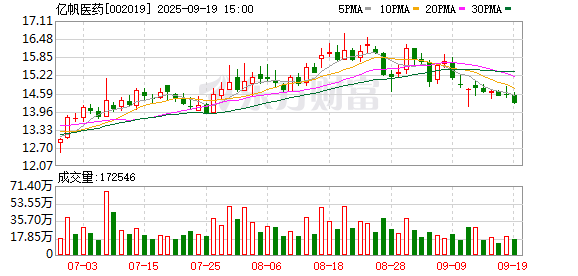
亿帆医药(002019.SZ):目前亿立舒已在美国实现上市销售
Ge Long Hui· 2025-09-19 07:59
Group 1 - The core point of the article is that Yifan Pharmaceutical (002019.SZ) has successfully launched its product Yilishu in the United States [1] Group 2 - The company has announced this achievement on its investor interaction platform [1]
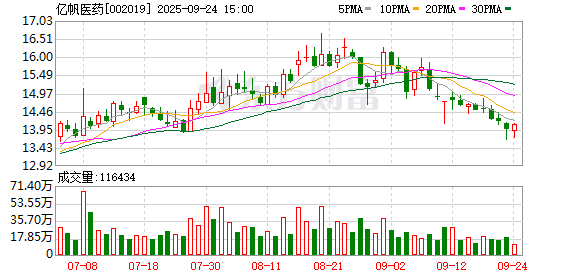
亿帆医药涨2.14%,成交额1.76亿元,主力资金净流入815.92万元
Xin Lang Zheng Quan· 2025-09-18 05:32
Company Overview - Yifan Pharmaceutical's stock price increased by 2.14% on September 18, reaching 14.81 CNY per share, with a trading volume of 176 million CNY and a turnover rate of 1.43%, resulting in a total market capitalization of 18.015 billion CNY [1] - The company was established on November 10, 2000, and went public on July 13, 2004. It is located in Lin'an District, Hangzhou, Zhejiang Province [1] - Yifan Pharmaceutical's main business includes the production and sale of active pharmaceutical ingredients and high polymer materials, with revenue composition as follows: proprietary pharmaceutical products (including imports) 75.52%, vitamins 11.47%, other pharmaceutical products 9.52%, high polymer materials 3.00%, and pharmaceutical services 0.49% [1] Financial Performance - For the first half of 2025, Yifan Pharmaceutical achieved operating revenue of 2.635 billion CNY, a year-on-year increase of 0.11%, and a net profit attributable to shareholders of 304 million CNY, representing a year-on-year growth of 19.91% [2] - The company has distributed a total of 1.328 billion CNY in dividends since its A-share listing, with 243 million CNY distributed over the past three years [3] Shareholder Information - As of August 29, 2025, the number of shareholders of Yifan Pharmaceutical reached 42,900, an increase of 3.38% from the previous period, with an average of 19,634 circulating shares per person, a decrease of 3.27% [2] - As of June 30, 2025, Hong Kong Central Clearing Limited was the second-largest circulating shareholder, holding 25.5819 million shares, an increase of 2.4783 million shares from the previous period [3]