
南京银行

Search documents
红利低波ETF华泰柏瑞(512890)成交额4.15亿元领跑同类 机构:关注高股息策略
Xin Lang Cai Jing· 2026-02-04 04:24
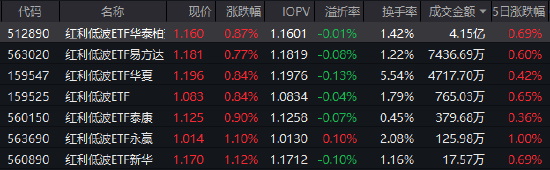
Core Viewpoint - The market experienced a downturn on February 4, with the Shanghai Composite Index turning negative and the ChiNext Index dropping over 2%. Despite this, the Huatai-PineBridge Low Volatility ETF (512890) rose by 0.87%, reaching a price of 1.160 yuan, with a turnover rate of 1.42% and a transaction volume of 415 million yuan, leading among similar ETFs [1][7]. ETF Performance - The Huatai-PineBridge Low Volatility ETF (512890) reported a price of 1.160 yuan, reflecting a 0.87% increase, with an indicative net asset value (IOPV) of 1.1601 yuan and a slight discount of -0.01% [2][8]. - The ETF's trading volume was 415 million yuan, with a 5-day price change of 0.69% [2][8]. Top Holdings - The top ten holdings of the Huatai-PineBridge Low Volatility ETF showed mostly positive performance during the morning session, with notable increases in Shanghai Bank (up 1.08%), Nanjing Bank (up 2.08%), and Ping An Bank (up 0.65%). However, COFCO Sugar fell by 1.61% [3][9]. Fund Inflows - The Huatai-PineBridge Low Volatility ETF has seen significant net inflows, with 670 million yuan over the last 5 trading days, 2.94 billion yuan over the last 20 days, and 4.68 billion yuan over the last 60 days. As of February 3, 2026, the ETF's latest circulation scale was 29.011 billion yuan [3][9]. Market Analysis - According to China International Capital Corporation (CICC), the A-share market is expected to experience short-term consolidation, but medium-term support factors remain unchanged, indicating a slow bull market. They recommend focusing on four key areas: the AI industry chain and commercial aerospace, supply-demand supported non-ferrous metals, cyclical sectors like chemicals and home appliances, and high-dividend strategies based on quality cash flow [5][11]. - Pacific Securities emphasized the attractiveness of bank sector valuations, highlighting significant dividend yield advantages and strong demand for high-dividend asset allocation. They noted that state-owned banks and quality regional banks have advantages in capital, dividends, and regional economic resilience, supporting low-volatility dividend strategies [6][11].

企业结汇意愿增加,是否影响银行间流动性?
Orient Securities· 2026-02-04 02:46
Investment Rating - The report maintains a "Positive" outlook for the banking sector in 2026 [5] Core Insights - The banking sector is expected to return to fundamental narratives in 2026, supported by policy financial tools and resilient asset expansion. The sector is still in a deposit repricing cycle, which is likely to stabilize net interest margins. Structural risks are anticipated to be supported by policy measures [3][32] - The report highlights two main investment themes: 1. High-quality small and medium-sized banks with confirmed fundamentals, including Nanjing Bank (601009, Buy), Ningbo Bank (002142, Buy), and Chongqing Rural Commercial Bank (601077, Buy) 2. State-owned large banks with stable fundamentals and good defensive value, including Bank of Communications (601328, Not Rated) and Industrial and Commercial Bank of China (601398, Not Rated) [3][32] Summary by Sections Impact of Corporate Foreign Exchange Settlement on Interbank Liquidity - Corporate foreign exchange settlement has increased due to the continuous appreciation of the RMB, with a record high of USD 99.9 billion in December 2025. The strong RMB trend is expected to maintain high settlement levels throughout 2026 [8][11] - The settlement process involves two stages: 1. Corporates settle with commercial banks, leading to a decrease in foreign currency deposits and a corresponding decrease in excess reserves. This results in an increase in RMB deposits and a need for banks to match more statutory reserves, which may reduce excess reserves [10][13] 2. If commercial banks settle with the central bank, it results in a decrease in foreign currency assets and an increase in excess reserves, thereby injecting liquidity into the market [10][13] Current Liquidity Conditions - Current liquidity is relatively loose, supported by the central bank's clear stance on maintaining liquidity and stable growth in deposits. Concerns about deposit disintermediation have not materialized, and the overall disintermediation pressure remains moderate [26][32] - The central bank has net injected CNY 1 trillion in medium- and long-term funds through various operations, indicating a proactive approach to liquidity management [15][32]





银行股集体上扬,渝农商行涨超2%成“领头羊,渝农商行涨超2%领跑,多股跟涨超1%
Ge Long Hui· 2026-02-04 02:02
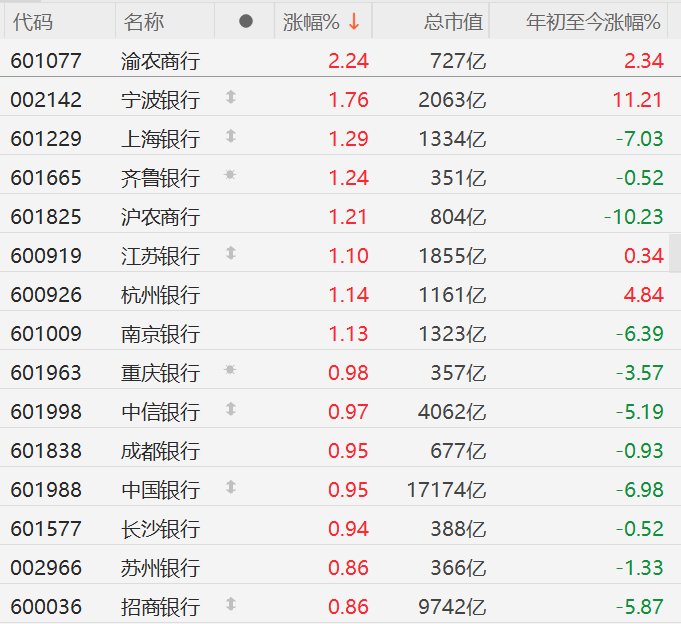
此次银行(核心股)股的集体上扬,也吸引了众多投资者的目光。市场分析人士认为,银行股作为大盘 蓝筹股的重要组成部分,其稳定的表现和较高的股息率,对于追求稳健收益的投资者具有较强的吸引 力。未来,随着银行业基本面的不断改善和市场信心的逐步恢复,银行股有望继续保持良好的上涨态 势。 股票频道更多独家策划、专家专栏,免费查阅>> 责任编辑:栎树 2月4日,A股市场银行(核心股)板块表现亮眼,呈现出集体上涨的态势,为市场注入了一股强劲动 力。在众多银行股中,渝农商行表现尤为突出,涨幅超过2%,成为银行板块中的领涨先锋。与此同 时,宁波银行、上海银行、齐鲁银行、沪农商行、江苏银行、杭州银行、南京银行等也纷纷跟涨,涨幅 均超过1%。 | 代码 | 名称 | | 涨幅% ↓ | 总市值 | 年初至今涨幅%。 | | --- | --- | --- | --- | --- | --- | | 601077 | 渝农商行 | | 2.24 | 727亿 | 2.34 | | 002142 | 宁波银行 | 1 | 1.76 | 2063亿 | 11.21 | | 601229 | 上海银行 | 1 | 1.29 | 1334 乙 ...
A股银行股集体上涨,渝农商行涨超2%
Ge Long Hui A P P· 2026-02-04 01:57
Group 1 - A-shares of bank stocks collectively rose, with notable increases in stocks such as Chongqing Rural Commercial Bank, which rose over 2%, and several others including Ningbo Bank, Shanghai Bank, and Qilu Bank, which rose over 1% [1] - Specific stock performance includes Chongqing Rural Commercial Bank increasing by 2.24% with a total market value of 72.7 billion, and Ningbo Bank rising by 1.76% with a market value of 206.3 billion [2] - The year-to-date performance shows significant variations, with Ningbo Bank up 11.21%, while Shanghai Bank down 7.03%, and Hu'nong Commercial Bank down 10.23% [2] Group 2 - The MACD golden cross signal has formed, indicating a positive trend for these bank stocks [2]


“业绩亮眼+部署升级” 银行业以高质量发展护航“十五五”开局
Jin Rong Shi Bao· 2026-02-04 01:47
Core Viewpoint - The banking industry is focusing on supporting the real economy through strategic transformation and risk management, with a clear emphasis on high-quality development and service to key sectors [1][3][8]. Group 1: Performance of Listed Banks - Several A-share listed banks, including China Merchants Bank, CITIC Bank, and Shanghai Pudong Development Bank, have reported significant growth in both operating income and net profit for 2025, indicating a recovery in profitability [2]. - CITIC Bank and Shanghai Pudong Development Bank have both entered the "10 trillion yuan club," with total assets of 10.13 trillion yuan and 10.08 trillion yuan respectively, marking growth rates of 6.28% and 6.55% year-on-year [2]. - The overall trend for joint-stock banks in 2025 is characterized by stable scale, optimized structure, risk control, and improved efficiency, showcasing strong resilience against economic cycles [2]. Group 2: Strategic Focus on Real Economy - The banking sector is shifting from "scale expansion" to "high-quality development," with a focus on precise strategies to support the real economy and address cyclical fluctuations [3][6]. - Major state-owned banks have emphasized the importance of serving the real economy in their 2026 operational plans, aligning their actions with national strategic directives [4]. - Agricultural Bank of China is prioritizing support for rural revitalization, while Bank of China aims to enhance its global capabilities and services [4]. Group 3: Digital Transformation and Innovation - Digital transformation is becoming a key support for banks to enhance their service efficiency to the real economy, with initiatives like "AI+" being implemented to innovate service models and improve decision-making [5]. - Postal Savings Bank is pursuing a comprehensive upgrade strategy focusing on digitalization and value-driven growth, aiming for high-quality development [5]. Group 4: Financial Resource Allocation - The banking industry is actively channeling more financial resources into key areas such as expanding domestic demand, technological innovation, and supporting small and micro enterprises [6][8]. - Banks are adjusting their strategic layouts to focus on the "five major financial articles," enhancing the precision and effectiveness of their services to the real economy [6]. - Notable growth in technology finance loans has been reported, with Hangzhou Bank and Nanjing Bank showing increases of 23.44% and 19.49% respectively [6][7]. Group 5: Regional and Sectoral Support - Banks are increasingly focusing on regional development and industrial upgrades, with initiatives to strengthen local financial services and support manufacturing sector transformations [7]. - The emphasis on supporting small and micro enterprises has led to significant growth in inclusive finance loans, with Hangzhou Bank and Nanjing Bank reporting increases of 17.06% and 17.46% respectively [7]. - The banking sector is aligning its services with national strategies in areas such as technological innovation, green development, and rural revitalization [8].
黄金白银继续暴跌 轮到银行股机会了?
Di Yi Cai Jing· 2026-02-04 01:02
Core Viewpoint - The A-share market experienced significant declines in various sectors, particularly in metals and banks, with a notable focus on bank stocks as a safe haven amid volatility in precious metals prices [1][3][4]. Group 1: Market Performance - On February 2, A-share non-ferrous metals led the decline with a drop of 7.62%, while steel, chemicals, coal, and oil and gas sectors also fell over 5% [1]. - The Shanghai Composite Index closed down 2.48%, with over 4,600 stocks declining and a trading volume of approximately 2.61 trillion yuan, a decrease of nearly 250 billion yuan from the previous trading day [3][4]. - The banking sector showed resilience, with certain banks like Citic Bank and Shanghai Bank posting gains of 2.64% and 1.62%, respectively, amidst the overall market downturn [4]. Group 2: Bank Sector Analysis - The banking sector has seen a significant correction, with the China Securities Bank Index dropping 6.76% as of January 30, with major banks like Pudong Development Bank and Agricultural Bank of China experiencing declines of 19.29% and 12.5%, respectively [4][5]. - Analysts believe that the peak of fund outflows from the banking sector has passed, with the sector's valuation becoming more attractive, as the median price-to-book (PB) ratio is around 0.57 and the median dividend yield has risen to over 4.5% [5][6]. - Recent reports indicate that passive fund outflows have been a major factor in the banking sector's recent adjustments, but the selling pressure is expected to diminish, allowing for potential recovery in bank stock prices [6][7]. Group 3: Institutional Insights - Institutions are starting to show interest in bank stocks, with reports indicating that active funds had reduced their holdings in bank stocks by 1.3 billion shares by the end of the fourth quarter [7]. - Several regional banks have announced stock buyback plans, which have been positively received by the market, reinforcing confidence in the banking sector's fundamentals [7].




丈量地方性银行(2):浙江163家区域性银行全梳理-20260203
GF SECURITIES· 2026-02-03 13:31
Investment Rating - The industry investment rating is "Buy" [2] Core Insights - The report provides a comprehensive analysis of 163 regional banks in Zhejiang Province, highlighting their asset and liability structures, profitability, and asset quality [6][20] - The asset growth rate for major city commercial banks in Zhejiang is 9.4%, which is lower than the 14.2% growth rate of listed city commercial banks, while major rural commercial banks show an asset growth rate of 8.0%, exceeding the 6.7% growth rate of listed rural commercial banks [6][25] - The report indicates that the loan-to-asset ratio for city commercial banks is projected to reach 55.5% in 2024, an increase of 95 basis points year-on-year, while rural commercial banks will see a decrease to 59.3%, down 19 basis points [31] - Profitability metrics show that the average Return on Assets (ROA) for city commercial banks in Zhejiang is 0.78%, slightly above the average of listed city commercial banks, while rural commercial banks have an average ROA of 0.82%, which is below the average of listed rural commercial banks [6][31] - The asset quality of regional banks in Zhejiang is reported to be better than that of listed banks, with non-performing loan ratios lower by 16 basis points for city commercial banks and 9 basis points for rural commercial banks compared to their listed counterparts [6][31] Summary by Sections Section 1: Economic Structure of Zhejiang Province - Zhejiang Province is focused on high-quality development and aims to become a model for common prosperity [13] - The province's GDP is heavily concentrated in cities like Hangzhou, Ningbo, and Wenzhou, with Hangzhou accounting for 24.3% of the total GDP in 2025 [15] Section 2: Overview of 163 Regional Banks - The report categorizes the banks into city commercial banks, rural banks, and others, with a total of 163 banks in the region [20] - The distribution of registered capital among these banks is relatively balanced, with 63 banks having over 500 million yuan in registered capital [22] Section 3: Asset and Liability Structure - The asset growth of major city and rural commercial banks has been declining since 2019, with city banks showing a growth rate of 9.4% in the first half of 2025 [25] - The liability structure indicates that customer deposits account for 77.5% of liabilities for city commercial banks, which is higher than the 66.2% for listed city banks [44] Section 4: Profitability and Asset Quality - The average ROE for city commercial banks in Zhejiang is 11.98%, slightly lower than the average of listed city banks [6][31] - The report highlights that the non-performing loan ratio for city commercial banks is lower than that of listed banks, indicating better asset quality [6][31]



城商行板块2月3日跌0.59%,重庆银行领跌,主力资金净流入1.74亿元
Zheng Xing Xing Ye Ri Bao· 2026-02-03 09:03
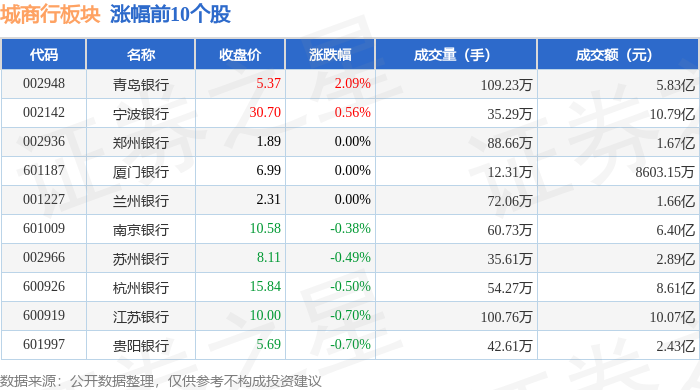
Market Overview - The city commercial bank sector experienced a decline of 0.59% on February 3, with Chongqing Bank leading the drop [1] - The Shanghai Composite Index closed at 4067.74, up by 1.29%, while the Shenzhen Component Index closed at 14127.1, up by 2.19% [1] Individual Bank Performance - Qingdao Bank closed at 5.37, with an increase of 2.09% and a trading volume of 1.09 million shares, totaling a transaction value of 583 million yuan [1] - Ningbo Bank closed at 30.70, up by 0.56%, with a trading volume of 352,900 shares and a transaction value of 1.079 billion yuan [1] - Chongqing Bank closed at 10.18, down by 1.83%, with a trading volume of 122,900 shares and a transaction value of 125 million yuan [2] - Chengdu Bank closed at 15.82, down by 1.62%, with a trading volume of 447,000 shares and a transaction value of 710 million yuan [2] Capital Flow Analysis - The city commercial bank sector saw a net inflow of 174 million yuan from institutional investors, while retail investors experienced a net outflow of 322 million yuan [2] - The main capital inflow and outflow for individual banks showed that Hangzhou Bank had a net inflow of 104.1 million yuan from institutional investors, while retail investors had a net outflow of 63.65 million yuan [3] - Chengdu Bank had a net inflow of 75.59 million yuan from institutional investors, with a net outflow of 66.56 million yuan from retail investors [3]

贵金属风暴下的银行“围城”:大行筑墙,小行借道
Hua Er Jie Jian Wen· 2026-02-03 07:14
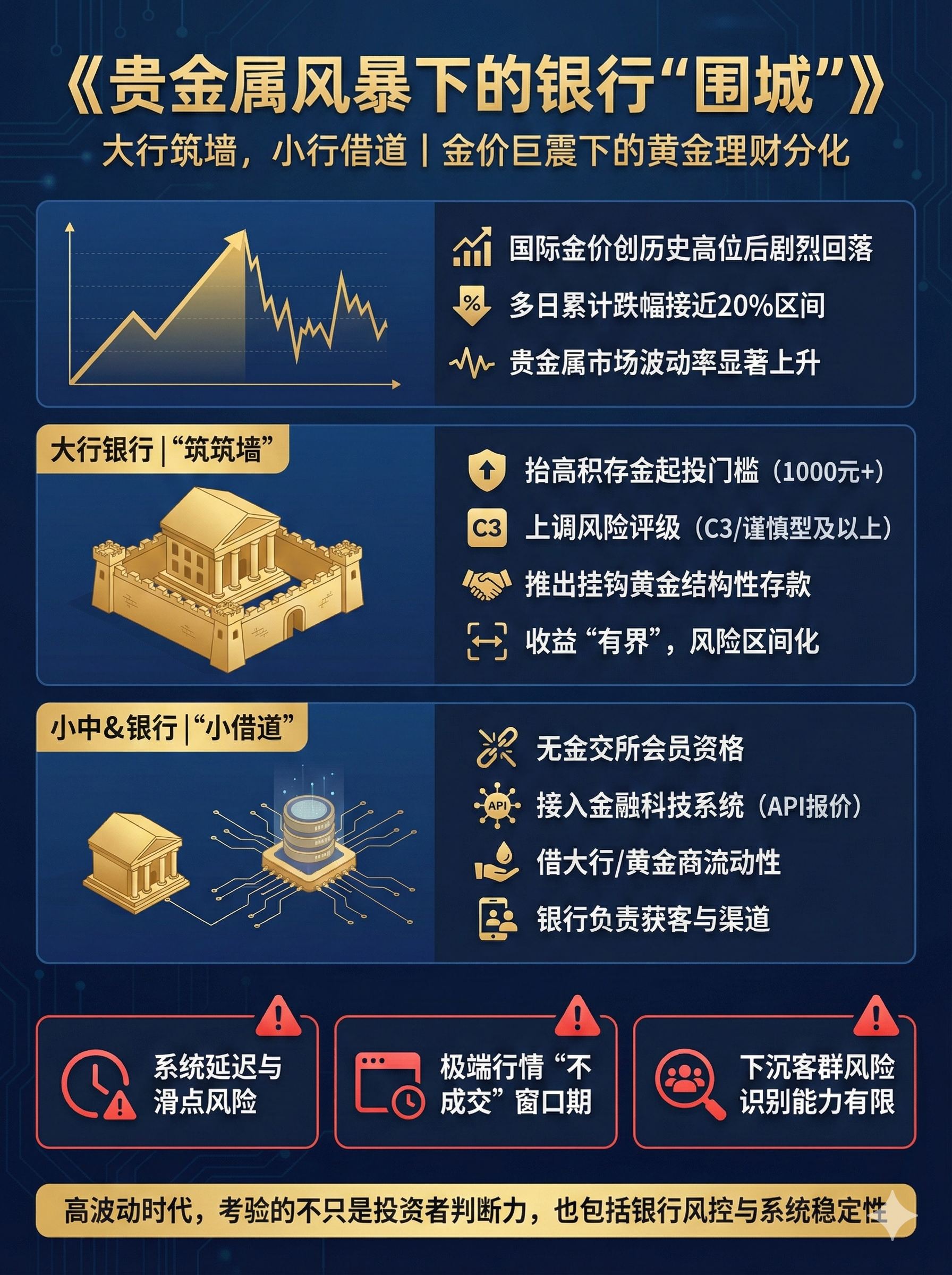
年终奖即将到手的律师王植(化名),在二月初的寒意中感到了某种难言的燥热。那是金价巨震带给市场的余温,也是财富焦虑在特定节点下的投射。 2月2日,全球贵金属市场遭遇深幅回调,此前一度冲破5500美元/盎司大关的现货黄金,在短短数个交易日内掉头向下,多日累计跌幅接近20%区间。 尽管市场弥漫着对"史诗级暴跌"的恐慌,但对于王植而言,波动即是磁石——他既不甘心在这一轮黄金热潮中彻底缺位,又对当前高位的剧烈波动心存忌 惮,最终在多家大型银行推出的黄金挂钩结构性存款前,停下了目光。 这并非王植一个人的选择。 随着大量存款到期与年终奖发放季重合,在黄金行情余温尚存的背景下,各类挂钩贵金属的理财产品正成为银行获客揽储的"胜负手"。 在这场全民淘金热中,大型银行与中小型银行对于黄金业务的态度,正在呈现出微妙的分化: 一边是努力"降温"的国股行,正通过抬高门槛、强化风险评级来构筑防火墙; 一边是仍在"升温"的中小银行,试图在技术与渠道的缝隙中,借道分享这场盛宴。 大行"筑墙" 在金价立于高位、波动率放大的背景下,国有大行与头部股份制银行正悄然掀起一场"去散户"的运动; 这种策略并非拒绝客户,而是通过提高准入门槛与设计风险对冲产 ...

银行业以高质量发展护航“十五五”开局
Jin Rong Shi Bao· 2026-02-03 01:49
Core Viewpoint - The banking industry is focusing on supporting the real economy through strategic transformation and risk management, with several banks reporting improved performance for 2025, indicating a shift towards high-quality development [1][2][3]. Group 1: Performance of Listed Banks - Multiple A-share listed banks, including China Merchants Bank, CITIC Bank, and Industrial Bank, have reported significant increases in both operating income and net profit for 2025, demonstrating a recovery in profitability [2]. - CITIC Bank and Pudong Development Bank have both entered the "10 trillion yuan club," with total assets of 10.13 trillion yuan and 10.08 trillion yuan respectively, marking growth rates of 6.28% and 6.55% year-on-year [2]. - The overall trend for joint-stock banks in 2025 is characterized by stable growth, optimized structure, risk control, and improved efficiency, showcasing strong resilience against economic cycles [2]. Group 2: Strategic Focus on Real Economy - The banking sector is shifting from "scale expansion" to "high-quality development," emphasizing targeted support for key areas and weak links in the economy [3]. - Major state-owned banks have outlined systematic plans to enhance their service to the real economy, aligning their strategies with national priorities and focusing on specific sectors such as agriculture and global expansion [4]. Group 3: Digital Transformation and Innovation - Digital transformation is identified as a key support for enhancing the effectiveness of banks in serving the real economy, with banks like Bank of Communications and Postal Savings Bank implementing AI and other digital strategies [5]. - The banking industry is increasingly focusing on technology finance, with significant growth in loans to technology enterprises, such as a 23.44% increase in technology finance loans at Hangzhou Bank [6][7]. Group 4: Support for Key Sectors - Banks are concentrating their resources on critical areas such as expanding domestic demand, technological innovation, and green development, with a focus on providing tailored financial solutions for small and micro enterprises [6][7]. - The emphasis on regional development and industrial upgrades is evident, with banks enhancing their service layouts to support local economies and specific industries, such as manufacturing [7]. Group 5: Future Outlook - The banking industry is expected to continue optimizing financial resource allocation and enhancing support for key sectors, while also deepening financial innovation and improving service precision [8]. - Collaboration among different types of banks is crucial for effectively serving the real economy, with large state-owned banks leading the way and smaller banks focusing on local needs [8].
