
祥源文旅

Search documents
上百亿待兑付!140亿富豪的资本局,崩了 || 深度
Sou Hu Cai Jing· 2025-12-10 09:24
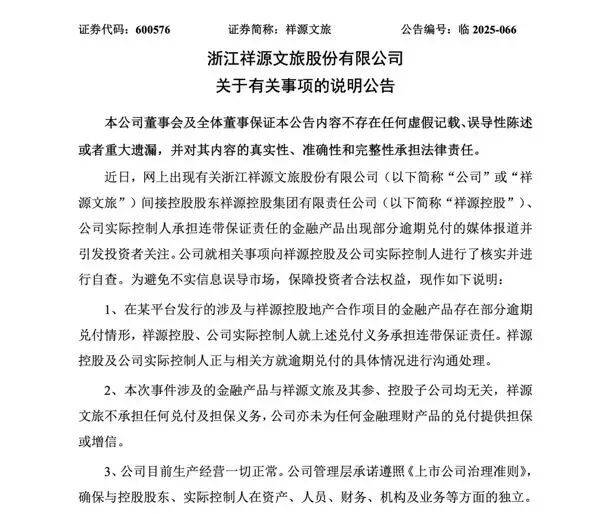
Core Viewpoint - Xiangyuan Cultural Tourism confirmed overdue payments on financial products guaranteed by its actual controller, Yu Faxiang, while distancing itself from any liability related to these products [1][4][11]. Group 1: Company Announcements - On December 7, Xiangyuan Cultural Tourism, along with two other listed companies, issued urgent announcements to clarify their positions regarding overdue financial products linked to Xiangyuan Holdings [7][8]. - The announcements stated that the overdue financial products are unrelated to the listed companies and that they do not bear any repayment or guarantee obligations [9][10]. - The companies emphasized that their operations remain normal and independent, aiming to isolate themselves from the risks associated with the overdue payments [11]. Group 2: Financial Crisis Background - The crisis began in late November, with reports of overdue payments on various financial products linked to Xiangyuan Holdings, affecting hundreds of investors and potentially involving over 100 billion yuan in unpaid funds [6][12]. - By December 3, a significant number of these products failed to make scheduled payments, leading to widespread concern among investors [6][7]. - The overdue products are primarily tied to real estate projects under Xiangyuan Holdings, indicating a broader financial strain within the group [6][12]. Group 3: Market Reaction - Following the announcements, the stock prices of Xiangyuan Cultural Tourism, Jiaojian Co., and Haichang Ocean Park dropped significantly, with declines of 14.23%, 16.32%, and 27.54% respectively [11][29]. - The market's reaction reflects deep concerns about the potential transmission of financial risks from the controlling shareholder to the listed companies [4][11]. Group 4: Financial Structure and Risks - The financial products in question involve complex arrangements where Xiangyuan Holdings has transferred receivables to affiliated entities, which then issue financial products to the public [12][13]. - Yu Faxiang, as the actual controller, provided guarantees for these products, raising questions about the sustainability of this financial structure amid liquidity challenges [14][28]. - The underlying issue stems from the real estate sector's downturn, which has historically been the main revenue source for the group, now facing cash flow problems [28][29]. Group 5: Broader Implications - The crisis highlights the risks associated with the "Xiangyuan system," where significant off-balance-sheet debts pose a threat to the stability of the listed companies [29]. - Regulatory bodies are reportedly investigating the financial products and the associated risks, indicating potential repercussions for the involved parties [14][29].

财经早报:光伏行业酝酿第四次洗牌 4个一线城市二手房大卖创4年新高丨2025年12月10日
Xin Lang Cai Jing· 2025-12-10 00:16
Group 1 - Silver prices have surged to a historic high of $60, significantly outperforming gold, with the gold-silver ratio dropping to 69, the lowest since July 2021 [2][41] - Standard Chartered's Suki Cooper noted that while silver's price momentum is supported by strong fundamentals, normalization of market dynamics may lead to short-term volatility [2][41] - The recent increase in silver prices is expected to face a correction before reaching new highs, influenced by reduced demand in India and replenished London inventories [2][41] Group 2 - The major asset restructuring between Haiguang Information and Zhongke Shuguang has been terminated due to unfavorable market conditions and the complexity of the transaction [3][42] - Both companies stated that the termination of the transaction will not adversely affect their production, operations, or financial status [3][42] Group 3 - The AI sector is experiencing a global investment shift, with international funds increasingly targeting China's technology sector due to its valuation advantages and complete industrial ecosystem [5][44] - Despite concerns over potential AI bubbles, major asset management firms continue to view artificial intelligence as a core investment theme for 2026 [5][44] - The Chinese technology sector is becoming a new battleground for global capital, driven by its manufacturing capabilities and market potential [5][44] Group 4 - The wholesale price of Feitian Moutai has dropped to 1,520 yuan per bottle, a 43% decrease over two years, nearing the official price of 1,499 yuan [6][45] - There are speculations regarding whether the manufacturer has stopped supplying distributors to control prices amid this decline [6][45] Group 5 - A new platform for the consolidation of polysilicon production capacity has been established, named Beijing Guanghe Qiancheng Technology Co., Ltd., with a registered capital of 3 billion yuan [7][46] - This platform aims to explore strategic cooperation opportunities within the industry, including technology upgrades and market expansion [7][46] Group 6 - The second-hand housing market in four first-tier cities has seen a significant recovery, with cumulative transactions reaching 519,000 units by November, surpassing the previous year's figures [8][47] - Analysts predict that this trend may continue into 2026, supported by expected monetary policy easing [8][47]

“祥源系”3家上市公司股价狂泻
Di Yi Cai Jing Zi Xun· 2025-12-09 15:57
Core Viewpoint - The "Xiangyuan System" default event is causing significant stock price declines for its three listed companies, leading to a substantial market value loss of approximately 3.2 billion yuan over two trading days [2][3]. Group 1: Stock Performance - On December 9, Xiangyuan Cultural Tourism (600576.SH) fell by 7.51%, Haichang Ocean Park (02255.HK) dropped by 12%, and Jiaojian Co. (603815.SH) hit the daily limit down [2]. - The market capitalization of the three companies has evaporated by 3.2 billion yuan over two trading days due to the stock price declines [2][3]. - Jiaojian Co. reported a closing price of 9.78 yuan per share on December 9, with a market value of 60.53 billion yuan, down 1.424 billion yuan from December 7 [4]. - Xiangyuan Cultural Tourism's stock price fell by 20.67% from December 4 to 9, with a closing price of 5.91 yuan per share and a market value of 62.32 billion yuan, down 759 million yuan from December 7 [4]. - Haichang Ocean Park's stock price dropped 36.23% from December 4 to 9, closing at 0.44 HKD per share, with a market value of 58.14 billion HKD, down approximately 1.057 billion yuan from December 7 [4]. Group 2: Default Event Details - The rumors of the "Xiangyuan System" default began in late November, with reports of overdue products surfacing around December 4 [3]. - The financial products in question were traded on the Zhejiang Financial Asset Trading Center, with a total trading scale exceeding 10 billion yuan [5]. - On December 8, meetings were held between representatives from the Zhejiang provincial government and investors, where it was revealed that the company had been using a "borrow new to repay old" model, leading to a cash flow crisis [5][6]. Group 3: Financial Position of Xiangyuan Holdings - As of the end of Q3, Xiangyuan Holdings held 2.74 billion shares of Jiaojian Co., with 2.29 billion shares pledged, leaving a market value of approximately 442 million yuan for the unpledged shares [7]. - The direct holdings of Yu Faxiang in Jiaojian Co. amounted to 15.73 million shares, with a market value of about 154 million yuan [7]. - Xiangyuan Holdings had total assets of 599.78 billion yuan and equity of 215.90 billion yuan as of the end of 2024, with a net profit of 5.75 billion yuan [10].



“祥源系”3家上市公司股价狂泻
第一财经· 2025-12-09 15:46
Core Viewpoint - The "Xiangyuan System" default event is causing significant stock price declines for its three listed companies, leading to a substantial market value loss of approximately 3.2 billion yuan over two trading days [3][4]. Group 1: Stock Performance - Xiangyuan Cultural Tourism (600576.SH) dropped by 7.51% on December 9, while Haichang Ocean Park (02255.HK) fell by 12%, and Jiaojian Co., Ltd. (603815.SH) hit the daily limit down [3][4]. - The market capitalization of the three companies has decreased by 3.2 billion yuan over two trading days, with Jiaojian Co., Ltd. alone losing 1.424 billion yuan in market value [4][6]. - From December 4 to December 9, Xiangyuan Cultural Tourism's stock price fell by a cumulative 20.67%, and Haichang Ocean Park's stock price dropped by 36.23% during the same period [7]. Group 2: Default Event Details - The rumors of the "Xiangyuan System" default began in late November, with reports of overdue products surfacing around December 4 [5]. - On December 7, the three listed companies issued announcements stating that certain financial products related to real estate projects with Xiangyuan Holdings had overdue payments, clarifying that the companies would not bear any repayment obligations [5][6]. - The scale of the "Xiangyuan System" products traded on the Zhejiang Financial Asset Trading Center has exceeded 10 billion yuan, indicating a significant impact on investors [7]. Group 3: Financial Position of Xiangyuan Holdings - As of the end of Q3, Xiangyuan Holdings held 274 million shares of Jiaojian Co., Ltd., with a market value of approximately 442 million yuan based on the latest stock price [10]. - The financial report from October indicated that Xiangyuan Holdings had total assets of 599.78 billion yuan and a net profit of 5.75 billion yuan for 2024 [12][13]. - The company is facing a cash flow crisis, with a net cash flow from operating activities of -3.30 billion yuan for the first half of 2025 [13].

"祥源系" 上市公司股价大跌,均发声称不承担逾期产品兑付义务
Sou Hu Cai Jing· 2025-12-09 15:42
Core Viewpoint - The "Xiangyuan System" stocks have experienced significant declines, with companies like Jiaojian Co. hitting the daily limit down, and Xiangyuan Cultural Tourism and Haichang Ocean Park also facing substantial drops due to financial product defaults linked to Xiangyuan Holdings [2][4]. Group 1: Financial Product Defaults - Zhejiang Financial Assets Exchange has reported that certain financial products backed by Xiangyuan Holdings and its actual controller, Yu Faxiang, have not been redeemed upon maturity, leading to widespread investor concern [2]. - As of December 8, investors have reported that products guaranteed by Xiangyuan Holdings have not been paid back, with many experiencing delays in receiving their principal and expected returns of 4%-5% [2][3]. - The total amount of pending redemptions registered by investors exceeds 10 billion yuan, with most due between the end of 2025 and the first quarter of 2026 [3]. Group 2: Company Responses and Market Impact - On December 7, three listed companies, including Xiangyuan Cultural Tourism, Jiaojian Co., and Haichang Ocean Park, confirmed the existence of overdue financial products but stated they bear no responsibility for the repayment or guarantees [4]. - Following the announcement of overdue payments, the stock prices of the three companies collectively fell, with Jiaojian Co. hitting the daily limit down at 10.87 yuan per share, Xiangyuan Cultural Tourism dropping 3.62% to 6.39 yuan per share, and Haichang Ocean Park decreasing 3.85% to 0.5 HKD per share [4]. - The financial turmoil surrounding Xiangyuan Holdings has raised questions about its ability to navigate the current crisis, with ongoing monitoring by financial analysts [5].

“金字招牌”理财产品爆雷!有投资者称,到期无法兑付,也无法提现
Sou Hu Cai Jing· 2025-12-09 15:02
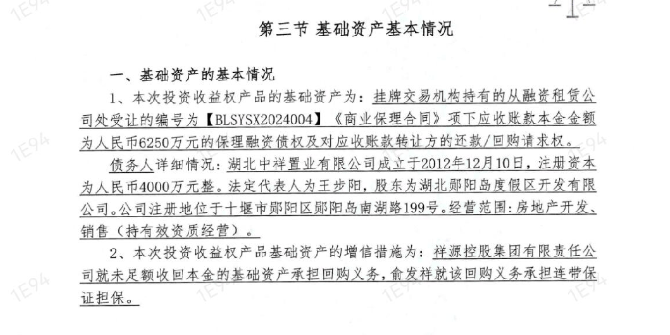
Core Viewpoint - The financial products associated with Xiangyuan Group are facing default issues, leading to investor concerns about the ability to redeem both matured and unmatured products [2][3]. Group 1: Default and Investor Concerns - Since late November, rumors of default on financial products purchased at Zhejiang Jin Center have emerged, confirmed by Xiangyuan Group's executive stating that around 2 to 3 products have not been redeemed due to lack of funds [2]. - Investors have expressed worries about the redemption of unmatured products, with reports of inability to transfer these products on the app [2][3]. - Following the news, shares of related companies, including Jiaojian Co., Xiangyuan Cultural Tourism, and Ocean Park, experienced significant declines, with Jiaojian Co. hitting a daily limit down [3]. Group 2: Company and Platform Relationships - Zhejiang Jin Center, a platform for financial asset trading, has historical ties to state-owned enterprises, which initially attracted investors [5]. - The platform has undergone ownership changes, with Hangzhou Minzhi Investment Management Co. becoming the controlling shareholder, which has close connections to Xiangyuan Group [5][6]. - Xiangyuan Group is a leading player in the cultural tourism industry, with its subsidiaries listed on stock exchanges, and has been involved in issuing financial products with guarantees from its own entities [7][8]. Group 3: Financial Product Structure - The financial products in question are primarily backed by debts owed by real estate companies associated with Xiangyuan Group, with funds reportedly used to supplement liquidity [8][12]. - Legal documents indicate that Xiangyuan Group has obligations to repurchase any unpaid principal related to these products, with the group's actual controller providing guarantees [12]. - The underlying assets of these products are debts from Xiangyuan's real estate ventures, which have been under financial strain due to a downturn in the real estate market [14]. Group 4: Regulatory Response - The Zhejiang Provincial Financial Regulatory Bureau is currently conducting a comprehensive review of the financing products involved, promising to keep investors informed about their rights [3][15].
超30家A股公司花式回馈股东
Di Yi Cai Jing Zi Xun· 2025-12-09 14:52
Core Viewpoint - The trend of "physical dividends" is gaining momentum in the A-share market, with over 30 companies offering unique shareholder rewards that integrate their business and products in 2025 [2] Group 1: Overview of Physical Dividends - Companies are increasingly engaging in shareholder reward activities, with examples including tickets, food items, and discounts, reflecting a wave of "creative rewards" in the capital market [2][5] - The concept of "physical dividends" is popular among investors, who refer to these stocks as "wool stocks" that can be passed down through generations [2] - Experts warn that while this trend can strengthen shareholder relationships if aligned with long-term strategies, it risks becoming a short-term marketing gimmick if it deviates from core business [2] Group 2: Examples of Shareholder Rewards - Emei Mountain A (000888.SZ) offers tickets, cable cars, hotels, hot springs, skiing, and tea as rewards for shareholders holding over 500 shares [4] - Qianwei Central Kitchen (001215.SZ) provides product gift packages for shareholders holding 100 shares or more [4] - Other companies like Hainan Airlines (600221.SH) and Xiangxiang Cultural Tourism (600576.SH) offer various discounts and free access to attractions for all shareholders [4][5] Group 3: Industry Trends and Patterns - The consumer sector, particularly food and beverage, remains the primary driver of "creative rewards," with companies like Wufangzhai (603237.SH) giving out rice dumpling gift boxes [5] - Many companies have established regular "physical dividend" mechanisms, such as Xiangyuan Cultural Tourism (600576.SH), which has been rewarding shareholders for three consecutive years [6] - Continuous rewards are seen in companies like Zhongjing Food (300908.SZ), which provides mushroom sauce annually, and Jiahua Food (605300.SH), which has been giving coffee products for five years [7] Group 4: Strategic Implications - The trend of "physical dividends" represents a shift in investor relations management from a focus on financial returns to a more interactive value creation approach [8][9] - This strategy allows companies, especially small to mid-cap consumer firms, to reduce financial pressure while enhancing shareholder loyalty and market reach [10] - However, the sustainability of this model is questioned, as it relies heavily on the event's popularity and lacks fundamental support, which may lead to stock price volatility [10]



“祥源系”3家上市公司股价狂泻,俞发祥“家底”再缩水
Di Yi Cai Jing· 2025-12-09 14:49
Core Viewpoint - The "Xiangyuan System" is facing significant financial distress, leading to a sharp decline in the stock prices of its three listed companies, resulting in a market value loss of approximately 3.2 billion yuan over two trading days [1][2][3]. Group 1: Stock Performance and Market Impact - On December 9, Xiangyuan Cultural Tourism (600576.SH) fell by 7.51%, Haichang Ocean Park (02255.HK) dropped by 12%, and Jiaojian Co. (603815.SH) hit the daily limit down [1]. - The cumulative market value loss for the three companies over two trading days reached 3.2 billion yuan [2]. - Jiaojian Co. reported a market value of 60.53 billion yuan as of December 9, down 1.42 billion yuan from December 7 [2]. - Xiangyuan Cultural Tourism's stock price fell by 20.67% from December 4 to 9, with a market value of 62.32 billion yuan, down 759 million yuan from December 7 [3][4]. - Haichang Ocean Park's stock price dropped 36.23% from December 4 to 9, with a market value decrease of approximately 1.057 billion yuan [4]. Group 2: Financial Products and Default Issues - The rumors of the "Xiangyuan System" default began in late November, with reports of overdue products surfacing around December 4 [2]. - The financial products in question were traded on the Zhejiang Financial Asset Trading Center, with a total trading scale exceeding 10 billion yuan [4]. - On December 8, a meeting occurred between representatives from the Zhejiang provincial government and investors, where it was revealed that the company had a funding chain break and real estate assets valued over 30 billion yuan that are difficult to liquidate [4]. Group 3: Asset Holdings and Financial Health - As of the end of Q3, Xiangyuan Holdings held 274 million shares of Jiaojian Co., with a market value of approximately 442 million yuan for the unpledged shares [6]. - Yu Faxiang directly held 15.73 million shares of Jiaojian Co., valued at around 154 million yuan [6]. - Xiangyuan Holdings has total assets of 599.78 billion yuan and equity of 215.90 billion yuan as of the end of 2024, with a net profit of 57.5 million yuan [8].
商社美护行业周报:国资入主君亭,林清轩上半年收入超10亿-20251209
Guoyuan Securities· 2025-12-09 14:15
Investment Rating - The industry maintains a "Recommended" rating, with a focus on new consumption sectors such as beauty care, IP derivatives, and gold jewelry [5][29]. Core Insights - The report highlights significant growth in the beauty care sector, with Lin Qingxuan achieving a revenue of 1.052 billion yuan in the first half of 2025, marking a year-on-year increase of 98.3% and a net profit of 182 million yuan, up 109.9% [3][23]. - The retail sector saw a notable increase in Hainan's duty-free shopping, amounting to 2.38 billion yuan in November 2025, representing a 27.1% year-on-year growth [4][28]. - The travel sector is experiencing a surge in bookings for the New Year holiday, with overall reservation heat increasing by nearly 30% compared to the previous year [3][25]. Summary by Sections Market Performance - For the week of December 1-5, 2025, the performance of the retail, social services, and beauty care sectors was -0.83%, -0.65%, and -2.00% respectively, ranking 22nd, 20th, and 29th among 31 primary industries [14][16]. Key Industry Data and News - In the beauty care sector, the establishment of the world's first national standard for pig type I collagen purity was approved, marking a significant advancement in protein measurement [23]. - Galderma's Sculptra® received EU approval for new body indications, expanding its application [23]. - The travel sector saw Hubei Culture Tourism Group acquire a 29.99% stake in Junting Hotel for 1.499 billion yuan, becoming the controlling shareholder [24]. - The toy business of Qimeng Island reported a revenue of 127 million yuan for the third quarter of 2025, with a quarter-on-quarter growth of 93.3% [27]. Investment Recommendations - The report recommends focusing on companies such as Shangmei Co., Ltd., Juzhi Biotechnology, Marubi Biotechnology, Runben Co., Ltd., Proya, Chaohongji, and Furuida in the beauty care and new consumption sectors [5][29].
A股“实物分红”持续升温,超30家公司花式回馈股东
Di Yi Cai Jing· 2025-12-09 13:09
Core Viewpoint - The trend of "physical dividends" is gaining momentum in the A-share market, with over 30 companies offering unique shareholder rewards that integrate their core business and products in 2025, reflecting a shift towards enhancing shareholder relationships through tangible benefits [1][2]. Group 1: Company Initiatives - Companies like Emei Mountain A (000888.SZ) and Qianwei Yangchun (001215.SZ) are leading the trend by offering tickets, discounts, and product gift packages to shareholders, showcasing a variety of rewards across different sectors including tourism, consumption, and technology [1][2][4]. - A significant number of companies have established regular "physical dividend" mechanisms, such as Xiangyuan Culture (600576.SH) and Jiangjing Food (300908.SZ), which have consistently provided rewards to shareholders over multiple years [5][6]. Group 2: Market Dynamics - The "physical dividend" trend is primarily driven by small to mid-cap consumer companies, which leverage their products for shareholder rewards, thereby reducing financial pressure while enhancing market reach and shareholder loyalty [8][9]. - The practice of offering physical rewards is seen as a novel approach to investor relations and brand marketing, allowing companies to create a "value co-creation" environment with shareholders [6][7]. Group 3: Investor Sentiment - Shareholders are increasingly attracted to stocks with "physical dividend" offerings, often referred to as "wool stocks," indicating a growing interest in tangible benefits over traditional cash dividends [1][2]. - However, experts caution that while these initiatives can temporarily boost stock prices, their sustainability is contingent upon the underlying business fundamentals and cash flow quality [8][9].

