国电南瑞

Search documents
我国年用电量首破10万亿千瓦时,精准供电解密
Xin Lang Cai Jing· 2026-01-17 14:41
Group 1 - China's annual electricity consumption has surpassed 10 trillion kilowatt-hours for the first time, indicating a significant milestone in energy usage [1] - The annual electricity consumption in China is more than double that of the United States, highlighting the scale of China's energy demand [1] - China's electricity consumption exceeds the combined total of the European Union, Russia, India, and Japan, showcasing its dominant position in global energy consumption [1]
【新华解读】我国年用电量首超10万亿千瓦时,意味着什么?
Xin Hua Cai Jing· 2026-01-17 11:00
Core Insights - The total electricity consumption in China is projected to exceed 10 trillion kilowatt-hours for the first time in 2025, indicating significant economic growth and development [1] - The electricity consumption structure is shifting towards new and green energy, with substantial contributions from the tertiary industry and urban-rural residential sectors [2] - The supply side shows that 2025 will be the best year for energy supply security since the 14th Five-Year Plan, with effective measures taken to ensure stable electricity supply [3] Group 1: Electricity Consumption - In 2025, total electricity consumption is expected to reach 10,368.2 billion kilowatt-hours, a 5.0% increase year-on-year [1] - The first industry will consume 149.4 billion kilowatt-hours, growing by 9.9%; the second industry will consume 6,636.6 billion kilowatt-hours, growing by 3.7%; the third industry will consume 199.4 billion kilowatt-hours, growing by 8.2%; and urban-rural residential consumption will reach 158.8 billion kilowatt-hours, growing by 6.3% [2] - The contribution of the tertiary industry and urban-rural residential electricity consumption to overall growth will reach 50% in 2025 [2] Group 2: Energy Supply and Infrastructure - In 2025, the total installed power generation capacity in China is expected to exceed 3.8 billion kilowatts, a 14% increase [4] - The "West-to-East Power Transmission" project will reach a scale of 340 million kilowatts, accounting for about 23% of the national maximum electricity load [5] - The new power system is crucial for energy security and requires a balance between high-quality development and safety [4] Group 3: Future Outlook - By 2030, the proportion of renewable energy in total installed capacity is expected to exceed 50%, necessitating enhanced grid security [6] - The State Grid Corporation anticipates a fixed asset investment of 4 trillion yuan during the 15th Five-Year Plan, a 40% increase from the previous plan [6] - In 2026, the addition of over 200 million kilowatts of wind and solar power capacity is planned, along with the orderly advancement of major hydropower projects [7]
海拔3750米的偏远点位告别“用电难”
Xin Lang Cai Jing· 2026-01-17 03:20
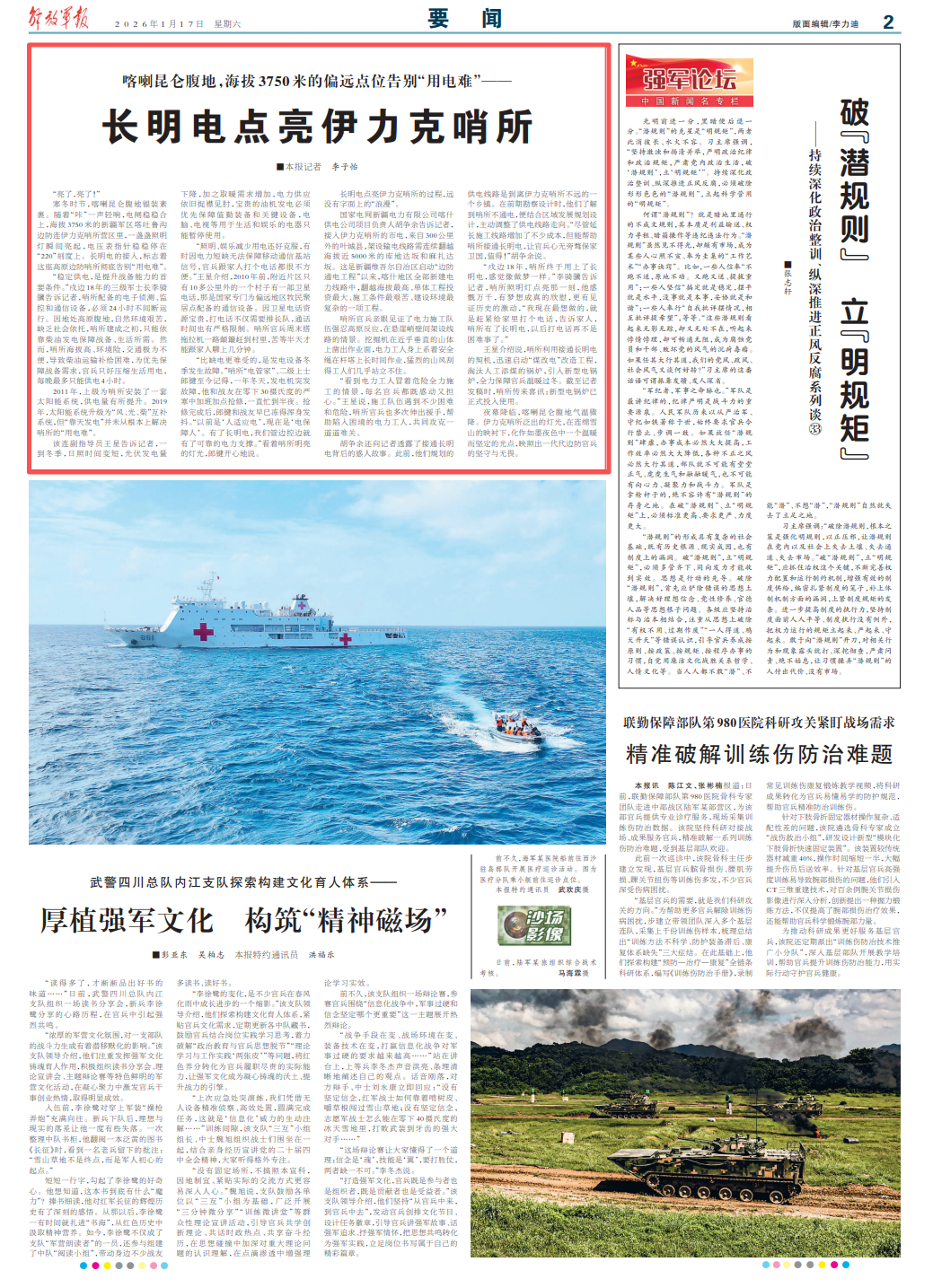
(来源:学习军团) 喀喇昆仑腹地,海拔3750米的偏远点位告别"用电难"—— 长明电点亮伊力克哨所 ■解放军报记者 李子怡 2011年,上级为哨所安装了一套太阳能系统,供电量有所提升。2019年,太阳能系统升级为"风、光、柴"互补系统,但"靠天发电"并未从根本上解 决哨所的"用电难"。 该连副指导员王星告诉记者,一到冬季,日照时间变短,光伏发电量下降,加之取暖需求增加,电力供应依旧捉襟见肘,宝贵的油机发电必须优先 保障值勤装备和关键设备,电脑、电视等用于生活和娱乐的电器只能暂停使用。 "照明、娱乐减少用电还好克服,有时因电力短缺无法保障移动通信基站信号,官兵跟家人打个电话都很不方便。"王星介绍,2010年前,附近片区 只有10多公里外的一个村子有一部卫星电话,那是国家专门为偏远地区牧民聚居点配备的通信设备。因卫星电话资源宝贵,打电话不仅需要排长 队,通话时间也有严格限制。哨所官兵周末搭拖拉机一路颠簸赶到村里,苦等半天才能跟家人聊上几分钟。 "比缺电更难受的,是发电设备冬季发生故障。"哨所"电管家"、二级上士郎键至今记得,一年冬天,发电机突发故障,他和战友在零下30摄氏度的 严寒中加班加点抢修,一直忙到半夜。抢 ...

专访核工业西南物理研究院副院长冯勇进:以强磁场与AI为翼 助力中国聚变能源加速产业化
Zhong Guo Zheng Quan Bao· 2026-01-17 02:56
Core Insights - The article discusses the advancements in nuclear fusion technology in China, particularly focusing on the Chengdu region's development as a hub for fusion energy, highlighted by the achievement of the "double hundred degree" breakthrough in the Chinese Circulation No. 3 project [1] Group 1: Technological Advancements - Strong magnetic field technology is becoming a crucial support for the commercialization of fusion energy, allowing for effective control of high-temperature plasma and reducing the size of Tokamak devices [2] - The Chinese Circulation No. 3 is the largest and highest-parameter magnetic confinement fusion device in China, achieving significant milestones such as the first domestic "double hundred degree" and a fusion triple product reaching 10^20 [2] - AI technology is being utilized to enhance plasma control, achieving near threefold energy confinement time through an "AI operator" that automates the adjustment of magnetic fields [4] Group 2: Industry Collaboration and Development - The Southwest Institute of Physics (西物院) plays a pivotal role in the fusion industry by driving the localization of key components and leading international collaborations, including participation in the ITER project [3] - The establishment of a controllable nuclear fusion innovation consortium aims to foster collaboration among various stakeholders, including state-owned enterprises and universities, to address key technological challenges [6] - The long-term goal is to achieve commercial fusion energy by 2045, with a roadmap that includes the development of experimental and demonstration reactors leading up to commercial deployment [6]
央企掌门人年薪披露:20人超90万元,国家电网董事长居首
2 1 Shi Ji Jing Ji Bao Dao· 2026-01-17 00:19
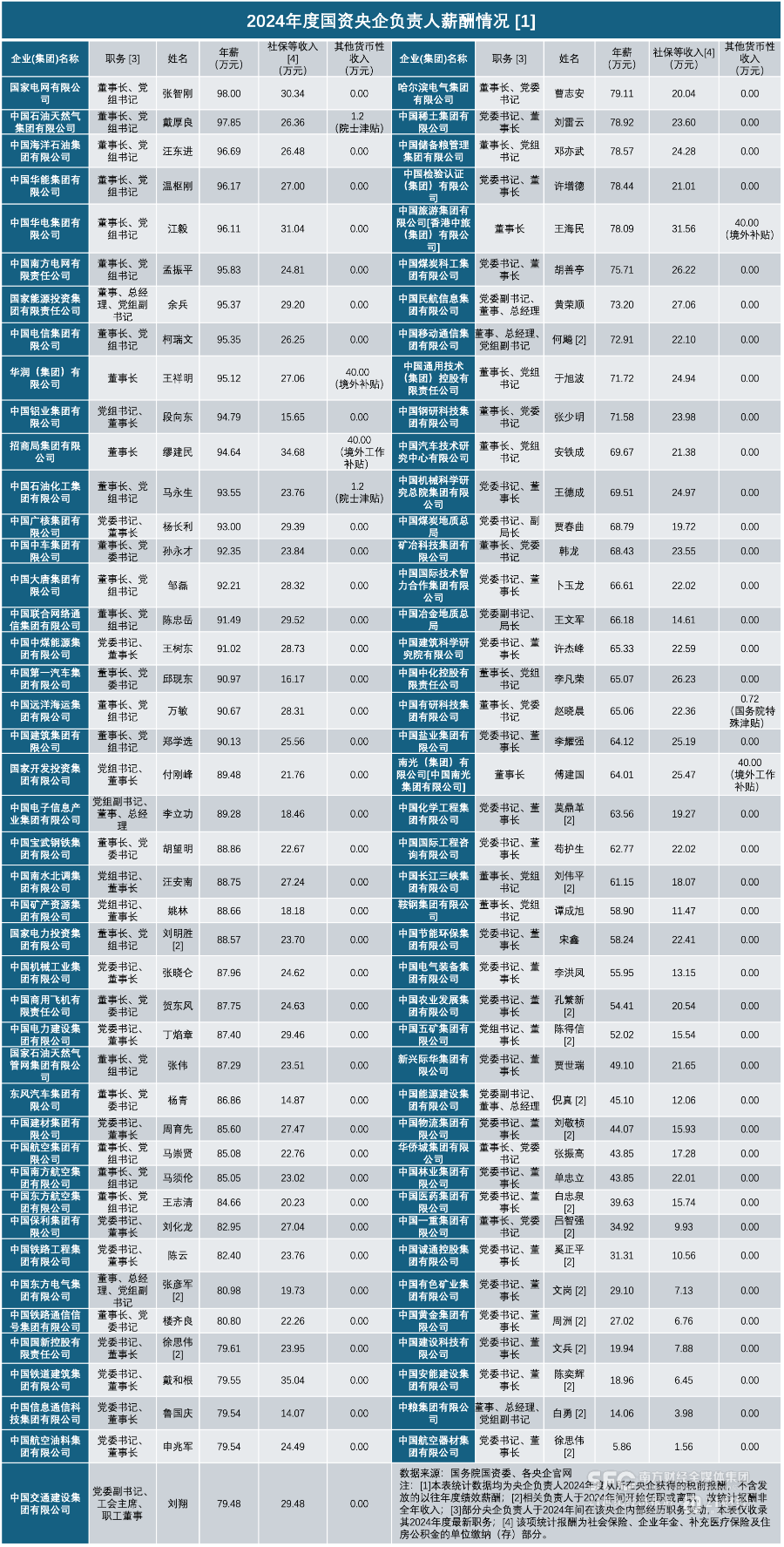
Core Insights - The State-owned Assets Supervision and Administration Commission (SASAC) disclosed the 2024 salary information for 87 central enterprises, revealing that 20 of them have annual salaries exceeding 900,000 yuan, primarily in the energy and power sector [1][4]. Group 1: Salary Disclosure - SASAC published salary data for 87 central enterprises, with notable omissions such as China Aerospace Science and Technology Corporation and China Shipbuilding Industry Corporation [1]. - Among the disclosed enterprises, 20 have annual salaries exceeding 900,000 yuan, with a concentration in the energy and power industries [1][4]. - Nine enterprises headquartered in the Guangdong-Hong Kong-Macao Greater Bay Area also reported salaries, with four exceeding 900,000 yuan [1][9]. Group 2: Top Earners - The highest reported salary is 980,000 yuan for Zhang Zhigang, Chairman of State Grid Corporation, whose salary is split due to a change in position during the year [4][7]. - Other top earners include Dai Houliang from China National Petroleum Corporation at 978,500 yuan, and Wang Dongjin from China National Offshore Oil Corporation at 966,900 yuan [4][7]. - A total of nine enterprises have salaries exceeding 950,000 yuan, all primarily in the energy sector [4][7]. Group 3: Performance Metrics - State Grid Corporation reported a total revenue of 3,945.928 billion yuan and a net profit of 77.298 billion yuan for 2024 [7]. - China Telecom achieved a revenue of 523.6 billion yuan in 2024, marking a 3.1% year-on-year increase [7]. - The performance of these enterprises aligns with SASAC's A-grade assessment for operational performance for the 2024 fiscal year [7]. Group 4: Regional Insights - In the Greater Bay Area, China Southern Power Grid, China Resources Group, China Merchants Group, and China General Nuclear Power Group reported salaries exceeding 900,000 yuan [9][10]. - China Southern Power Grid's Chairman earned 958,300 yuan, while China Resources Group's Chairman received 951,200 yuan, including overseas allowances [9][10]. - China Merchants Group's Chairman reported a salary of 946,400 yuan, also including overseas work allowances [10].



这组数据太提气!多个新高见证中国经济硬实力
Jing Ji Guan Cha Wang· 2026-01-16 22:52
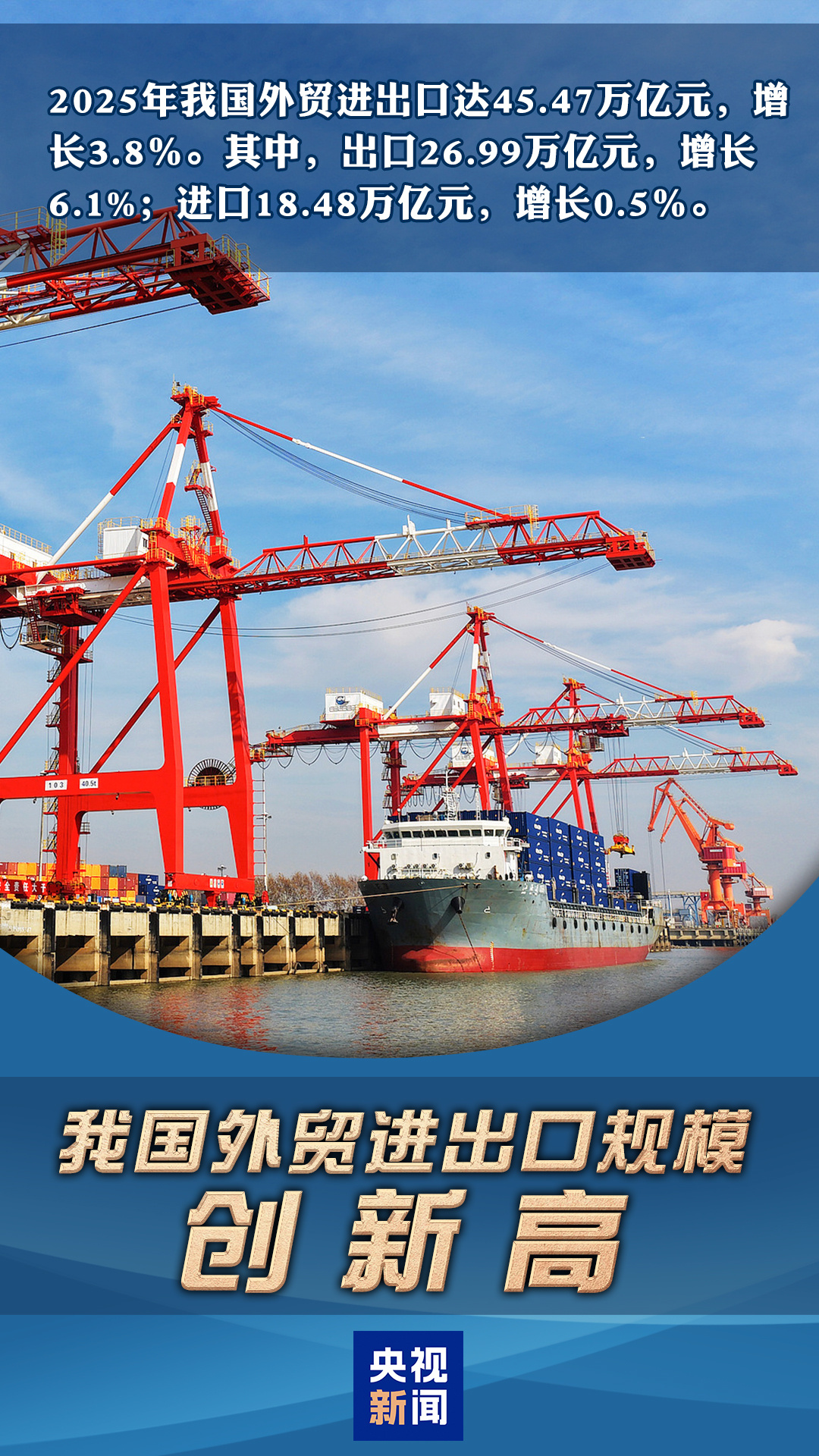
Group 1 - In 2025, China's automobile production and sales will both exceed 34 million units, setting a new historical high and maintaining the position as the world's largest for 17 consecutive years [4] - The foreign exchange market transaction volume in China will reach 42.6 trillion USD in 2025, with the corporate foreign exchange hedging ratio rising to 30%, both marking historical highs [7] - The number of inbound and outbound personnel through the Zhuhai Port of the Hong Kong-Zhuhai-Macao Bridge will exceed 31 million, with over 6.8 million vehicles, and the import and export value through the bridge will surpass 300 billion CNY [9] Group 2 - The inter-provincial electricity transaction volume in the State Grid's operating area will reach 1.67 trillion kWh in 2025, representing a year-on-year growth of 10%, with the transaction scale hitting a historical high [11]
以强磁场与AI为翼 助力中国聚变能源加速产业化
Zhong Guo Zheng Quan Bao· 2026-01-16 20:47
Core Insights - The article discusses the advancements in nuclear fusion technology in China, particularly focusing on the Chengdu Nuclear Fusion Industry Corridor and the achievements of the Southwestern Institute of Physics (西物院) in developing the Chinese Circulation No. 3, which has reached significant milestones in fusion research [1][2]. Group 1: Technological Advancements - The Chinese Circulation No. 3 is the largest and highest-parameter magnetic confinement fusion device in China, achieving the first domestic "double hundred million degrees" and "million ampere billion degree high confinement mode operation," with fusion triple product reaching 10^20 [2]. - High-temperature superconducting magnets are identified as a core technology for enhancing magnetic field strength, which is crucial for effective plasma control and commercializing fusion energy [1][2]. - AI technology has been integrated into plasma control, allowing for near "autonomous driving" capabilities in managing plasma stability, significantly increasing energy confinement time [4]. Group 2: Industrial Development - The Southwestern Institute of Physics plays a pivotal role in the fusion industry by driving the localization of key components and achieving international standards in fusion technology, including the development of the first wall prototype for the ITER project [3]. - The institute is also fostering international collaboration, positioning the Chinese Circulation No. 3 as a satellite device for ITER and enhancing China's influence in global fusion research [3]. Group 3: Future Plans and Goals - The Southwestern Institute of Physics aims to achieve commercial fusion energy by 2045, with a roadmap that includes the construction of a demonstration reactor by that year, and plans to start fusion energy burning experiments by 2027 [6][7]. - The focus will remain on high-temperature superconducting technology, with a target of achieving 20 Tesla in large magnet engineering applications, while addressing challenges in the mechanical structure and quench protection technology [5][7]. - Collaboration with various stakeholders, including state-owned enterprises and universities, is essential for developing a closed-loop system for research, validation, and commercialization of fusion technology [5][7].
2026年全国电力安全生产电视电话会议在京召开
国家能源局· 2026-01-16 13:04
Core Viewpoint - The National Energy Administration emphasizes the importance of safety production in the electricity sector for 2026, aiming to enhance the safety level and ensure high-quality economic development [2][4]. Group 1: Meeting Overview - The meeting held on January 16, 2026, focused on summarizing previous work, analyzing the current situation, and deploying key tasks for the year [2]. - The meeting was attended by key officials, including Wang Hongzhi, the Secretary of the Party Leadership Group and Director of the National Energy Administration, and He Yang, the Deputy Director [2]. Group 2: 2025 Achievements - In 2025, the electricity industry maintained a stable safety production situation, contributing to high-quality economic development [4]. - The industry adhered to the guidance of Xi Jinping's thoughts and implemented the national security strategy, focusing on safety, supply, and transformation [4]. Group 3: 2026 Key Tasks - For 2026, the meeting outlined the need to implement the spirit of the 20th National Congress and prioritize safety in electricity production [4]. - Key tasks include enhancing the essence of electricity safety, conducting special governance actions, and strengthening emergency response capabilities [4]. - The meeting also emphasized the importance of high-level safety regulation to support economic development [4]. Group 4: Educational and Regulatory Actions - The meeting included a viewing of a safety education film and reported on the 2025 special actions for electricity safety production [5]. - It also discussed the safety quality rectification of pumped storage power station construction projects [5].

大涨!四万亿砸中赛道
Ge Long Hui A P P· 2026-01-16 08:51
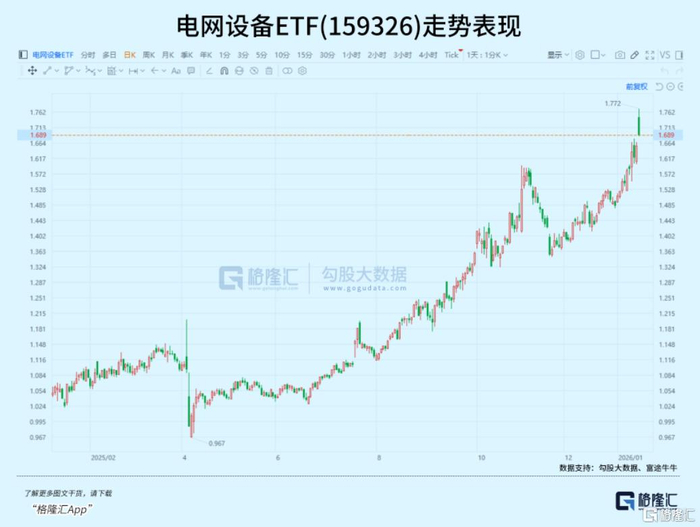
Group 1 - The core message highlights a significant investment plan by the State Grid, with a projected fixed asset investment of 4 trillion yuan during the 14th Five-Year Plan, representing a 40% increase compared to the previous plan [3] - The investment in the power grid is expected to create a clear growth space for the industry over the next five years, focusing on green transformation and the construction of a new power system [7] - The unique ETF for power grid equipment has seen substantial capital inflow, with over 24.39 billion yuan in net inflow in the past five days, indicating strong market interest [8][10] Group 2 - The demand for power grid equipment is expected to surge due to the rapid growth of AI and data centers, which are projected to consume a significant portion of electricity in the coming years [11][12] - The structural shortage of power transformers in North America, exacerbated by aging infrastructure and high demand, presents a lucrative opportunity for Chinese suppliers [15][18] - The global average annual investment in power grids is projected to reach 500 billion USD from 2022 to 2030, with Chinese companies likely to benefit significantly from this trend [18]
四川大决策投顾:全球电网投资加快背景下,特高压高景气可期
Sou Hu Cai Jing· 2026-01-16 08:51
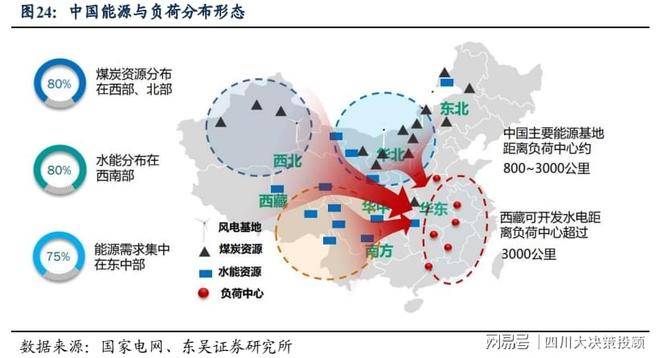
Core Insights - The ultra-high voltage (UHV) industry is a key carrier for energy transition, driven by the urgent demand for power delivery from western renewable energy bases under the "dual carbon" goals, leading to accelerated UHV construction [1][19] - Investment during the 14th Five-Year Plan period is expected to remain stable, with ample planned projects providing high certainty for upstream equipment performance [1][19] Group 1: UHV Construction and Demand - UHV construction aims to address the imbalance of electricity resources and demand in China, with resources concentrated in inland areas and demand in urbanized eastern coastal regions [2] - The recent peak in domestic UHV construction began in 2022, with approvals for 5, 5, 4, and 5 projects in 2022, 2023, 2024, and 2025 respectively, driven by the demand for power delivery from renewable energy bases [9] - The National Energy Administration has emphasized the importance of grid investment for renewable energy consumption, accelerating the construction of supporting projects [9] Group 2: UHV Industry Chain - The UHV industry chain is complete, divided into three main segments: upstream (core raw materials, special insulation materials, key components), midstream (core equipment manufacturing), and downstream (final users and investors like State Grid and Southern Grid) [4] - Key players in the midstream include companies like State Grid NARI, XJ Electric, Pinggao Electric, and TBEA, focusing on both DC and AC UHV technologies [4] Group 3: Global and Domestic Investment Trends - Global UHV investment is entering an upward cycle, with a projected CAGR of 6.7% from 2021 to 2024, driven by the integration of renewable energy and aging infrastructure [6] - The State Grid's fixed asset investment plan for the 14th Five-Year Plan has increased significantly to 4 trillion yuan, a 40% increase from the previous plan, focusing on UHV DC transmission projects [13] Group 4: Competitive Landscape - The competitive landscape of the UHV equipment market is stable, with high technical barriers and a consistent market share among core suppliers [15] - Major suppliers include State Grid NARI, XJ Electric, and China XD Electric, with significant shares in both DC and AC core equipment [16] Group 5: International Expansion Opportunities - The UHV industry is entering a significant international expansion phase, with China's mastery of core UHV technology and extensive experience in construction and operation [17] - Opportunities for international expansion are driven by demand for grid upgrades and renewable energy integration in countries along the Belt and Road Initiative and in developed regions [18] Group 6: Investment Logic - The investment logic in the UHV industry is clear, with urgent power delivery needs from western renewable energy bases driving continuous construction, supported by stable investment and ample project planning during the 14th Five-Year Plan [19]