Scale AI

Search documents
X @Bloomberg
Bloomberg· 2025-08-29 13:04
Lucy Guo became a billionaire by age 30 after co-founding Scale AI. But her new venture, Passes, faces entrenched rivals in the celebrity influencer market. https://t.co/jjHSWEFry4 ...
AI人才争夺战加大薪资差距,OpenAI前副总裁:能留住人才是最重要的
3 6 Ke· 2025-08-29 03:11
Core Insights - The competition for AI talent has intensified, leading to a widening salary gap between researchers and non-researchers in large model companies [1][3] - Companies are struggling to retain talent due to significant salary disparities, which may lead to employee turnover [3][16] - The ability to command higher salaries is increasingly linked to individual capabilities, with those possessing unique skills having stronger pricing power in the job market [4][7] Group 1: Talent Competition - Major labs are aggressively recruiting research talent, resulting in noticeable salary differences between researchers and non-researchers [3] - The former OpenAI VP, Peter Deng, emphasizes the necessity for labs to retain talent while attracting skilled individuals from competitors [3][4] - Companies must consider long-term strategies to maintain competitiveness, rather than focusing solely on immediate advantages [8] Group 2: Company Strategies - Meta has evolved from a campus website to a global social platform, continuously leveraging its advantages to reach new heights [9][10][11] - The company is currently investing in hardware platforms and future-oriented superintelligence as part of its strategic vision [12][14] - The future of Meta's AI strategy remains uncertain, but the development of personalized agents is a key focus area [15] Group 3: Salary Dynamics - High salaries offered by companies like Meta have prompted criticism from competitors, who are concerned about the impact on company culture [16][18] - The aggressive recruitment tactics and substantial compensation packages may undermine the emphasis on work content and mission, potentially harming corporate culture [18]



Meta raids Google DeepMind and Scale AI for its all-star superintelligence team
Business Insider· 2025-08-26 09:00
Core Insights - Meta is aggressively recruiting talent from Google's AI division DeepMind and Scale AI to bolster its superintelligence team, indicating a strategic focus on enhancing its AI capabilities [1][2][3] Group 1: Recruitment from DeepMind - Meta has hired at least 10 researchers from Google's DeepMind since July, including key contributors to Google's advanced AI models [1] - Notable hires include Yuanzhong Xu, who played a significant role in developing LaMDA and PaLM 2, and Mingyang Zhang, who has expertise in information retrieval for large language models [9][11] - Other DeepMind recruits include Tong He, who contributed to a gold medal achievement at the International Mathematical Olympiad, and Xinyun Chen, who specializes in autonomous code generation [10][12] Group 2: Recruitment from Scale AI - Meta has also recruited at least six researchers from Scale AI, particularly for its safety and evaluations team, following its acquisition of nearly half of Scale AI for $14 billion [2][3] - Key hires from Scale AI include Ziwen Han and Nathaniel Li, who co-authored a challenging test for AI models, and Summer Yue, who now leads the alignment group at Meta's Superintelligence Labs [14][15] - The SEAL (Safety, Evaluations, and Alignment Lab) team from Scale AI focuses on ensuring AI models align with human values and improve performance [13]


走进办公室,美国投资巨头合伙人惊讶:都在用中国AI?
Guan Cha Zhe Wang· 2025-08-22 07:28
Core Insights - The article highlights the increasing influence of Chinese open-source AI models in the global market, with a significant number of startups in Silicon Valley reportedly using these models [1][2] - The competitive landscape is shifting, as Chinese companies focus on open-source development while American firms, like OpenAI, are pressured to adapt their strategies in response to this trend [2][5] Group 1: Chinese AI Models - Chinese startup DeepSeek has gained global attention by releasing an advanced AI model for free, marking a significant shift in the AI landscape [1] - The performance of Chinese open-source models has outperformed similar models from American companies like Meta in various intelligence tests conducted this year [2] - The competitive enthusiasm among Chinese developers is raising alarms in the West, indicating a potential shift in the balance of power in AI development [2] Group 2: American AI Companies' Response - OpenAI's CEO Sam Altman acknowledged the pressure from Chinese open-source models, leading to a change in their model release strategy [2][5] - OpenAI recently launched two open-weight models, gpt-oss-120b and gpt-oss-20b, marking a strategic shift towards increasing accessibility and expanding their developer ecosystem [5] - Despite this move, the reception of these models has been mixed, with criticisms regarding their lack of standout features compared to OpenAI's proprietary offerings [5][6] Group 3: Industry Dynamics - The article notes a trend among American companies, including Meta, to shift towards more closed models, which could hinder their competitiveness in the open-source AI space [7][8] - The divergence in strategies between Chinese and American firms is leading to significant differences in revenue generation and innovation potential [10] - The focus on open-source models in China allows for broader application scenarios, enabling easier adaptation for various sectors, while American firms prioritize proprietary models for profit [10]

“天价挖角”踩刹车,刚建3个月的团队解散,28岁华人接管Meta AI,图灵奖大佬也向他汇报
3 6 Ke· 2025-08-21 11:05
Core Insights - Meta has paused recruitment for its newly established AI department and is undergoing a significant internal reorganization, marking a shift from aggressive talent acquisition to a focus on internal structure and efficiency [1][3][4] Group 1: Recruitment and Financial Moves - Meta previously offered up to $100 million in signing bonuses to attract top AI talent from competitors like OpenAI and Anthropic, and made a notable investment of $14.3 billion to acquire 49% of Scale AI [3][4] - The company is now in a phase characterized by "burning money," indicating a shift in strategy as it reassesses its AI investments and organizational structure [3][4] Group 2: Organizational Structure - The newly formed Meta Superintelligence Labs (MSL) will consist of four teams: Research, Training, Product, and Infrastructure, each with specific roles in advancing AI capabilities [6][8][9] - The Research team will include TBD Lab and FAIR, with FAIR transitioning from a basic research focus to an "innovation engine" that supports large-scale model training [7][8] - Alexandr Wang, the head of MSL, has consolidated leadership, with most team leaders reporting directly to him, indicating a streamlined decision-making process [9] Group 3: Team Dynamics and Internal Challenges - Internal tensions have arisen between new hires and existing employees over compensation disparities, leading to dissatisfaction and potential turnover [4][5] - The recent hiring freeze is framed by Meta as a necessary organizational planning step, but it raises questions about whether this is a natural adjustment or a sign of an impending investment bubble in AI [4][5] Group 4: Future Outlook and Market Reactions - Analysts express mixed views on the implications of Meta's restructuring, with some suggesting it is a tactical adjustment rather than a retreat from AI investment [5][11] - The ongoing reorganization is seen as a move to enhance efficiency and accelerate AI product development, although concerns about team stability and talent retention persist [11][12]

砸钱行动告一段落!Meta(META.US)暂停招聘AI人才
Zhi Tong Cai Jing· 2025-08-21 07:09
Group 1 - Meta has confirmed the suspension of hiring in its newly established AI department, marking the end of a high-priced talent acquisition spree [1] - The hiring freeze is part of a broader organizational restructuring, with plans to establish a solid framework for superintelligence projects after personnel are in place [1] - Meta's AI business is being reorganized into four main teams under the "Meta Superintelligence Lab," focusing on building machine superintelligence, AI products, infrastructure, and long-term project exploration [1] Group 2 - Concerns about over-investment in AI have arisen, coinciding with a broader sell-off in the tech sector [2] - Despite the hiring freeze, analysts believe that Meta will not significantly cut its AI investments, viewing the pause as a "digestive period" after substantial spending [2] - The hiring freeze is seen as a natural adjustment point for Meta after completing several large acquisitions and high-level recruitments [2]
科技股的“敏感时刻”,Meta停止了“重金挖人”
Hua Er Jie Jian Wen· 2025-08-21 06:33
Core Viewpoint - Meta has paused its AI talent recruitment amid a broader restructuring of its AI department, coinciding with a significant sell-off in US tech stocks and growing concerns about the pace of AI investments [1][2]. Group 1: Recruitment and Restructuring - Meta confirmed that it has suspended hiring for its new AI department, effective last week, as part of a larger reorganization [1]. - The restructuring divides Meta's AI business into four teams, focusing on machine superintelligence, AI products, infrastructure, and long-term projects, all under the Superintelligence Lab [1]. Group 2: Market Reactions and Analysis - Analysts view Meta's hiring freeze not as a strategic contraction but as a natural pause after a period of aggressive spending and recruitment [2]. - Dan Ives from Wedbush Securities suggests that the hiring freeze is a "digestive mode" following significant investments and acquisitions [2]. - Concerns about an "AI bubble" have been heightened by recent comments from OpenAI's CEO, Sam Altman, although many analysts disagree with this perspective, arguing that tech stocks are undervalued in the context of the ongoing AI revolution [3]. Group 3: Investment and Spending - Prior to the hiring pause, Meta had been aggressively investing in AI talent, including offering signing bonuses up to $100 million and acquiring a 49% stake in AI startup Scale AI for $14.3 billion [3]. - The recruitment of Alexandr Wang, founder of Scale AI, to lead Meta's AI lab highlights the company's commitment to the AI talent race, making the pause in plans more surprising [3].
Meta puts the brakes on its massive AI talent spending spree
CNBC· 2025-08-21 04:39
Core Insights - Meta Platforms has paused hiring for its new artificial intelligence division, marking the end of a significant spending spree on AI talent acquisition [1][2] - The hiring freeze is part of a broader restructuring within the company, aimed at creating a solid organizational structure for its AI initiatives [2] - Meta's AI efforts have been divided into four teams under the "Meta Superintelligence Labs," reflecting CEO Mark Zuckerberg's ambition to develop AI that surpasses human cognitive abilities [3] Hiring and Restructuring - The hiring pause went into effect last week and is described as basic organizational planning, including yearly budgeting and planning exercises [2] - The four teams within the AI division include a machine superintelligence team, an AI products division, an infrastructure division, and a long-term projects division [2] Financial Investments and Acquisitions - Meta has aggressively invested in AI this year, including offers for top talent that reportedly included signing bonuses up to $100 million [3] - A notable acquisition involved Meta purchasing a 49% stake in Scale AI for $14.3 billion, with founder Alexandr Wang now leading the company's AI lab focused on the Llama series of open-source large language models [4]

估值飙升、比字节跳动还高,OpenAI真的值5000亿美元?
Feng Huang Wang· 2025-08-20 04:27
Core Insights - OpenAI's valuation is projected to reach approximately $500 billion, making it the most valuable private company globally, surpassing SpaceX and ByteDance [1] - The valuation is based on two transactions: a $300 billion financing led by SoftBank and a secondary market sale of employee shares valuing the company at $500 billion [1] - An investor compares the current AI development to the dawn of the internet, suggesting a significant technological wave is underway [1] Financial Projections - If ChatGPT reaches 2 billion users, generating $5 per user monthly, annual revenue could hit $120 billion, supporting a valuation of $1.5 trillion [2] - Current active users of ChatGPT are around 700 million, with less than 10% being paid users, indicating ambitious growth targets [3] Competitive Landscape - The $5 per user revenue estimate may underestimate competition from giants like Google and Meta, raising concerns about customer retention and cost management [3] - Investors expect OpenAI to achieve a valuation exceeding $1 trillion within two to three years to justify their investments [3] Cost Structure - OpenAI is projected to burn through $8 billion in cash this year, with significant costs associated with infrastructure and data centers [4] - The overall costs are expected to rise as larger models are trained and user queries increase, despite advancements in chip technology [5] Investment Climate - There is a strong appetite for AI startups, with 65% of venture capital funding this year directed towards AI companies [5] - The recent funding rounds indicate a potential bubble, with significant investments flowing into AI ventures [6] CEO's Perspective - OpenAI's CEO acknowledges the possibility of a bubble but emphasizes that historical bubbles often have real value backing them [6] - The ability of the CEO to sell a compelling vision is crucial for the company's high valuation, with investors betting on ChatGPT's essentiality akin to Google [6]
AI“烧钱大战”仍然如火如荼! AI初创公司吞下1220亿美元 一己之力带动VC复苏
智通财经网· 2025-08-20 04:13
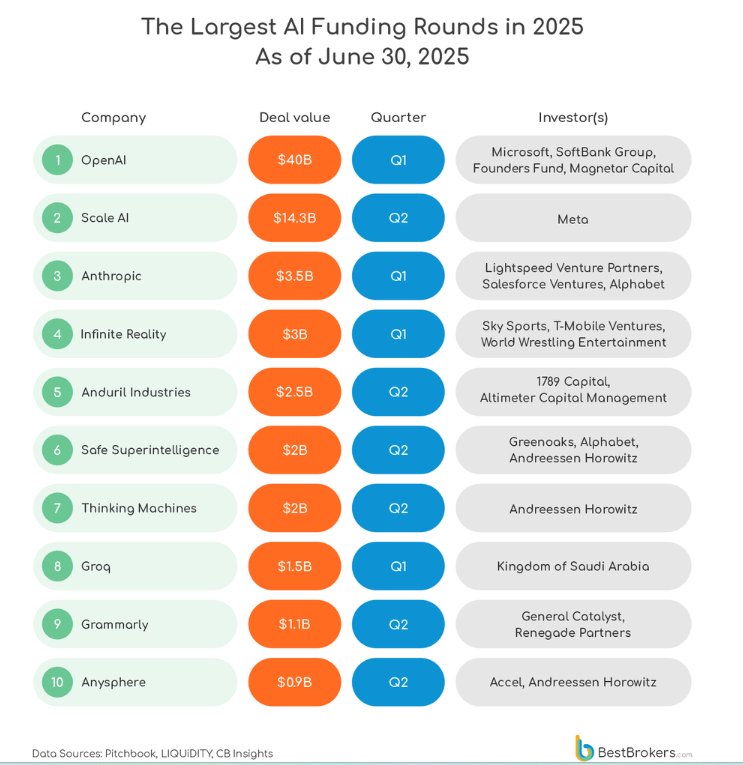
Core Insights - The global AI startup funding has reached an astonishing $122 billion since the beginning of the year, with the US market accounting for $104.3 billion, representing 85.5% of the total raised [1] - The AI funding landscape continues to grow, with a projected $110 billion in 2024 and significant investments from major players like Meta and Anduril [1][5] - Despite a slight decrease in total investment from the previous quarter, AI-related funding remains at historically high levels [4][5] Investment Trends - In Q2, global AI startup funding totaled $50 billion, nearly half of the total VC investment of approximately $101.5 billion during the same period [1][5] - The largest funding round this quarter was Meta's $14.3 billion investment in Scale AI, which resulted in CEO Mark Zuckerberg acquiring a 49% stake [5] - There is a notable shift towards AI projects with "intensive infrastructure," supported by significant public and private sector investments [6] Market Dynamics - The AI-driven venture capital market has shown resilience, with a year-over-year growth of 7.28% from 2023 to 2024 and 9.26% from 2024 to 2025, totaling a 17.22% increase over two years [5] - Major VC firms like SoftBank, Andreessen Horowitz, and Sequoia continue to dominate the AI startup funding landscape [7] - The concentration of capital in leading AI startups has created a challenging environment for smaller companies seeking funding [7] Future Projections - OpenAI plans to invest trillions in core AI infrastructure, including AI chips and advanced power systems, indicating a long-term commitment to AI development [8] - Analysts predict that major tech companies will spend over $350 billion on AI infrastructure in 2023, with expectations of nearly 50% growth in 2024 [8] - Morgan Stanley forecasts that the AI investment boom could add $13 to $16 trillion in value to the S&P 500 index, representing a potential 30% increase [9][10]