联发科

Search documents
联发科新赛道 AI 自研芯片
Jing Ji Ri Bao· 2025-11-23 23:19
Core Insights - Major international companies are investing heavily in self-developed AI chip technology, creating new business opportunities. MediaTek is leveraging its years of R&D strength to enter the ASIC design service market, targeting high-end orders and capitalizing on AI opportunities in cloud data centers [1] Group 1: Company Developments - MediaTek's previous product focus was primarily on edge devices, with three main product lines: mobile chips, smart device platforms, and power management ICs. The company is now making significant strides into the data center AI accelerator ASIC market, marking a major step into cloud business [1] - Although MediaTek has not disclosed its AI accelerator ASIC client list, speculation about its business expansion continues. After securing its first client, the company mentioned that it is working on more complex follow-up projects, expected to contribute to revenue starting in 2028 [1] - MediaTek is actively engaging with a second large-scale data center operator to discuss new ASIC projects, expressing confidence in the rapid growth of related business in the future [1] Group 2: Market Potential - MediaTek has revised its total addressable market (TAM) estimate for data center ASICs, increasing it from $40 billion two years ago to $50 billion, in line with the upward adjustment of capital expenditure outlooks from cloud service providers [1] - The CEO of MediaTek, Cai Lixing, revealed that the company's goal is to achieve approximately 10% to 15% market share within the next two years. Analysts believe that as the data center ASIC market expands, even maintaining a stable market share will contribute to overall performance growth [2]
高通与联发科明年新挑战:2nm与LPDDR6太贵
半导体行业观察· 2025-11-23 03:37
Core Insights - Qualcomm and MediaTek are preparing to launch their flagship chips, Snapdragon 8 Elite Gen 6 and Dimensity 9600, while facing rising DRAM prices, particularly for LPDDR6 RAM, which may limit its availability to only the Pro versions of these chipsets [2][3] - The increase in memory costs is expected to negatively impact flagship devices in 2026, as both companies will have to either reduce profits or push their smartphone partners to raise prices [3][4] - Qualcomm's Snapdragon 8 Elite Gen 6 will have two versions, with only one supporting LPDDR6 RAM, while MediaTek's Dimensity 9600 will have a single version [2][3] Pricing and Production Insights - The estimated cost for each wafer from TSMC's 2nm process is around $30,000, which adds to the financial pressure on Qualcomm and MediaTek [3] - There are rumors that Chinese memory manufacturers are preparing for mass production of the new DRAM technology, which could provide some pricing negotiation leverage for Qualcomm and MediaTek [2] - Memory prices are expected to stabilize starting in 2027, potentially making smartphones with Snapdragon 8 Elite Gen 7 and Dimensity 9700 more affordable [3] Performance Insights - The N2P node from TSMC offers only a 5% performance improvement over the N2 node, yet Qualcomm and MediaTek aim to gain an edge over Apple, even if it results in higher prices for their Snapdragon 8 Elite Gen 6 and Dimensity 9600 [4]


这条芯片赛道,大火
3 6 Ke· 2025-11-22 03:18
Core Insights - The ASIC (Application Specific Integrated Circuit) market is experiencing unprecedented growth due to the surging demand for AI computing power, positioning it as a new focal point in the semiconductor industry [1][11]. Group 1: ASIC Market Dynamics - The emergence of ASICs was driven by the need for customized chips that meet specific application requirements, contrasting with the traditional model of generic chip production [2][3]. - The introduction of TSMC and the maturation of EDA tools allowed system vendors to adopt a customer-owned tools (COT) model, enhancing supply chain flexibility [4]. - The AI boom in the 2010s has made ASICs the most important and fastest-growing application area, with major tech companies like Google, Tesla, and Amazon investing heavily in custom ASICs [6][11]. Group 2: Key Players and Market Share - Broadcom and Marvell have emerged as the dominant players in the ASIC market, collectively holding over 60% market share, with Broadcom alone capturing 55-60% [12]. - The collaboration between Broadcom and Google has been particularly successful, leading to the development of multiple generations of TPU products [13]. - Marvell focuses on Amazon AWS, developing AI training and inference chips, securing a significant portion of production capacity for upcoming projects [13]. Group 3: Financial Performance and Projections - Broadcom's AI business revenue exceeded $4.4 billion, a 46% year-over-year increase, while Marvell's data center revenue reached $1.441 billion, a 76% increase [12]. - By 2028, global data center capital expenditures are projected to exceed $1 trillion, with ASIC market size expected to reach $55.4 billion, reflecting a compound annual growth rate (CAGR) of 53% [14]. - The growth in the ASIC market is driven by both custom XPU business and related peripheral markets, with the latter expected to grow at a CAGR of 90% [14][15]. Group 4: Technological Advancements - ASICs offer significant advantages in performance optimization, power efficiency, and physical size, making them ideal for AI applications [7][8][9]. - The development of advanced SerDes technology is crucial for high-speed data transmission in AI training tasks, with Broadcom and Marvell leading in this area [17][18]. Group 5: Competitive Landscape - Traditional chip manufacturers like Intel and Qualcomm are pivoting towards ASICs, with Intel focusing on custom chip services and Qualcomm acquiring Alphawave to enhance its SerDes capabilities [21][24]. - Taiwanese companies like MediaTek and the trio of design service firms (WorldChip, Creative, and Chipone) are also emerging as significant players in the ASIC market, leveraging their relationships with foundries like TSMC [30][31][34]. Group 6: Challenges and Future Outlook - The ASIC market faces challenges such as increasing competition and potential pressure on profit margins due to the bargaining power of cloud giants [41]. - Despite these challenges, the ASIC market is expected to continue thriving, driven by the ongoing demand for AI computing power and the evolution of industry dynamics [41].
这条芯片赛道,大火
半导体行业观察· 2025-11-22 03:09
Core Viewpoint - The article highlights the rapid growth and significance of ASIC (Application Specific Integrated Circuit) in the semiconductor industry, particularly driven by the increasing demand for AI computing power. Unlike general-purpose GPUs, ASICs are tailored for specific applications, leading to superior performance and efficiency in AI tasks [1][4][11]. Group 1: ASIC Development and Market Dynamics - ASIC emerged in the 1980s as a response to the need for customized chips that could meet specific product requirements, breaking away from the traditional model of generic chip production [1][2]. - The introduction of TSMC and the evolution of EDA tools in the 1990s allowed system manufacturers to design chips independently, leading to the customer-owned tools (COT) model, which enhanced supply chain flexibility [3]. - The success of Google's TPU in 2016 marked a turning point, establishing ASIC as a critical component in AI infrastructure, with major tech companies recognizing the need for customized chips to optimize efficiency and cost [4][5]. Group 2: Advantages of ASIC - ASICs offer extreme performance optimization by focusing resources on specific tasks, such as matrix multiplication and convolution operations, which are essential for AI computations [7][8]. - The energy efficiency of ASICs is a significant advantage, especially in AI applications where power consumption is critical. ASICs can minimize static power loss by eliminating unnecessary components [9][10]. - The compact design of ASICs allows for powerful functionalities to be integrated into small form factors, which is increasingly important in modern devices like smartphones and IoT applications [10][11]. Group 3: Market Leaders and Financial Performance - Broadcom and Marvell have emerged as dominant players in the ASIC market, with Broadcom reporting AI business revenues exceeding $4.4 billion, a 46% year-over-year increase, and Marvell's data center revenue reaching $1.441 billion, a 76% increase [12][14]. - The combined market share of Broadcom and Marvell exceeds 60%, with Broadcom holding 55-60% and Marvell 13-15%, primarily serving top-tier cloud service providers [12][13]. - Marvell predicts that global data center capital expenditures will surpass $1 trillion by 2028, with ASIC market size expected to reach $55.4 billion, growing at a CAGR of 53% from 2023 to 2028 [14][15]. Group 4: Emerging Competitors and Strategic Moves - Traditional semiconductor companies like Intel and Qualcomm are pivoting towards ASIC markets, with Intel focusing on custom chip services and Qualcomm acquiring Alphawave to enhance its SerDes capabilities [22][24]. - MediaTek is also making strides in the ASIC space, securing contracts with major tech firms like Google and Meta for custom chip designs [29][31]. - Taiwanese companies such as Wistron and Chipone are capitalizing on the ASIC trend, leveraging their relationships with TSMC and their technical expertise to secure significant market positions [32][34]. Group 5: Future Outlook and Challenges - The ASIC market is expected to continue growing, driven by the increasing complexity of AI models and the need for efficient computing solutions [16][17]. - However, challenges remain, including the need for advanced IP design capabilities and the ability to manage complex system integrations as AI applications evolve [17][20]. - Domestic Chinese firms are also positioning themselves to capture market share in the ASIC space, despite facing challenges in IP accumulation compared to international giants [39][41].


苹果自研WiFi芯片,吊打所有友商
半导体行业观察· 2025-11-19 01:35
Core Insights - The article highlights that Apple's N1 network chip in the iPhone 17 outperforms similar chips from Qualcomm, MediaTek, and Broadcom in network speed tests, marking a significant advancement in Apple's technology [2][10][17]. Performance Comparison - The N1 chip shows a nearly 40% increase in speed compared to the previous iPhone 16 model, with an average download speed of 329.56 Mbps compared to 236.46 Mbps [17]. - In North America, the iPhone 17 achieves a maximum speed of 416.14 Mbps, surpassing competitors like the Pixel 10 Pro at 411.21 Mbps and Samsung Galaxy S25 at 323.69 Mbps [3][25]. - The iPhone 17's 90th percentile download speed reaches 976.39 Mbps, the highest among all devices in North America [7][29]. Technical Specifications - The N1 chip integrates Wi-Fi 7 and Bluetooth 6, but has a channel width limit of 160 MHz, which may restrict peak performance compared to competitors that support 320 MHz [8][26]. - Despite this limitation, the N1 chip's performance remains competitive due to the current low adoption rate of 320 MHz routers, which diminishes its impact on real-world usage [29][32]. User Experience - The N1 chip enhances the user experience by providing more stable performance in less-than-ideal Wi-Fi conditions, with a 60% improvement in the 10th percentile speed [20][22]. - The iPhone 17 consistently outperforms the iPhone 16 across various markets, indicating a genuine improvement in device performance rather than a temporary effect [13][17]. Market Insights - The highest average download speeds for iPhone 17 users are recorded in Singapore (613.80 Mbps) and France (601.46 Mbps), reflecting the prevalence of gigabit fiber networks in these regions [25]. - North America has the highest proportion of Wi-Fi 7 users at 20.62%, followed by Northeast Asia (5.38%) and Europe (4.95%) [7].


DisplayPort,加速走向汽车
半导体芯闻· 2025-11-18 10:29
Core Points - VESA has been dedicated to establishing and promoting universal and compatible solutions for the video and electronics industry for over 30 years, with the DisplayPort standard becoming a key alternative to DVI, LVDS, and VGA [1] - The automotive sector is emerging as a new focus for DisplayPort, driven by the increasing number of high-resolution displays in vehicles that provide critical information for safe driving [4][5] - The introduction of the DP AE compliance testing model in May 2025 aims to standardize the verification of data integrity between display devices and sources, addressing previous industry gaps [4][5] Summary by Sections VESA and DisplayPort - VESA is an international non-profit organization that includes over 340 manufacturers in the hardware, software, and electronics sectors, focusing on video standards [1] - The DisplayPort standard is recognized for its advanced digital protocol and scalability, enhancing digital display experiences across various devices [1] Automotive Display Technology - The rise of smart and connected vehicle technologies has led to an increase in the number of in-car high-resolution displays [4] - Most automotive displays currently utilize DisplayPort or eDP for video data transmission from the central vehicle computer [4] - The DP AE standard, set to be released in May 2025, will provide a comprehensive compliance testing model to ensure data integrity and security in automotive displays [4][5] DP AE Standard Features - The DP AE standard is compatible with the latest DisplayPort 2.1a and eDP 1.5a versions, ensuring functional and information security for automotive displays [5] - It supports both compressed and uncompressed video, allowing for multi-stream transmission of up to 16 display regions [5] - The standard aims to meet the highest safety requirements (ISO 26262 ASIL-D) for automotive display interfaces [5] Industry Collaboration and Future Directions - VESA's DP AE standard incorporates critical safety protocols to enhance data integrity and prevent unauthorized access [10] - Industry leaders emphasize the importance of advanced, safe, and reliable display interfaces in the automotive sector, encouraging collaboration among silicon IP providers and automotive suppliers [10][11]

12份料单更新!出售安世、威世、英飞凌等芯片
芯世相· 2025-11-18 07:56
Core Insights - The article discusses the challenges of managing excess inventory in the semiconductor industry, highlighting the financial burden of storage and capital costs associated with unsold materials [1] - It promotes a service called "Chip Superman," which has served 21,000 users and offers rapid inventory clearance solutions [9] Group 1: Inventory Management - Excess inventory of 100,000 units incurs monthly storage and capital costs of at least 5,000, leading to a potential loss of 30,000 after six months [1] - The article emphasizes the difficulty in promoting and selling excess materials, suggesting that companies can seek assistance from Chip Superman for better pricing and faster transactions [1][10] Group 2: Inventory Offerings - Chip Superman has a substantial inventory, including over 5,000 million chips across 1,000+ models and 100 brands, with a total inventory value exceeding 100 million [8] - Specific excess materials available for sale include various semiconductor components from brands like 安世 (Nexperia), 英特尔 (Intel), and others, with quantities ranging from thousands to hundreds of thousands [4][5] Group 3: Purchase Requests - The article lists specific semiconductor components that are in demand, indicating a market for certain models, such as the MICROCHIP ATMEGA2561-16AU and ADI LTC2174IUKG-14, with quantities requested in the thousands [6] Group 4: Service Features - Chip Superman claims to complete transactions in as little as half a day, providing a quick solution for companies looking to clear their inventory [9] - The company operates a 1,600 square meter smart storage facility, ensuring quality control for each component through an independent laboratory [8]


电子行业周报:先进制程产能需求持续走高,关注头部代工厂产能扩张进程-20251117
Shanghai Securities· 2025-11-17 11:24
Investment Rating - The report maintains an "Overweight" rating for the electronics industry [1] Core Insights - Demand for advanced process capacity is continuously rising, with TSMC's 3nm capacity facing severe shortages due to strong demand from major AI chip clients like Nvidia [3][4] - TSMC's 3nm process is expected to have a significant supply gap by 2026, leading to high premiums for capacity and potentially pushing TSMC's overall gross margin above 60% [3] - The smartphone AP-SoC shipment volume is projected to reach 51% advanced process by 2025, indicating a shift towards advanced nodes across various price segments [4] Market Overview - The SW electronics index fell by 4.77% in the past week, underperforming the CSI 300 index by 3.68 percentage points, with all six sub-sectors showing declines [3] - The semiconductor sector is anticipated to experience a comprehensive recovery in 2025, with an accelerated clearing of the competitive landscape and a sustained recovery in industry profitability [5] Investment Recommendations - The report suggests focusing on semiconductor design stocks with real performance and low PE/PEG ratios, such as Zhongke Lanyun and Juxin Technology in the AIOT SoC chip sector [5] - In the analog chip sector, attention is recommended for Meixin Sheng and Nanchip Technology, while in the driver chip area, Fengcai Technology and Xinxiangwei are highlighted [5] - For semiconductor key materials, the report emphasizes the logic of domestic substitution, recommending leading electronic materials companies like Tongcheng New Materials and Dinglong Co [5]

2nm拿下两大客户,三星再建一座晶圆厂
半导体行业观察· 2025-11-17 01:26
Group 1 - The core point of the article highlights that major Chinese cryptocurrency mining companies, Bitmain, MicroBT, and Canaan, are shifting their 2nm ASIC orders to Samsung due to TSMC's full capacity, indicating a significant development in the semiconductor industry [2][3] - Samsung's foundry division has received 2nm orders from MicroBT and Canaan, which represent about 10% of Samsung's total 2nm capacity, translating to an estimated annual revenue of $480 million [2][3] - The article notes that Samsung is accelerating its acquisition of 2nm clients, having already secured important customers like Tesla, and is expected to reduce prices to attract TSMC's clients [3] Group 2 - Samsung plans to invest in a new chip production line in Pyeongtaek, South Korea, as part of a broader $310.79 billion investment plan over the next five years, driven by the growing demand for AI [4][5] - The new production line, known as the P5 factory, is expected to start mass production in 2028 and aims to meet the increasing demand for memory chips amid a global semiconductor supply shortage [5] - Samsung has raised prices for certain memory chips by up to 60% compared to September, reflecting the tight supply conditions in the semiconductor market [4][5]
Counterpoint:先进制程将在2025年占据近50%的智能手机SoC出货量
智通财经网· 2025-11-13 01:53
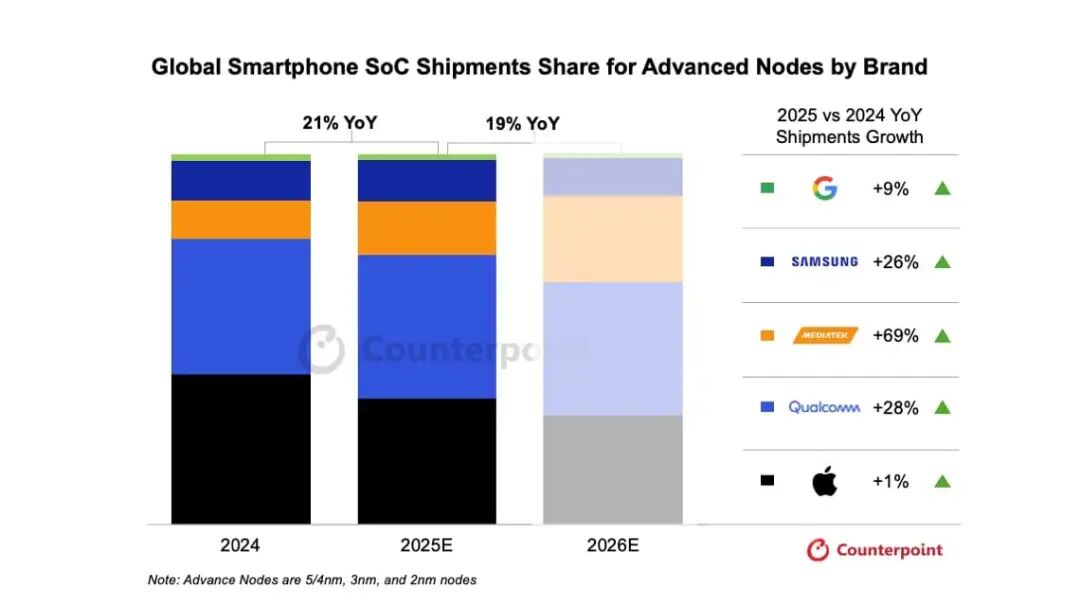
Core Insights - The report from Counterpoint indicates that advanced process nodes (5/4/3/2nm) will account for nearly 50% of smartphone SoC shipments by 2025, driven by a shift from mature nodes to advanced nodes across various price segments [1][4] - This transition enhances performance and energy efficiency, enabling stronger GenAI capabilities, improved gaming performance, and better thermal management in devices [1] - The revenue from advanced process chips is expected to exceed 80% of total smartphone SoC revenue by 2025, reflecting a rise in semiconductor content and average selling price (ASP) [1][5] Company Insights - Qualcomm is projected to benefit the most from the transition to advanced processes, expected to capture nearly 40% of the shipment share in 2025 with a 28% year-on-year growth, surpassing Apple [4] - MediaTek is also anticipated to see a 69% year-on-year increase in advanced process shipments by 2025, driven by the migration of mid-range products to 5/4nm [4] - TSMC is expected to maintain its leadership in advanced process SoC manufacturing, with a projected 27% year-on-year growth in shipments by 2025, capturing over 75% of the advanced process smartphone SoC shipment share [5] Market Outlook - By 2026, advanced processes are expected to account for 60% of total smartphone SoC shipments, primarily due to the accelerated migration of mid-range models to 5/4nm [5] - The mass production of 2nm processes and the continued ramp-up of 3nm processes will further accelerate the penetration of advanced processes in the market [5]