索菲亚

Search documents
家居用品板块9月29日涨0.57%,麒盛科技领涨,主力资金净流出1.99亿元
Zheng Xing Xing Ye Ri Bao· 2025-09-29 08:46
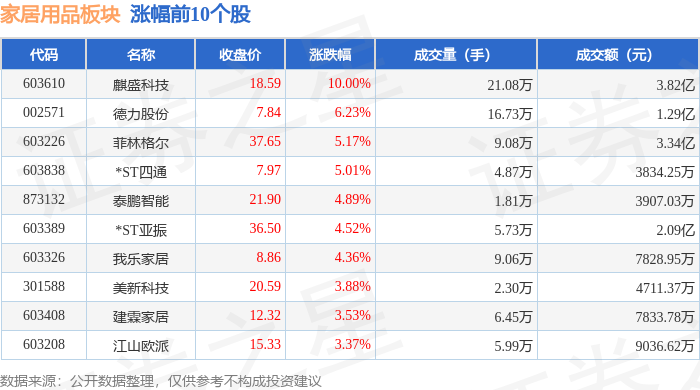
Market Overview - On September 29, the home goods sector rose by 0.57% compared to the previous trading day, with Qisheng Technology leading the gains [1] - The Shanghai Composite Index closed at 3862.53, up 0.9%, while the Shenzhen Component Index closed at 13479.43, up 2.05% [1] Top Gainers in Home Goods Sector - Qisheng Technology (603610) closed at 18.59, up 10.00% with a trading volume of 210,800 shares and a transaction value of 382 million [1] - Delixi Co., Ltd. (002571) closed at 7.84, up 6.23% with a trading volume of 167,300 shares [1] - Filinger (603226) closed at 37.65, up 5.17% with a trading volume of 90,800 shares and a transaction value of 334 million [1] Top Losers in Home Goods Sector - Haotaitai (603848) closed at 19.33, down 6.39% with a trading volume of 121,200 shares and a transaction value of 237 million [2] - Tianzhen Co., Ltd. (301356) closed at 24.66, down 5.48% with a trading volume of 84,500 shares [2] - Mengtian Home (603216) closed at 18.39, down 2.85% with a trading volume of 160,900 shares and a transaction value of 288 million [2] Capital Flow Analysis - The home goods sector experienced a net outflow of 199 million from institutional investors, while retail investors saw a net inflow of 232 million [2] - Qisheng Technology had a net inflow of 66.73 million from institutional investors, but a net outflow of 39.91 million from speculative funds [3] - Sofia (002572) had a net inflow of 13.29 million from institutional investors, with a net outflow of 6.09 million from speculative funds [3]


索菲亚发布《中国家庭空间利用白皮书》并推出“5A全普惠整家699”活动
Zheng Quan Ri Bao Wang· 2025-09-28 09:13
Core Insights - The article highlights Sofia's initiative to enhance home space efficiency and promote customized living through the launch of the "5A All-Popular Whole House 699" policy, aiming to redefine industry standards and value logic [1][2][4] - The company is addressing the challenges posed by the real estate market's adjustments and the increasing competition in the home furnishing sector, focusing on innovative solutions rather than engaging in price wars [2][3] Company Initiatives - Sofia recently held a significant event to release the "China Family Space Utilization White Paper" and celebrate the "5A Good Design" national finals, showcasing its commitment to professional design and affordable products for Chinese families [1] - The "5A All-Popular Whole House 699" initiative offers a unified price of 699 yuan for selected popular products, aiming to meet diverse consumer needs and enhance market trust [2][4] Industry Context - The home furnishing industry is experiencing intense competition, with many companies resorting to harmful practices such as cost-cutting and quality compromises, leading to consumer distrust [2] - The shift in consumer demographics, particularly the rise of younger consumers with diverse and personalized demands, is reshaping the market landscape [2] - Policy guidance and the emergence of the secondary housing market are creating new opportunities for growth beyond the traditional new home demand [2] Quality Standards - Sofia has actively promoted the "China Custom Home 5A Standard," developed in collaboration with 18 reputable organizations, which encompasses 14 indicators across four dimensions: environmental protection, durability, hardware, and edge sealing [3] - The company ensures product quality consistency through its eight production bases across key regions, optimizing logistics and supply chain management to balance environmental standards, durability, and design [3][4]
收益超20%!这一工商业储能项目接入虚拟电厂
行家说储能· 2025-09-28 08:36
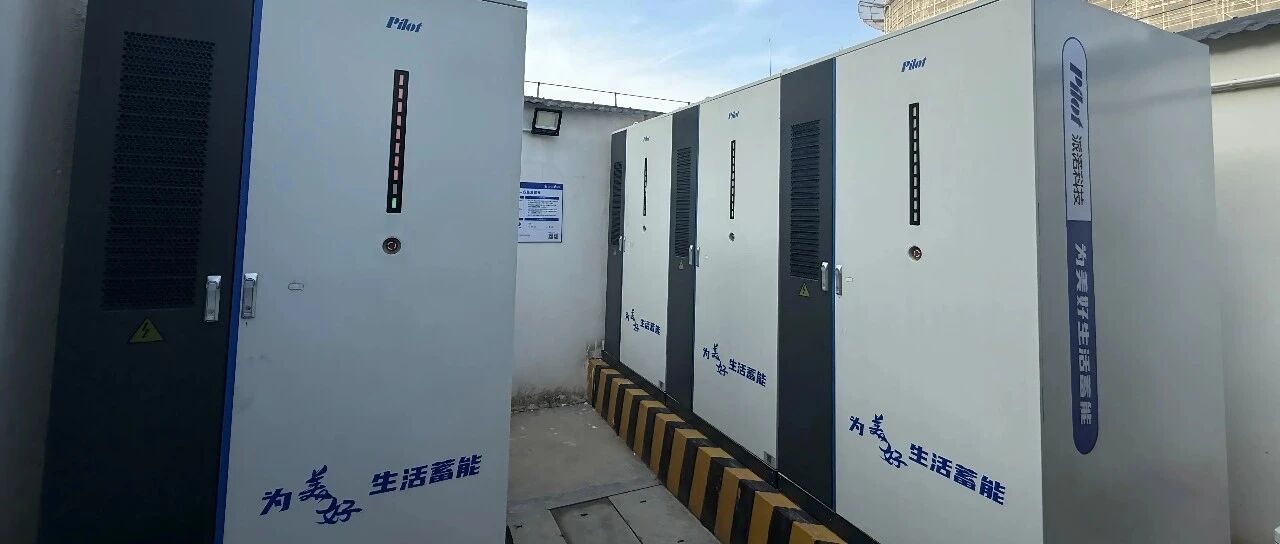
Core Insights - The article discusses the evolution of commercial energy storage from a single arbitrage model to an ecosystem of "virtual power plants + diversified services" by 2025 [1] - The project by Sophia Home, supported by Zhuhai Pano Technology, is the first commercial energy storage project connected to Guangzhou's virtual power plant, expected to generate over 180,000 yuan in additional annual revenue through energy storage adjustments [1][2] Project Overview - The project is the first 10kV grid-connected commercial energy storage project in Guangzhou's Zengcheng District, with Pano Technology providing a one-stop service for investment, construction, and operation [2] - The project consists of two phases and utilizes Pano Technology's self-developed 418kWh distributed energy storage system [2] Operational Efficiency - The project leverages Pano's virtual power plant management platform, utilizing IoT control technology and peak shaving strategies, resulting in an annual discharge volume exceeding 2.2 million kWh and significantly reducing factory energy costs [4] - The energy management system implemented in the factory aims to enhance operational efficiency, saving over one million yuan in electricity costs annually [4] Industry Implications - The project serves as a model for high-energy-consuming manufacturing facilities and offers insights for comprehensive energy service operators, energy-saving companies, and electricity sales companies regarding virtual power plant applications [6] - Pano Technology's virtual power plant solution has been approved by the Guangzhou Municipal Bureau of Industry and Information Technology, allowing it to become a market player [8] Financial Performance - The annualized return on energy storage is projected to increase from 8%-12% to 15%-20% through optimized charging and discharging strategies, breaking the limitations of traditional peak shaving revenue models [10] - Pano Technology's comprehensive solution covers all aspects of virtual power plants, from smart meters to aggregation platforms and trading strategies, enhancing operational efficiency and maximizing revenue [10] Future Developments - Pano Technology has been actively expanding its ecosystem in virtual power plants and energy storage, including strategic partnerships and the establishment of an industrial fund focused on new energy and storage project development [11]
开始“为猫设计”,多家企业可定制宠物别墅,家居产业瞄准情绪消费
Hua Xia Shi Bao· 2025-09-27 11:17
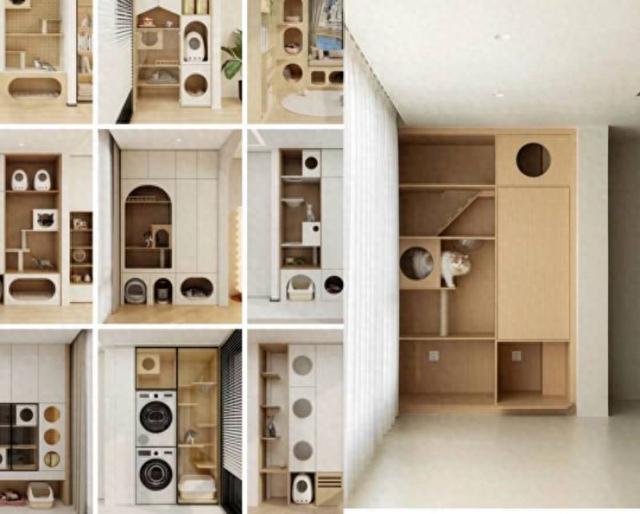
Core Insights - The home furnishing industry is experiencing a contraction, with soft furniture seeking growth through international markets, while custom furniture struggles in a price war. Only Iole Home has achieved revenue and profit growth in the first half of the year, indicating a shift towards high-end design and emotional consumption [2][8]. Group 1: Market Trends - The rise of pet-customized home products is becoming a significant trend, with companies integrating pet spaces into home designs, reflecting a shift from functionality to emotional value [2][5]. - The pet economy is expanding, with the urban pet population in China expected to exceed 120 million by 2024, and the market size projected to reach 404.2 billion yuan by 2027, growing at a compound annual growth rate of approximately 9.9% [5]. Group 2: Company Strategies - Iole Home has strategically exited low-price competition and focused on high-end offerings, which CEO Wang Chunjun considers one of the company's best strategic decisions [2][8]. - The company has launched several high-end series, including the Stockholm Pro series, designed specifically for pet owners, emphasizing the integration of pet needs into home design [5][8]. - Iole Home reported a revenue of 669 million yuan in the first half of the year, a 1.8% increase year-on-year, and a net profit of 92.31 million yuan, reflecting a 103.18% increase, attributed to its competitive edge in mid-to-high-end brand differentiation [8][10].
家居企业出海记
Bei Jing Shang Bao· 2025-09-25 16:53
Core Viewpoint - The transition of Chinese home furnishing companies from simple product sales abroad to strategic brand operations is highlighted, indicating a shift from opportunistic exploration to strategic deepening in international markets [1][2]. Group 1: Industry Trends - The home furnishing industry is experiencing a transformation where companies are increasingly viewing overseas markets as a second growth curve rather than just a supplement to domestic business [1]. - The Shanghai Home Expo is creating a comprehensive support system for brands going abroad, utilizing social media platforms like Facebook and TikTok to help Chinese companies integrate into the international home furnishing ecosystem [2]. - Companies are moving from "light asset attempts" to "heavy asset investments" in their overseas operations, focusing on localized operations and global supply chains [2]. Group 2: Company Developments - Jinpai Home has established wholly-owned subsidiaries in the US, Canada, Australia, Singapore, and Thailand; Zhibang Home has expanded its overseas business to 41 countries with 36 stores; Oppein Home has a sales network in 146 countries; and Kuka Home plans to open 15 new stores by mid-2025 [3]. - The home furnishing market is seeing significant growth in overseas revenue, with companies like Kuka Home achieving 4.258 billion yuan in overseas revenue, a 9.55% increase year-on-year [8]. Group 3: Market Dynamics - The domestic home furnishing market is becoming saturated, with growth rates slowing down, prompting companies to seek new opportunities abroad [7]. - The global furniture market is projected to reach $800 billion by 2025, with a compound annual growth rate of 9% for online furniture sales from 2021 to 2025 [12]. Group 4: Challenges - Chinese home furnishing companies face challenges such as increasing compliance barriers in overseas markets, including various safety and environmental regulations [10][11]. - Low brand recognition in international markets remains a long-term challenge, necessitating a shift from mere product sales to building brand value and awareness [11].


监管闭环、企业补位、市场焕新……告别 “九九八十一难” 家装行业重构防“暴雷”防线
Sou Hu Cai Jing· 2025-09-25 11:59
Core Insights - Alipay's "Home Decoration Treasure" service has gained significant attention, attracting over 50,000 homeowners for appointments within three days, reflecting the urgent demand for quality upgrades in the home decoration industry [1] - The rapid rise of this service highlights the industry's shift towards regulatory compliance and quality assurance following a series of trust crises due to previous financial collapses [1] Group 1: Industry Challenges - The collapse of "internet celebrity decoration companies" like Zhu Fan Er, which left over 800 unfinished projects and millions in supplier debts, exemplifies the industry's ongoing issues [4] - Consumer complaints in the furniture sector reached 33,822 in 2024, a 20.95% increase year-on-year, revealing three critical problems within the industry [5] - The prevalent "fund pool" model, where companies collect advance payments from homeowners while withholding payments to suppliers, has been identified as a core reason for financial failures [5] Group 2: Industry Response and Recovery - In response to the crisis, industry associations and leading companies have collaborated to establish a protection network for consumer rights, transitioning from crisis management to systematic upgrades [6][7] - The establishment of a "rescue alliance" consisting of 12 qualified decoration companies has helped restart construction on 237 halted projects, with over 30% of supplier debts resolved through debt restructuring [6] Group 3: Long-term Solutions and Innovations - The China Building Decoration Association is spearheading reforms to address fragmented regulations and misconceptions about advance payment models, aiming to reduce risks of financial collapse [7] - Leading companies are implementing various initiatives, such as cost reduction strategies and enhanced service commitments, to rebuild consumer trust and improve operational efficiency [8] Group 4: Regulatory Developments - New regulations mandate that renovation loans must utilize third-party escrow services, preventing direct transfers to decoration companies, thereby mitigating risks at the source [9] - The Shanghai pilot "home decoration fund supervision platform" has integrated over 200 companies, ensuring traceability and regulatory oversight of funds [9] Group 5: Market Opportunities - The inclusion of home decoration in the consumer subsidy program for old-for-new exchanges is expected to stimulate market growth, potentially exceeding one trillion in scale [10] - The industry is undergoing a transformation from a "traffic-driven" model to a "value-driven" approach, emphasizing meticulous operations and systemic changes across regulatory, corporate, market, and consumer dimensions [11][12]

索菲亚涨2.02%,成交额5161.45万元,主力资金净流入412.06万元
Xin Lang Cai Jing· 2025-09-24 02:24
Core Viewpoint - The stock price of Sophia has experienced a decline of 18.85% year-to-date, with recent trading showing a slight recovery, indicating potential volatility in the market [2]. Group 1: Stock Performance - On September 24, Sophia's stock rose by 2.02%, reaching 13.13 CNY per share, with a trading volume of 51.61 million CNY and a turnover rate of 0.61%, resulting in a total market capitalization of 12.645 billion CNY [1]. - Year-to-date, Sophia's stock has decreased by 18.85%, with a 3.60% drop over the last five trading days, a 4.02% decline over the last 20 days, and a 4.86% decrease over the last 60 days [2]. Group 2: Financial Performance - For the first half of 2025, Sophia reported a revenue of 4.551 billion CNY, a year-on-year decrease of 7.68%, and a net profit attributable to shareholders of 319 million CNY, down 43.43% year-on-year [2]. - Since its A-share listing, Sophia has distributed a total of 5.997 billion CNY in dividends, with 2.550 billion CNY distributed over the past three years [3]. Group 3: Shareholder and Institutional Holdings - As of June 30, 2025, the number of shareholders for Sophia increased by 24.50% to 42,800, while the average number of circulating shares per shareholder decreased by 19.68% to 15,221 shares [2]. - Among the top ten circulating shareholders, Hong Kong Central Clearing Limited is the third largest, holding 39.594 million shares, a decrease of 18.536 million shares from the previous period [3].
定制家居价格洗牌,索菲亚“整家699”普惠政策重塑行业定价
Qi Lu Wan Bao· 2025-09-23 09:47
Core Viewpoint - The introduction of the "5A Universal Benefit · Whole House 699" policy by Sophia aims to recalibrate the value balance in home decoration by offering high-quality products at an affordable price, addressing consumer pain points in the home furnishing market [1][3]. Group 1: Market Structure Adjustment - The "5A Universal Benefit · Whole House 699" policy offers a straightforward pricing model of 699 yuan for various popular products, ensuring budget control and transparency in consumer choices [3]. - This initiative is expected to trigger a "catfish effect," shifting the industry focus from price competition to quality, service, and user experience [5]. - Despite a decline in the real estate market, consumer demand for home furnishings is increasing, with middle-to-high-income families willing to pay a premium of 30%-50% for design and service quality [6]. Group 2: Company Strengths - Sophia's ability to break the "high quality must mean high price" norm is supported by its 44 years of industry experience and advanced manufacturing capabilities, achieving 125% higher efficiency than foreign production lines [7]. - The company has established eight production bases across the country, reducing logistics and time costs through localized production and delivery [7]. - Sophia has a robust quality management system, recognized as the only representative of the custom home furnishing industry in the first batch of "High-Level Quality Management Capability Enterprises" by the Ministry of Industry and Information Technology [9]. Group 3: Industry Leadership - As a leading enterprise, Sophia is committed to elevating industry standards, having co-authored the "5A Standard" for custom home furnishings with various authoritative institutions [11]. - The company has received the "2023 Guangdong Province Science and Technology Progress Award" for its project on personalized furniture manufacturing, marking a significant achievement in the industry [11]. - Sophia is also involved in developing standards for aging-friendly home products, aiming to fill gaps in this niche market and demonstrating that true affordability does not compromise quality [12].

盈峰集团战略入股索菲亚 持股比例1.95%
Huan Qiu Wang· 2025-09-23 02:49
Core Viewpoint - The recent mid-term performance report of Sophia Home Co., Ltd. reveals that Yingfeng Group has become a significant shareholder, holding 18,762,417 shares, which accounts for 1.95% of the total share capital [1] Group 1: Shareholding Changes - Yingfeng Group is now the fifth largest unrestricted shareholder of Sophia, following the company's founders and other major shareholders [1] - This move follows Yingfeng Group's previous acquisition of a controlling stake in Gujia Home, a leading soft furniture company, for 8.88 billion yuan, indicating a strategic expansion in the home furnishings sector [1] Group 2: Strategic Collaboration - The investment marks a continuation of the relationship between Yingfeng Group and Sophia, as they previously co-established a technology consumption fund in 2022 to collaborate in areas such as smart home and green manufacturing [1] - The recent share acquisition suggests potential for deeper cooperation in industrial synergy, technological innovation, and market expansion between the two companies [1]
索菲亚重磅发布整家套餐 构建新的“价值锚点”
Xiao Fei Ri Bao Wang· 2025-09-22 08:08
Core Insights - The article discusses the launch of "5A All-Popular·Whole Home 699" by Sophia, aimed at addressing consumer trust issues in the custom home furnishing market, which has been plagued by low-quality, low-price tactics [1][3] - The initiative is positioned as a significant shift from traditional pricing models, promoting a transparent and value-driven approach to home customization [4][6] Industry Context - The Chinese home furnishing industry is transitioning from incremental expansion to stock competition, with increasing competition from both small manufacturers and major players like JD.com [1][3] - Consumers face challenges such as price opacity, lack of choice, and uncontrollable total costs, leading to a state of "customization anxiety" [3][4] Sophia's Strategy - The "Whole Home 699" policy eliminates traditional pricing based on square footage, allowing consumers to purchase a complete home setup at a flat rate of 699 yuan, addressing the "area anxiety" prevalent in the industry [4][5] - The initiative includes a comprehensive range of products, moving beyond single-item packages to a holistic pricing model, thus simplifying the purchasing process for consumers [4][5] Value Proposition - Sophia aims to redefine the value of whole-home customization by leveraging its integrated capabilities across various product categories, ensuring cohesive design and service delivery [5][6] - The company emphasizes quality assurance through the "China Custom Home 5A Standard," which sets benchmarks for environmental performance, durability, and material quality [6][7] Competitive Advantages - Sophia's operational efficiency is bolstered by eight production bases across China, enhancing logistics and reducing costs through proximity to markets [7][8] - The company maintains a vertically integrated supply chain, allowing it to exert significant influence over pricing and quality, thus avoiding the pitfalls of low-cost, low-quality offerings [7][8] Business Model - The "headquarters profit-sharing" model ensures that both consumers and dealers benefit, fostering a sustainable business ecosystem rather than short-term exploitation [9][10] - This approach balances visible consumer savings with sustainable dealer profits, promoting a healthy commercial environment [9][10]