衣柜

Search documents
欧派家居(603833):大家居战略纵深推进新周期欧派行稳致远
Guotou Securities· 2026-03-30 09:36
Investment Rating - The report maintains a "Buy-A" investment rating for the company, with a target price of 66.80 CNY [5]. Core Insights - The company is a leading one-stop high-quality home furnishing service provider in China, focusing on whole-house customization and integrated solutions, and has established a multi-brand matrix covering various price ranges [1][13]. - The real estate sector's adjustment is reshaping the home furnishing industry, transitioning from a new housing-driven model to a dual-driven model of new and existing home renovations, with expectations for a recovery in demand supported by policies [2][22]. - The company has integrated its operations into four major marketing divisions, promoting both retail and integrated home furnishing strategies, which has led to a significant reduction in unit costs and improved delivery efficiency [3][19]. Summary by Sections 1. Company Overview - The company has developed a multi-brand platform for the home furnishing industry, offering personalized design, research, production, and sales of various home products [13][14]. - The founder holds a 66.19% stake, indicating a highly concentrated ownership structure, and the company has committed to distributing at least 1.5 billion CNY in cash dividends annually from 2024 to 2026 [1][18]. 2. Industry Dynamics - The home furnishing industry is experiencing a shift due to the real estate sector's deep adjustment, with a growing emphasis on renovation of existing homes alongside new constructions [2][22]. - The market is expected to stabilize in 2024, with a projected 9.5% decline in new housing sales area in 2025, a significant improvement from the previous year's 12.9% drop [2][23]. 3. Strategic Development - The company is advancing its home furnishing strategy through organizational reforms and enhancing internal driving forces, which solidifies its leading position in the industry [3][22]. - The company has achieved a net promoter score of 61% in 2024, significantly higher than the industry benchmark of 38%, indicating strong customer satisfaction [3]. 4. Financial Forecast and Valuation - The company is projected to generate revenues of 182.01 billion CNY, 189.78 billion CNY, and 202.53 billion CNY for the years 2025 to 2027, with corresponding net profits of 24.37 billion CNY, 25.43 billion CNY, and 27.60 billion CNY [3][12].

索菲亚20260316
2026-03-17 02:07
Summary of the Conference Call for Sophia (2026) Company Overview - **Company**: Sophia - **Industry**: Home Furnishing and Custom Furniture Key Points and Arguments 1. Performance Goals and Distribution Strategy - The company aims for overall positive growth in 2026, implementing a "1+N+X" distribution model and plans to open 200-300 community stores to penetrate existing markets [2][3][4] 2. Pricing Strategy - During the 315 promotional event, the price range for promotional products is maintained at 800-1,000 RMB per square meter, while regular products are priced at 1,000-1,300 RMB per square meter. Price competition is becoming more rational, avoiding blind price cuts [2][4] 3. Brand Development - Milan brand plans to open 100 new stores in 2026 after clearing channels in 2025, aiming to stabilize its performance. The brands Simi and Huahwei are expected to maintain a scale of around 100 million RMB each [2][3] 4. Business Structure and Focus - The bulk business is targeted to maintain a 10% share, focusing on state-owned enterprises and high-end real estate projects. The integrated business is expected to see volume release in the second half of 2026 due to the elimination of low-priced projects in 2025 [2][3] 5. Product Bundling and Sales Strategy - The product bundling rate has improved to 30%, with strategies focusing on transparent pricing and product design combinations to enhance sales. The company anticipates further growth in 2026 with the launch of popular products [2][6][7] 6. International Expansion - The overseas business aims for double-digit growth, focusing on brand expansion in the Middle East and Southeast Asia, with plans to open 30-50 new stores [2][4][15] 7. Distributor and Dealer Relations - The company is adjusting its distributor relationships and expanding cooperation with construction companies. The integrated business is expected to stabilize, with a focus on maintaining a healthy business structure [3][11] 8. Cost Control and Efficiency - The company is focusing on cost reduction through refined procurement management and efficiency improvements via smart upgrades. The overall marketing and management expenses are expected to remain stable [12][14] 9. Market Conditions and Consumer Behavior - There has been a significant improvement in market consumption vitality and consumer price sensitivity compared to the second half of 2025. The company expects positive impacts to manifest in the second and third quarters of 2026 [3][4] 10. Challenges in the Second-Hand Market - Approximately 30% of customers are from the second-hand market, which presents challenges due to the additional renovation processes required. The company is working to streamline these services [16][17] 11. Shareholder Influence - The entry of Yingfeng Group as the second-largest shareholder has not changed daily operations or specific demands but is expected to maintain a stable dividend policy [16] 12. Future Outlook - The company is optimistic about maintaining a stable dividend policy due to sufficient cash reserves and no large-scale capital expenditure plans [16] This summary encapsulates the key insights and strategic directions discussed during the conference call, highlighting the company's focus on growth, market adaptation, and operational efficiency.

ESG观察|授权经销商“跑路”,索菲亚“塌房”,谁为消费者兜底?
Xin Lang Cai Jing· 2026-02-14 04:00
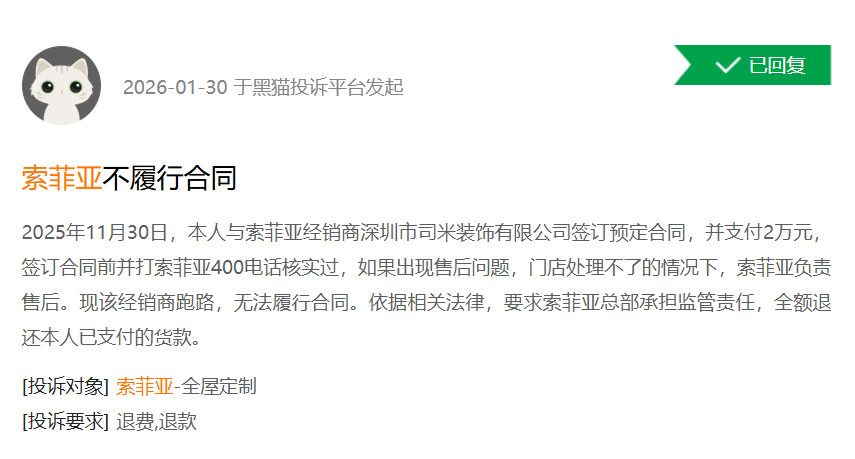
Core Viewpoint - The incident involving Sophia's brand Simi cabinets highlights significant risks in social responsibility and corporate governance within the rapidly expanding home furnishing industry, as a licensed dealer in Shenzhen suddenly closed, leaving hundreds of homeowners in financial distress with estimated losses reaching millions [1][16]. Group 1: Incident Overview - The crisis began with collective complaints from consumers on social media and complaint platforms, revealing that a Simi cabinets store in Shenzhen abruptly shut down, leaving customers unable to receive their orders or refunds [2][17]. - Many consumers were directed to the store through official channels, including advertisements and customer service recommendations from Sophia, which led them to trust the legitimacy of the dealer [2][17]. - The closure of the store resulted in significant confusion regarding the contractual obligations, as the signing entity and the actual payment recipient were not aligned, complicating the consumers' efforts to seek redress [8][21]. Group 2: Company Response - On February 5, Simi cabinets confirmed the dealer's issues, attributing the consumer losses to the dealer's financial troubles and unauthorized business practices [8][21]. - The company stated that it was also a victim in this situation, which sparked dissatisfaction among consumers who felt that the brand should take responsibility for the actions of its authorized dealer [8][21]. - As of February 7, Sophia announced that it had initiated delivery processes for valid orders in its system, while advising consumers with unrecorded orders to report to the authorities for legal assistance [9][22]. Group 3: ESG Performance and Implications - Sophia's ESG rating from Refinitiv on January 30 was C-, ranking last among four companies in the home goods sector, with low scores in environmental, social, and governance categories [10][22]. - The incident exposed a gap between Sophia's ESG commitments and actual practices, indicating a lack of effective integration of ESG management into business operations, particularly in high-risk franchise management [11][23]. - The company has recognized the urgency of the situation and plans to conduct comprehensive evaluations of its partners, implement electronic contract systems for traceability, and establish dedicated consumer service channels [11][23]. Group 4: Industry Perspective - The challenges faced by Sophia reflect broader governance issues in the home furnishing industry, particularly regarding franchise models during rapid expansion [12][24]. - Industry leaders are encouraged to establish stricter dealer admission standards and utilize digital technologies to enhance transparency in supply chains and sales processes [12][24]. - The competitive edge of home furnishing companies should extend beyond store numbers and revenue to include responsible management across the entire value chain, embedding ESG principles at every operational level to prevent similar crises in the future [12][24].

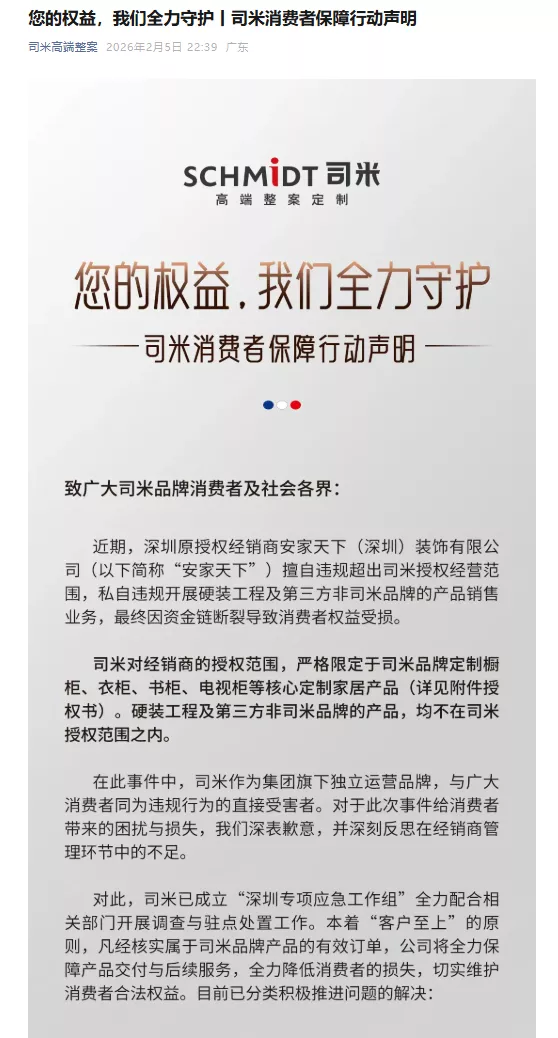
司米橱柜发声明回应原授权经销商违规事宜,全力守护消费者权益
Cai Jing Wang· 2026-02-06 14:26
Core Viewpoint - The company, Simi Kitchen Cabinets, has initiated a consumer protection action in response to unauthorized activities by a former authorized dealer, Anjia Tianxia, which led to consumer rights violations [1][3]. Group 1: Incident Overview - An authorized dealer, Anjia Tianxia, exceeded its authorized operational scope by engaging in hard decoration projects and selling third-party non-Simi brand products, resulting in consumer rights being compromised due to the dealer's financial collapse [1][3]. - Simi has established a "Shenzhen Special Emergency Working Group" to cooperate with relevant authorities in investigating the incident and ensuring product delivery and service continuity for affected consumers [1][3]. Group 2: Consumer Protection Measures - Simi has launched a consumer protection plan that includes a "visit-verification-service-delivery" process for customers who purchased Simi brand custom products, aiming to facilitate smooth delivery and service [1][5]. - The company has formed a legal assistance team to help affected consumers gather evidence and report to law enforcement and market supervision departments, aiming to recover funds involved in the dealer's misconduct [5]. Group 3: Market Rectification Actions - Starting from February 5, Simi will conduct a nationwide rectification action, which includes evaluating the qualifications and operational capabilities of partners, implementing an electronic contract signing system for authorized terminals, and establishing a rapid response mechanism for consumer issues [5][6]. - The company emphasizes its commitment to customer-centric principles and aims to build a transparent and trustworthy home consumption environment in collaboration with industry peers [6].
行业承压期见担当 司米全力守护消费者权益
Zheng Quan Ri Bao· 2026-02-06 09:45
Core Viewpoint - The incident involving the Shenzhen dealer's financial collapse has prompted the company to establish a special emergency task force to protect consumer rights and ensure product delivery and service continuity [1][2]. Company Summary - The company, Simi Kitchen Cabinets, is a high-end custom home furnishing brand under the Schmidt Groupe, introduced to the Chinese market by Sophia Home Co., Ltd. in 2014 [1]. - The dealer involved, Anjia Tianxia (Shenzhen) Decoration Co., Ltd., exceeded its authorized operational scope by engaging in unauthorized construction and selling non-Simi products, leading to significant consumer losses estimated in the millions [1][2]. - The company has acknowledged its role as a victim of the dealer's misconduct and has expressed deep regret for the inconvenience caused to consumers [2]. Consumer Protection Measures - The company has initiated a consumer protection plan that includes a "visit-verify-service-delivery" process for authorized orders, ensuring that affected customers can register their claims with valid documentation [3]. - For non-authorized business dealings, the company is providing legal assistance to help consumers recover their funds and report the dealer to relevant authorities [3]. Industry Challenges - The incident highlights common regulatory challenges in the home furnishing industry, particularly in the context of intense competition and the ongoing downturn in the real estate market [2]. - The company plans to implement corrective actions nationwide, including evaluating the qualifications and operational capabilities of partners, launching an electronic contract system for traceability, and establishing a rapid response mechanism for consumer issues [4][5]. Industry Recommendations - Industry experts suggest that addressing consumer safety issues requires collaborative efforts, including establishing risk warning mechanisms for merchants, enhancing dealer risk management, and promoting regulatory measures to control prepayment risks [5].
「1元起拍」的宜家拍卖会,比苏富比玩得还刺激
36氪· 2026-01-12 13:35
Core Viewpoint - The article discusses how IKEA is democratizing the auction experience by offering low-entry auctions for everyday items, contrasting it with traditional high-end auctions like Sotheby's and Christie's [14][15][19]. Group 1: Auction Dynamics - IKEA's auctions start at prices as low as 1 yuan or 1% of the original price, making it accessible to the general public [17][19]. - The auction items include a variety of everyday products, such as toys, lamps, desks, and cabinets, which are often slightly damaged or overstocked [21]. - The auction process includes standard procedures like online reservations and live bidding, creating an engaging experience for participants [23][25]. Group 2: Competitive Environment - Participants in IKEA's auctions are primarily budget-conscious individuals, creating a competitive atmosphere where everyone aims to get the best deal [36][40]. - Unlike high-end auctions where wealthier bidders may not be as price-sensitive, IKEA's auctions feature participants who are all looking to save money, leading to intense bidding wars [38][41]. - The auction's structure encourages strategic bidding, as participants must balance their desire to win with the need to keep costs low [45][47]. Group 3: Experience and Engagement - The fast-paced nature of IKEA's auctions, often with time limits, adds an element of excitement and urgency, requiring quick decision-making from bidders [51]. - The experience is designed to be enjoyable, allowing participants to feel a sense of achievement whether they win or lose, thus enhancing customer engagement [56][57]. - Other brands like Decathlon and Sam's Club have also started similar low-entry auctions, indicating a growing trend in the retail industry [60].

欧派家居获得2025年度“中国消费名品”称号
Zheng Quan Ri Bao Zhi Sheng· 2026-01-08 10:17
Core Viewpoint - The company, Oppein Home Group, has been recognized as one of the "Chinese Consumer Brands" for 2025 by the Ministry of Industry and Information Technology, highlighting its strong market competitiveness and consumer recognition [1][2]. Group 1: Recognition and Awards - Oppein Home has been selected for the 2025 "Chinese Consumer Brands" list alongside other notable brands like Midea, TCL, and Haitian, indicating its status as a leading brand in the home furnishing industry [1]. - The selection process is rigorous, focusing on innovation, quality, reputation, and market performance, serving as a comprehensive assessment of the company's overall strength [1]. Group 2: Business Operations and Strategy - As a pioneer and leader in the custom home furnishing industry, Oppein Home aims to create a beautiful home life for consumers, starting with integrated kitchen cabinets and expanding into various product categories [1]. - The company has developed a diversified industrial structure, including wardrobes, whole-home customization, bathroom products, soft furnishings, and more, establishing a comprehensive modern home furnishing service provider [1]. - In the context of consumption upgrades and industrial transformation, Oppein Home is committed to providing high-quality, aesthetically pleasing, and valuable home solutions to stimulate consumer potential and contribute to the high-end, intelligent, and green development of the Chinese consumer goods industry [1]. Group 3: Future Directions - The company plans to uphold its spirit of "pursuing perfection" and use this recognition as a new starting point to deepen innovation, enhance manufacturing efficiency, and improve service experiences [2]. - Oppein Home aims to lead home consumption trends with smarter, more environmentally friendly, and more humanized products and services, contributing to the transition from "Chinese manufacturing" to "Chinese brands" [2].
皮阿诺涨2.00%,成交额3701.78万元,主力资金净流出19.21万元
Xin Lang Cai Jing· 2026-01-07 01:59
Core Viewpoint - The stock of PIANO has shown mixed performance, with a slight increase in the short term but a significant decline in revenue and profit year-over-year, indicating potential challenges ahead for the company [1][2]. Group 1: Stock Performance - On January 7, PIANO's stock rose by 2.00%, reaching a price of 20.89 yuan per share, with a trading volume of 37.02 million yuan and a turnover rate of 1.40%, resulting in a total market capitalization of 3.82 billion yuan [1]. - Year-to-date, PIANO's stock price has decreased by 0.33%, with a 5-day decline of 0.90%, a 20-day increase of 42.11%, and a 60-day increase of 71.23% [1]. Group 2: Financial Performance - For the period from January to September 2025, PIANO reported a revenue of 420 million yuan, representing a year-over-year decrease of 37.27%, and a net profit attributable to shareholders of -7.53 million yuan, a decline of 191.47% compared to the previous year [2]. - Since its A-share listing, PIANO has distributed a total of 198 million yuan in dividends, with 36.58 million yuan distributed over the past three years [3]. Group 3: Shareholder Information - As of December 31, PIANO had 15,300 shareholders, a decrease of 39.17% from the previous period, with an average of 8,409 circulating shares per shareholder, an increase of 64.39% [2]. - As of September 30, 2025, the ninth largest circulating shareholder is the Nuoan Multi-Strategy Mixed A fund, holding 1.2967 million shares as a new shareholder [3].

欧派家居:“大家居”战略转型阵痛,千亿市值缩水背后
Xin Lang Cai Jing· 2025-12-31 05:49
Core Viewpoint - The company, Oppein Home, is undergoing a significant transformation towards a "whole home" strategy amid declining growth engines, raising questions about its ability to navigate through this challenging period and regain its former strength [3][17]. Financial Performance - In 2024, Oppein Home experienced its first-ever decline in both revenue and profit, with revenue dropping by 16.93% to 18.925 billion yuan and net profit decreasing by 14.38% to 2.599 billion yuan [4][21]. - The decline in performance is attributed to a reduction in internal growth drivers, particularly in its core cabinet and wardrobe businesses, which saw revenue declines of 22.48% and 18.06% respectively [6][23][24]. Market Position and Stock Performance - By the end of 2025, Oppein Home was removed from the CSI 300 index, marking a significant shift in its market position as its market value shrank by approximately two-thirds in less than four years [3][18]. - Following the index adjustment, the company's stock price fell by 0.53%, reaching an annual low of 49.30 yuan per share [19]. Store Network and Distribution Challenges - The company closed 2,058 stores in 2024, resulting in a net reduction of 973 stores compared to the previous year, with a continued decline into 2025 [7][26]. - The revenue from its distribution channels fell by 20.10% in 2024, marking two consecutive years of contraction [26]. Brand Reputation and Trust Issues - Recent incidents of authorized dealers "running away" with consumer funds have led to a crisis of brand trust, affecting the company's reputation [10][28]. - The company's inconsistent handling of consumer complaints and disputes has exacerbated public distrust, with many consumers facing unresolved issues [11][28]. Industry Context and Economic Challenges - Oppein Home's struggles reflect broader challenges in the Chinese economy, particularly the reliance on the real estate sector, which has been experiencing a downturn [13][30]. - The company aims to stabilize its transition to a "whole home" model by enhancing operational efficiency and upgrading its marketing supply chain [30]. Investor Sentiment and Internal Signals - There are signs of waning confidence among investors, as indicated by the reduction of holdings by significant shareholders and the company's founder's decision to sell shares for personal financial needs [14][31]. - The founder received approximately 2.1 billion yuan in dividends during the downturn, raising concerns about the alignment of interests between management and shareholders [14][30].
这家公司筹划控制权变更,股价“提前”涨停
Guo Ji Jin Rong Bao· 2025-12-26 08:29
Core Viewpoint - PIANO is undergoing a potential change in control as its major shareholder and actual controller, Ma Libin, is planning to transfer control, leading to a suspension of trading for the company's stock [1][8]. Company Summary - PIANO is a listed company specializing in high-end customized home products, including cabinets and wardrobes, facing significant revenue decline due to the real estate cycle [3]. - In 2024, PIANO's total revenue dropped to 886 million yuan, a substantial decrease of 32.68% year-on-year, reaching levels last seen in 2017; the net profit attributable to shareholders was -375 million yuan, a staggering decline of 535.88% [3]. - For the first three quarters of 2025, PIANO reported revenue of 420 million yuan, down 37.27% year-on-year, continuing the downward trend; the net profit attributable to shareholders was -7.52 million yuan, a decline of 191.47%, although the loss narrowed compared to the first half of the year [3]. Industry Summary - The customized home furnishing industry is closely tied to the real estate sector, which is currently experiencing a downturn, adversely affecting companies in this space [5]. - Major brands like Oppein and Sophia also reported disappointing revenue in 2024, with Oppein's revenue at 18.93 billion yuan (down 16.93%) and Sophia's at 10.49 billion yuan (down 10.04%); however, Sophia managed to achieve a net profit of 1.37 billion yuan, an increase of 8.69% [5]. - As the new housing market slows, renovation and partial updates are emerging as new growth points, prompting companies to transition from product suppliers to space solution providers [6]. Control Change Details - Ma Libin, the founder and current chairman of PIANO, holds 39.12% of the company's shares, making him the largest single shareholder [7]. - This planned change in control marks Ma Libin's first explicit intention to relinquish control of PIANO, although he has attempted to reduce his stake multiple times in the past three years [8]. - Previous attempts to transfer shares included a plan in October 2022 to transfer 20% of shares to Zhuhai Honglu, with part of the transfer completed but later attempts halted due to external conditions [9]. - Speculation suggests that Poly Group may be a potential buyer for the control stake, as its subsidiary, Poly Capital, currently holds a significant share in PIANO [9].