郑州银行

Search documents
五家银行跻身绿色信贷“万亿俱乐部” 绿色债券存量规模近2万亿
2 1 Shi Ji Jing Ji Bao Dao· 2025-11-05 23:42
Core Insights - Green finance has transitioned from an optional choice to a mandatory requirement for the banking industry, serving as a new engine for strategic transformation and a blue ocean market for future growth [1] - The balance of green financing at Industrial Bank has reached nearly 2.5 trillion yuan, with green loans exceeding 1 trillion yuan and a non-performing loan rate of only 0.57% [1] - The People's Bank of China and other departments have issued a unified policy framework for green finance, effective from October 1, 2025, to standardize various financial products [2] Group 1: Green Credit Growth - As of the end of 2024, the total balance of green credit among 42 A-share listed banks exceeded 27 trillion yuan, reflecting a year-on-year growth of approximately 20% [3] - State-owned banks dominate the green credit market, with the six major state-owned banks accounting for over 21 trillion yuan, representing 77.6% of the total [3] - Industrial Bank's green loan balance has risen to 1.08 trillion yuan, joining the "trillion club" [3] Group 2: Performance and Sector Focus - The average growth rate of green credit for A-share listed banks in 2024 was 20.6%, a slowdown from approximately 28% in 2023, yet leading institutions maintained strong growth [4] - The focus of green credit issuance is concentrated in four key areas: clean energy, green transportation, energy conservation and environmental protection, and green buildings [4] - The Yangtze River Delta, Guangdong-Hong Kong-Macau Greater Bay Area, and Chengdu-Chongqing Economic Circle are identified as core regions for green credit [4] Group 3: Product Innovation - A-share listed banks are deepening innovation in green financial products, creating a multi-dimensional product system that includes loans, bonds, asset securitization, insurance, and carbon finance [5] - Sustainable Development Linked Loans (SLL), carbon emission rights pledge financing, and environmental rights collateral loans are gaining traction [5] - Industrial Bank has launched the first green loan with biodiversity protection insurance, while Bohai Bank introduced a green loan linked to data center energy efficiency [6] Group 4: Broader Financial Tools - The issuance of green bonds has expanded, with the cumulative issuance of labeled green bonds in 2024 surpassing 4 trillion yuan [6] - Banks are actively participating in green wealth management and fund products, enhancing investor engagement through innovative offerings [6] - Carbon finance tools are transitioning from pilot programs to broader applications, with various banks introducing carbon emission rights pledge financing products [6] Group 5: Future Directions - The banking industry is expected to continue innovating green financial products to support sustainable economic development, moving beyond traditional green credit [7] - The development of ESG-linked loans and financing models using carbon emission rights as collateral will be explored [7] - These innovations will not only assist in achieving national carbon reduction goals but also cultivate new growth momentum for banks [7]




广东日丰电缆股份有限公司向特定对象发行股票上市公告书
Shang Hai Zheng Quan Bao· 2025-11-05 19:24
Core Points - The company, Guangdong RIFENG Cable Co., Ltd., is set to issue 34,690,799 shares at a price of 6.63 yuan per share, raising a total of approximately 229.99 million yuan, with a net amount of about 226.27 million yuan after deducting issuance costs [1][14][30]. Group 1: Issuance Details - The total number of shares to be issued is 34,690,799 [11]. - The issuance price is set at 6.63 yuan per share, which is 80% of the average trading price over the previous 20 trading days [13]. - The total funds raised will be approximately 229.99 million yuan, with net proceeds of about 226.27 million yuan after deducting issuance expenses [14][15]. Group 2: Lock-up Period and Shareholder Structure - The controlling shareholder, Feng Jiuqing, is subject to an 18-month lock-up period starting from the listing date of the new shares [16][30]. - The shareholding structure will remain compliant with the listing requirements of the Shenzhen Stock Exchange post-issuance [22][33]. Group 3: Regulatory Compliance - The issuance has been approved by the Shenzhen Stock Exchange and the China Securities Regulatory Commission, confirming compliance with relevant laws and regulations [8][47]. - The underwriting process and selection of the subscription object have been deemed fair and compliant by the sponsor, Dongguan Securities [26][27]. Group 4: Financial Impact - The issuance is expected to enhance the company's total assets and net assets, thereby reducing the debt-to-asset ratio and improving financial stability [34]. - The net proceeds from the issuance will be used to supplement working capital and repay bank loans, with no significant changes anticipated in the company's business structure [35].
郑州银行,1.21亿股将被司法拍卖
Shen Zhen Shang Bao· 2025-11-05 13:01
Core Insights - Zhengzhou Bank reported a revenue of 9.395 billion yuan for the first three quarters of 2025, representing a year-on-year increase of 3.91%, and a net profit of 2.279 billion yuan, up 1.56% year-on-year. Despite this growth, the bank's stock has declined by 2% this year [1][2]. Financial Performance - In Q3 2025, Zhengzhou Bank achieved a revenue of 2.705 billion yuan, a 2.15% increase year-on-year, with a net profit of 652 million yuan, up 0.22% year-on-year [2]. - Non-interest income for the first three quarters reached 1.579 billion yuan, showing significant growth, but was heavily influenced by investment income and fair value changes, which are volatile and do not provide stable profit support [2]. - The bank's credit impairment losses rose significantly, reaching 4.359 billion yuan in Q3, an increase of 313 million yuan or 7.74% year-on-year, primarily due to increased losses from loans and advances [2][3]. Capital Adequacy - The bank's capital adequacy ratios have been declining for three consecutive years, with the core tier 1 capital ratio dropping from 9.29% at the end of 2022 to 8.76% by Q3 2025. The tier 1 capital ratio fell from 11.63% to 10.74%, and the total capital ratio decreased from 12.72% to 12.00% [3]. Shareholder Issues - Zhengzhou Bank has faced challenges with executive share reductions, judicial auctions of shares, and severe share pledges. The largest shareholder, Zhengzhou Municipal Finance Bureau, holds 657 million shares, accounting for 7.23% of total shares, with a significant portion pledged [4]. - Henan Guoyuan Trading Co., one of the top ten shareholders, has continuously reduced its holdings, selling 20.8488 million shares in 2023, 9.4066 million shares in 2024, and 88.8012 million shares in the first half of 2025, reducing its stake from 3.53% at the end of 2024 to 1.76% by the end of September 2025 [4]. Market Performance - In the Hong Kong stock market, institutional investors like Yuanta Financial Holdings and Yunnan Energy Investment Group have reduced their holdings in Zhengzhou Bank's H-shares from 11.99% to 10.81% [6]. - As of November 5, 2025, Zhengzhou Bank's A-shares closed at 2.04 yuan per share, down over 50% from their historical peak, while H-shares reached a low of 0.68 HKD, currently trading at 1.28 HKD [6].


郑州银行(002936) - H股公告 - 截至二零二五年十月三十一日止月份之股份发行人的证券变动月报表
2025-11-05 12:15
股份發行人及根據《上市規則》第十九B章上市的香港預託證券發行人的證券變動月報表 截至月份: 2025年10月31日 狀態: 新提交 致:香港交易及結算所有限公司 公司名稱: 鄭州銀行股份有限公司 (於中華人民共和國註冊成立的股份有限公司) 呈交日期: 2025年11月5日 I. 法定/註冊股本變動 | 1. 股份分類 | 普通股 | 股份類別 | H | | 於香港聯交所上市 (註1) | | 是 | | | --- | --- | --- | --- | --- | --- | --- | --- | --- | | 證券代號 (如上市) | 06196 | 說明 | H股 | | | | | | | | | 法定/註冊股份數目 | | | 面值 | | 法定/註冊股本 | | | 上月底結存 | | | 2,020,458,000 | RMB | | 1 RMB | | 2,020,458,000 | | 增加 / 減少 (-) | | | 0 | | | RMB | | 0 | | 本月底結存 | | | 2,020,458,000 | RMB | | 1 RMB | | 2,020,458,000 | ...
郑州银行(06196) - 截至二零二五年十月三十一日止月份之股份发行人的证券变动月报表
2025-11-05 11:35
股份發行人及根據《上市規則》第十九B章上市的香港預託證券發行人的證券變動月報表 截至月份: 2025年10月31日 狀態: 新提交 致:香港交易及結算所有限公司 公司名稱: 鄭州銀行股份有限公司 (於中華人民共和國註冊成立的股份有限公司) 呈交日期: 2025年11月5日 I. 法定/註冊股本變動 | 1. 股份分類 | 普通股 | 股份類別 | H | | 於香港聯交所上市 (註1) | | 是 | | | --- | --- | --- | --- | --- | --- | --- | --- | --- | | 證券代號 (如上市) | 06196 | 說明 | H股 | | | | | | | | | 法定/註冊股份數目 | | | 面值 | | 法定/註冊股本 | | | 上月底結存 | | | 2,020,458,000 | RMB | | 1 RMB | | 2,020,458,000 | | 增加 / 減少 (-) | | | 0 | | | RMB | | 0 | | 本月底結存 | | | 2,020,458,000 | RMB | | 1 RMB | | 2,020,458,000 | ...
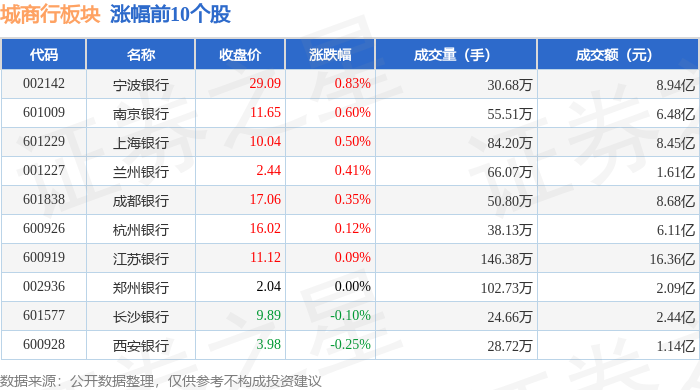
城商行板块11月5日涨0.12%,宁波银行领涨,主力资金净流入5236.36万元
Zheng Xing Xing Ye Ri Bao· 2025-11-05 08:55
Market Performance - The city commercial bank sector increased by 0.12% on November 5, with Ningbo Bank leading the gains [1] - The Shanghai Composite Index closed at 3969.25, up 0.23%, while the Shenzhen Component Index closed at 13223.56, up 0.37% [1] Individual Stock Performance - Ningbo Bank (002142) closed at 29.09, up 0.83% with a trading volume of 306,800 shares and a transaction value of 894 million [1] - Nanjing Bank (6000000) closed at 11.65, up 0.60%, with a trading volume of 555,100 shares and a transaction value of 648 million [1] - Shanghai Bank (601229) closed at 10.04, up 0.50%, with a trading volume of 842,000 shares [1] - Other notable performances include Chengdu Bank (601838) at 17.06, up 0.35%, and Hangzhou Bank (600926) at 16.02, up 0.12% [1] Capital Flow Analysis - The city commercial bank sector saw a net inflow of 52.36 million from institutional investors, while retail investors contributed a net inflow of 89.18 million [2] - The sector experienced a net outflow of 142 million from speculative funds [2] Detailed Capital Flow for Selected Banks - Jiangsu Bank (600919) had a net inflow of 63.74 million from institutional investors, while it faced a net outflow of 46.26 million from speculative funds [3] - Chengdu Bank (601838) reported a net inflow of 63.42 million from institutional investors, with a net outflow of 57.05 million from speculative funds [3] - Ningbo Bank (002142) had a net inflow of 5.72 million from institutional investors but a significant net outflow of 43.57 million from retail investors [3]




郑州银行发布三季度报:资产规模增速创历史新高,营收利润延续双增长趋势
2 1 Shi Ji Jing Ji Bao Dao· 2025-11-05 01:02
Core Viewpoint - Zhengzhou Bank reported significant growth in total assets and liabilities for Q3 2025, indicating strong performance and a solid foundation for future business expansion [1][2]. Group 1: Financial Performance - As of the end of Q3 2025, Zhengzhou Bank's total assets reached 743.55 billion yuan, a year-on-year increase of 9.93%, marking the highest growth rate in the same period historically [1]. - The bank's total liabilities amounted to 685.94 billion yuan, reflecting a growth of 10.62% compared to the end of the previous year [1]. - The bank's net profit attributable to shareholders was 2.28 billion yuan, a year-on-year increase of 1.56%, while operating income reached 9.40 billion yuan, up 3.91% from the previous year [3]. Group 2: Asset and Liability Management - Zhengzhou Bank's loan and advance total reached 406.72 billion yuan, with a steady growth of 4.91% year-on-year, demonstrating robust credit deployment [1][2]. - The bank's total deposits reached 459.52 billion yuan, an increase of 13.59% from the previous year, with personal deposits growing by 22.44% to 267.14 billion yuan [2]. - The bank's provision coverage ratio stood at 186.17%, up 19.94 percentage points year-on-year, while the non-performing loan ratio was 1.76%, a decrease of 0.1 percentage points [3]. Group 3: Strategic Focus - Zhengzhou Bank is committed to supporting the local economy by focusing on key industries and projects, enhancing financial services for small and medium-sized enterprises [2]. - The bank has implemented targeted relief measures for businesses, demonstrating its role as a stabilizing force in the local market [2].
单日狂揽超6.7亿元,这一板块突然大涨!
Zhong Guo Jing Ying Bao· 2025-11-04 13:01
Core Viewpoint - The recent performance of the banking sector is supported by improved earnings and significant capital inflows, driven by favorable policies and a shift in investment logic towards high-dividend assets [5][6][9]. Group 1: Banking Sector Performance - As of November 4, the A-share banking stocks showed a collective increase, with 41 out of 42 banks rising, and Xiamen Bank seeing a nearly 6% increase [5]. - The banking ETF (512800) experienced a net inflow of 678 million yuan, reversing a trend of six consecutive days of outflows [5]. - The banking sector's recovery is attributed to improved third-quarter earnings, with listed banks' revenue and net profit growing by 0.9% and 1.5% year-on-year, respectively [6]. Group 2: Earnings Improvement - The net interest margin for listed banks was 1.41%, remaining stable compared to the first half of the year, with the decline in net interest income narrowing to 0.6% year-on-year [6]. - A favorable policy environment is expected to support a rebound in bank performance, with stable monetary policy and active fiscal measures enhancing economic vitality [6][7]. Group 3: Policy Support - The People's Bank of China reported a 6.6% year-on-year increase in loans and a stable social financing growth rate of 8.7%, indicating a solid banking environment [7]. - The "Suggestions" from the Central Committee emphasize accelerating the construction of a financial powerhouse, providing a long-term policy anchor for the banking sector [8]. Group 4: Investment Logic Shift - The investment logic for banking stocks has shifted from "pro-cyclical" to "weak-cyclical," making high-dividend banking stocks more attractive during economic slowdowns [9]. - Long-term funds, including insurance and asset management companies, are increasingly allocating to high-dividend assets, indicating a strong demand for stable banking stocks [10]. Group 5: Historical Performance Insights - Historical data shows that the banking sector has a 70% probability of generating absolute returns in the last two months of the year, with an 80% success rate in January of the following year [11].
地方政府与城投企业债务风险研究报告:河南篇
Lian He Zi Xin· 2025-11-04 12:20
1. Report Industry Investment Rating No information provided in the content. 2. Core Viewpoints of the Report - Henan Province has a high - level economic development with a leading GDP in China, but a relatively low per - capita GDP and urbanization rate. The province has taken measures to prevent and resolve government debt risks, and has completed the implicit debt resolution plan for seven consecutive years since 2018 [4]. - There is a high degree of differentiation in the development of cities in Henan. Zhengzhou has an absolute advantage in economic and fiscal strength, and Luoyang also maintains a leading position. Some cities have relatively high government debt ratios and need to pay attention to the credit risks of urban investment enterprises [4]. - Most of Henan's bond - issuing urban investment enterprises still face significant short - term debt repayment pressure, and the bond maturity scale of provincial - level, Zhengzhou, and Luoyang urban investment enterprises in 2026 is large. Attention should be paid to the credit risks of urban investment enterprises with relatively heavy local government debt burdens, low debt - repayment and support capabilities, and insufficient refinancing capabilities [4]. 3. Summary by Relevant Catalogs 3.1 Henan's Economic and Fiscal Strength 3.1.1 Regional Characteristics and Economic Development - Henan is located in the central - eastern part of China, with superior transportation location and prominent resource endowment. It has a high - level economic development, a leading GDP, a middle - lower per - capita GDP, and a low urbanization rate. The industrial structure is "tertiary - secondary - primary", and strategic opportunities such as the construction of the Central Plains Urban Agglomeration help the regional development [5]. - Henan has a large population, with a permanent population of 97.85 million in 2024, ranking third in China. The urbanization rate is 59.22%, lower than the national average, with large room for development [9]. - In 2024, Henan's GDP was 6.358999 trillion yuan, ranking sixth in China, with a growth rate of 5.1%. The per - capita GDP was 64,900 yuan, lower than the national level. The industrial and service industries have good development momentum, and investment in fixed assets and industry has increased [10][14][15]. 3.1.2 Fiscal Strength and Government Debt - In 2024, Henan's general public budget revenue decreased slightly year - on - year, ranking in the upper - middle level in China. The fiscal self - sufficiency rate is low, and the government - funded revenue continued to decline. The provincial government debt ratio and liability ratio are in the middle in China, but the liability level is rising rapidly [23]. - In 2024, Henan's local government debt ratio and liability ratio were 169.48% and 33.51% respectively, ranking 15th and 10th in China, up 26.36 and 3.25 percentage points from the end of the previous year [24]. 3.2 Economic and Fiscal Conditions of Prefecture - Level Cities in Henan 3.2.1 Economic Strength of Prefecture - Level Cities - There is a high degree of imbalance in the development of cities in Henan. Zhengzhou is the only city with a GDP of over one trillion yuan, and Luoyang and Nanyang also have obvious leading advantages. Most cities have a lower urbanization rate than the national average [26]. - The economic development levels of cities in Henan are highly differentiated, showing a ladder - like distribution. In 2024, most cities' GDP rankings remained the same as in 2023. In terms of per - capita GDP, Zhengzhou and Jiyuan lead, and Zhoukou ranks last. In terms of urbanization rate, Zhengzhou has the highest level [35][36]. 3.2.2 Fiscal Strength and Government Debt of Prefecture - Level Cities - The fiscal strength of cities in Henan is highly differentiated. Zhengzhou leads in terms of fiscal revenue scale and fiscal self - sufficiency rate. In 2024, the general public budget revenue of some cities fluctuated, and more than half of the cities' government - funded revenue decreased. The superior subsidy income contributes significantly to the comprehensive financial resources [38]. - In 2024, the government debt balance of all cities in Henan increased, with Zhengzhou having the largest balance. The government debt ratio and liability ratio of all cities increased, and the debt burden is relatively heavy. Shangqiu, Puyang, Xuchang, and Zhoukou had a relatively large increase in the government debt ratio [48][49]. 3.2.3 Debt Resolution - Henan has taken various measures to prevent and resolve government debt risks, and the overall debt risk is controllable. It has optimized the debt structure and reduced the risk level. Since 2024, the spread of urban investment bonds in Henan has shown a downward trend [50][53]. 3.3 Debt Repayment Ability of Urban Investment Enterprises in Henan 3.3.1 Overview of Urban Investment Enterprises - There are bond - issuing urban investment enterprises in Henan at the provincial level and in 18 cities. The administrative levels of these enterprises are mainly at the prefecture - level and district - county levels, and they are mainly distributed in Zhengzhou and its surrounding cities. The credit levels of Zhengzhou's urban investment enterprises are relatively high [55]. - As of the end of September 2025, there were 148 bond - issuing urban investment enterprises in Henan, with a total balance of outstanding bonds of 768.689 billion yuan. High - credit - level enterprises are mainly concentrated at the provincial level and in Zhengzhou, and AA - level enterprises account for the highest proportion [56][57]. 3.3.2 Bond Issuance - In 2024, the number of bonds issued by Henan's urban investment enterprises decreased year - on - year, while the scale increased. Most cities maintained a net inflow of bond financing. From January to September 2025, the bond issuance rhythm slowed down, and regional differentiation intensified [63]. 3.3.3 Debt Repayment Ability Analysis - At the end of 2024, most of Henan's bond - issuing urban investment enterprises faced significant short - term debt repayment pressure, and the bond maturity scale of provincial - level, Zhengzhou, and Luoyang urban investment enterprises in 2026 is large. The debt burden of some cities' urban investment enterprises is relatively heavy [68][71]. 3.3.4 Support and Guarantee Ability of Local Fiscal Revenue for Urban Investment Enterprises' Debt - At the end of 2024, the ratio of "total debt of bond - issuing urban investment enterprises + local government debt" to comprehensive financial resources in Henan cities was at least about 220.15%. Zhengzhou had the highest ratio, and the support and guarantee ability of some cities was under pressure [76].
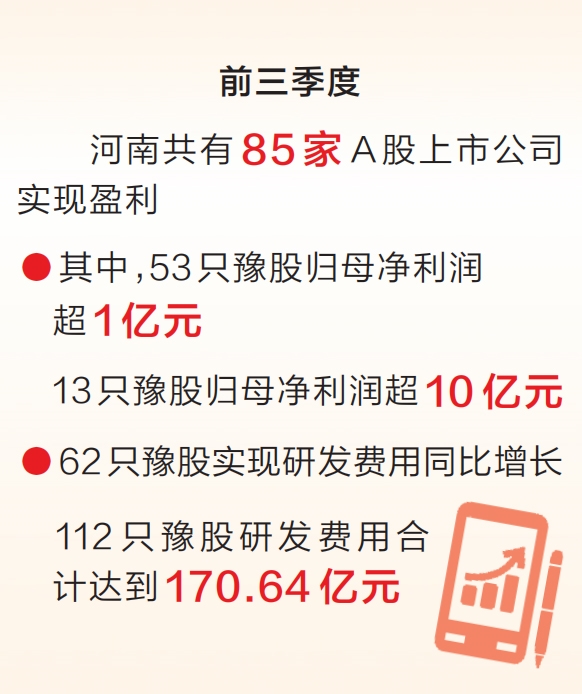
豫股三季报彰显经济韧性 近八成实现盈利 53家企业盈利超亿元
He Nan Ri Bao· 2025-11-04 00:01
Group 1 - The core viewpoint of the articles indicates that the performance of A-share listed companies in Henan province shows a steady progress amidst a complex economic environment, with many companies achieving significant revenue growth [1][2] - In terms of revenue, Luoyang Molybdenum Co. leads with an operating income of 145.485 billion yuan, while several other companies, including Muyuan Foods and Shuanghui Development, also reported revenues exceeding 30 billion yuan [1] - A total of 85 out of 112 listed companies in Henan achieved profitability in the first three quarters, with 53 companies reporting net profits exceeding 100 million yuan and 13 companies exceeding 1 billion yuan [1] Group 2 - Research and development (R&D) expenses for Henan listed companies reached a total of 17.064 billion yuan, with 62 companies reporting year-on-year growth in R&D spending [2] - Eleven companies, including AVIC Optoelectronics and Hualan Biological, allocated over 10% of their operating income to R&D, indicating a shift towards self-driven innovation [2] - The performance of these listed companies not only reflects the current economic situation but also indicates future industry development directions and potential [2]