
卫材

Search documents
复星医药14亿控股绿谷医药 押注阿尔茨海默病赛道
Huan Qiu Wang· 2025-12-16 05:54
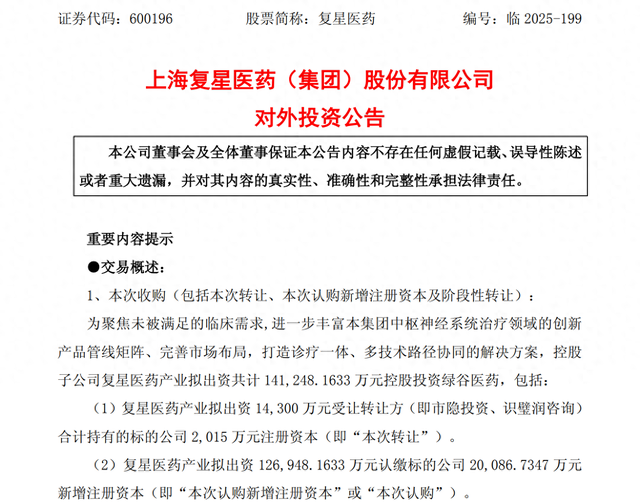
Core Viewpoint - Fosun Pharma announced a strategic investment to acquire a controlling stake in Green Valley Pharmaceutical, investing approximately RMB 1.412 billion, which is seen as a high-risk bet in the Alzheimer's disease (AD) drug market [1][4]. Group 1: Transaction Details - The acquisition involves purchasing existing shares from current shareholders and subscribing to new registered capital, resulting in Fosun holding 51% of Green Valley [4]. - Fosun will pay RMB 143 million for existing shares and RMB 1.269 billion for new capital, primarily to support clinical research and daily operations [4]. - Green Valley is currently in a difficult financial position, with total assets of RMB 806 million and liabilities of RMB 795 million, leading to owner equity of only RMB 10.36 million [4]. Group 2: Product Focus - The key asset in this transaction is the controversial Alzheimer's drug, Ganluotena Capsules (marketed as "Jiuyiqi"), which has been halted due to regulatory issues [4][5]. - "Jiuyiqi" was conditionally approved in 2019 and had a significant market presence, benefiting over 500,000 patients after being included in medical insurance [5]. - The drug's unique mechanism has faced skepticism, and its clinical trials were prematurely terminated due to funding issues [5]. Group 3: Market Context - The AD market in China shows a significant unmet need, with nearly 17 million patients and a 242.5% increase in incidence from 1990 to 2021, indicating substantial growth potential [5][6]. - Fosun's existing portfolio includes other CNS assets, and "Jiuyiqi" could fill a gap in treatments for moderate AD patients, potentially creating an integrated diagnostic and therapeutic model [6]. Group 4: Strategic Implications - The transaction is viewed as a "low-cost acquisition," with Green Valley's total equity valued at RMB 1.674 billion, allowing Fosun to gain control at a significantly lower cost than previous investments [6]. - Fosun's management emphasizes the importance of addressing clinical needs in the CNS field and the potential for breakthroughs in AD drug development [6]. Group 5: Future Considerations - The success of this investment hinges on the ability to complete necessary post-marketing clinical trials and secure regulatory approvals for the drug's re-commercialization [6][7]. - The competitive landscape for AD treatments is intensifying, with international drugs gaining approval and recognition, posing challenges for "Jiuyiqi" to regain trust [7]. - The financial burden of Green Valley's liabilities will test Fosun's financial management capabilities [7].

复星医药14亿入局阿尔茨海默病,缘何选择押注绿谷“九期一”?
2 1 Shi Ji Jing Ji Bao Dao· 2025-12-15 14:23
Core Viewpoint - The acquisition of Green Valley Pharmaceutical by Fosun Pharma marks a significant strategic move into the Alzheimer's disease treatment sector, amidst ongoing controversies and challenges surrounding the drug GV-971 (Guanluotena) [1][2][3] Group 1: Acquisition Details - Fosun Pharma announced an investment of approximately RMB 1.412 billion to acquire a controlling stake in Green Valley Pharmaceutical, which will now become a subsidiary [1][3] - The transaction involves three parts: acquiring existing capital, subscribing to new capital, and addressing stock incentive plans [3] - Post-acquisition, Fosun Pharma will hold 53% of Green Valley's shares, with plans to increase this to 51% through further transfers [3] Group 2: Market Context and Challenges - The Alzheimer's drug market is characterized by high failure rates, with over 99.6% of drug development efforts failing globally [6] - GV-971 has faced significant scrutiny regarding its efficacy and clinical trial design, leading to questions about its market viability [5][6] - The drug's conditional approval requires completion of post-marketing confirmatory clinical trials to maintain its market status [5][8] Group 3: Strategic Implications - Fosun Pharma's entry into the Alzheimer's treatment space is seen as a strategic response to the growing demand for effective therapies in light of China's aging population [7][8] - The acquisition allows Fosun to leverage Green Valley's existing research while avoiding lengthy development timelines associated with new drug discovery [7] - Analysts suggest that the Alzheimer's treatment market is still in its early stages, providing an opportunity for Fosun to establish a competitive advantage [7]
复星医药14亿入局阿尔茨海默病 缘何选择押注绿谷“九期一”?
2 1 Shi Ji Jing Ji Bao Dao· 2025-12-15 14:21
Core Viewpoint - Fosun Pharma is acquiring a controlling stake in Green Valley Pharmaceutical for approximately RMB 1.412 billion, aiming to integrate its Alzheimer's drug, GV-971, into its innovative drug pipeline, despite the drug facing operational challenges and controversies since its launch in 2019 [1][2][3]. Company Summary - Fosun Pharma's acquisition will result in Green Valley becoming a subsidiary, with Fosun holding 53% of its shares post-transaction [5][6]. - The investment will be allocated to clinical research and daily operations of Green Valley, which has been under financial pressure and facing supply issues for GV-971 [1][5]. - The acquisition is seen as a strategic move for Fosun to enter the cognitive disorder treatment market and enhance its position in the neurodegenerative disease sector [4][10]. Industry Summary - The Alzheimer's drug market is experiencing significant activity, with recent approvals of two new targeted therapies, highlighting the competitive landscape [3][9]. - There is a substantial unmet clinical need for effective Alzheimer's treatments, as current options are limited and the disease poses a major public health challenge [5][9]. - The global pharmaceutical industry has invested over $600 billion in Alzheimer's research, with a high failure rate in drug development, indicating the complexities involved in this field [9][11]. - The Chinese government is prioritizing Alzheimer's disease management, with plans to enhance screening and intervention strategies by 2030, which may increase market opportunities [10].
重大突破,5款百万一针抗癌药被纳入商保
21世纪经济报道· 2025-12-15 13:38
Core Viewpoint - The inclusion of 19 drugs in the first version of the commercial health insurance innovation drug directory marks a significant step towards improving access and affordability of innovative drugs, particularly high-cost CAR-T therapies, while presenting challenges for insurance companies in product development and risk management [1][4][10]. Group 1: Policy and Implementation - The National Medical Security Work Conference emphasized the support for the development of commercial health insurance and the establishment of a multi-tiered medical security system, with a focus on the implementation of the commercial health insurance innovation drug directory by January 1, 2026 [1][2]. - The first version of the commercial health insurance innovation drug directory includes 19 drugs, focusing on high-cost and innovative treatments, including five CAR-T products and drugs for rare diseases [2][4]. Group 2: Challenges for Insurance Companies - Insurance companies face significant challenges in translating the drug directory into viable insurance products, including issues related to pricing, risk control, and compliance [4][5]. - Accurate pricing for insurance products relies on detailed data regarding potential patient populations, disease incidence, treatment cycles, and real-world efficacy, which are primarily held by pharmaceutical companies and hospitals [4][5]. Group 3: Risk Management and Compliance - The inclusion of Alzheimer's disease treatments raises concerns about adverse selection risks, as these drugs have high costs and long treatment durations, necessitating strict eligibility criteria for insurance coverage [5][6]. - Establishing transparent and compliant financial flows between insurance companies and pharmaceutical firms is crucial for effective collaboration [5][6]. Group 4: Data Sharing and Integration - The "医保+商保" one-stop clearing and settlement model aims to break down data silos, enhancing the efficiency of claims processing and improving patient experiences [6][8]. - Successful implementation of data sharing initiatives in regions like Shanghai and Beijing indicates potential for nationwide adoption, which could facilitate better integration of commercial health insurance with innovative drug offerings [8][10]. Group 5: Investment in Innovative Drugs - The policy encourages insurance funds to invest in the upstream of the pharmaceutical industry, positioning them as "patient capital" for innovative drug development [10][11]. - Major insurance companies are already investing in health industry funds, supporting numerous innovative drug companies and enhancing the overall funding environment for drug development [10][11]. Group 6: Future Outlook - Despite the potential for increased investment in innovative drugs, insurance companies remain cautious due to the high risks and costs associated with drug development, which may lead to a preference for established pharmaceutical firms over smaller, innovative companies [12].

创新药保障“最后一公里”待解:买得到、赔得快、保得起
2 1 Shi Ji Jing Ji Bao Dao· 2025-12-15 10:47
Core Insights - The release of the 2025 National Medical Insurance Directory and the first Commercial Health Insurance Innovative Drug Directory marks a significant milestone in China's healthcare payment system, transitioning to a dual-driven model of "basic medical insurance + commercial health insurance" [1][3][10] Group 1: Policy Changes - The new policies clarify the payment boundaries between government and market, with the Commercial Health Insurance Innovative Drug Directory focusing on high-value innovative drugs that exceed the basic medical insurance coverage [3][4] - The 2025 Medical Insurance Directory adds 114 new drugs, achieving a negotiation success rate of 88.19%, the highest in seven years, with a total of 3,253 drugs now covered [3][4] Group 2: Drug Inclusion - The first Commercial Health Insurance Innovative Drug Directory includes 19 drugs, such as CAR-T therapies and new Alzheimer's medications, which are typically expensive and risky, thus not included in basic medical insurance [4][5] - Five CAR-T therapies have been included in the directory, representing over half of the currently available products in China, with prices exceeding 1 million yuan for most [5][6] Group 3: Market Dynamics - The dual-track system addresses the affordability of high-value drugs for patients while providing a sustainable return mechanism for pharmaceutical companies, thus driving high-quality development in China's innovative drug industry [4][6] - The introduction of these directories is expected to enhance clinical medication levels and overall R&D returns, particularly benefiting leading innovative pharmaceutical companies with extensive pipelines [6][7] Group 4: Consumer Impact - The integration of the two directories allows for a complementary relationship, where commercial insurance can cover innovative drugs first before they are potentially included in basic medical insurance [7][8] - The "gradient payment" mechanism enables patients to access the latest therapies without facing the dilemma of full out-of-pocket expenses, as commercial insurance will provide payment support [8][10] Group 5: Implementation Challenges - There are practical challenges in ensuring that hospitals stock the newly included high-priced drugs, as they may face financial disincentives to do so [10][11] - The claims process for commercial insurance may still require patients to pay upfront, which can be a significant burden for high-cost innovative drugs [10][11] - The potential for increased claims rates due to the inclusion of high-risk drugs may lead to higher insurance premiums or stricter underwriting standards in the future [12]

创新药商保目录专家电话会议
2025-12-08 15:36
Summary of Conference Call on Commercial Health Insurance and Innovative Drugs Industry Overview - The conference focused on the commercial health insurance (CHI) sector in China, particularly its integration with the national medical insurance system and the implications for innovative drug companies [1][2]. Key Points and Arguments Integration of Commercial Health Insurance and National Medical Insurance - The National Healthcare Security Administration (NHSA) has led the establishment of a commercial insurance directory, addressing fragmentation in the commercial insurance industry and enhancing the importance of pharmaceutical companies and their products [1][3]. - The commercial health insurance directory aims to provide a platform for innovative drugs, similar to centralized procurement but with a greater emphasis on clinical and economic evaluations rather than just fund calculations [2][4]. Innovative Drug Coverage and Payment Models - Commercial health insurance is adapting to high treatment costs, such as CAR-T therapy, by implementing partial reimbursement and pay-for-performance models to alleviate patient financial burdens [1][5]. - The NHSA's increasing payment for innovative drugs is projected to reach approximately CNY 200 billion by 2024, yet the share of commercial insurance remains low, around CNY 12.5 billion [7][10]. Market Dynamics and Challenges - The high-end medical insurance market in China is currently underdeveloped, with a total market size of less than CNY 10 billion, primarily due to economic factors and the limited purchasing power of potential customers [8][9]. - The commercial health insurance sector is expected to see significant growth, with projections indicating that by 2030, health insurance investments could reach CNY 25 trillion, with CNY 500 billion allocated for innovative drugs, increasing the reimbursement share from 1/16 to 1/4 [10][11]. Future Trends and Opportunities - The future growth of commercial health insurance is anticipated to focus on mid-tier medical insurance, particularly for patients with pre-existing conditions, which can fill gaps in the current healthcare system [13][19]. - The integration of commercial insurance with national healthcare is expected to facilitate a one-stop settlement model, enhancing patient access to innovative treatments and improving overall healthcare service quality [11][27]. Characteristics of Newly Added Drugs - The drugs included in the commercial insurance directory this year are characterized by small market sizes, high costs, and uncertain efficacy, which allows for real-world studies to support future inclusion in the national insurance system [20][21]. Operational Changes in Insurance Companies - Future operational changes in commercial insurance companies may include direct settlement models, where patients do not need to pay upfront, and a focus on different customer segments through business separation [25][27]. Additional Important Insights - The average reimbursement rate for million medical insurance is around 40%, indicating a significant portion of funds is allocated to operational costs rather than patient payouts [18]. - The commercial health insurance market in China has substantial growth potential, with current insurance density and depth significantly lower than OECD averages, suggesting room for expansion [16][17]. This summary encapsulates the critical insights from the conference call, highlighting the evolving landscape of commercial health insurance in China and its implications for innovative drug companies.
医保商保“双目录”发布!多家上市公司产品榜上有名
Shang Hai Zheng Quan Bao· 2025-12-08 13:04
Core Viewpoint - The new National Medical Insurance Directory and the first Commercial Health Insurance Innovative Drug Directory will be implemented nationwide starting January 1, 2026, providing a dual-track system for basic and innovative drug coverage [1][2]. Group 1: National Medical Insurance Directory - A total of 114 new drugs have been added to the National Medical Insurance Directory, with 111 being new products launched within the last five years, representing 97.3% of the new entries [2]. - Among the new additions, 50 are classified as Class 1 innovative drugs, with an overall success rate of 88%, an increase from 76% in 2024 [2]. - The total number of drugs in the directory has increased to 3,253, including 1,857 Western medicines and 1,396 traditional Chinese medicines [2]. Group 2: Company Announcements - Several listed companies, including Heng Rui Medicine and Fuxing Medicine, announced new drug entries or renewals in the National Medical Insurance Directory [3]. - Heng Rui Medicine reported that 20 products/indications were included in the new directory, with a projected sales revenue of approximately 8.66 billion yuan in 2024 and about 7.55 billion yuan in the first three quarters of 2025 [4]. - Hai Si Ke's two Class 1 innovative drugs were also included, with applications in sedation and pain management [6]. Group 3: Commercial Health Insurance Innovative Drug Directory - The first Commercial Health Insurance Innovative Drug Directory includes 19 new drugs from 18 innovative pharmaceutical companies, with 9 being Class 1 innovative drugs [11]. - Notably, 5 CAR-T products were included, representing over half of the CAR-T products available in China, addressing previous challenges in pricing negotiations [11][12]. - The directory also includes treatments for rare diseases and high-profile conditions such as Alzheimer's disease, enhancing the coverage provided by basic medical insurance [11][13].
数十万元阿尔茨海默病疗法纳入首版商保创新药目录,离进医保还远吗
Di Yi Cai Jing· 2025-12-08 09:55
Core Insights - The introduction of the first commercial insurance innovative drug directory by China's National Healthcare Security Administration on December 7 has garnered attention, particularly for including two Alzheimer's disease treatments from Eisai and Eli Lilly, highlighting the high barriers to drug development in this area and the limited treatment options available globally [1][2] Group 1: Drug Pricing and Accessibility - The annual treatment costs for Eisai's Lecanemab and Eli Lilly's Donanemab exceed 200,000 RMB and 300,000 RMB respectively, with total treatment expenses potentially reaching up to 500,000 RMB over a year and a half [2] - By 2025, Donanemab will be included in commercial health insurance across ten cities, including Beijing, Guangzhou, and Shenzhen, indicating a step towards broader patient access, although reliance solely on large city insurance is insufficient [2][3] Group 2: Policy and System Development - The exploration of the commercial insurance innovative drug directory reflects significant progress in China's multi-tiered healthcare system, aiming to enhance the affordability and accessibility of innovative therapies for major diseases through collaboration between commercial insurance and national healthcare [2][3] - The Chinese government encourages investment in valuable innovations, with commercial health insurance providing diverse support pathways for innovative drug payments, as emphasized by industry experts [3] Group 3: Economic Impact of Alzheimer's Disease - Alzheimer's disease poses a heavy burden, with the annual cost for patients in China reaching 1.1 trillion RMB in 2015, projected to escalate to 3.2 trillion RMB by 2030 and 11.9 trillion RMB by 2050 [4] - The disease is a key focus in addressing the challenges of an aging population, with policies aimed at facilitating access to innovative therapies for early-stage patients to improve their quality of life [4][5] Group 4: Development of Domestic Therapies - Domestic companies are actively developing related therapies, although most innovative Alzheimer's treatments are still in early preclinical stages and not yet ready for formal clinical trials [5]

2025医保、商保双目录公布:医保新增50种一类创新药,多款CAR
Xin Lang Cai Jing· 2025-12-08 07:57
Core Insights - The National Healthcare Security Administration (NHSA) and the Ministry of Human Resources and Social Security have issued a new drug directory for basic medical insurance and commercial health insurance, effective from January 1, 2026, which includes 114 new drugs, with 50 being innovative drugs, marking an 88% success rate compared to 76% in 2024 [2][12] Group 1: Commercial Health Insurance Drug Directory - The first edition of the commercial health insurance innovative drug directory includes 19 drugs, with a price reduction range of 15% to 50%, significantly lower than the basic medical insurance negotiation intensity [3][13] - Among the 19 drugs, there are 5 CAR-T products, 2 Alzheimer's drugs, and 6 rare disease medications, primarily focusing on high-cost treatments for catastrophic diseases [3][14] - The inclusion of CAR-T therapies in the commercial insurance directory represents a significant milestone, with all 5 domestic CAR-T therapies successfully entering the directory [3][13] Group 2: Innovative Drug Characteristics - The commercial health insurance directory emphasizes high innovation, significant clinical value, and substantial patient benefits, particularly for drugs that exceed basic medical insurance coverage [4][14] - Notable drugs include Takeda's injection of teduglutide for short bowel syndrome and North Sea Kangcheng's injection of velaglucerase alfa for Gaucher disease, which could significantly reduce treatment costs for patients [5][15] Group 3: Policy Support and Market Implications - Drugs included in the commercial health insurance directory will benefit from the "three exclusions" policy, which provides a more favorable environment for clinical application and timely treatment for patients [6][16] - The new drug directory is seen as a positive development for new drug launches, with commercial insurance attempting to address issues related to medical insurance funds [7][17] Group 4: Additional Drug Listings and Market Dynamics - The 2025 national medical insurance directory also includes drugs that fill gaps in basic insurance coverage, such as Sanofi's innovative blood cancer drug, which is the first of its kind approved in China [8][18] - Some high-profile drugs did not make it into the directory, highlighting the competitive nature of the approval process [8][19]
礼来(LLY.US)、强生(JNJ.US)与辉瑞(PFE.US)拓展中国市场:旗下创新药物纳入首版商保目录
智通财经网· 2025-12-08 04:16
Core Insights - Eli Lilly (LLY.US), Pfizer (PFE.US), and Johnson & Johnson (JNJ.US) have secured positions in China's first innovative drug catalog, opening new market channels and enhancing sales prospects for expensive therapies [1] - The inclusion of 19 innovative drugs in the medical insurance reimbursement list aims to alleviate the burden on the national insurance system while allowing pharmaceutical companies to sell at higher prices, thus improving profit margins [1] - The list is expected to expand the role of private insurance in funding innovative drugs, which currently holds a small market share in China [1][2] Group 1 - The drugs listed cover various diseases, including cancer, Alzheimer's, and rare genetic disorders, reflecting the growing demand for treatments due to China's aging population [1] - The average discount for the drugs has not been disclosed, but previous reports suggest a range of 15% to 50%, which is lower than the typical 60% discount required for inclusion in the National Reimbursement Drug List (NRDL) [2] - The selection process for the final list was competitive, with only a few drugs making it through from an initial pool of 24, indicating a cautious approach by regulators in the first year of implementation [2] Group 2 - Analysts suggest that the growth rate of commercial insurance sales may not match that of national insurance, as insurance companies need to establish communication with hospitals regarding reimbursement processes [3] - The initial catalog included both foreign and domestic pharmaceutical products, but the final list is relatively small and may not significantly disrupt the market landscape [3] - Projections indicate that the number of drugs in the catalog could increase to 300 by 2027, suggesting potential future growth in the market [3]

