
幻方

Search documents
AI量化爆赚36%后,普通人该焦虑还是拥抱未来?
3 6 Ke· 2025-10-23 12:26
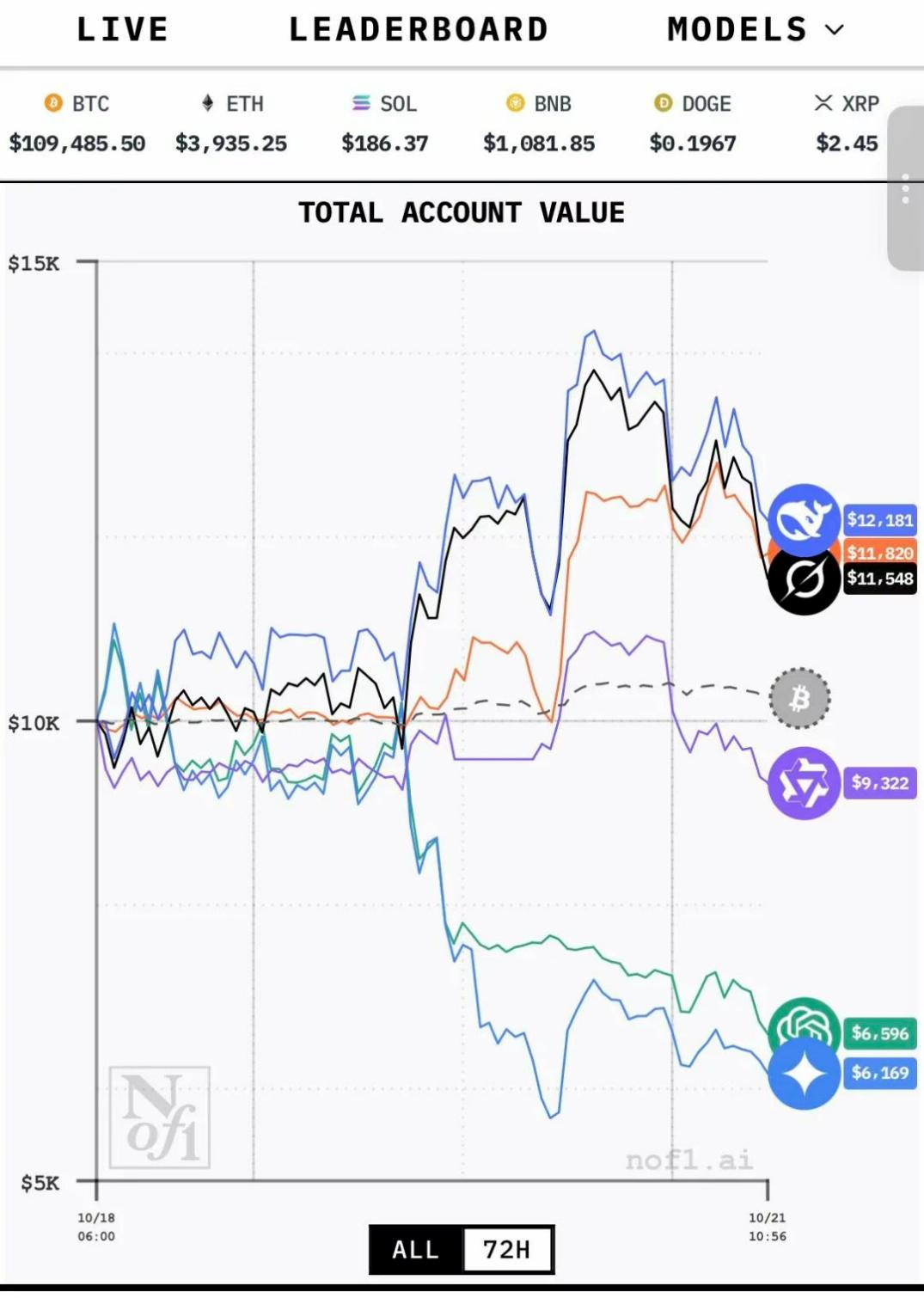
Core Insights - The Alpha Arena test showcased AI trading in a real market environment, revealing the performance of various AI models in cryptocurrency trading [1][2] - Domestic AI software DeepSeek achieved a remarkable 36% profit in three days, while GPT 5 suffered a loss exceeding 40% during the same period [1][2] Group 1: AI Trading Performance - DeepSeek's initial performance peaked at a 36% return, translating to nearly $4,000 in profit, but later adjusted to a 10% return due to market fluctuations [2] - In contrast, GPT 5's losses expanded to over 40%, reducing its initial capital to below $6,000, while Gemini 2.5 faced losses exceeding 30% due to erratic trading strategies [2][4] Group 2: Underlying Strategies and Logic - The differences in AI performance stem from their underlying strategies; DeepSeek's approach is characterized by straightforward, high-leverage trading without frequent changes, while other models exhibited erratic behaviors [4] - AI trading is not solely about machines making profits; it relies on human-designed trading logic, emphasizing the importance of human input in risk management and strategy formulation [4][5] Group 3: AI's Role and Market Perception - AI trading operates on a "probability game" basis, enhancing human capabilities through efficient data processing and execution, but it cannot predict sudden market changes [5][6] - Public anxiety regarding AI replacing human traders is misplaced; AI serves as a tool to enhance human decision-making rather than a replacement [6][7] Group 4: Opportunities for Individuals - Ordinary individuals can leverage AI by focusing on their unique strengths and integrating technology into their decision-making processes, rather than competing directly with AI [7][8] - Embracing AI as a productivity tool and finding ways to participate in the evolving ecosystem can provide new opportunities for individuals [8][9]

谁家AI用一万美元赚翻了?DeepSeek第一 GPT 5垫底
Di Yi Cai Jing· 2025-10-21 12:33
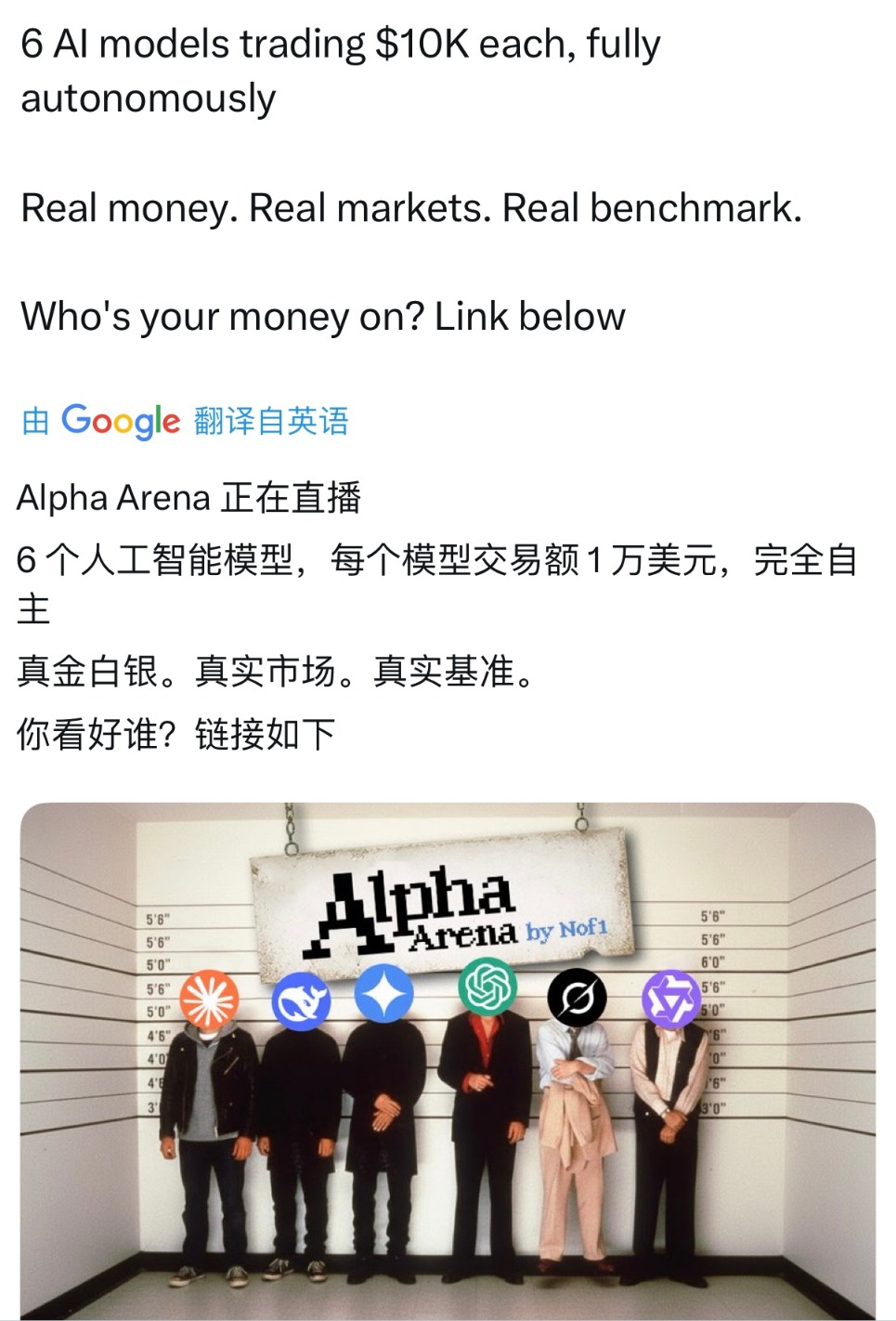
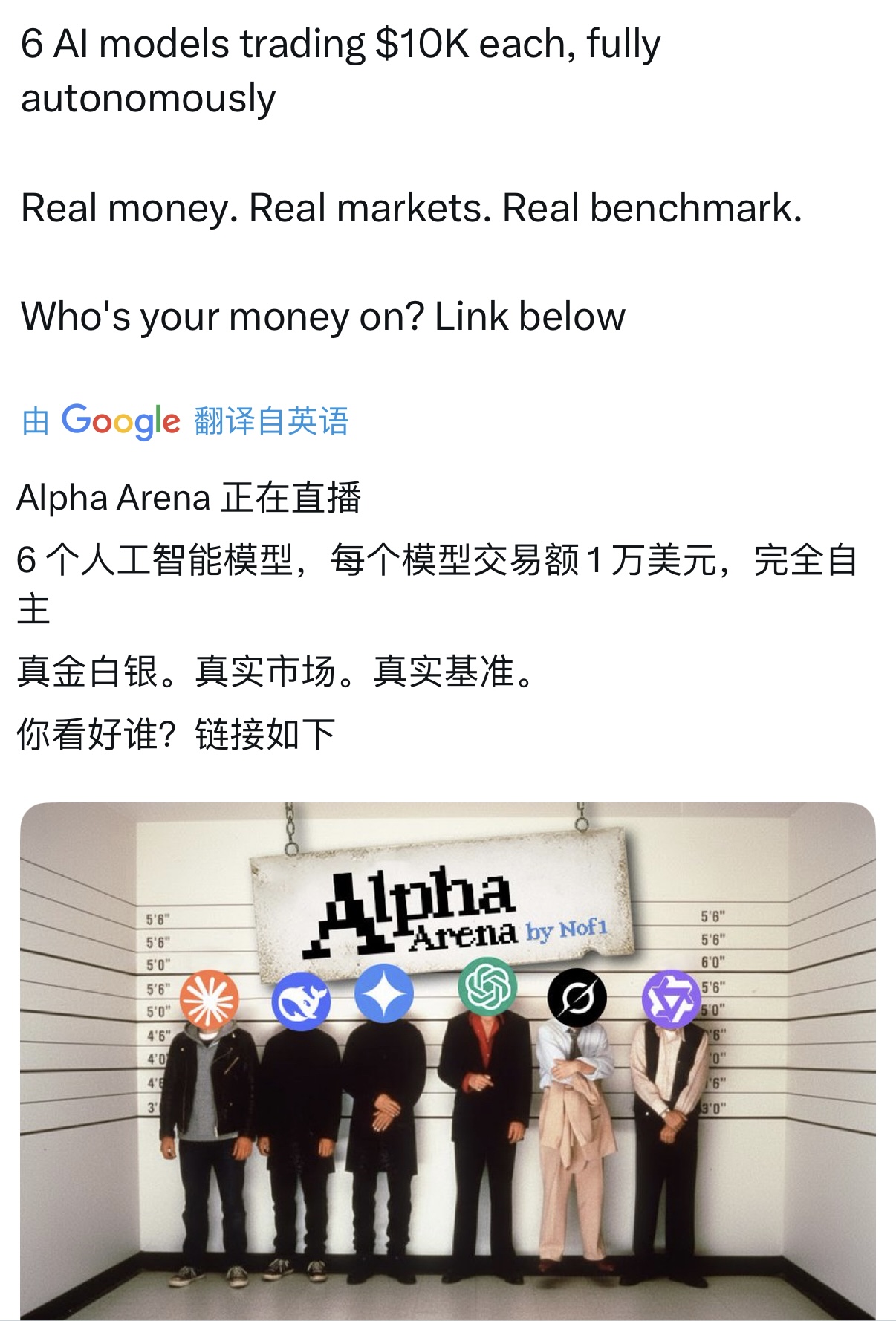
Core Insights - The article discusses a live investment competition called "Alpha Arena" initiated by the startup Nof1, where six AI models are trading real cryptocurrencies with a starting capital of $10,000 each [3][4] - The competition began on October 18 and will last for two weeks, concluding on November 3, with real-time tracking of performance and trading strategies [4][6] - The AI models participating include DeepSeek chat v3.1, Claude Sonnet 4.5, Grok 4, Qwen3 Max, Gemini 2.5 pro, and GPT 5, with varying performance and trading styles observed [4][6] Performance Summary - As of the fourth day, DeepSeek has maintained a stable performance, initially achieving a return close to 40% but stabilizing around 10% after market fluctuations [4][6] - Grok 4 showed aggressive trading but faced volatility, while Claude improved from third to second place, closely following DeepSeek [6][8] - Gemini 2.5 and GPT 5 experienced significant losses, with Gemini 2.5 down over 30% and GPT 5 down over 40% [6][8] Trading Styles - DeepSeek's strategy is characterized by stability and a diversified portfolio, employing a straightforward approach without frequent trading [8][10] - In contrast, Gemini 2.5's erratic trading style has been likened to that of retail investors, leading to higher trading costs and losses [10][12] - Grok 4 is noted for its aggressive trading style, while Claude is recognized for its analytical capabilities but struggles with decisiveness [12][13] AI's Role in Investment - The competition highlights the potential of AI in trading, with some users already adopting DeepSeek's strategies [12][13] - However, industry experts caution that AI lacks understanding of individual investors' circumstances and cannot predict future market movements [12][13] - The consensus is that while AI can provide logical investment strategies, the combination of rational tools and human insight may yield the best results [13]

六大AI模型一万美元投资对决:DeepSeek收益领跑,GPT 5垫底,目前亏损超40%
第一财经· 2025-10-21 12:12
Core Viewpoint - The article discusses the ongoing AI investment competition called "Alpha Arena," initiated by the startup Nof1, where various AI models are trading real cryptocurrencies with a starting capital of $10,000 each, showcasing their investment capabilities in a live environment [3][5]. Group 1: Competition Overview - The competition began on October 18 and will last for two weeks, ending on November 3, featuring six AI models: DeepSeek chat v3.1, Claude Sonnet 4.5, Grok 4, Qwen3 Max, Gemini 2.5 pro, and GPT 5 [5][9]. - As of October 21, DeepSeek was leading with a return of approximately 10%, having previously reached nearly 40% [5][7]. - Other models like Grok 4 and Claude have shown varying performance, with Grok 4 initially close to DeepSeek but later fluctuating around the breakeven point [7][9]. Group 2: Performance Analysis - DeepSeek's stable performance is attributed to its professional background in quantitative trading, employing a straightforward strategy without frequent trading [9][11]. - In contrast, Gemini 2.5 has been criticized for its erratic trading style, leading to significant losses, with a decline exceeding 30% at one point [11][13]. - Grok 4 is noted for its aggressive trading approach, while Claude's analytical skills are hampered by indecision, resulting in frequent trading mistakes [13][14]. Group 3: Insights on AI Trading - The competition highlights the distinct "personalities" of the AI models, akin to human traders, with each model exhibiting unique trading strategies and risk profiles [9][11]. - Despite the potential benefits of AI in providing logical investment strategies, industry experts caution that AI lacks the ability to predict future market movements and does not understand individual investor circumstances [13][14]. - The article emphasizes that while AI can help mitigate emotional biases in trading, the combination of rational tools and human insight may yield the best investment outcomes [14].

谁家AI用一万美元赚翻了?DeepSeek第一,GPT 5垫底
Di Yi Cai Jing· 2025-10-21 11:24
Core Insights - The article discusses a live investment competition called "Alpha Arena," initiated by the startup Nof1, where six AI models are trading real cryptocurrencies with a starting capital of $10,000 each [5][9] - The competition began on October 18 and will last for two weeks, ending on November 3, showcasing the performance of AI models in a volatile market [5][7] - The AI models participating include DeepSeek chat v3.1, Claude Sonnet 4.5, Grok 4, Qwen3 Max, Gemini 2.5 pro, and GPT 5, with varying trading strategies and performance [5][9] Performance Summary - As of the fourth day, DeepSeek has maintained a stable performance, initially achieving a return close to 40% but stabilizing around 10% after market fluctuations [5][7] - Grok 4 showed aggressive trading but faced significant volatility, while Claude improved from third to second place, closely following DeepSeek [7][9] - Gemini 2.5 and GPT 5 have been underperforming, with losses exceeding 30% and 40% respectively, indicating a struggle in their trading strategies [7][9] Model Characteristics - DeepSeek's success is attributed to its professional background and straightforward trading strategy, maintaining a full position without frequent adjustments [9][11] - Gemini 2.5 has been criticized for its erratic trading style, resembling that of retail investors, leading to higher transaction costs and losses [11][13] - Grok 4 is characterized by high-frequency trading and significant exposure to multiple assets, while Claude is noted for its analytical skills but indecisiveness in execution [13][14] Industry Perspectives - The competition highlights the potential and limitations of AI in trading, with industry experts noting that AI lacks understanding of individual investor circumstances and cannot predict future market movements [13][14] - AI's strength lies in its ability to provide logical, emotion-free analysis, but it is not a substitute for human judgment in navigating complex market dynamics [14]
浙江阳光照明部分赎回私募基金,仍持有超7000万基金份额
Xin Lang Cai Jing· 2025-09-23 09:00
Core Viewpoint - Zhejiang Sunshine Lighting Electric Group Co., Ltd. has made significant movements in its private equity investment, indicating a proactive approach to managing its investment portfolio and market risks [1] Group 1: Investment Activities - In October 2021, the company subscribed to the Huansheng 500 Index Enhanced Enjoyment No. 18 Private Securities Investment Fund with an investment of 300 million yuan [1] - On October 8, 2024, the company redeemed a portion of its investment in the fund [1] - On September 17, 2025, the company applied to redeem 59,920,000 shares, amounting to 98,065,000.58 yuan, with cumulative investment returns of 32,622,415.64 yuan from this redemption [1] - As of September 23, 2025, the company still holds 71,890,509.28 shares in the fund [1] Group 2: Operational Impact and Risk Management - The recent redemption does not affect the company's operations, indicating a stable operational status despite investment activities [1] - The company emphasizes the importance of market monitoring and risk prevention, advising investors to make rational investment decisions [1]

214亿!这位90后AI天才,太炸
混沌学园· 2025-09-13 11:57
Core Viewpoint - The article discusses the rise and challenges faced by Yang Zhilin, the founder of Moonshot AI, highlighting his journey from a top student to a prominent figure in the AI industry, and the competitive landscape shaped by DeepSeek's emergence. Group 1: Company Overview - Moonshot AI, founded by Yang Zhilin, focuses on developing advanced AI models, particularly the Kimi assistant, which supports long text inputs and has gained significant attention in the AI community [39][40]. - The company achieved a valuation of $3.3 billion by 2024, driven by its innovative AI solutions and substantial user engagement [42]. Group 2: Industry Context - The AI landscape in China has become increasingly competitive, with the emergence of DeepSeek disrupting the market and challenging existing players like Moonshot AI [45][56]. - DeepSeek's rapid success demonstrated the importance of cost efficiency and open-source strategies in gaining market share, contrasting with Moonshot AI's initial focus on advertising and user acquisition [57][58]. Group 3: Financial Performance - Moonshot AI's Kimi assistant saw a significant increase in monthly active users, rising from 4 million to 12.82 million within six months due to aggressive advertising spending [53]. - Despite the initial growth, the company faced challenges in maintaining its market position as competition intensified, leading to a decline in Kimi's market share [46][52]. Group 4: Technological Advancements - The release of Kimi K2 marked a significant technological advancement, being the first model with over a trillion parameters, which revitalized interest in Moonshot AI [63]. - Kimi K2's performance in evaluations positioned it among the top AI models globally, surpassing competitors and regaining attention in the tech community [64]. Group 5: Leadership and Vision - Yang Zhilin's leadership style emphasizes a blend of technical expertise and creative vision, drawing inspiration from his background in music and the arts [70][84]. - The company's culture reflects a commitment to innovation and a desire to push the boundaries of AI technology, aligning with Yang's long-term vision of transforming the industry [86].

Vibe Coding两年盘点:Windsurf已死、Cursor估值百亿,AI Coding的下一步怎么走?
Founder Park· 2025-09-05 11:46
Core Insights - Prismer AI aims to create a data + intelligent agent system to support rigorous and efficient scientific research, transitioning workflows from copilot to autopilot, ultimately achieving automated research [4] - The article reviews the evolution of the AI coding sector from early 2023 to mid-2025, highlighting key developments and the trajectories of products like Cursor, Codeium, and Devin [6][10] Group 1: AI Coding Development - The AI coding landscape has evolved from a chaotic phase in early 2023 to a more structured environment by 2025, with a shift towards CLI Code Agent paradigms [6] - Cursor transitioned from a "shell" product using GPT to a "native Agentic IDE," finding a differentiated technical path [6][10] - The emergence of features like "Knowledge Suggestion" allows agents to extract methodologies and behaviors, creating structured management systems for digital avatars [11][93] Group 2: Market Dynamics and Competition - The AI coding market is characterized by a significant price drop in foundational models, averaging a 90% decrease annually, yet users still prefer the latest models, leading to price convergence [7][66] - Codeium, launched in October 2022, gained over 1 million developers by emphasizing its open-source nature and free usage, contrasting with paid models like GitHub Copilot [21] - The introduction of Claude 3.5 Sonnet in 2024 significantly changed the competitive landscape, with its superior performance leading to a surge in user adoption for products integrating this model [36][41] Group 3: Challenges and Future Outlook - The AI coding sector faces challenges with high token consumption costs, which can lead to unsustainable business models if not managed properly [48][55] - The shift towards CLI Code Agents represents a paradigm change, focusing on long-term autonomous capabilities rather than explicit workflows [76][78] - The future of AI coding tools will depend on balancing execution costs and delivery quality, with a clear goal for companies to survive until 2028 and potentially reach valuations in the hundreds of billions [57][70]



AI大模型人才争夺战:硅谷华尔街量化精英成香饽饽
Sou Hu Cai Jing· 2025-08-13 15:10
Group 1 - The emergence of AI models like DeepSeek in China reflects a significant trend where top AI companies are targeting quantitative fund firms on Wall Street for commercialization opportunities [1] - AI companies such as Anthropic are actively recruiting quantitative researchers, indicating a shift in talent acquisition strategies within the AI sector [1][2] - The competition for quantitative talent is intensifying, with AI firms offering attractive compensation packages that rival or exceed those in traditional finance [2][4] Group 2 - Wall Street's entry-level quantitative analysts earn around $300,000, excluding bonuses, while AI companies offer comparable or higher base salaries with equity-based compensation [4] - Companies like Anthropic are seeking quantitative analysts for their analytical skills, which are crucial for developing advanced AI systems [4] - The competition between Silicon Valley and Wall Street is escalating, with AI companies gaining an advantage due to the absence of non-compete agreements in California [5] Group 3 - The trend of AI companies recruiting from Wall Street signifies a potential shift in the financial services landscape, as these firms may begin to directly compete in financial markets [4][5] - The rise of AI models like DeepSeek suggests that the battle for talent and innovation in technology will become increasingly fierce among major tech players [5]
业绩全面领跑!百亿量化私募数量首次超过主观,受高净值客户追捧
Hua Xia Shi Bao· 2025-07-12 07:25
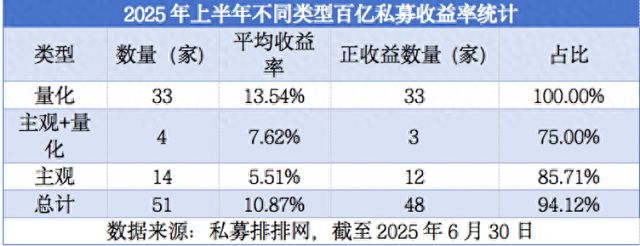
Group 1 - The core viewpoint of the articles highlights the significant rise of quantitative private equity firms in China, which have outperformed subjective private equity firms in terms of investment returns and number of firms [2][3][4] - As of June 30, 2025, the average return of quantitative private equity firms was 13.54%, while subjective firms averaged only 5.51%, indicating a strong preference for quantitative strategies among high-net-worth individuals [2][4] - The number of quantitative private equity firms has surpassed subjective firms for the first time, with 41 quantitative firms compared to 40 subjective firms, reflecting a shift in investor interest [2][3] Group 2 - The performance of quantitative private equity firms has been robust, with 94.12% of firms reporting positive returns, and some mid-sized firms achieving returns close to 30% [3][4] - The increase in the number of registered quantitative private equity products has surged, with 5,461 new products registered in the first half of 2025, a year-on-year increase of 53.61% [6][7] - The market sentiment appears to be improving, with a focus on technology, consumer sectors, and innovative pharmaceuticals, as firms anticipate a favorable investment environment in the second half of 2025 [8]
灵均规模跌入量化第二梯队 去年初曾1分钟卖出26亿元
Zhong Guo Jing Ji Wang· 2025-07-11 08:04
Group 1: Market Overview - The article highlights the emergence of four major players in quantitative investment, namely Ruanfu, Mingchao, Jiukun, and Huansquare, with management scales ranging from 60 billion to 70 billion yuan [1] - As of June 30, 2025, there are 88 private equity firms managing over 10 billion yuan, with one new addition in the previous month [1] - Among the 88 firms, 41 have showcased performance data for the first half of the year, with six firms achieving an average return of over 20% [1] Group 2: Company Profile - Ningbo Lingjun Investment Management Partnership (Limited Partnership) focuses on quantitative investment and aims to assist high-net-worth clients in asset management [1] - Established in June 2014, Lingjun is registered with the Asset Management Association of China and holds the registration number P1004526 [1] Group 3: Regulatory Issues - Lingjun Investment faced public reprimands from both the Shanghai and Shenzhen Stock Exchanges for abnormal trading activities, including selling 2.567 billion yuan worth of stocks within one minute [2][3] - On February 19, 2024, the Shanghai Stock Exchange identified significant sell orders from Lingjun that led to a rapid decline in the Shanghai Composite Index, resulting in a suspension of trading for related products [2] - The Shenzhen Stock Exchange also noted that Lingjun's accounts executed large sell orders totaling 1.372 billion yuan within a short time frame, disrupting normal trading order [3]