智源研究院

Search documents
智源RoboBrain 2.0+RoboOS 2.0双发:问鼎评测基准最强具身大脑,刷新跨本体多机协作技术范式
机器之心· 2025-07-14 11:33
Core Insights - The article discusses the release of RoboBrain 2.0 and RoboOS 2.0, highlighting their advancements in embodied intelligence and multi-agent collaboration, which are expected to transition robotics from "single-agent intelligence" to "collective intelligence" [2][19]. RoboBrain 2.0 Breakthroughs - RoboBrain 2.0 has overcome three major capability bottlenecks: spatial understanding, temporal modeling, and long-chain reasoning, significantly enhancing its ability to understand and execute complex embodied tasks [4][6]. - The model employs a modular encoder-decoder architecture, integrating perception, reasoning, and planning, and is designed to handle complex embodied reasoning tasks beyond traditional visual-language models [5][6]. Training and Performance - RoboBrain 2.0 utilizes a comprehensive multi-modal dataset, including high-resolution images, multi-view video sequences, and complex natural language instructions, to empower robots in embodied environments [9][12]. - The training process consists of three phases: foundational spatiotemporal learning, embodied spatiotemporal enhancement, and chain-of-thought reasoning in embodied contexts, each progressively building the model's capabilities [12][13][14]. - The model has achieved state-of-the-art (SOTA) performance in various benchmarks, including spatial reasoning and multi-robot planning, outperforming competitors like Gemini and GPT-4o [17][19]. RoboOS 2.0 Framework - RoboOS 2.0 is the world's first embodied intelligence SaaS platform that supports serverless, lightweight robot deployment, facilitating multi-agent collaboration across various scenarios [21][22]. - The framework includes a cloud-based brain model for high-level cognition and multi-agent coordination, a distributed module for executing specialized skills, and a real-time shared memory mechanism to enhance environmental awareness [25][26]. - RoboOS 2.0 has optimized end-to-end reasoning links, achieving a 30% overall performance improvement and reducing average response latency to below 3ms [25]. Open Source Initiative - Both RoboBrain 2.0 and RoboOS 2.0 have been fully open-sourced, making model weights, training codes, and evaluation benchmarks available to the global community [24][28]. - The initiative has garnered significant attention in social media and tech communities, with strategic partnerships established with over 20 robotics companies and top laboratories worldwide [28][29].

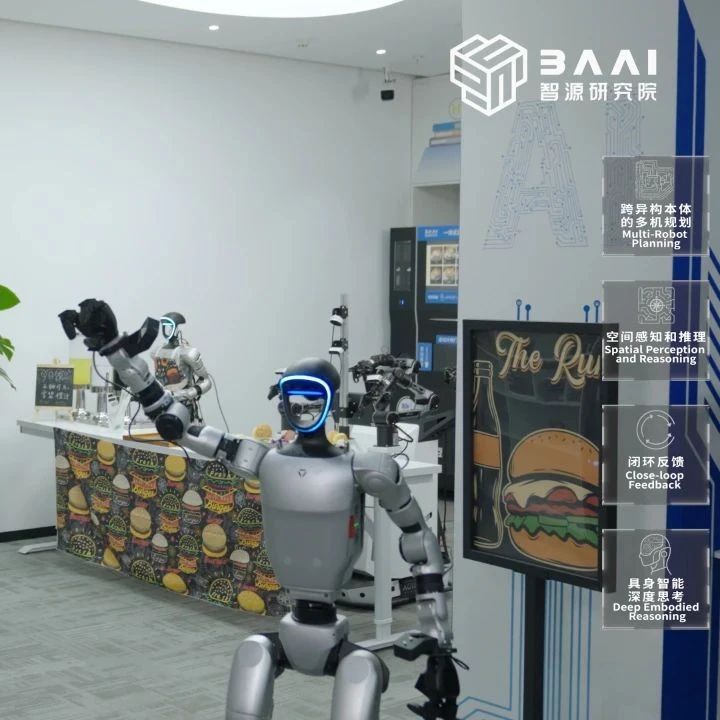
智源全面开源具身大脑RoboBrain 2.0与大小脑协同框架RoboOS 2.0:刷新10项评测基准
具身智能之心· 2025-07-14 11:15
Core Insights - The article discusses the release of RoboBrain 2.0 and RoboOS 2.0, highlighting their advancements in embodied intelligence and multi-agent collaboration capabilities [2][3][30]. Group 1: RoboBrain 2.0 Capabilities - RoboBrain 2.0 overcomes three major capability bottlenecks: spatial understanding, temporal modeling, and long-chain reasoning, significantly enhancing its ability to understand and execute complex embodied tasks [4]. - The model features a modular encoder-decoder architecture that integrates perception, reasoning, and planning, specifically designed for embodied reasoning tasks [9]. - It utilizes a diverse multimodal dataset, including high-resolution images and complex natural language instructions, to empower robots in physical environments [12][18]. Group 2: Training Phases of RoboBrain 2.0 - The training process consists of three phases: foundational spatiotemporal learning, embodied spatiotemporal enhancement, and chain-of-thought reasoning in embodied contexts [15][17][18]. - Each phase progressively builds the model's capabilities, from basic spatial and temporal understanding to complex reasoning and decision-making in dynamic environments [15][18]. Group 3: Performance Benchmarks - RoboBrain 2.0 achieved state-of-the-art (SOTA) results across multiple benchmarks, including BLINK, CV-Bench, and RoboSpatial, demonstrating superior spatial and temporal reasoning abilities [21][22]. - The 7B model scored 83.95 in BLINK and 85.75 in CV-Bench, while the 32B model excelled in various multi-robot planning tasks [22][23]. Group 4: RoboOS 2.0 Framework - RoboOS 2.0 is the first open-source framework for embodied intelligence SaaS, enabling lightweight deployment and seamless integration of robot skills [3][25]. - It features a cloud-based brain model for high-level cognition and a distributed module for executing specific robot skills, enhancing multi-agent collaboration [27]. - The framework has been optimized for performance, achieving a 30% improvement in overall efficiency and reducing average response latency to below 3ms [27][29]. Group 5: Open Source and Community Engagement - Both RoboBrain 2.0 and RoboOS 2.0 have been fully open-sourced, inviting global developers and researchers to contribute to the embodied intelligence ecosystem [30][33]. - The initiative has garnered interest from over 20 robotics companies and top laboratories worldwide, fostering collaboration in the field [33].
具身智能大脑+首个SaaS开源框架,智源研究院刷新10项测评基准,加速群体智能新范式
量子位· 2025-07-14 05:23
Core Insights - The article discusses the advancements in embodied intelligence through the launch of RoboBrain 2.0 and RoboOS 2.0, which aim to enhance robotic capabilities in real-world environments [1][3][25]. Group 1: RoboBrain 2.0 Features - RoboBrain 2.0 integrates perception, reasoning, and planning, addressing three core limitations of current AI models: spatial understanding, temporal modeling, and long-chain reasoning [5][8]. - The model employs a modular encoder-decoder architecture, enabling it to process high-resolution images, multi-view inputs, video frames, language instructions, and scene graphs as a unified multimodal sequence [8][10]. - It has demonstrated superior performance in spatial reasoning benchmarks, achieving state-of-the-art results in various tests, including BLINK and CV-Bench [22][23]. Group 2: Training Methodology - The training of RoboBrain 2.0 is structured in three progressive phases, focusing on foundational spatiotemporal learning, embodied spatiotemporal enhancement, and chain-of-thought reasoning in embodied contexts [14][16][18]. - The model utilizes a diverse multimodal dataset, which includes high-resolution images, multi-view video sequences, and complex natural language instructions, to enhance its capabilities in embodied environments [11][19]. Group 3: RoboOS 2.0 Framework - RoboOS 2.0 is the world's first embodied intelligence SaaS platform that supports serverless, lightweight deployment of robotic bodies, facilitating multi-agent collaboration [27][28]. - The framework features a cloud-based brain model for high-level cognition and distributed modules for specialized skill execution, enhancing real-time environmental awareness [28][30]. - It has achieved a 30% overall performance improvement and reduced average response latency to below 3ms, significantly enhancing communication efficiency [29]. Group 4: Application and Deployment - RoboBrain 2.0 and RoboOS 2.0 are fully open-sourced, providing model weights, training code, and evaluation benchmarks to developers [32]. - The systems are designed for various deployment scenarios, including commercial kitchens and home environments, enabling robots to perform complex tasks collaboratively [25][31].
GitHub一周2000星!国产统一图像生成模型神器升级,理解质量双up,还学会了“反思”
量子位· 2025-07-03 04:26
Core Viewpoint - The article discusses the significant upgrade of the OmniGen model, a domestic open-source unified image generation model, with the release of its 2.0 version, which supports text-to-image, image editing, and theme-driven image generation [1][2]. Summary by Sections Model Features - OmniGen2 enhances context understanding, instruction adherence, and image generation quality while maintaining a simple architecture [2]. - The model supports both image and text generation, further integrating the multi-modal technology ecosystem [2]. - The model's capabilities include natural language-based image editing, allowing for local modifications such as object addition/removal, color adjustments, expression changes, and background replacements [6][7]. - OmniGen2 can extract specified elements from input images and generate new images based on these elements, excelling in maintaining object similarity rather than facial similarity [8]. Technical Innovations - The model employs a separated architecture with a dual-encoder strategy using ViT and VAE, enhancing image consistency while preserving text generation capabilities [14][15]. - OmniGen2 addresses challenges in foundational data and evaluation by developing a process to generate image editing and context reference data from video and image data [18]. - Inspired by large language models, OmniGen2 integrates a reflection mechanism into its multi-modal generation model, allowing for iterative improvement based on user instructions and generated outputs [20][21][23]. Performance and Evaluation - OmniGen2 achieves competitive results on existing benchmarks for text-to-image and image editing tasks [25]. - The introduction of the OmniContext benchmark, which includes eight task categories for assessing consistency in personal, object, and scene generation, aims to address limitations in current evaluation methods [27]. - OmniGen2 scored 7.18 on the new benchmark, outperforming other leading open-source models, demonstrating a balance between instruction adherence and subject consistency across various task scenarios [28]. Deployment and Community Engagement - The model's weights, training code, and training data will be fully open-sourced, providing a foundation for community developers to optimize and expand the model [5][29]. - The model has generated significant interest in the open-source community, with over 2000 stars on GitHub within a week and hundreds of thousands of views on related topics [3].
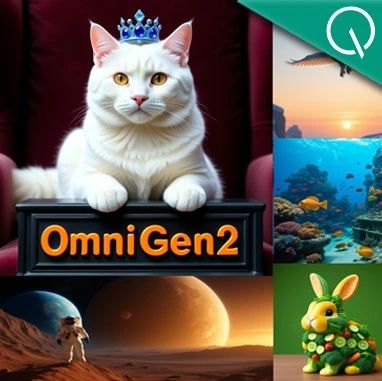
智源新出OmniGen2开源神器,一键解锁AI绘图「哆啦 A 梦」任意门
机器之心· 2025-07-03 04:14
Core Viewpoint - The article discusses the release and advancements of the OmniGen and OmniGen2 models by the Zhiyuan Research Institute, highlighting their capabilities in multi-modal image generation tasks and the significance of open-source contributions to the community [1][2]. Group 1: Model Features and Architecture - OmniGen2 features a separated architecture that decouples text and image processing, utilizing a dual encoder strategy with ViT and VAE to enhance image consistency while maintaining text generation capabilities [4]. - The model significantly improves context understanding, instruction adherence, and image generation quality compared to its predecessor [2]. Group 2: Data Generation and Evaluation - OmniGen2 addresses challenges in foundational data and evaluation by developing a process to generate image editing and context reference data from video and image datasets, overcoming quality deficiencies in existing open-source datasets [6]. - The introduction of the OmniContext benchmark aims to evaluate consistency across personal, object, and scene categories, utilizing a hybrid approach of initial screening by multi-modal large language models and manual annotation by human experts [28]. Group 3: Reflective Learning and Training - Inspired by the self-reflective capabilities of large language models, OmniGen2 integrates reflective data that includes user instructions, generated images, and subsequent reflections on the outputs, focusing on identifying defects and proposing solutions [8][9]. - The model is trained to possess initial reflective capabilities, with future goals to enhance this through reinforcement learning [11]. Group 4: Open Source and Community Engagement - OmniGen2's model weights, training code, and training data will be fully open-sourced, providing a foundation for developers to optimize and expand the model, thus accelerating the transition from concept to reality in unified image generation [30]. - A research experience version is available for users to explore image editing and context reference generation capabilities [19][20].

100万token!全球首个混合架构模型M1开源了!近期AI新鲜事还有这些……
红杉汇· 2025-06-25 11:06
Group 1 - MiniMax-M1 is the world's first hybrid architecture model supporting the longest context window, with 1 million tokens input and 80,000 tokens output, completed training in 3 weeks at a cost of 3.8 million yuan [3][6] - The model outperforms or matches several open-source models like DeepSeek-R1 and Qwen3 in various benchmark tests, and even exceeds OpenAI's o3 and Claude 4 Opus in complex tasks [4][6] - A key innovation of MiniMax-M1 is the Lightning Attention mechanism, which reduces computational complexity and improves efficiency by dividing attention calculations into intra-block and inter-block components [5][7] Group 2 - The model's input length of 1 million tokens is approximately 8 times that of DeepSeek R1, while its output length of 80,000 tokens surpasses Gemini 2.5 Pro's 64,000 tokens [6] - The Lightning Attention mechanism employs tiling technology to optimize GPU memory usage, allowing for efficient training without slowing down as sequence length increases [7] - The new CISPO algorithm enhances training efficiency, achieving double the training speed compared to traditional methods, allowing performance to be reached in half the training steps [7] Group 3 - Microsoft has released over 700 real-world Agent applications, showcasing how AI is transforming work across various industries, including finance, healthcare, technology, and education [10][12] - Notable examples include Accenture's autonomous agent that automates overdue payment collections, reducing sales outstanding days by up to 20%, and KPMG's ComplyAI, which improves compliance maturity and reduces ongoing compliance work by 50% [12] Group 4 - Zhiyuan AI has launched CoCo, an enterprise-level intelligent assistant with memory capabilities, allowing it to provide tailored services based on employee interactions and departmental functions [14] - CoCo integrates seamlessly into existing workflows and offers task planning and editing options, enhancing operational efficiency [14] Group 5 - OpenAI has introduced the o3-pro model, which surpasses Google's Gemini 2.5 Pro in mathematical benchmark tests, showcasing its leading performance in reasoning models [16][19] - The o3-pro model is now available for ChatGPT Pro and Team users, with API access for developers at a cost of $20 per million input tokens and $80 per million output tokens [19] Group 6 - Zhiyuan Research Institute has released Video-XL-2, a lightweight model for long video understanding, which significantly improves processing efficiency and can handle videos of up to 10,000 frames [21][23] - The model's architecture allows for efficient processing on a single GPU, making it suitable for applications in content analysis and behavior monitoring [23] Group 7 - Google has launched the Google AI Edge Gallery, enabling users to run AI models locally on their phones, allowing for functionalities like image generation and code editing without internet connectivity [27] - This application is positioned as an experimental version and is open-sourced under the Apache 2.0 license, promoting privacy and offline usage [27]

消费与医药分论坛 - 新格局 新供给 2025年中期策略报告会
2025-06-24 15:30
Summary of Key Points from Conference Call Records Industry Overview - The conference call primarily discusses the **pharmaceutical industry** and its recovery driven by **policy support**, **funding inflow**, **AI technology**, and **innovation in drug development**. [1][2][4] Core Insights and Arguments 1. **Pharmaceutical Sector Recovery**: The pharmaceutical sector has shown signs of recovery, with the biopharmaceutical index outperforming the CSI 300 index, and the pharmaceutical sector increasing by **28%**. This recovery is attributed to supportive policies, funding inflow, AI technology advancements, and the international expansion of innovative drugs. [2][4] 2. **Innovative Drug Development**: In the first four months, the total amount of business development (BD) events in innovative drugs reached **$55 billion**, with upfront payments exceeding **$5 billion**, indicating strong market recognition of China's innovative drug development capabilities. [1][3][5] 3. **Investment Focus for H2 2025**: The main investment themes for the second half of 2025 include innovative drugs, AI medical technology, the silver economy, and emerging medical technologies empowered by AI, such as protein prediction. [1][4] 4. **Demographic Changes Impacting Consumption**: The decline in newborn population is weakening traditional consumption demand, while the pet economy is rapidly growing. The increasing proportion of elderly people is driving the development potential of the silver economy and health industry. [1][6] 5. **AI Technology in Pharmaceuticals**: AI technology is enhancing the pharmaceutical industry by improving research efficiency and reducing costs, particularly in protein prediction and innovative therapy development. [2][7] Additional Important Insights 1. **Clinical Data Driving Market Confidence**: The performance of innovative drug companies is expected to remain strong, with significant BD activities and impressive financial reports anticipated for the second half of 2025. [9][10] 2. **Challenges in the Pharmaceutical Supply Chain**: Hospitals face challenges in drug supply, emphasizing the need for innovative drugs to demonstrate significant clinical value and effectiveness. [18] 3. **Insurance and Policy Developments**: The introduction of commercial insurance policies is expected to stimulate the innovative drug sector positively, with ongoing adjustments to the medical insurance directory providing negotiation opportunities for companies. [11][21] 4. **Emerging Consumer Trends**: The rise of new consumer demographics, particularly among younger generations, is reshaping consumption patterns, with a notable increase in spending on pet-related products and services. [30][31] 5. **Pet Industry Growth**: The pet industry is experiencing rapid growth, with the market size reaching **300.2 billion yuan** by 2024, driven by an increase in pet ownership and spending on pet care. [53][54] This summary encapsulates the key points discussed in the conference call, highlighting the pharmaceutical industry's recovery, the impact of AI technology, demographic changes, and emerging consumer trends in the pet industry.
AI商业本周必读|149亿美金创纪录收购!3D创作提速40倍!国产算力突破300%!
混沌学园· 2025-06-13 10:16
Core Trends - Infrastructure monopoly is becoming a trend as Silicon Valley giants shift towards computing power and data infrastructure mergers, with competition moving from model layers to infrastructure layers [2] - The democratization of tools is accelerating, as AI tools lower barriers and liberate non-professional users' productivity, expanding market size [3] - Domestic infrastructure optimization is evident as Chinese AI evolves from "usable" to "user-friendly," with toolchains and computing power becoming key breakthroughs [4] - AI is breaking digital boundaries, expanding from the digital world to the physical world, giving rise to new application scenarios such as robotics [5] - The global AI race has entered a deep-water phase, with a fierce competition for AI infrastructure and a corresponding tool revolution accelerating across various industries [6] Key Developments - On June 12, 2025, Alibaba's Qwen3 model surpassed 12.5 million downloads in a month, marking a significant improvement in China's AI open-source ecosystem, ranking fifth globally [10] - OpenAI announced a cloud service agreement with Google, ending its exclusive partnership with Microsoft, leading to a 2.1% increase in Google's stock and a 0.6% decrease in Microsoft's stock [11] - Meta's acquisition of 49% of Scale AI for $14.9 billion (approximately 106.6 billion RMB) marks the highest single investment in the AI sector, aiming to enhance its AI infrastructure [12][13] - ByteDance's Doubao model upgraded to version 1.6, with its video generation model Seedance 1.0 Pro topping global rankings, indicating a breakthrough in multi-modal generation [14] - Ilya Sutskever returned to the University of Toronto, emphasizing the limitless potential of AI in his commencement speech [16] - VAST secured tens of millions in Pre-A+ funding, launching the world's first AI-driven 3D workspace, significantly improving 3D content production efficiency [17] - AI programming tool Cursor achieved $100 million in annual revenue within 20 months, projected to reach $300 million in two years, redefining developer interaction with systems [19] - Silicon-based Flow completed a billion RMB A-round financing, enhancing domestic AI computing power and filling gaps in AI development tools [22] - Beijing Zhiyuan Institute launched the "Wujie" series of large models, promoting new paradigms for AI interaction with the physical world [23] - The domestic version of the AI video tool PixVerse, named "拍我 AI," was launched, integrating advanced features and aiming to become a leading tool in the domestic AI video creation market [25]


对话智源王仲远:机器人的大小脑可能会“合体”,但不是今天
AI前线· 2025-06-11 08:39
Core Insights - The article discusses the launch of the "Wujie" series of large models by Zhiyuan Research Institute, focusing on advancements in multi-modal AI technology and its applications in physical AGI [1][2][3] Group 1: New Model Launch - The "Wujie" series includes several models such as Emu3, Brainμ, RoboOS2.0, RoboBrain2.0, and OpenComplex2, aimed at enhancing AI's understanding and interaction with the physical world [1][2] - Emu3 is designed as a native multi-modal architecture that enables large models to comprehend and reason about the world, set to be released in October 2024 [3][4] Group 2: Technological Advancements - Brainμ, based on Emu3, integrates various brain signals to perform multiple neuroscience tasks, demonstrating significant performance improvements over existing models [4][5] - RoboOS2.0 is the first open-source framework for embodied intelligence, allowing seamless integration of skills from various robot models, with a 30% performance enhancement compared to its predecessor [6][7] Group 3: Applications and Collaborations - Brainμ has potential applications in brain-computer interfaces, having successfully reconstructed sensory signals using portable EEG systems [5] - The OpenComplex2 model represents a breakthrough in dynamic conformational modeling of biological molecules, enhancing the understanding of molecular interactions at atomic resolution [11][12] Group 4: Future Directions - The article emphasizes the ongoing evolution of large model technology, with a focus on bridging the gap between digital and physical worlds, which is crucial for achieving physical AGI [2][3] - RoboBrain2.0 has improved task planning and spatial reasoning capabilities, achieving a 74% increase in task planning accuracy compared to its predecessor [8][9]

聚焦多模态:ChatGPT时刻未到,2025大模型“变慢”了吗
Bei Jing Shang Bao· 2025-06-08 13:27
Core Insights - The emergence of multi-modal models, such as Emu3, signifies a shift in content generation, with the potential to understand and generate text, images, and videos through a single model [1][3] - The rapid development of AI has led to a competitive landscape where new and existing products coexist, but the core capabilities of video generation are still lagging behind expectations [1][5] - The commercial application of large models faces challenges, particularly in integrating visual generation with existing models, which limits scalability and effectiveness [7][8] Multi-Modal Model Development - Emu3, released by Zhiyuan Research Institute, is a native multi-modal model that incorporates various data types from the beginning of its training process, unlike traditional models that focus on language first [3][4] - The current learning path for multi-modal models often leads to a decline in performance as they transition from strong language capabilities to integrating other modalities [3][4] - The development of multi-modal models is still in its early stages, with significant technical challenges remaining, particularly in filtering effective information from diverse data types [3][4] Video Generation Challenges - Video generation technology is currently at a transitional phase, comparable to the evolution from GPT-2 to GPT-3, indicating that there is substantial room for improvement [5][6] - Key issues in video generation include narrative coherence, stability, and controllability, which are essential for producing high-quality content [6] - The industry is awaiting a breakthrough moment akin to the "ChatGPT moment" to enhance video generation capabilities [6] Commercialization and Market Growth - The multi-modal AI market is projected to reach $2.4 billion in 2024, with a compound annual growth rate (CAGR) exceeding 28%, and is expected to grow to $128 billion by 2025, reflecting a CAGR of 62.3% from 2023 to 2025 [8] - The integration of traditional computer vision models with large models is seen as a potential pathway for commercial applications, contingent on achieving a favorable cost-benefit ratio [7][8] - Companies are evolving their service models from providing platforms (PaaS) to offering tools (SaaS) and ultimately delivering direct results to users by 2025 [8]