Mistral AI

Search documents
南极土著|达沃斯论坛:欧洲的失落、反思和挣扎
Guan Cha Zhe Wang· 2026-01-22 00:34
【文/南极土著】 今年的达沃斯,特朗普放话要拿下格陵兰,还要对周末在格陵兰参加联合军演的8个欧洲国家加征10%关税,成了全场避不开的"房间里的大象"。 特朗普在社交媒体上晒出一张电脑合成图:图中的他正在格陵兰岛插旗,身旁一块木牌赫然写着"格陵兰岛,美国领土,始于2026年"。 欧盟委员会主席冯德莱恩和法国总统马克龙都讲了话,但在真正和特朗普当面交锋前,两个人的措辞都比较克制。 直到最后,冯德莱恩才点名格陵兰问题,直说这10%的关税是个错误,美国不该这么对待盟友。她强调,欧盟和美国去年7月已经达成贸易协议,协议就是 协议,既然握了手就该守信用;欧盟和美国不只是盟友,更是朋友。至于格陵兰,丹麦的主权和领土完整不容谈判;如果美方担心的是中国和俄罗斯在北极 的存在,欧盟愿意和美国一起合作,维护北极地区的安全。 1月20日,马克龙在达沃斯论坛发表开幕致辞。 图源: 法媒 这套东西对美国并不是空喊口号,美国国防工业高度依赖欧洲提供的关键技术和服务,而这些恰恰集中在这次被特朗普点名加了关税的北欧和西欧国家手 里,从反无人机技术到情报软件都有。如果欧盟真动用出口管制,美国确实会疼。 现在欧盟心里很清楚,美国靠不住,俄罗斯又得 ...


WEF Davos: CFI, Bharti show interest in setting up data centres in Karnataka
The Economic Times· 2026-01-21 15:31
Investment and Expansion Plans - Minister for Large and Medium Industries M B Patil engaged in high-level discussions with global company executives regarding investment and expansion plans during the World Economic Forum (WEF) Annual Meeting in Davos [1][9] - CFI Technologies announced readiness to inaugurate a data centre in Bengaluru and expressed interest in expanding into tier-2 cities [2][9] - Bharti Enterprises has invested approximately Rs 13,000 crore in Karnataka and discussed plans for an additional data centre in the state [2][9] Sector-Specific Investments - Philip Morris International is interested in investing in Karnataka for the manufacturing of next-generation smoke-free products, identifying the state as its second-largest global procurement location [3][9] - Carlsberg Group confirmed a Rs 350-crore investment for bottling capacity and indicated plans for further expansion in Karnataka [4][9] - Bharat Forge Limited sought information on further investment opportunities aligned with Karnataka's industrial and manufacturing ecosystem [9] Research and Development Initiatives - Imperial College London is considering establishing a research and development centre in KWIN City and aims to expand research activities in collaboration with local higher education institutions [5][9] - The university currently operates an innovation hub in Bengaluru and collaborates with the Indian Institute of Science (IISc) [5][9] Renewable Energy and Technology Discussions - Discussions were held with ReNew Power regarding renewable energy generation and storage opportunities [6][9] - Xylem Inc engaged in talks about smart wastewater treatment and tertiary treated water plants for industrial areas [6][9] - Octopus Energy discussed vehicle-to-grid technology and digital solutions for grid management [6][9] Digital Infrastructure and Talent Pool - PayPal emphasized Karnataka's significance to its global operations, highlighting Bengaluru's talent pool and discussing AI-driven innovation and startup ecosystem collaboration [7][9] - Sify Technologies announced a new data centre facility in Karnataka set for imminent inauguration and explored opportunities for data centre development in tier-2 cities [7][9] Government Commitment - The Karnataka government reaffirmed its commitment to policy continuity, regulatory certainty, and full facilitation to ensure the timely execution of investments discussed at WEF [8][9]


达沃斯论坛:欧洲的失落、反思和挣扎
Xin Lang Cai Jing· 2026-01-21 01:52
Group 1 - The core issue at the Davos meeting was Trump's announcement of a 10% tariff on eight European countries participating in military exercises in Greenland, which was met with criticism from EU leaders [1][19] - EU Commission President Ursula von der Leyen emphasized that the 10% tariff is a mistake and that the US should honor the trade agreement made in July [1][19] - French President Macron highlighted the need for Europe to unite against US pressure and mentioned the potential use of the "anti-coercion mechanism" against the US if new tariffs are imposed [2][19] Group 2 - The "anti-coercion mechanism" is described as a toolbox for sanctions that could include tariffs on US goods worth approximately $1.09 trillion, export controls, and restrictions on US investments in Europe [2][20] - European leaders are increasingly aware of the need for strategic autonomy, with discussions on enhancing defense spending and technological independence from the US [3][20] Group 3 - The EU is focusing on strengthening its defense capabilities and has been increasing defense spending in response to perceived unreliability from the US [3][20] - The discussions at Davos revealed a significant shift in European leaders' attitudes towards US relations, with calls for a more self-reliant Europe [24][25] Group 4 - Macron outlined three strategic pillars for Europe: protection, simplification, and investment, emphasizing the need to protect European industries from unfair competition [26][27] - The EU plans to initiate a new budget negotiation to increase investments in key areas such as AI, quantum technology, and defense [27][30] Group 5 - The EU is moving towards a revised cybersecurity law that mandates the removal of equipment from "high-risk suppliers," which is seen as a direct response to geopolitical tensions [31][33] - The law aims to unify member states' approaches to cybersecurity and reduce reliance on Chinese technology, particularly in critical sectors [32][34]


对话 Mistral CEO:大模型都差不多了,AI公司靠什么赚钱?
3 6 Ke· 2026-01-19 00:47
Core Insights - The gap between leading AI models is narrowing, with Google Gemini catching up to OpenAI and Claude briefly surpassing GPT-4, indicating a shift in competition from model performance to practical application in business [1][2][4] - The development of AI models is becoming less unique due to the widespread use of similar methods and data across various labs, leading to a decrease in competitive advantage [2][3] Group 1: Model Development and Market Dynamics - The rapid dissemination of technology through open-source initiatives is contributing to the convergence of model performance, making it easier for teams to catch up [3][4] - The focus is shifting from merely having a powerful model to ensuring that businesses can effectively implement and utilize these models in their operations [5][6][7] Group 2: Practical Applications of AI - Mistral AI categorizes enterprise AI applications into two types: efficiency improvements and technological breakthroughs [10][12] - An example of efficiency improvement is seen in CMA CGM, where AI has reduced the workforce needed for complex shipping operations from 20 to 2 by automating communication and coordination tasks [12][13] - Technological breakthroughs are illustrated by Mistral's model aiding ASML in enhancing precision in chip manufacturing, allowing for faster and more accurate defect detection [17][18][20] Group 3: Control and Deployment of AI - Mistral emphasizes the importance of open-source models that allow businesses to customize and deploy AI systems on their own infrastructure, reducing dependency on external vendors [24][26] - The ability to maintain control over AI systems is crucial for businesses, as reliance on closed-source models can lead to vulnerabilities and loss of operational autonomy [26][30] - Mistral's approach not only addresses technical needs but also aligns with local economic interests by fostering local talent and infrastructure [30]
维基百科运营方与微软、元宇宙平台公司达成人工智能内容训练合作协议
Xin Lang Cai Jing· 2026-01-15 10:35
Core Insights - Wikipedia has announced partnerships with major tech companies including Microsoft, Meta, and Amazon, marking a significant step in monetizing its content reliance by these firms [1][4] - The Wikimedia Foundation has signed agreements with several companies, including AI startups Perplexity and Mistral AI, in addition to existing partnerships [1][4] Industry Context - Wikipedia's content is crucial for training AI models, encompassing over 65 million entries in more than 300 languages, serving as a primary data source for tech giants developing generative AI chatbots and smart assistants [2][5] - The increasing demand for Wikipedia's free content for AI training has led to rising server demands and costs for the non-profit organization, which primarily relies on small public donations for funding [2][5] Business Model Evolution - The Wikimedia Foundation is promoting its enterprise service, which allows tech companies to pay for content training access and offers customized data services based on large-scale training needs [2][5] - Ryan Becker, president of Wikimedia Enterprise, emphasized the necessity for tech companies to financially support Wikipedia, recognizing the importance of transitioning from free access to commercial partnerships [6] Leadership Changes - The Wikimedia Foundation has appointed Bernadette Meehan, former U.S. ambassador to Chile, as the new CEO, effective January 20 [3][6]



?AI推理狂潮席卷全球 “英伟达挑战者”Cerebras来势汹汹! 估值狂飙170%至220亿美元
Zhi Tong Cai Jing· 2026-01-14 03:27
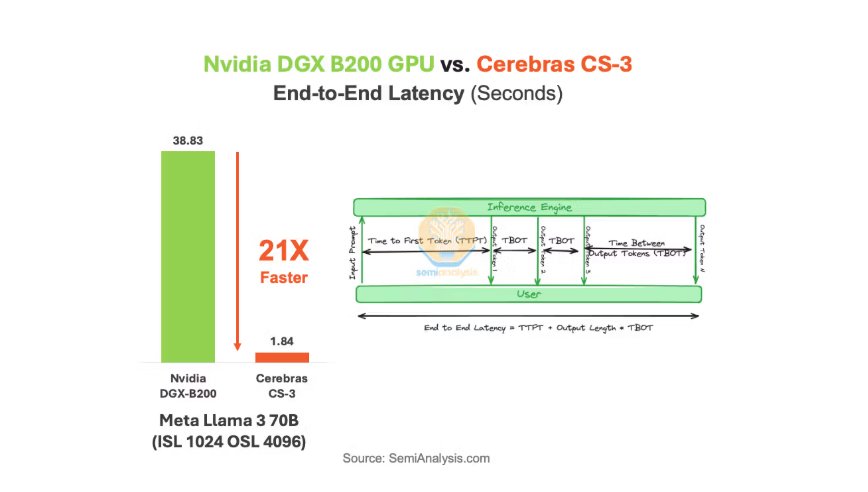
Core Viewpoint - The AI chip supplier Cerebras Systems Inc. is in discussions for a new funding round of approximately $1 billion, aiming to enhance its competitiveness against Nvidia, which currently holds a 90% market share in the AI chip sector. The valuation of Cerebras is expected to rise to $22 billion, reflecting a significant increase of 170% from its previous valuation of $8.1 billion in September 2022 [1][3][7]. Group 1: Company Overview - Cerebras Systems is led by CEO Andrew Feldman and is actively seeking to challenge Nvidia's dominance in the AI chip market [2][3]. - The company provides remote AI computing services to major clients, including Meta Platforms Inc. and IBM, and aims to significantly improve the cost-effectiveness and energy efficiency of its AI computing clusters compared to Nvidia's offerings [3][5]. Group 2: Technology and Competitive Edge - Cerebras employs a unique "Wafer-Scale Engine" (WSE) architecture, allowing it to place entire AI models on a single large chip, which enhances inference performance and memory bandwidth [5][8]. - The latest CS-3 system, featuring the WSE-3 chip, reportedly outperforms Nvidia's Blackwell architecture by approximately 21 times in specific large language model inference tasks, while also being more cost-effective in terms of hardware and energy consumption [7][8]. Group 3: Market Dynamics and Competition - The AI inference market is experiencing rapid growth, with demand doubling every six months, prompting Cerebras to leverage this trend through funding and an IPO to increase its market presence [6][9]. - Nvidia's recent partnership with Groq, which includes a $20 billion non-exclusive licensing agreement, highlights the competitive pressure in the AI chip market, as Nvidia seeks to maintain its market share through diversification of hardware technology and strengthening its AI application ecosystem [4][10].

AI推理狂潮席卷全球 “英伟达挑战者”Cerebras来势汹汹! 估值狂飙170%至220亿美元
Zhi Tong Cai Jing· 2026-01-14 02:49
Core Insights - Cerebras Systems Inc. is in discussions for a new funding round of approximately $1 billion to enhance its AI chip capabilities and compete with Nvidia, which currently holds a 90% market share in the AI chip sector [1][4] - The company's valuation is set to reach $22 billion, reflecting a significant increase of 170% from its previous valuation of $8.1 billion in September [2][4] - Cerebras aims to challenge Nvidia's dominance by leveraging its unique wafer-scale engine architecture, which reportedly offers superior performance and efficiency in AI inference tasks compared to Nvidia's GPU systems [3][5] Funding and Valuation - Cerebras Systems is seeking $1 billion in new financing, which would elevate its valuation to $22 billion, a substantial increase from $8.1 billion in September [1][2] - The funding is intended to support the company's long-term competition with Nvidia and to facilitate its planned IPO [1][4] Competitive Landscape - Cerebras Systems is recognized as one of the strongest competitors to Nvidia in the AI chip market, particularly in the rapidly growing AI inference segment [3] - The company utilizes a distinct wafer-scale engine architecture that enhances performance and memory bandwidth, providing a competitive edge over traditional GPU clusters [3][5] - Recent market dynamics indicate a growing interest in AI chips, with Nvidia's acquisition of Groq and its licensing agreement further intensifying competition in the sector [2][10] Technological Advantages - Cerebras' latest CS3 system, featuring the WSE3 chip, reportedly outperforms Nvidia's Blackwell architecture by approximately 21 times in specific large language model inference tasks [5] - The wafer-scale architecture allows for higher performance density and energy efficiency, particularly in large-scale inference scenarios [3][5] - While Cerebras excels in specific inference tasks, Nvidia maintains advantages in general computing tasks and compatibility with its CUDA ecosystem [5] Market Trends - The demand for AI inference capabilities is rapidly increasing, with projections indicating that the need for such technology is doubling every six months [9] - Companies are increasingly seeking cost-effective AI ASIC accelerators for cloud-based solutions, driven by the rising costs associated with AI inference [8][9] - The competitive landscape is evolving, with companies like Google also enhancing their AI capabilities through advancements in their TPU technology, further challenging Nvidia's market position [9][10]
AI推理狂潮席卷全球 “英伟达挑战者”Cerebras来势汹汹! 估值狂飙170%至220亿美元
智通财经网· 2026-01-14 02:40
Core Viewpoint - Cerebras Systems Inc., a strong competitor to Nvidia in the AI chip market, is reportedly seeking around $1 billion in new funding to enhance its AI computing capabilities and challenge Nvidia's dominance, which holds a 90% market share in the sector [1][4]. Group 1: Company Overview - Cerebras Systems aims to significantly improve the cost-effectiveness and energy efficiency of its AI computing clusters compared to Nvidia's AI GPU clusters [1]. - The company's latest valuation is set at $22 billion, reflecting a substantial increase of 170% from its previous valuation of approximately $8.1 billion in September [1][2]. - Under CEO Andrew Feldman, Cerebras is actively providing remote AI computing services to major clients, including Meta Platforms Inc. and IBM [2]. Group 2: Competitive Landscape - Nvidia recently signed a $20 billion non-exclusive licensing agreement with Groq, another AI chip startup, to bolster its AI inference technology and maintain its market share [3][12]. - Cerebras Systems utilizes a unique wafer-scale engine architecture, which allows it to place entire AI models on a single large chip, enhancing inference performance and memory bandwidth [4]. - The company's CS-3 system, equipped with the WSE-3 chip, reportedly outperforms Nvidia's latest Blackwell architecture AI GPU by approximately 21 times in specific large language model inference tasks [6][7]. Group 3: Market Dynamics - The AI inference market is experiencing rapid growth, with demand for large-scale AI inference doubling approximately every six months [11]. - Cerebras Systems is leveraging this trend to enhance its competitive position and challenge Nvidia's substantial market share [6]. - The increasing pressure from competitors like Google, which has introduced the TPU v7 with significant performance improvements, is prompting Nvidia to diversify its hardware technology and strengthen its AI application ecosystem [10][11].
Sebastian Raschka万字年终复盘:2025,属于「推理模型」的一年
机器之心· 2026-01-02 09:30
Core Insights - The AI field continues to evolve rapidly, with significant advancements in reasoning models and algorithms such as RLVR and GRPO, marking 2025 as a pivotal year for large language models (LLMs) [1][4][19] - DeepSeek R1's introduction has shifted the focus from merely stacking parameters to enhancing reasoning capabilities, demonstrating that high-performance models can be developed at a fraction of previously estimated costs [9][10][12] - The importance of collaboration between humans and AI is emphasized, reflecting on the boundaries of this partnership and the evolving role of AI in various tasks [1][4][66] Group 1: Reasoning Models and Algorithms - The year 2025 has been characterized as a "year of reasoning," with RLVR and GRPO algorithms gaining prominence in the development of LLMs [5][19] - DeepSeek R1's release showcased that reasoning behavior can be developed through reinforcement learning, enhancing the accuracy of model outputs [6][19] - The estimated training cost for the DeepSeek R1 model is significantly lower than previous assumptions, around $5.576 million, indicating a shift in cost expectations for advanced model training [10][12] Group 2: Focus Areas in LLM Development - Key focus areas for LLM development have evolved over the years, with 2025 emphasizing RLVR and GRPO, following previous years' focus on RLHF and LoRA techniques [20][22][24] - The trend of "Benchmaxxing" has emerged, highlighting the overemphasis on benchmark scores rather than real-world applicability of LLMs [60][63] - The integration of tools in LLM training has improved performance, allowing models to access external information and reduce hallucination rates [54][56] Group 3: Architectural Trends - The architecture of LLMs is converging towards using mixture of experts (MoE) layers and efficient attention mechanisms, indicating a shift towards more scalable and efficient models [43][53] - Despite advancements, traditional transformer architectures remain prevalent, with ongoing improvements in efficiency and engineering adjustments [43][53] Group 4: Future Directions - Future developments are expected to focus on expanding RLVR applications beyond mathematics and coding, incorporating reasoning evaluation into training signals [25][27] - Continuous learning is anticipated to gain traction, addressing challenges such as catastrophic forgetting while enhancing model adaptability [31][32] - The need for domain-specific data is highlighted as a critical factor for LLMs to establish a foothold in various industries, with proprietary data being a significant concern for companies [85][88]

Which Oil and Gas Stocks Are Best Positioned for AI Adoption
ZACKS· 2025-12-29 16:06
Core Insights - Artificial intelligence (AI) is becoming essential in the oil and energy sector, helping companies manage volatile commodity prices, operational complexity, and emissions scrutiny [1] - AI capabilities indicate not just innovation but also cost control, operational consistency, and scalability, which are crucial for long-term returns in a capital-intensive industry [2] AI's Importance for Energy Companies - AI enables real-time analysis of vast operational data, transforming complexity into actionable insights, leading to faster decisions and better asset utilization [3] - AI tools assist in emissions monitoring and predictive maintenance, aligning profitability with sustainability goals [4] Company-Specific AI Initiatives - BP is aggressively adopting AI through a partnership with Palantir Technologies, creating a digital twin of its global operations, which integrates data from over two million sensors for real-time asset monitoring [5][6] - Chevron employs AI-enabled drones for methane leak detection and uses machine learning to optimize drilling parameters, resulting in reduced unplanned downtime and improved safety [7][8] - ExxonMobil leads in autonomous drilling, utilizing AI for real-time adjustments in deepwater projects and extending its AI capabilities into carbon capture initiatives [11][12] - TotalEnergies collaborates with Mistral AI to enhance industrial performance and energy efficiency, deploying AI tools for upstream and downstream operations, focusing on decarbonization [13][14] Assessing AI Readiness - Investors should evaluate AI readiness based on operational outcomes like reduced downtime and improved drilling consistency, rather than just announcements [15] - Companies that integrate AI as core infrastructure are better positioned for efficiency across cycles, as demonstrated by BP, Chevron, ExxonMobil, and TotalEnergies [16] - AI adoption is becoming a key factor in how energy majors compete and create value over time [17]