Nutrien Ltd.

Search documents
Wells Fargo Initiates Nutrien (NTR) Coverage With Equal Weight Despite Strong Q3
Yahoo Finance· 2025-11-21 06:17
Core Insights - Nutrien Ltd. (NYSE:NTR) is recognized as one of the best Canadian dividend stocks for long-term investment [1] - Wells Fargo initiated coverage of Nutrien with an Equal Weight rating and a price target of $64, slightly reduced from $65, despite strong Q3 results [2] - Analysts maintain a positive long-term outlook for Nutrien due to increasing global food demand and the company's unique position in supplying essential nutrients [3] Financial Performance - In Q3 2025, Nutrien reported net earnings of $1.7 billion and generated adjusted EBITDA of $4.8 billion for the first nine months of the year [4] - The increase in adjusted EBITDA was driven by improved fertilizer selling prices, stronger upstream fertilizer volumes, and better performance in the Retail segment [4] - The company prioritized shareholder returns, distributing approximately $1.2 billion through dividends and buybacks during the same nine-month period [4] Company Overview - Nutrien operates as the world's largest producer and distributor of crop inputs, supplying fertilizers and seeds, along with a variety of agricultural retail services [5]

美国:第三季度聚合物业务收益受不确定性和成本削减的影响较大
Xin Lang Cai Jing· 2025-11-17 07:45
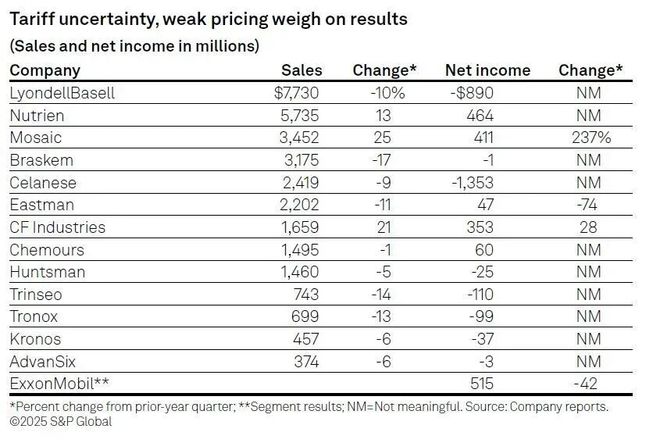
Group 1: Market Overview - The market conditions for most bulk and diversified chemical producers remain challenging, despite some signs of recent demand improvement in polymer production [1] - Long-term issues of oversupply and cost-cutting persist in the industry [1] Group 2: Polyolefins Market Performance - LyondellBasell reported an adjusted net income of $330 million, up from $202 million in the second quarter, driven by strong polyethylene (PE) sales and lower ethylene costs [2] - LyondellBasell noted that while PE profit margins improved due to cost reductions, polypropylene margins and sales remain weak; however, PE sales in the U.S. and Europe have begun to recover [2] - ExxonMobil also contributed to the positive performance in the polyolefins market, although specific figures were not detailed [2] Group 3: Company Financials - LyondellBasell's sales decreased by 10% to $7.73 billion, with a net income of -$890 million [3] - Nutrien's sales increased by 13% to $5.735 billion, with a net income of $464 million [3] - Mosaic reported a 25% increase in sales to $3.452 billion, with a net income of $411 million, a 237% increase [3] - Braskem's adjusted net income was $1.7 million, recovering from a loss of $89 million in the previous quarter, attributed to cost-cutting and a focus on higher-value sales [5]


Adecoagro S.A.:Adjusted EBITDA reached $115.1 million in 3Q25.
Prnewswire· 2025-11-11 22:30
Core Insights - Adecoagro S.A. reported its third-quarter results for 2025, highlighting a mixed performance across its business segments, with a notable increase in Adjusted EBITDA for the Sugar, Ethanol & Energy business but a decline in the Farming business [1][2]. Sugar, Ethanol & Energy Business - Adjusted EBITDA reached $120.5 million in 3Q25, a 20.3% increase year-over-year, while year-to-date it totaled $218.4 million, down 15.6% compared to 9M24 [3]. - The company shifted to an ethanol-max scenario, achieving 58% in 3Q25 and 55% in 9M25 due to better margins compared to sugar [3]. - Crushing volumes hit an all-time record of 4.9 million tons in 3Q25, a 20.4% increase from 3Q24, with year-to-date crushing at 9.8 million tons [3]. - Production costs remained stable in 3Q25, but year-to-date costs increased to 8.3 cents per pound from 7.8 cents per pound in 9M24 due to lower TRS equivalent produced [3]. - Net sales declined in both 3Q25 and 9M25 due to lower selling volumes and prices of sugar, despite a recovery in ethanol prices [3]. Farming Business - Adjusted EBITDA for the Farming business was $1.5 million in 3Q25 and $19.2 million in 9M25, down $15.9 million and $80.0 million year-over-year, respectively [4]. - Excluding the sale of La Pecuaria farm, Adjusted EBITDA decreased by $65.0 million year-to-date [4]. - Higher volumes of dairy products and crops were sold, but lower prices for crops, rice, and dairy products negatively impacted results [4]. - The company experienced year-over-year losses in the mark-to-market of biological assets for the 2024/25 harvest season and faced higher costs in U.S. dollar terms for the same period [4]. Acquisition Strategy - Adecoagro announced an agreement to acquire Nutrien Ltd.'s 50% interest in Profertil S.A. for approximately $600 million, with an initial down payment of $120 million [7]. - This acquisition is expected to enhance Adecoagro's agro-industrial platform and diversify its revenue base, as Profertil is one of the lowest-cost producers of urea globally [7]. - The acquisition is structured as an 80%-20% partnership between Adecoagro and Asociación de Cooperativas Argentinas, with closing expected before year-end [7]. Shareholder Distribution - The company will pay a second cash dividend of $17.5 million on November 19, 2025, completing a total annual cash dividend of $35.0 million [8]. - In 2025, Adecoagro also repurchased 1.1% of its equity, totaling $10.2 million [8]. Farmland Valuation - As of September 30, 2025, Adecoagro's farmland, consisting of 210,371 hectares, was valued at $714.8 million, reflecting a 4.7% year-over-year increase [9].


The strategy for developing Canada's critical minerals needs a rethink
Investorideas.com· 2025-11-11 15:38
Core Viewpoint - The article argues that Canada needs to rethink its strategy for developing critical minerals, particularly focusing on the Ring of Fire, which may not be the best investment compared to other existing mining regions in Canada. Group 1: Government Initiatives and Policies - Prime Minister Mark Carney has prioritized critical minerals alongside infrastructure development, aiming to double Canada's non-US exports over the next decade, unlocking $300 billion in new trade [5][15]. - The Ontario government is frustrated with the lengthy timelines for mining project approvals, leading to the introduction of Bill 5 to expedite mining projects and create Special Economic Zones [7][8]. - The Building Canada Act aims to streamline federal approval processes for major projects, including critical mineral developments [11]. Group 2: The Ring of Fire - The Ring of Fire has been highlighted as a potential area for critical mineral extraction, but it faces significant challenges, including lack of infrastructure and opposition from local First Nations [24][25]. - The estimated economic return from the Ring of Fire is $22 billion over 30 years, averaging $730 million per year, which is less than the current earnings from platinum group elements in Ontario [33][96]. - Critics argue that the Ring of Fire is overhyped and that other mining regions, such as the Sudbury Basin and Abitibi Greenstone Belt, offer better returns and should be prioritized for investment [17][30][96]. Group 3: Infrastructure and Investment Needs - Canada needs to build more mining infrastructure, including ports, power lines, and railways, to support the extraction and transportation of critical minerals [60][66][73]. - The Port of Churchill is identified as a key project for diversifying trade and enhancing Canada's economy, with a commitment of $180 million for improvements [63][64]. - The lack of power infrastructure in remote mining areas, such as the Ring of Fire, poses a significant barrier to development [66][70]. Group 4: Comparison with Other Mining Regions - The Sudbury Basin and Abitibi Greenstone Belt are highlighted as more productive mining regions compared to the Ring of Fire, with the Sudbury Basin generating $800 million annually from platinum group elements alone [30][96]. - The article emphasizes that Canada has several existing mining camps that could drive GDP and exports more effectively than the Ring of Fire [93][96]. Group 5: Future Directions - The article suggests that instead of focusing on the Ring of Fire, the Canadian government should identify and fund advanced mineral projects that are more likely to succeed [97][98]. - There is a call for the government to support junior mining companies, which are crucial for future mineral discoveries and developments [55][57]. - The need for a strategic approach to mining, including the establishment of smelters and refineries within Canada, is emphasized to avoid exporting raw materials for processing abroad [104][106].


“反内卷”发力 化工品价格有望回暖
Zheng Quan Shi Bao Wang· 2025-11-10 01:59
Core Viewpoint - The chemical industry has experienced a decline in profitability for three consecutive years since 2022, with some sectors facing intense competition and overall losses. However, there is a shift towards industry self-regulation to restore product supply-demand balance and improve profitability [1] Industry Overview - The agricultural chemicals, refrigerants, bioenergy, tires, and metal chromium sectors are currently in an upward cycle of prosperity [1] Market Trends - According to GGII statistics, domestic energy storage lithium battery shipments are expected to reach 430 GWh in the first three quarters of 2025, exceeding 30% of the total for 2024, with an anticipated annual total of 580 GWh, representing a 67% year-on-year growth. This surge in storage demand, coupled with pre-subsidy rushes, has led to strong demand for upstream lithium battery materials, resulting in a supply shortage and a continuous price recovery [1] - Nutrien forecasts that global potash demand may further increase to 74-77 million tons by 2026, with global potash prices expected to maintain high levels and potential for further increases due to major companies delaying capacity expansions [1] Investment Focus - CITIC Securities indicates that the chemical sector is currently trading around three main themes: 1. The rise in energy storage demand is enhancing the prosperity of the supply chain, with a reshaping of the supply-demand dynamics for upstream lithium battery materials, recommending a focus on new energy-related materials [1] 2. The ongoing "anti-involution" efforts in the chemical industry are leading to self-regulation across multiple sectors, which is likely to support a bottoming out and recovery in chemical product prices [1] 3. The chemical sector itself is experiencing high prosperity, with core businesses expected to maintain robust growth [1]
Horizon Kinetics Q3 2025 Commentary (HKHC)
Seeking Alpha· 2025-10-31 01:15
Core Insights - The article discusses the evolution and performance of indexation investing, particularly focusing on ETFs, highlighting that passive funds have now surpassed active funds in assets under management by the end of 2023 [3][4] - It emphasizes the disappointing annualized returns of equity ETFs, which have been in the 7% to 8% range over the past 25 years, despite expectations of higher returns [4][5] - The concentration of the Information Technology sector in the S&P 500 is noted, raising concerns about potential capital loss if valuations contract [6][9] Group 1: ETF Performance and Market Dynamics - The total assets in ETFs grew from $65 billion in 2000 to over $90 billion for the iShares Bitcoin Trust ETF alone by 2023, marking a significant shift in market dynamics [3][4] - Annualized equity ETF returns have consistently underperformed expectations, with fixed-income ETFs yielding even lower returns, often negative when adjusted for taxes and inflation [4][5] - The dominance of the Information Technology sector, which now comprises 46.1% of the S&P 500 market value, raises concerns about market concentration and the risks associated with it [5][6] Group 2: Market Concentration and Valuation Concerns - The article presents data showing that the top 10 companies in the S&P 500 accounted for 38.9% of total market capitalization by October 2025, compared to 18.0% in 1988, indicating increased market concentration [11] - The valuation metrics of the Information Technology sector are highlighted, with a forward P/E ratio of 122x earnings, contrasting sharply with lower valuations in other sectors [10][12] - The historical context of market concentration is discussed, comparing the current situation to the Dot-com Bubble, suggesting that high valuations in the IT sector may not be sustainable [9][13] Group 3: Securities Exchanges and Investment Strategies - The commentary introduces the concept of investing in securities exchanges as a strategy to sidestep indexation, suggesting that these entities have outperformed regional stock indices over time [15][19] - Data shows that major securities exchanges have consistently outperformed their respective regional stock indices, with CME Group and Nasdaq demonstrating significant returns over 20 years [20] - The article argues that the business model of securities exchanges allows them to benefit from increasing trading volumes and market activity, making them a compelling investment opportunity [24][32] Group 4: Localized Inflation and Investment Opportunities - The article discusses the concept of localized inflation, emphasizing that individual experiences of inflation can vary significantly across different sectors and commodities [58][60] - It highlights the challenges in measuring inflation accurately and the implications for investment strategies, particularly in sectors like energy and food [49][55] - The performance of specific investment vehicles, such as oil royalty trusts, is presented as a potential hedge against localized inflation, showcasing their ability to provide robust cash flow without significant capital expenditures [66][69]

The Art of the Deal, or Just the Art of the Tantrum? Markets Shrug (Mostly) at Trump’s Latest Tariff Tango
Stock Market News· 2025-10-26 06:00
Core Points - The recent announcement of a 10% tariff on Canadian goods by President Trump was triggered by an Ontario ad campaign featuring Ronald Reagan, which Trump labeled as a "hostile act" [1][2] - The Canadian dollar experienced a slight depreciation against the U.S. dollar, but the overall market response was muted, with the S&P/TSX Composite Index showing resilience [3][4] - Specific sectors in Canada, particularly auto, steel, aluminum, and lumber, are more vulnerable to tariff impacts, with potential costs to American consumers estimated at $50 billion [5][6] Market Reactions - The Canadian dollar (CAD) saw a slight depreciation, with the USD/CAD exchange rate approaching 1.3980, reflecting a 50-pip spike post-announcement [3] - U.S. equity futures were mixed, but major indices like the Dow Jones Industrial Average and S&P 500 reached record highs on the same day as the tariff announcement, attributed to softer inflation data [4] - Analysts view the tariff announcement as typical political maneuvering rather than a serious threat to trade relationships, indicating a level of desensitization among investors [6][10] Sector-Specific Impacts - Industries with significant cross-border trade exposure, such as automotive and energy, are on high alert due to the potential for increased costs and market volatility [5][6] - The Canadian Chamber of Commerce emphasized that tariffs are ultimately a tax on American consumers and competitiveness [7] Broader Trade Context - The tariff announcement occurs amid ongoing trade tensions, including investigations into China's compliance with trade agreements and threats of new tariffs on Chinese goods [9] - The frequency and rhetoric of trade policy announcements have led to a market environment where investors are increasingly able to filter out noise and focus on other economic indicators [10][11]


AMD upgraded, Micron downgraded: Wall Street's top analyst calls
Yahoo Finance· 2025-10-14 13:44
Upgrades - HSBC upgraded HP Inc. (HPQ) to Buy from Hold with a price target of $30, up from $28.10, citing better-than-expected market indications for personal computer and printer volumes [2] - RBC Capital upgraded T-Mobile (TMUS) to Outperform from Sector Perform with an unchanged price target of $270, highlighting the stock's valuation compression year-to-date and solid operating trends [2] - Wolfe Research upgraded Monolithic Power (MPWR) to Outperform from Peer Perform with a price target of $1,200, projecting a conservative path to over $24 in earnings per share by 2027 [3] - JPMorgan upgraded DoorDash (DASH) to Overweight from Neutral with a price target of $325, up from $175, noting industry-leading growth and improving unit economics [4] - Wolfe Research upgraded AMD (AMD) to Outperform from Peer Perform with a price target of $300, following the company's OpenAI win and projecting over $10 in earnings per share [5] Downgrades - New Street downgraded Micron (MU) to Neutral from Buy with a price target of $190, indicating that while demand for high bandwidth memory is increasing, earnings beats will be offset by continued multiple compression [6] - Northland downgraded Salesforce (CRM) to Market Perform from Outperform with a price target of $264, down from $396, citing stagnant constant currency cRPO growth between 10% and 11% [6] - Barclays downgraded CyberArk (CYBR) to Equal Weight from Overweight with a price target of $520, reflecting the pending takeover by Palo Alto Networks (PANW) expected to close in the second half of 2026 [6] - BofA downgraded Nutrien (NTR) to Neutral from Buy with an unchanged price target of $67, noting a more balanced risk-reward scenario amid concerns regarding the fertilizer price rally [6] - Oppenheimer downgraded Carrier Global (CARR) to Perform from Outperform without a price target, citing near-term earnings risk and few catalysts for the shares [6]


Nutrien: Great Company, Wrong Timing. Waiting For A Better Margin Of Safety (NYSE:NTR)
Seeking Alpha· 2025-10-13 13:16
Core Viewpoint - Nutrien Ltd. (NYSE: NTR) is currently not considered an attractive investment opportunity despite several important developments, with the stock remaining flat since June [1]. Company Research - The analyst has over 10 years of experience researching companies across various sectors, including commodities like oil, natural gas, gold, and copper, as well as technology companies such as Google and Nokia [2]. - The analyst has researched over 1000 companies in-depth, which contributes to the ability to provide valuable insights [2]. - The focus has shifted to a value investing-oriented YouTube channel after three years of blogging, covering hundreds of different companies [2]. - The analyst expresses a particular interest in metals and mining stocks but is also comfortable analyzing other industries, including consumer discretionary/staples, REITs, and utilities [2].

Invest in Inflation-Sensitive Stocks in Active ETF TURF
Etftrends· 2025-10-10 13:49
Core Insights - The article discusses the potential rise in inflation and its implications for investment in inflation-sensitive natural resources [1] - The New York Federal Reserve has indicated rising short-term inflation and an increase in one-year horizon inflation, suggesting a favorable environment for natural resources investments [1] Investment Opportunities - Active ETFs, particularly the T. Rowe Price Natural Resources ETF (TURF), provide exposure to inflation-sensitive stocks, which historically perform better than traditional equities and bonds during inflationary periods [2] - TURF focuses on global natural resources companies, investing in 60-80 stocks with a fee of 44 basis points, and has returned 9.5% over the last three months, outperforming its category average [3] Company Performance - Nutrien Ltd. (NTR), a crop nutrient company, has achieved a year-to-date return of 39.1%, focusing on potash, nitrogen, and phosphates [4] - BHP Group (BHP), which specializes in iron and copper ore as well as coal, has returned 19.7% year-to-date [4] Future Outlook - Inflation-sensitive stocks, particularly in the natural resources sector, are expected to provide both upside potential and defensive benefits in a challenging market environment [4]