
OPEC

Search documents
Oil prices rise 3% after Trump cancels meetings with Iran, tells protesters help is on the way
CNBC· 2026-01-13 16:44
Group 1 - Crude oil prices increased approximately 3% following U.S. President Trump's cancellation of meetings with Iranian officials and his support for protesters [1] - U.S. crude oil rose by $1.96, or 3.29%, reaching $61.46 per barrel, while global benchmark Brent increased by $1.99, or 3.12%, to $65.86 per barrel [1] - The unrest in Iran, characterized by large-scale demonstrations and a government crackdown, raises concerns about potential disruptions in oil supply [2][3] Group 2 - The Iranian government has restricted Internet access, complicating the verification of the situation on the ground amid reports of hundreds of deaths [2] - President Trump has threatened intervention if the Iranian government continues to harm protesters, emphasizing the potential for significant consequences for Iran [2][3] - Iran's status as a major crude oil producer and OPEC member makes the oil market particularly sensitive to developments in the region [3]

Oil climbs, intensifying unrest in Iran spark supply concerns
Reuters· 2026-01-12 00:19
Core Viewpoint - Oil prices are rising due to concerns over potential supply disruptions from Iran amid escalating protests, despite efforts to restore oil exports from Venezuela [1] Group 1 - Oil prices extended gains on Monday, indicating a bullish trend in the market [1] - The intensifying protests in Iran are raising fears of supply disruptions from this OPEC producer [1] - Efforts to quickly resume oil exports from Venezuela are ongoing, but the impact on overall supply remains uncertain [1]

Trump's Oil Grab Is a Big Problem for the OPEC Cartel
WSJ· 2026-01-11 02:00
Core Insights - The potential for U.S. control over Venezuela's oil output could significantly alter the global power dynamics in the energy market [1] Group 1 - U.S. intervention in Venezuela's oil production may lead to a shift in market power, impacting both supply and pricing strategies globally [1] - The control over Venezuela's output could enhance U.S. leverage in negotiations with other oil-producing nations [1] - This situation may create opportunities for U.S. companies to expand their influence in the Latin American energy sector [1]


OPEC oil output falls in December on Iran and Venezuela, Reuters survey finds
Reuters· 2026-01-09 12:25
Core Viewpoint - OPEC's oil output decreased in December due to reduced supply from Iran and Venezuela, counteracting an OPEC+ agreement to increase production for the month [1] Group 1 - OPEC's oil output fell in December [1] - The decline in output was primarily attributed to lower supply from Iran and Venezuela [1] - This decrease offset the OPEC+ agreement aimed at raising production levels for the month [1]

U.S. Push Into Venezuela Oil Patch Raises Questions About OPEC Dynamic
WSJ· 2026-01-08 17:52
Core Perspective - The potential for increased U.S. influence over Venezuela's oil industry raises questions about Washington's future role in OPEC, particularly in relation to President Trump's calls for the cartel to lower crude prices [1] Industry Implications - The dynamics of U.S. involvement in Venezuela's oil sector could alter the balance of power within OPEC, impacting global oil production and pricing strategies [1] - Increased U.S. influence may lead to shifts in OPEC's operational strategies, as the organization navigates external pressures from the U.S. government [1] Geopolitical Context - The situation highlights the intersection of U.S. foreign policy and global oil markets, emphasizing how political decisions can directly affect commodity prices and international relations [1] - The evolving role of the U.S. in Venezuela's oil industry could set a precedent for future interactions between the U.S. and other OPEC member countries [1]
供应过剩压力山大,本周OPEC+拟按兵不动,维持暂停增产计划
Hua Er Jie Jian Wen· 2025-12-30 12:25
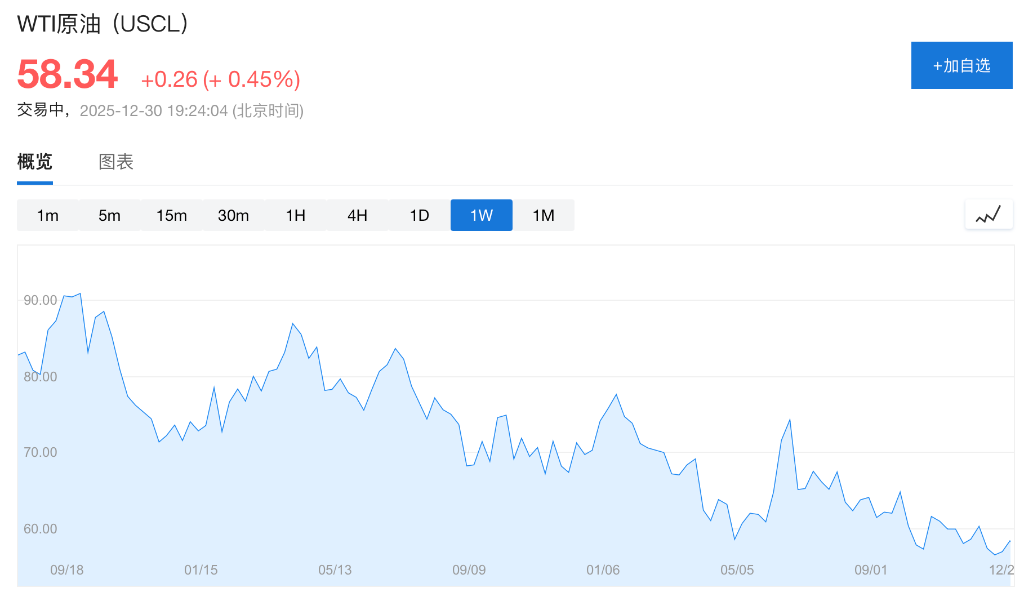
Core Viewpoint - OPEC+ is expected to maintain its current production pause plan during the upcoming meeting, responding to global oil supply surplus pressures [1][2] Group 1: OPEC+ Meeting and Production Plans - OPEC+ will hold a monthly video meeting on January 4, led by Saudi Arabia and Russia, to reaffirm the decision made in November to pause further production increases until Q1 2026 [1] - The policy confirmed in the early December meeting is anticipated to be reiterated, with ongoing internal consultations [2] - Despite earlier indications of sufficient global oil supply, OPEC+ had decided in April to accelerate the restoration of production, which surprised market traders [6] Group 2: Market Conditions and Price Trends - WTI crude oil prices have dropped by 20% this year, marking the largest annual decline since 2020 [2] - OPEC+ and its competitors have seen a continuous rise in oil supply, while global demand growth has noticeably slowed [2] - Several authoritative institutions, including the International Energy Agency, predict a record supply surplus in the oil market for the coming year [2] Group 3: Geopolitical Risks - The global oil market is currently facing multiple intertwined geopolitical risks, including the closure of oil wells in Venezuela due to U.S. sanctions and attacks on Russian oil infrastructure by Ukraine [5] - Tensions have also emerged between OPEC leaders Saudi Arabia and the UAE regarding support for armed groups in Yemen [5] Group 4: Production Capacity and Challenges - Approximately 1.2 million barrels per day of production capacity remains unrecovered from the earlier production cuts, with some member countries struggling to meet their production commitments [6]
Why China Is Driving Short-Term Oil Prices But OPEC Still Holds the Lever
Yahoo Finance· 2025-12-28 00:00
Core Insights - Oil markets are increasingly influenced by China's buying behavior rather than OPEC's decisions, marking a shift in price formation dynamics [1][2][5] - China has become the world's largest crude importer, and its demand now plays a central role in oil price discovery [2][5] - The traditional view of OPEC as the primary price setter is being challenged, with China's strategic stockpiling affecting price floors and ceilings [3][6] Group 1: China's Influence on Oil Prices - China's crude purchases have overtaken OPEC's influence, indicating a demand-led market with China at the center [2][5] - The buying behavior of China's state-owned majors and independent refiners is often opaque, contributing to market uncertainty [4][5] - When Chinese buying accelerates, oil prices tend to firm, while a slowdown in imports leads to price drops, regardless of OPEC's output [5][6] Group 2: Market Dynamics and Volatility - OPEC, particularly Saudi Arabia, still holds significant spare capacity, which influences long-term expectations but is less impactful in the short term [6] - Chinese refinery margins serve as an early indicator for price direction, with improved margins leading to increased crude imports [7] - The behavior of independent refiners, characterized by short planning cycles and limited flexibility, introduces volatility that OPEC policies struggle to manage [7]
Watch for Crude Oil "Washout" Before Bottom Hits, Plunge to $15 Possible
Youtube· 2025-12-19 19:00
Core Viewpoint - The outlook for crude oil prices in 2026 appears bleak, with expectations of continued downward pressure and potential for prices to drop significantly unless a major market shift occurs [2][6][10]. Crude Oil Market Analysis - Historical trends indicate that the current bearish market for crude oil is the fourth in two decades, with previous downturns ending in significant price drops [5][6]. - A short-term bounce in crude oil prices is anticipated due to seasonal factors and a weak dollar, but this is not expected to lead to a sustained recovery [3][4]. - The market has experienced a risk premium due to geopolitical tensions, particularly related to the Russia-Ukraine conflict, which could influence future pricing [9][10]. - Analysts suggest that a capitulation in price and sentiment is necessary to identify a true market bottom, with potential for prices to reach $40 per barrel if conditions worsen [7][10]. Natural Gas Market Analysis - Natural gas prices are influenced by seasonal factors, with a historical pivot point around $3.60; prices above this level tend to be bullish, while those below are bearish [13][14]. - Current natural gas prices around $4 may seem high compared to recent lows but are significantly lower than the peaks seen in previous years [16][17]. - Expectations for natural gas prices should be tempered, with projections suggesting a trading range of $2 to $5.50 in the near future [17].
能源开采|2026策略报告
2025-12-16 03:26
Summary of Key Points from Conference Call Records Industry Overview - **OPEC Strategy**: OPEC announced a pause in production increases in Q4 2025 and plans to continue this in Q1 2026, which is better than market expectations and helps support oil prices above $65 per barrel [1][2][9]. - **Refining Industry**: The refining sector has been at a low point since 2022, with some products experiencing long-term losses. A potential upcycle is expected in the next 3-5 years, contingent on the balance sheets of China and global markets [1][3]. - **Coal Market**: The coal market is expected to see a price center higher than in 2025, with a lower limit of 700 RMB/ton and a potential high of around 850 RMB/ton, indicating that the bottom has passed for thermal coal [1][5]. - **Natural Gas Market**: Significant changes in the natural gas market have been noted, with the Henry Hub price rising and the price gap between the US and Europe narrowing, which requires further monitoring [1][6]. Core Insights and Arguments - **Oil Market Outlook for 2026**: A relatively optimistic view is held for the oil market in 2026, with expectations for contract prices to remain at $65 or above. The market is seen as bottoming out despite some supply pressures [2][12]. - **Predictions on Supply and Demand**: Global oil supply is expected to increase in 2026, with OPEC potentially halting production increases. The US shale oil production remains resilient, contributing to a projected supply increase of about 1.6 million barrels per day [12][14]. - **Demand Growth**: Demand growth for oil is forecasted at around 1 million barrels per day, with varying predictions from major institutions [13][14]. Additional Important Insights - **China's Strategic Reserves**: China has engaged in significant strategic reserve replenishment in 2025 and shows a strong intent to continue this, with plans to increase storage capacity by 170 million barrels [10][11]. - **Refining Sector Dynamics**: The refining industry is expected to see a shift towards more profitable products like aromatics, while ethylene and propylene markets are anticipated to improve around 2027 [3][19][25]. - **Impact of Policies**: Anti-involution policies are limiting new capacity in the petrochemical sector, while older facilities are being phased out, which may have a limited impact on actual capacity reduction [18]. - **International Market Influence**: The overseas refined oil market is tightening, which is expected to support the demand for aromatics and other petrochemical products [24][28]. This summary encapsulates the key points from the conference call records, highlighting the current state and future expectations of the energy and petrochemical industries.
能源化工期权:能源化工期权策略早报-20251215
Wu Kuang Qi Huo· 2025-12-15 01:22
Group 1: Report Summary - The report focuses on energy and chemical options, covering various sectors such as energy, alcohols, polyolefins, rubber, polyesters, alkalis, and others [10]. - It provides option strategies and suggestions for selected varieties in each sector, including fundamental analysis, market trends, option factor research, and option strategy recommendations [10]. Group 2: Market Overview - **Futures Market**: The report presents the latest prices, price changes, trading volumes, and open interest of various energy and chemical futures contracts, including crude oil, liquefied petroleum gas (LPG), methanol, ethylene glycol, etc. [5]. - **Option Factors**: It includes data on option volume - PCR, open interest - PCR, pressure and support levels, implied volatility, and historical volatility for different option varieties [6][7][8]. Group 3: Option Strategies Energy Options - **Crude Oil**: Fundamental analysis shows stable US refinery demand and unchanged shale oil production. The market has a weak trend. Option strategies include bear - spread combinations, selling call + put option combinations, and long - collar strategies for spot hedging [9]. - **LPG**: With an increase in warehouse receipts and mixed supply - demand conditions, the market is weak. Strategies involve bear - spread combinations, selling call + put option combinations, and long - collar strategies for spot hedging [11]. Alcohol Options - **Methanol**: Inventory is decreasing, and the market is weak. Strategies include bear - spread combinations, selling call + put option combinations, and long - collar strategies for spot hedging [11]. - **Ethylene Glycol**: Polyester load is decreasing, and inventory is increasing. The market is weak. Strategies involve bear - spread combinations, short - volatility strategies, and long - collar strategies for spot hedging [12]. Polyolefin Options - **PVC**: Inventory is increasing, and the market is weak. Strategies include bear - spread combinations and long - collar strategies for spot hedging [12]. Rubber Options - **Rubber**: Tire factory开工率 has mixed trends, and inventory has changed. The market is in a weak consolidation. Strategies involve selling neutral call + put option combinations [13]. Polyester Options - **PTA**: Production load is stable but low. The market has a weak rebound and then a decline. Strategies involve selling neutral call + put option combinations [13]. Alkali Options - **Caustic Soda**: Capacity utilization is increasing, and the market is weak. Strategies include bear - spread combinations and long - collar strategies for spot hedging [14]. - **Soda Ash**: Inventory is decreasing, and the market is in a low - level weak oscillation. Strategies include bear - spread combinations, short - volatility strategies, and long - collar strategies for spot hedging [14]. Other Options - **Urea**: Enterprise inventory is decreasing, and port inventory is increasing. The market is short - term weak. Strategies involve selling neutral call + put option combinations and long - collar strategies for spot hedging [15]. Group 4: Charts - The report includes price charts, trading volume and open - interest charts, option volume - PCR and open interest - PCR charts, implied volatility charts, and historical volatility cone charts for various energy and chemical options, such as crude oil, LPG, methanol, etc. [17][34][55]