
石油供应过剩

Search documents
伊朗局势扰动石油市场:油价100美元/桶是预警还是虚惊?
2 1 Shi Ji Jing Ji Bao Dao· 2026-02-27 16:32
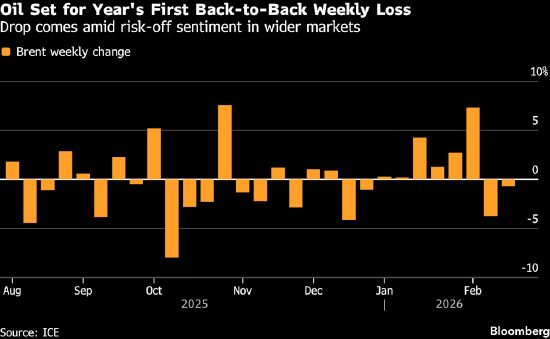
Group 1: Oil Market Dynamics - The ongoing negotiations between the US and Iran are causing fluctuations in the oil market, with reports indicating significant progress in talks, leading to a slight decline in Brent and US crude oil prices on February 26 [1] - The market is currently caught between expectations of a global supply surplus and geopolitical tensions surrounding Iran, which have increased risk premiums [2] - If a deal is reached between the US and Iran, oil prices could see a significant drop due to the current oversupply situation in the global oil market [2][3] Group 2: OPEC+ Production Decisions - OPEC+ is considering increasing oil production by 137,000 barrels per day in April, which could impact market dynamics and allow member countries to regain market share [3] - Despite expectations of a supply surplus, OPEC+ predicts strong oil demand, forecasting a daily average demand of 106.52 million barrels by 2026, which supports the case for production increases [3] Group 3: Price Projections and Risks - In extreme scenarios, if negotiations fail and Iran disrupts the Strait of Hormuz, oil prices could surge, potentially exceeding $100 per barrel due to significant supply disruptions [5][6] - Current oil prices have seen a cumulative increase of nearly 20% this year, driven by geopolitical tensions, while the market also faces concerns of oversupply [4][8] - The International Energy Agency (IEA) and the US Energy Information Administration (EIA) both project significant supply surpluses in the coming years, indicating that without geopolitical disruptions, oil prices may face downward pressure [7][8]
上游增产抵御价跌、中游强劲增长 西方石油(OXY.US)Q4盈利超预期
智通财经网· 2026-02-19 00:20
Core Viewpoint - Occidental Petroleum (OXY.US) reported fourth-quarter profits that exceeded Wall Street expectations, driven by strong midstream performance which offset the impact of declining crude oil prices [1] Group 1: Financial Performance - Adjusted earnings per share for the fourth quarter were $0.31, surpassing the expected $0.18 [1] - Revenue decreased by 5.2% year-over-year to $5.42 billion [1] - The company experienced a drop in oil prices from $69.73 per barrel in the same quarter last year to $59.22 per barrel [1] - The pre-tax income from oil and gas operations totaled $700 million in Q4 2025, down from $1.3 billion in Q3 2025 [1] Group 2: Midstream Business - The midstream segment reported pre-tax profits of $204 million, up from $81 million in the previous quarter and a loss of $123 million in the same quarter last year [2] - Increased natural gas margins due to optimized transportation capacity in the Permian Basin and reduced long-haul crude transportation costs contributed to the growth [2] Group 3: Capital Expenditure and Debt Management - The company expects capital expenditures for 2026 to be between $5.5 billion and $5.9 billion, with average production projected between 1.42 million and 1.48 million barrels of oil equivalent per day [2] - As of mid-December, the company has reduced its debt by $5.8 billion, bringing total debt principal down to $15 billion, with a target of approximately $14.3 billion by 2026 [2] Group 4: Dividend Increase - The quarterly dividend was increased by over 8% to $0.26 per share, payable on April 15, 2026, to shareholders on record as of March 10, 2026; the dividend has doubled over the past four years [3]

交易员权衡伊朗与欧佩克+前景,油价本周料收跌
Xin Lang Cai Jing· 2026-02-13 14:21
Core Viewpoint - Oil prices are expected to experience their first consecutive two-week decline of the year due to traders weighing multiple factors including potential supply increases from OPEC+, progress in US-Iran nuclear negotiations, and overall market weakness earlier in the week [1][3]. Group 1: Oil Price Trends - Global benchmark Brent crude oil fell approximately 0.5% this week and remained stable on Friday [4]. - The decline is projected to end the long-term upward trend in oil prices that began in early 2026, which was primarily supported by recurring geopolitical tensions such as the US-Iran standoff [6]. Group 2: Supply and Demand Dynamics - Participants at an energy conference in London indicated that global oil supply is expected to exceed demand this year, potentially leading to an increase in inventories in the Atlantic Basin, the core pricing region for global oil [6]. - Despite the anticipated supply surplus, the impact on the market has been limited so far due to the backlog of sanctioned oil and supply disruptions in multiple countries [6]. Group 3: Geopolitical Factors - Traders are closely monitoring the progress of US-Iran negotiations and efforts to achieve a ceasefire in the Russia-Ukraine conflict [6]. - US President Trump stated that the US-Iran negotiations could last up to a month, reducing the likelihood of immediate military action that could disrupt oil supplies [6].

原油成品油早报-20260213
Yong An Qi Huo· 2026-02-13 01:43
Group 1: Report Industry Investment Rating - No information provided Group 2: Core View of the Report - This week, crude oil prices fluctuated at high levels due to the Iran situation, with the monthly spread declining and the North Sea Brent basis falling to $1.005 per barrel. The first round of US-Iran nuclear negotiations lasted about six hours, and the second round is expected in the next few days. Netanyahu will meet with Trump next Wednesday to discuss the Iran issue. Iran stated it does not want a regional war. Fundamentally, global oil inventories decreased this week, with US commercial crude inventories declining by 3.455 million barrels and refined oil inventories by 5.553 million barrels due to the cold wave. Saudi Arabia adjusted the official selling prices of Arabian light crude for March. Singapore's refined oil inventories increased, while ARA's crude and refined oil inventories decreased. Domestic gasoline and diesel inventories increased. Short - term oil prices are still affected by the Iran situation, and the global crude oil supply - demand fundamentals in the first and second quarters remain in a surplus state, not supporting high valuations [5] Group 3: Summary by Relevant Catalogs 1. Daily News - Israeli Prime Minister Netanyahu is skeptical about the quality of any agreement with Iran, covering nuclear issues, ballistic missiles, and Iran's proxy problems. He also said Trump might reach a good agreement with Iran [3][4] - The Trump administration secretly shipped about 6,000 Starlink terminals to Iran after the Iranian regime's crackdown on demonstrations last month to help anti - regime activists bypass the internet shutdown, though it's illegal in Iran [4] - The IEA lowered the forecast of global oil demand growth in 2026 to 850,000 barrels per day from 930,000 barrels per day in January's report, while keeping the large supply - surplus estimate basically unchanged. OPEC's research department predicted a growth of 1.38 million barrels per day in 2026 [4] 2. EIA Report (02/06 Week) - US crude oil exports decreased by 308,000 barrels per day to 3.739 million barrels per day [14] - US domestic crude oil production increased by 498,000 barrels to 13.713 million barrels per day [14] - Commercial crude inventories excluding strategic reserves increased by 8.53 million barrels to 429 million barrels, a 2.03% increase [14] - The four - week average supply of US crude oil products was 20.827 million barrels per day, a 2.36% increase year - on - year [14] - US Strategic Petroleum Reserve (SPR) inventories decreased by 100,000 barrels to 415.2 million barrels, a 0.0% decrease [14] - US imports of commercial crude oil excluding strategic reserves were 6.805 million barrels per day, an increase of 604,000 barrels per day from the previous week [14] 3. Inventory - No detailed summary information provided other than mentioned in the weekly view 4. Weekly View - Crude oil prices were affected by the Iran situation, with monthly spreads and North Sea Brent basis declining. The US - Iran nuclear negotiations were held, and the second round is expected. Netanyahu will discuss the Iran issue with Trump. Iran doesn't want a regional war. Global oil inventories decreased, and Saudi Arabia adjusted oil prices. Singapore, ARA, and domestic inventories had different trends. Short - term oil prices are affected by the Iran situation, and the first - and second - quarter fundamentals are in surplus [5]
委内瑞拉石油遭美国炼油厂冷遇,对美出口激增三倍后陷入滞销
Jin Rong Jie· 2026-02-05 11:59
Group 1 - The core viewpoint of the articles highlights the significant increase in Venezuelan oil exports to the U.S. following a $2 billion supply agreement, but the U.S. refiners are facing a surplus situation leading to unsold oil [1] - Venezuelan oil exports to the U.S. surged nearly threefold month-on-month, reaching 284,000 barrels per day, but U.S. refiners are reluctant to purchase due to oversupply [1] - Companies like Chevron, Vitol, and Trafigura have received export licenses for Venezuelan oil, but they are struggling to find buyers along the Gulf Coast due to the simultaneous increase in exports by Chevron [1] Group 2 - Starting from December 2025, the U.S. will exert control over Venezuelan oil through maritime blockades, licensing systems, and the establishment of trust accounts [2] - The Venezuelan National Assembly has passed an oil and gas reform bill that opens the oil industry to private capital, legally solidifying foreign investment rights [2]

油价大跌2%,回吐上一日涨幅,EIA库存数据继续反应供应过剩压力
Xin Lang Cai Jing· 2026-01-22 23:31
Core Viewpoint - Oil prices have experienced a significant decline, fully reversing the gains from the previous trading day, indicating continued pressure on oil prices due to oversupply and reduced speculative interest in the market [4][5]. Market Dynamics - WTI crude oil futures closed down by $1.26, a decrease of 2.08%, at $59.36 per barrel; Brent crude oil futures fell by $1.19, or 1.84%, to $63.34 per barrel; INE crude oil futures dropped by 2.17% to 436.6 yuan [6][20]. - The U.S. Energy Information Administration (EIA) reported higher-than-expected inventory builds for both crude oil and gasoline, contributing to the oversupply pressure [4][21]. Chemical Industry Outlook - Despite struggles in the crude oil market, there is a notable increase in investment interest in chemical products, with significant gains in the stock and futures markets for synthetic rubber and PTA, indicating a potential recovery in profit margins within the petrochemical sector [4][18]. - The market is showing signs of overheating in certain chemical products, suggesting caution in pursuing high prices amid ongoing downward pressure on oil prices [4][18]. Geopolitical Factors - Geopolitical tensions have eased, contributing to the recent decline in oil prices, but the potential for sudden volatility remains due to ongoing uncertainties in the market [5][19]. - The U.S. Energy Secretary has called for a doubling of global oil production to meet rising demand and avoid energy poverty, emphasizing the need for innovation in the U.S. oil industry [21]. Global Oil Supply and Demand - The CEO of Saudi Aramco stated that predictions of a global oil supply surplus are exaggerated, citing strong demand growth and low global oil inventories [24]. - Emerging economies continue to show robust oil demand growth, with global total demand reaching record levels last year and expected to continue increasing [24][25]. - Current global idle capacity is at 2.5%, below the 3% threshold needed for market stability, raising concerns about potential risks if OPEC+ further relaxes production cuts [25].

小伙伴都惊呆了!美天然气连续二天暴涨近60%,这一夜油价终于守住了涨幅
Xin Lang Cai Jing· 2026-01-21 23:45
Group 1 - Oil prices continued to rise due to extreme cold weather, which led to a significant spike in natural gas prices, with a daily increase of 30% and a cumulative rise of over 60% in two days. This cold weather also boosted demand for heating, resulting in a two-month high for diesel prices in Europe and the US, which in turn supported a rebound in crude oil prices [3][20]. - The International Energy Agency (IEA) reported a notable oversupply pressure in the oil market, adjusting the 2026 oil demand growth forecast upward by 70,000 barrels per day to 930,000 barrels per day, compared to last year's growth of 850,000 barrels per day. The global oil supply growth forecast was also revised to 2.5 million barrels per day from the previous estimate of 2.4 million barrels per day [4][23]. - IEA emphasized that the large inventory levels are suppressing oil price increases and stated that it is currently unable to fully assess the impact of recent geopolitical developments on the oil market [4][23]. Group 2 - The IEA's report indicated that ample global oil supply is alleviating concerns regarding geopolitical risks associated with oil production and exports from Venezuela, Iran, and Russia. The report noted that while the geopolitical dynamics' impact on the oil market is not fully understood, the current inventory levels provide some comfort to market participants [7][23]. - The Middle Eastern benchmark crude, Murban, has seen a rise for three consecutive trading days, supported by strong demand from Asian buyers seeking alternatives to US supplies. Indian refiners are also using Murban crude to replace Russian oil, which has bolstered the price of this flagship light sour crude from the UAE [8][24]. - The state-owned Indian Oil Corporation has awarded a one-year procurement tender for Iraqi and Omani crude oil and is seeking to purchase Murban crude from the UAE through another tender [10][25].
国际能源署上调2026年石油需求增长预期
Sou Hu Cai Jing· 2026-01-21 22:45
Core Insights - The International Energy Agency (IEA) projects that global oil demand will increase by an average of 930,000 barrels per day by 2026, up from the previous forecast of 860,000 barrels per day [1] - The growth in global oil demand will be entirely driven by non-OECD countries [1] Supply and Demand Dynamics - Global crude oil supply is expected to rise by 2.5 million barrels per day, reaching 108.7 million barrels per day by 2026 [1] - In January, geopolitical factors, including the situations in Iran and Venezuela, caused benchmark crude oil prices to rise by $6 per barrel, but prices began to decline mid-month as tensions eased [1] - The global economy is adapting to the impacts of U.S. tariffs imposed in 2025, and lower oil prices compared to the same period last year are contributing to increased global oil demand [1] - It is anticipated that global oil supply will exceed demand by an average of 3.69 million barrels per day this year, slightly narrowing from previous reports [1]
“强卖”委内瑞拉石油,美国得失几何?
Huan Qiu Shi Bao· 2026-01-15 22:42
Core Viewpoint - The U.S. government has completed its first sale of Venezuelan oil, aiming to bring in cheap crude to control rising domestic energy prices, but this strategy is pressuring local oil companies and may lead to a decline in U.S. oil production by 2026 [1][2]. Group 1: Impact on U.S. Oil Industry - The U.S. shale oil industry, particularly in Midland, Texas, is facing significant challenges due to falling oil prices, which have dropped below $60 per barrel, leading to layoffs and reduced drilling activity [2][4]. - The number of drilling rigs in the Permian Basin has decreased by approximately 14% over the past year, with major producers like Chevron and ExxonMobil planning to cut thousands of jobs by 2025 [2][4]. - The U.S. Energy Information Administration (EIA) forecasts a 1% reduction in U.S. oil production this year due to inventory buildup and declining drilling activities [5]. Group 2: Economic and Policy Implications - The Trump administration's push to lower oil prices to $50 per barrel is exacerbating the situation for smaller U.S. shale operators, who are experiencing shrinking profit margins [4][5]. - Rising internal costs due to tariffs on essential materials for the oil industry are further complicating the operational landscape for U.S. oil producers [5]. - If oil prices remain below $60 per barrel, economic contraction could occur, leading to the closure of more drilling platforms and increased unemployment in oil-dependent regions like Texas [5]. Group 3: Global Oil Market Dynamics - The increase in Venezuelan oil supply, while beneficial for U.S. consumers, contributes to a global oversupply situation, putting additional pressure on U.S. oil prices [4]. - Analysts predict that geopolitical tensions, such as concerns over Iran, may temporarily affect oil supply but are unlikely to have a long-term impact on actual production levels [6]. - The potential recovery of Venezuelan oil production, previously curtailed by U.S. sanctions, could further suppress oil prices in the global market [6].
特朗普军事打击伊朗概率下降,油价大幅波动
Hua Tai Qi Huo· 2026-01-15 05:16
1. Report Industry Investment Rating - Short - term long diesel cracking, medium - term short position allocation [3] 2. Core View of the Report - Short - term oil prices are still trading around the possibility of Trump's military action against Iran. Since the US won't gain direct benefits from a military strike on Iran and the implementation is difficult, and neighboring countries are preventing such an action. If the situation in Iran remains unchanged, oil prices are expected to cool down soon [2] 3. Summary According to Related Catalogs Market News and Important Data - WTI February crude oil futures rose 1.42% to $62.02 per barrel, Brent March crude oil futures rose 1.6% to $66.52 per barrel, and SC crude oil futures rose 1.80% to 457 yuan per barrel [1] - Russia's crude oil production decreased slightly in 2025. The daily output decreased by about 0.7% year - on - year to 9.129 million barrels. In December 2025, the production decreased by 73,000 barrels per day month - on - month to 9.304 million barrels per day. The international oil price dropped by more than 18% in 2025 [1] - Iran's oil exports achieved "record growth" in the past 14 months, and external pressures such as tariffs and sanctions have no substantial impact on its oil exports [1] - After the US began seizing ships involved in Venezuelan oil trade, at least 26 ships changed their registration to Russia since early last month. About 13% of nearly 1,500 tankers transporting oil from Russia, Iran, and Venezuela are now registered in Russia [1] Investment Logic - Oil prices fluctuated greatly yesterday. After Trump's statement to wait and see the situation in Iran but not rule out military options, oil prices dropped by more than 3%. Military action against Iran is difficult for the US and may lead to instability in the Middle East [2] Strategy - Short - term oil price drivers are strong. Short - term long diesel cracking, medium - term short position allocation [3] Risk - Downward risks: OPEC significantly increases production, macro black - swan events [3] - Upward risks: Supply of sanctioned oil (Russia, Iran, Venezuela) tightens, large - scale supply disruptions due to Middle East conflicts [3]