拜耳

Search documents
Biotech Stocks Facing FDA Decision In November 2025
RTTNews· 2025-11-01 02:06
Regulatory Overview - The FDA has approved 34 novel drugs from January to October 2025, compared to 38 during the same period in 2024 [2] - Several biotech stocks are highlighted as they approach key regulatory decisions in November 2025 [2] Arrowhead Pharmaceuticals Inc. (ARWR) - ARWR's New Drug Application for Plozasiran is under FDA review, with a decision expected on November 18, 2025 [3] - Plozasiran targets familial chylomicronemia syndrome, a condition characterized by extremely high triglyceride levels, which can lead to acute pancreatitis [3] - Clinical trials showed significant reductions in triglycerides and the incidence of acute pancreatitis, potentially providing a new treatment option alongside Tryngolza, the only FDA-approved drug for this condition [4] Otsuka Holdings Co. Ltd. (OTSKF) - OTSKF is awaiting the FDA's decision on Sibeprenlimab, scheduled for November 28, 2025 [6] - Sibeprenlimab is an investigational monoclonal antibody for treating immunoglobulin A nephropathy (IgAN), a chronic kidney disease [6] - Clinical trials demonstrated a significant reduction in urine protein-to-creatinine ratio, indicating its potential as a blockbuster drug if approved [8] Bayer (BAYRY) - Bayer's investigational compound Sevabertinib is under priority review by the FDA, with a decision expected on November 28, 2025 [9] - Sevabertinib is proposed for treating advanced non-small cell lung cancer (NSCLC) with HER2 mutations, providing an additional option for previously treated patients [10] Ascendis Pharma A/S (ASND) - The FDA decision on Navepegritide, aimed at treating children with achondroplasia, is due on November 30, 2025 [11] - Achondroplasia is a rare genetic condition affecting over 250,000 people globally, leading to serious complications [12] - Navepegritide is designed for weekly subcutaneous administration, targeting the overactive FGFR3 pathway [13] Kura Oncology Inc. (KURA) - KURA is expecting FDA approval for Ziftomenib on November 30, 2025, for treating relapsed or refractory acute myeloid leukemia (AML) with NPM1 mutations [15] - Ziftomenib has shown significant efficacy in clinical trials, with a market opportunity estimated at $350 million to $400 million annually in the U.S. if approved [17]


BridgeBio Pharma: Bullish On Attruby's Momentum And 2026 Catalysts
Seeking Alpha· 2025-10-31 18:33
Group 1 - BridgeBio Pharma, Inc. is a commercial-stage biotechnology company focused on delivering Acoramidis for the treatment of ATTR-CM, marketed as Attruby in the US and Beyonttra in the EU and Japan [1] - Beyonttra is commercialized by Bayer, indicating a partnership that may enhance market reach and distribution capabilities for the drug [1]


Lilly Beats on Q3 Earnings, Ups View, Mounjaro, Zepbound Drive Sales
ZACKS· 2025-10-30 18:01
Core Insights - Eli Lilly and Company (LLY) reported third-quarter 2025 adjusted earnings per share (EPS) of $7.02, exceeding the Zacks Consensus Estimate of $6.02 per share, and significantly up from $1.18 per share in the same quarter last year [1][9] - Revenues reached $17.60 billion, a 54% increase year over year, driven by strong sales of GLP-1 drugs, Mounjaro and Zepbound, surpassing the Zacks Consensus Estimate of $16.01 billion [2][9] Revenue and Sales Performance - Mounjaro sales were $6.52 billion, up 109% year over year, beating the Zacks Consensus Estimate of $5.48 billion [3] - Zepbound recorded sales of $3.59 billion, a 185% increase year over year, exceeding the Zacks Consensus Estimate of $3.45 billion [4] - Trulicity generated revenues of $1.05 billion, down 19% year over year, in line with estimates [6] - Jardiance sales rose 40% to $959 million, surpassing the Zacks Consensus Estimate of $687 million [6] - Taltz brought in sales of $901.5 million, up 2% year over year, but missed the Zacks Consensus Estimate [7] - Verzenio generated sales of $1.47 billion, up 7% year over year, but also missed estimates [7] - Emgality revenues were $175.7 million, down 13% year over year, while Olumiant sales were $268.9 million, up 7% [8] Market Dynamics and Competition - Mounjaro and Zepbound are gaining market share from Novo Nordisk's Ozempic and Wegovy, despite facing strong competition [5] - The company is investing in obesity treatments and has several new molecules in clinical development, including orforglipron and retatrutide [14] Guidance and Future Outlook - Lilly raised its 2025 revenue guidance to $63.0 billion to $63.5 billion, up from a previous range of $60.0 billion to $62.0 billion, and increased EPS guidance to $23.00 to $23.70 [11][13] - The company is expanding its portfolio beyond GLP-1 drugs into cardiovascular, oncology, and neuroscience areas, with recent acquisitions to enhance its pipeline [17][18] Stock Performance - Following the strong third-quarter results and guidance increase, Lilly's shares rose more than 5% in pre-market trading, with a year-to-date increase of 5.3% compared to the industry average of 3.3% [13]

揭秘「伟哥」背后,多数人不知道的商业故事
36氪· 2025-10-30 13:37
Core Viewpoint - The article discusses the confusion and risks associated with the purchase of erectile dysfunction (ED) medications, particularly focusing on the brand name "Viagra" and its misuse in the market, leading to consumer deception and health risks [2][9][50]. Group 1: Market Confusion - The term "伟哥" (Weige) has become a generic term for ED medications in China, leading to a proliferation of misleading products and advertisements [21][32]. - A significant portion of complaints related to "伟哥" includes false advertising (28%), product mismatches (20%), and counterfeit or unregulated products (19%) [9][45]. - The commercialization of "伟哥" has resulted in a disconnect between the original drug, Viagra, and the various products marketed under the same name, creating a chaotic marketplace [20][40]. Group 2: Historical Context - Viagra, originally approved by the FDA in 1998 as a cardiovascular drug, became the first oral PDE-5 inhibitor for ED treatment, significantly impacting both medical and cultural perceptions [15][18]. - The introduction of Viagra to the Chinese market in 2000 marked the beginning of a complex relationship between the drug's medical use and its cultural symbolism [19][20]. - The brand name "万艾可" (Wan Aike) was established for Viagra in China, while "伟哥" became a separate trademark owned by a domestic company, leading to brand confusion [25][36]. Group 3: Regulatory and Legal Issues - Legal disputes have arisen over whether "伟哥" should be considered a generic term, with the National Intellectual Property Administration ruling that it retains its trademark status [38]. - Pfizer has attempted to assert that "伟哥" is a well-known trademark, but courts have not consistently supported this claim [39][40]. - The fragmentation of trademark rights has contributed to ongoing brand confusion and legal challenges in the market [37]. Group 4: Consumer Risks - Consumers face significant risks when purchasing ED medications online, including exposure to counterfeit products and unregulated substances that may contain harmful ingredients [46][59]. - The lack of clear labeling and the prevalence of misleading marketing tactics complicate the consumer's ability to make informed choices [44][45]. - The article emphasizes the importance of purchasing medications through legitimate channels and verifying product authenticity to mitigate health risks [54][60].


2025年拜耳处方药中国开放创新日成功举办
生物世界· 2025-10-30 04:21
Core Insights - Bayer's commitment to innovation in China's biopharmaceutical sector is highlighted through the successful hosting of the first "Co-Creation New Drug" competition, recognizing six biotech companies for their groundbreaking innovations in oncology, cardiovascular diseases, kidney diseases, immunology, and new technology platforms [1][4][9]. Group 1: Event Overview - The "Bayer Prescription Drug China Open Innovation Day" was held on October 28, 2025, showcasing Bayer's focus on China's innovation and new drug development capabilities [1]. - The event featured discussions among global and local management, industry experts, research institutions, investment firms, and startups, emphasizing Bayer's commitment to integrating into China's pharmaceutical innovation ecosystem [1][3]. Group 2: Strategic Focus - Bayer is concentrating on key research areas, establishing a differentiated pipeline for long-term growth in oncology, cardiovascular diseases, kidney diseases, neurology, rare diseases, and immunology [3][4]. - The company aims to leverage external collaborations to enhance its drug development process, focusing on unmet medical needs and high-value potential areas [3][4]. Group 3: Winning Companies - Six biotech companies were recognized for their innovative achievements: - **Zhihui Medicine** focuses on overcoming tumor resistance mechanisms [5][13]. - **Gaowei Medicine** utilizes advanced algorithms for drug target identification [5][14]. - **Aibelle** is developing next-generation immunotherapies for solid tumors [5][15]. - **Alpha Molecule** targets GPCRs with an AI-driven platform [5][16]. - **Shanghai Yinuo Pharmaceutical** specializes in autoimmune and chronic inflammatory diseases [5][17]. - **Yaoshu Technology** employs organ-on-chip technology for drug discovery [5][18]. - These companies will receive various rewards and support from Bayer, including entry into the Bayer Co.Lab platform and mentorship from experts [5][10]. Group 4: Bayer's Global Strategy - Bayer views China as a core strategic market for global pharmaceutical innovation and is actively exploring diverse external collaborations [4][9]. - The company has established the Bayer Co.Lab platform to support local startups and early-stage innovations, fostering a collaborative ecosystem [10].

外资缘何纷纷加码在华研发
Sou Hu Cai Jing· 2025-10-29 23:39
Group 1 - The core viewpoint is that multinational companies are not merely relocating production to China but are strategically reallocating global innovation resources, emphasizing future-oriented choices [3][5][6] - There is a notable trend of increased foreign investment in R&D in China, with 631 foreign R&D centers established in Shanghai and 221 in Beijing as of September and January respectively [3] - Significant investments include Bosch's plan to invest approximately 10 billion yuan in Suzhou for smart driving technology and Danfoss's additional investment of 2.7 billion yuan in Jiaxing for a new factory [3][4] Group 2 - China is recognized not only for its large consumer market but also as a vibrant market where new trends and demands often emerge first, making it essential for companies to integrate into this market for greater development opportunities [4] - The country has become a leader in several advanced technology fields, with Bayer reporting that 15% of its global innovative health products come from China, the highest for any single market [4][5] - The investment in China is seen as a forward-looking strategy rather than just a localization tactic, with many companies establishing R&D centers to enhance their global competitiveness [5][6] Group 3 - China's robust industrial system and rich application scenarios contribute to its increasing importance in the global innovation chain, with R&D expenditure intensity surpassing the EU average and a rise in global innovation index ranking to 10th [4][5] - The supportive environment for innovation in China, characterized by high acceptance of new technologies by government, enterprises, and consumers, fosters a positive cycle between technology and market [5][6] - The ongoing optimization of the business environment, including better protection of intellectual property rights and equal treatment for foreign enterprises, enhances the attractiveness of China for foreign investment [5][6]

外资缘何纷纷加码在华研发(人民时评)
Ren Min Ri Bao· 2025-10-29 22:19
Core Insights - Multinational companies are increasingly optimizing their investment layout in China, focusing on the reallocation of global innovation resources rather than merely shifting production processes [1][3] - The trend of foreign investment in China is driven by the favorable investment and innovation environment, with many companies establishing R&D centers to tap into the vast consumer market and emerging trends [2][4] Group 1: Investment Trends - As of September 2023, Shanghai has 631 foreign-funded R&D centers, while Beijing has 221, indicating a significant increase in foreign investment in R&D [1] - Bosch Group plans to invest approximately 10 billion yuan in Suzhou over the next five years to develop advanced intelligent driving systems [1] - Danfoss Group has committed an additional 2.7 billion yuan to build its second park in Jiaxing, marking its tenth investment increase in 20 years [1] Group 2: Innovation Environment - China is recognized for its robust innovation ecosystem, with 15% of Bayer's global innovative health consumer products originating from China, the highest for any single market [2] - The country has surpassed the EU average in R&D expenditure intensity and ranks 10th in the global innovation index, with 24 innovation clusters among the world's top 100 [2] - The acceptance of innovative technologies by the government, enterprises, and consumers fosters a positive cycle of technology and market development [3] Group 3: Strategic Choices - The establishment of R&D centers by multinational companies in China is a strategic choice aimed at global competitiveness, reflecting a shift from mere production to innovation resource allocation [3] - The Chinese government's commitment to high-level openness and improved business environments enhances foreign investment, creating a mutually beneficial relationship [3][4] - Companies that deeply engage with the Chinese market are increasingly attracted by its vitality and opportunities, reinforcing the notion that understanding China leads to greater confidence in investment [3]
30家药企涌入一条赛道!非奈利酮仿制热潮背后的医药内卷与破局机遇
Ge Long Hui· 2025-10-29 19:03
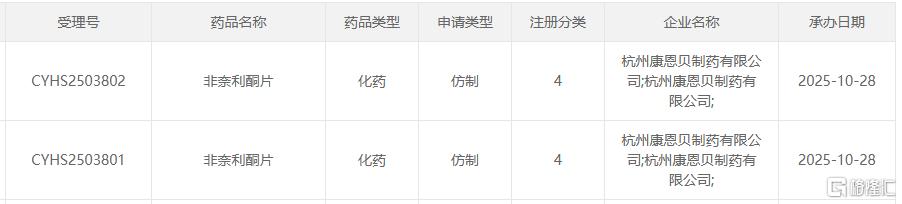
Core Insights - Hangzhou Kang En Bei Pharmaceutical's application for the generic version of Finerenone has been accepted, with 30 companies currently competing for the first generic approval [1][7][10] - Finerenone, originally developed by Bayer, is used for treating type 2 diabetes-related chronic kidney disease (CKD) and heart failure, showing strong market performance with sales exceeding 410 million yuan in the first half of 2025, a 135.98% year-on-year increase [4][10] - The original patent for Finerenone is set to expire in February 2028, with 23 companies currently filing for a type 3 patent declaration, indicating they cannot market the product until the patent expires [10][13] Company Developments - Kang En Bei Pharmaceutical has successfully obtained approvals for over 50 products, with several being the first to pass consistency evaluations, including Sulfamethoxazole and Amisulpride solutions [16] - The competition for Finerenone has intensified, with 37 companies having completed bioequivalence (BE) trials and over 20 more currently conducting BE trials [13][16] Market Dynamics - The strong sales performance of Finerenone has attracted numerous domestic pharmaceutical companies to enter the market, leading to a competitive landscape [4][7] - The ongoing patent challenges and the competitive nature of the generic drug market suggest a dynamic environment for both original and generic manufacturers [10][13]

红杉中国刚刚收购拜耳集团重要资产
FOFWEEKLY· 2025-10-29 10:04
Core Viewpoint - Bayer AG has agreed to sell its antibiotic drug Avelox to Sequoia China for an estimated transaction value between €160 million and €260 million, reflecting the growing investment value in off-patent branded drugs in China [1][2]. Group 1: Transaction Details - The sale includes Avelox's intellectual property, brand ownership, and global commercial rights [1]. - HSBC acted as the exclusive financial advisor for Bayer, while Shanghai Pudong Development Bank provided loan financing support to Sequoia China [1]. Group 2: Market Context - Avelox, a broad-spectrum antibiotic, was approved by the FDA in 1999 and peaked in sales in 2012, but has seen a decline since then [1]. - In 2021, Avelox's global sales were reported at $72 million, with Bayer's original brand holding a 40% market share in China despite competition from 22 local generic manufacturers [2]. Group 3: Industry Trends - The transaction highlights the investment opportunities in the market for off-patent branded drugs, as multinational pharmaceutical companies focus on innovative drug pipelines [2]. - The period from 2025 to 2029 is expected to see a new wave of patent expirations, with an estimated annual sales value of $180 billion for expiring drugs [3]. - Chinese capital is becoming a key player in the transaction of expired patent drug assets, as exemplified by Sequoia China's acquisition of Avelox [3].

REGN Stock Up on Q3 Earnings Beat, Eylea HD Sales Increase
ZACKS· 2025-10-28 20:05
Core Insights - Regeneron Pharmaceuticals reported Q3 2025 adjusted EPS of $11.83, exceeding the Zacks Consensus Estimate of $9.44, but down 5% from $12.46 in the previous year due to higher expenses [1][8] - Total revenues increased by 1% year over year to $3.7 billion, driven by higher sales of Eylea HD and increased profits from Dupixent, surpassing the Zacks Consensus Estimate of $3.6 billion [1][8] Revenue Breakdown - Eylea sales in the U.S. fell 41% year over year to $681 million, primarily due to increased competition and market share loss, missing the Zacks Consensus Estimate of $686 million [4] - Eylea HD generated $431 million in the U.S., up 10% year over year, exceeding the Zacks Consensus Estimate of $414 million [6] - Dupixent sales surged 27% year over year to $4.86 billion, contributing significantly to total revenues [10] - Total collaboration revenues reached $2 billion, an increase of 18.6% from the previous year, surpassing the Zacks Consensus Estimate of $1.8 billion [9] Cost and Margin Analysis - Gross margin on net product sales decreased to 86% from 89% due to ongoing investments in manufacturing operations [12] - Adjusted R&D expenses rose 18% year over year to $1.3 billion, reflecting advancements in the company's pipeline [12] - Adjusted SG&A expenses decreased by 12% to $541 million [12] Pipeline and Regulatory Updates - The FDA approved a label expansion for Libtayo as an adjuvant treatment for high-risk adult patients with cutaneous squamous cell carcinoma [16] - A positive opinion was adopted by the EMA for Dupixent for chronic spontaneous urticaria treatment in the EU, with a decision expected soon [14] - Regeneron plans to submit an application for a new pre-filled syringe manufacturing filler for Eylea HD by January 2026 [15] - A phase III study of cemdisiran met its primary and key secondary endpoints, with a regulatory submission planned for Q1 2026 [17] Market Performance - Regeneron's shares have increased following the better-than-expected quarterly results, although they have lost 17.8% year to date compared to the industry's growth of 10.3% [2]