中信保诚基金

Search documents
从爆款频频到濒临清盘 昔日热门基金规模大缩水
Zheng Quan Shi Bao· 2025-08-17 17:44
Core Viewpoint - The scale of interbank certificate of deposit (CD) funds has significantly declined, with a reduction of over 60% from their initial fundraising scale, leading to many funds nearing liquidation [1][3][5]. Fund Scale Decline - As of August 15, the total scale of 101 interbank CD funds is less than 130 billion, down from over 350 billion [1]. - 26 funds have scales below 50 million, accounting for over 25% of the total, indicating a risk of liquidation [1]. - A specific fund established in December 2022 saw its scale drop from approximately 3.7 billion to just 51 million by the second quarter of 2025 [1]. Performance and Market Environment - The decline in fund scale is attributed to a lack of performance advantages and changes in market conditions, with a shift towards bond markets and recovering equity assets [1][5]. - Over 88% of interbank CD funds have experienced a reduction in scale since their establishment, with 64 funds seeing declines exceeding 80% [3]. Fund Growth Exceptions - A few funds have managed to grow in scale, such as the Chuangjin Hexin interbank CD fund, which increased from 288 million to 7.37 billion [4]. - The Huatai Bairui interbank CD fund has also seen significant growth, expanding from over 5 billion to over 9 billion, making it the largest in the category [4]. Investment Performance - The average yield for interbank CD funds over the past year is 1.41%, with only 2 funds exceeding 2% [6]. - In comparison, money market funds and short-term pure bond funds have shown better performance, with average yields of 1.43% and 1.89% respectively [6]. Market Dynamics - The interbank CD funds were initially popular but have lost their appeal as the capital market dynamics shifted, particularly with the rise of bond markets and improved equity performance [5][6]. - The recent establishment of new interbank CD funds has been limited, with only 9 funds launched since 2025, indicating a cautious approach in a changing market environment [7].
基金经理晒实盘,“战绩”可查!
Sou Hu Cai Jing· 2025-08-17 07:23
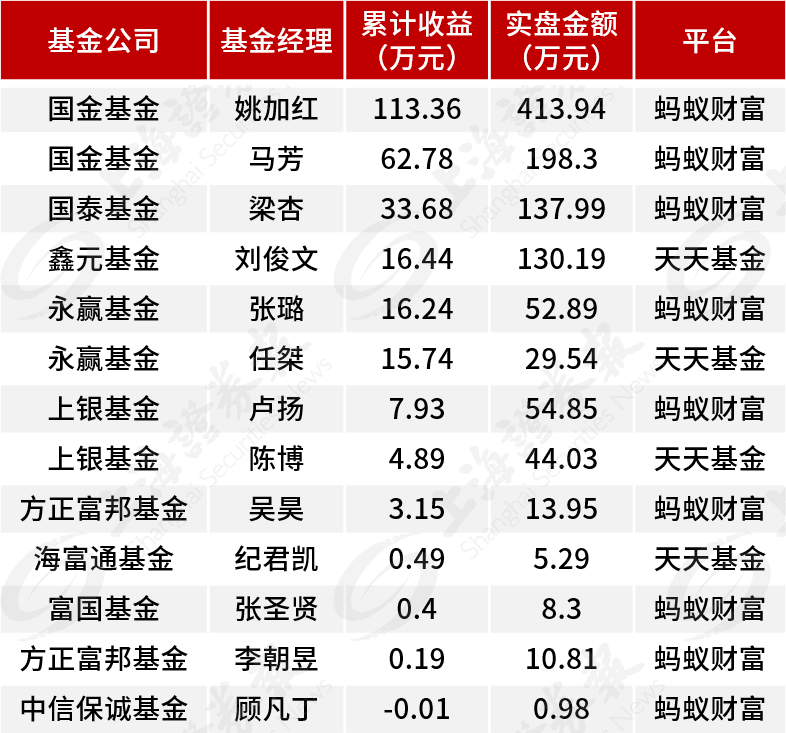
Core Viewpoint - The trend of "showing real accounts" among fund managers is becoming a new competition, reflecting increased industry transparency, upgraded investor professionalism, and a transformation in marketing models [1][6]. Group 1: Fund Manager Performance - Several fund managers have reported substantial real account gains, with notable examples including Yao Jiahong from Guojin Fund achieving a cumulative profit of 1.1336 million yuan on an investment of 4.139 million yuan, and Ma Fang from Guojin Fund with a profit of 627,765 yuan on an investment of 1.982 million yuan [3][4]. - Other fund managers like Zhang Lu and Ren Jie from Yongying Fund have also seen significant returns, with Ren Jie achieving a return rate close to 120% on an investment of 295,400 yuan [4][6]. Group 2: Industry Trends - The practice of "showing real accounts" is enhancing communication between fund managers and investors, allowing for more immediate and interactive exchanges regarding investment strategies and market conditions [6][7]. - Analysts believe that this trend helps break down information asymmetry, allowing investors to better understand fund managers' strategies and performance, thus fostering a more informed investment environment [6][7]. Group 3: Market Insights - Fund managers are addressing investor concerns about market conditions, particularly regarding the recent highs in indices, attributing these movements to ample liquidity and supportive government policies [6][7]. - The shift in market sentiment is seen as a response to the previous two years of pessimism, with expectations that the transition to new economic drivers will occur more rapidly than anticipated [7].

绩优基金年涨超75%,密集限购,高位资金涌入受控
Sou Hu Cai Jing· 2025-08-16 09:48
Group 1 - The equity market has been heating up recently, with strong performance across multiple indices, particularly in sectors like artificial intelligence, innovative pharmaceuticals, and military industry, leading to a rapid increase in fund net values [1] - Many high-performing funds have chosen to implement purchase limits despite the bullish market, attracting market attention [1] Group 2 - Since mid-August, several high-performing funds have announced purchase limit measures, including the China Europe Medical Innovation Fund, which has raised its daily subscription limit to 100,000 yuan, having achieved a year-to-date increase of over 75% [3] - The Zhaoshang Growth Quantitative Selection Fund has tightened its purchase limits twice in a short period, first to 200,000 yuan and then to 20,000 yuan, reflecting the intense demand for subscriptions [3] - The Yongying Ruixin Mixed Fund has also joined the limit purchase ranks, setting a daily subscription cap of 1 million yuan, with a year-to-date return exceeding 47% and its scale increasing from less than 1.4 billion yuan to over 5 billion yuan [3] Group 3 - Fund companies are implementing purchase limits primarily due to two considerations: strategy capacity constraints and the protection of existing holders' interests [4] - Small-cap style funds have performed well this year, with the CSI 2000 index rising approximately 30%, but these strategies often face capacity bottlenecks that can impact investment efficiency [4] - The limits on quantitative funds are largely due to the characteristics of the strategy, as small-cap stocks have relatively poor liquidity, and a large influx of funds can increase trading costs [4] Group 4 - Protecting the interests of existing holders is another significant consideration, as large inflows at high net asset values can force fund managers to build positions at unfavorable times, increasing trading costs and potentially diluting existing holders' returns [4] - Some funds' purchase limits are also related to specific investment areas, such as medical innovation and artificial intelligence, where high-quality targets are relatively scarce, and rapid scale growth may lead fund managers to invest in suboptimal targets, affecting overall returns [4]

市场火热,绩优基金却批量限购,所为何因?
Sou Hu Cai Jing· 2025-08-16 02:40
Core Viewpoint - The recent trend of high-performing funds implementing purchase limits reflects a shift from a scale-oriented approach to a focus on investor returns, aiming to optimize long-term investment performance while protecting existing investors' interests [1][4][6]. Group 1: Fund Purchase Limits - Multiple high-performing funds have announced purchase limits, including the招商成长量化选股, which reduced its maximum single purchase amount from 200,000 to 20,000 yuan within a month due to high demand, achieving a year-to-date return of 26.16% as of August 14 [2]. - 中欧数字经济混合 and 长信国防军工量化混合 also implemented limits, with year-to-date returns of 75.44% and 37% respectively, indicating a broader trend among funds to restrict large inflows [3]. - As of mid-August, 31 funds with over 50% year-to-date returns were fully closed to new investments, while 69 funds had suspended large purchases [3]. Group 2: Reasons for Purchase Limits - Industry experts suggest that the limits are primarily to protect existing investors from the adverse effects of new capital inflows, which could force fund managers to invest at high net asset values, potentially diluting returns [4][5]. - The shift in strategy is also influenced by the capacity constraints of small-cap funds, which can suffer from increased trading costs and reduced excess returns when inflows exceed optimal levels [4][5]. Group 3: Industry Transformation - The trend of limiting purchases signals a transformation in the fund industry from a focus on scale to prioritizing investor returns, as emphasized by recent regulatory guidance aimed at promoting long-term stable returns for investors [6]. - Fund companies are increasingly recognizing the importance of maintaining performance stability and strategy effectiveness, which can be compromised by rapid growth in fund size [5][6].
都赚钱了,有人收益超100万!多位基金经理晒实盘
Sou Hu Cai Jing· 2025-08-14 12:56
Core Viewpoint - The trend of fund managers publicly sharing their real investment portfolios, known as "晒实盘," is gaining traction in the industry, serving as a tool for attracting investors and enhancing engagement with them [1][13][18]. Group 1: Fund Managers' Performance - At least 20 fund managers have publicly shared their real investment portfolios on platforms like Ant Wealth and Tian Tian Fund, with total investment amounts ranging from 40,000 to 4 million yuan [1][5]. - Six fund managers have total investments exceeding 1 million yuan, including notable figures from Guojin Fund and Guotai Fund [7][8]. - The average return on these real investments has been positive, with some managers reporting returns exceeding 1 million yuan and rates as high as nearly 130% [1][8][11]. Group 2: Investor Reactions and Engagement - Investors generally welcome the transparency provided by fund managers sharing their real portfolios, as it fosters trust and encourages better investment habits [1][18]. - The practice has led to increased interaction between fund managers and investors, with many managers using their portfolios to share insights and strategies [1][17][18]. - Fund managers often employ regular investment strategies, such as weekly or monthly contributions, which can help guide investors toward disciplined investment practices [1][18]. Group 3: Industry Trends and Implications - The introduction of real investment portfolio features on platforms like Tian Tian Fund has attracted significant participation from fund managers [3][4]. - The trend has sparked widespread discussion in the market, with industry experts noting its potential to enhance investment transparency and investor confidence [13][18]. - Fund managers view this practice as a way to align their interests with those of investors, emphasizing a shared commitment to navigating market fluctuations together [17][20].

超20位基金经理网上晒实盘,业内担忧异化为营销工具
2 1 Shi Ji Jing Ji Bao Dao· 2025-08-14 11:48
Group 1 - The core viewpoint of the article is that the trend of fund managers publicly sharing their real investment portfolios is gaining popularity, serving as a tool to attract investors and build trust [1][2][19] - At least 20 fund managers have publicly shared their real portfolios on platforms like Ant Wealth and Tian Tian Fund, with total investment amounts ranging from 40,000 to 4 million yuan [1][7] - Fund managers' real portfolios have generally achieved positive returns, with some reporting cumulative profits exceeding 1 million yuan and return rates as high as nearly 130% [1][8][11] Group 2 - Fund managers' public sharing of real portfolios has been well-received by investors, as it boosts confidence during market downturns and encourages good investment habits through regular contributions [2][20] - The highest investment amount comes from two quantitative fund managers at Guojin Fund, with total amounts of 4.1772 million yuan and 2 million yuan, respectively, achieving significant returns [8][9] - The trend of sharing real portfolios is seen as a new industry phenomenon, enhancing interaction between fund managers and investors while providing insights into investment strategies [13][19] Group 3 - The article highlights the potential risks associated with fund managers sharing their real portfolios, including compliance issues and the possibility of investors following trends irrationally [1][19][20] - Fund managers express confidence in their investment strategies and aim to share their experiences with investors, reinforcing the idea of shared risk and commitment to performance [18][19] - The practice of sharing real portfolios is viewed as a step forward in enhancing transparency and trust in the investment process, although caution is advised regarding the interpretation of short-term performance [19][20]
孙子兵法基金池:未知收益组合超额收益回升
Minsheng Securities· 2025-08-14 05:53
Group 1 - The "Sun Tzu" fund pool has achieved a stable outperformance against the equity fund index, with an annualized return of 13.14% and an excess return of 6.79% as of July 31, 2025, while maintaining a low annualized volatility of 21.59% and a Sharpe ratio of 0.61, indicating a favorable risk-return profile [1][11] - The unknown return fund pool has consistently outperformed the equity fund index in most years, with an annualized return of 15.80% and a Sharpe ratio of 0.69, demonstrating strong performance in both rising and falling markets, achieving an excess return of 10.32% in the last three months [1][14] - The flexible trading fund pool has captured structural market opportunities, yielding an annualized return of 11.07% and an excess return of 4.43% compared to the equity fund index, with a history of low excess drawdown [2][18] Group 2 - The stock-picking pioneer fund pool has shown strong return elasticity, with an annualized return of 11.14% and an excess return of 4.49% against the equity fund index, particularly excelling in bull markets [2][23] - The hotspot tracking fund pool has outperformed the market in most years, achieving an annualized return of 12.18% and an excess return of 5.53% compared to the equity fund index, although its performance has weakened recently due to short-lived market trends [2][28] - The risk-averse fund pool has demonstrated stable excess returns, with an annualized return of 11.64% and an excess return of 5.00% against the equity fund index, effectively managing risks in both rising and falling markets [3][33] Group 3 - The low Beta fund pool has shown strong defensive characteristics, with an annualized return of 8.06% and an excess return of 2.08% compared to the equity fund index, particularly excelling during market downturns with excess returns of 10.12% and 2.45% in 2023 and 2024 respectively [3][38]
利好因素不断累积公募乐观看待A股后市行情
Zhong Guo Zheng Quan Bao· 2025-08-13 21:11
Market Performance - The A-share market showed strong performance on August 13, with the Shanghai Composite Index reaching a peak of 3688.63 points, surpassing the previous high of 3674.40 points from October 8, 2024 [1] - Market turnover significantly increased, exceeding 2 trillion yuan, with a total trading volume approaching 2.2 trillion yuan, marking a five-month high [1] Influencing Factors - Three main factors contributed to the strong performance of the A-share market: external risks have subsided, expectations for a Federal Reserve rate cut in September have increased due to a cooling U.S. job market, and multiple growth-stabilizing policies have been introduced, shifting fiscal spending from enterprises to households [1] - The technology sector has seen continuous breakthroughs this year, leading to a noticeable recovery in risk appetite, with funds being allocated from low-risk assets to high-risk equity assets [1] Sector Insights - The computing power sector is experiencing a clear upward trend, with optimistic order volumes for the year and a high level of market activity expected to continue [2] - The humanoid robot sector is showing signs of revival, with significant commercial application advantages in China, indicating a broad future development space [2] Market Sentiment - Multiple fund managers believe that market risk appetite is likely to remain at a high level, with short-term impacts from corporate earnings reports potentially enhancing market dynamics [3] - Attention is being directed towards the recovery and improvement of the market by Q3 2025 and the focus on breakthrough technologies and high global market share manufacturing as potential main themes for the second half of the year [3]
利好因素不断累积 公募乐观看待A股后市行情
Zhong Guo Zheng Quan Bao· 2025-08-13 21:04
Market Performance - The A-share market showed strong performance on August 13, with the Shanghai Composite Index reaching a peak of 3688.63 points, surpassing the previous high of 3674.40 points from October 8, 2024 [1] - Market turnover significantly increased, exceeding 2 trillion yuan [1] Influencing Factors - The strong performance of the A-share market is attributed to three main factors: external risks subsiding, improved external liquidity due to expectations of a Federal Reserve rate cut in September, and the introduction of multiple growth-stabilizing policies shifting focus from production to consumption [2] - Fiscal spending is gradually transitioning from corporate support to benefiting residents [2] - There has been a notable shift in risk preference among residents, moving funds from low-risk assets to high-risk equity assets [2] Sector Insights - The computing power sector is showing a clear upward trend, with optimistic order volumes expected for the year, indicating sustained high demand [3] - The AI core asset of optical modules remains a focus for investors, with the computing power chain being a key area of interest in the current and future market [3] - The humanoid robot sector is also experiencing a resurgence, with significant commercial application potential in China [3] Future Market Outlook - The market's upward trend is expected to continue in the medium term, despite potential short-term volatility as the Shanghai Composite Index may need to consolidate after breaking through previous highs [2][3] - Key areas of focus for the second half of the year include breakthrough technologies domestically and high global market share manufacturing sectors [4]
平台化投研体系下的量化实践:如何实现长期超额收益的“可复制性”?
Xin Lang Ji Jin· 2025-08-12 08:43
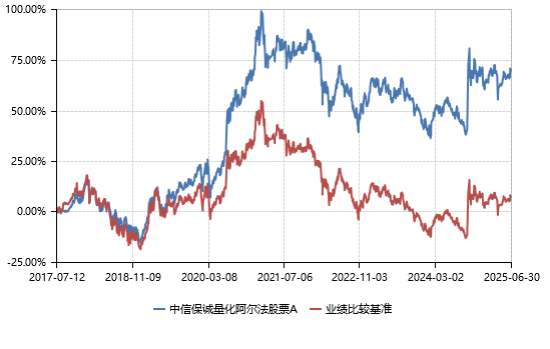
Group 1 - The core consensus in the current market is the search for certainty, with a focus on stable dividends and continuous returns, highlighting the scarcity of quantitative products that can provide long-term excess returns and stability [1][2] - The CITIC Prudential Quantitative Team has developed a series of solid products centered around fundamental factors, achieving significant excess returns over the CSI 300 Index for 7.5 years with the CITIC Prudential Quantitative Alpha [1][3] - The CITIC Prudential CSI 500 Index Enhanced has outperformed the CSI 500 Index by nearly 12% in the past year, showcasing the team's ability to deliver consistent performance [1][11] Group 2 - The CITIC Prudential Quantitative Alpha Stock A has a performance benchmark of 95% of the CSI 300 Index return plus 5% of the after-tax bank demand deposit rate, demonstrating stable excess output across various market conditions since its inception [3][4] - The performance data for CITIC Prudential Quantitative Alpha Stock A shows a net value growth rate of 15.58% in 2024 and a significant outperformance against its benchmark and the CSI 300 Index [4][6] - The CITIC Prudential CSI 300 Index Enhanced A has achieved a net value growth rate of 18.98% since its inception, consistently outperforming its benchmark and the CSI 300 Index [7][8] Group 3 - The CITIC Prudential CSI 500 Index Enhanced A has shown a strong performance since its establishment, with a return of 31.65% over the past year, significantly exceeding its benchmark [11][12] - The CITIC Prudential CSI 500 Index (LOF) has maintained excellent performance for 12 consecutive years, reflecting its status as a key player in the market [14][15] - The CITIC Prudential Quantitative Team integrates AI and behavioral finance into its models, enhancing its competitive edge in a complex market environment [2][18]