中信证券

Search documents
除夕不看春晚开电话会!春节期间电话会近300场
Feng Huang Wang· 2026-02-15 14:04
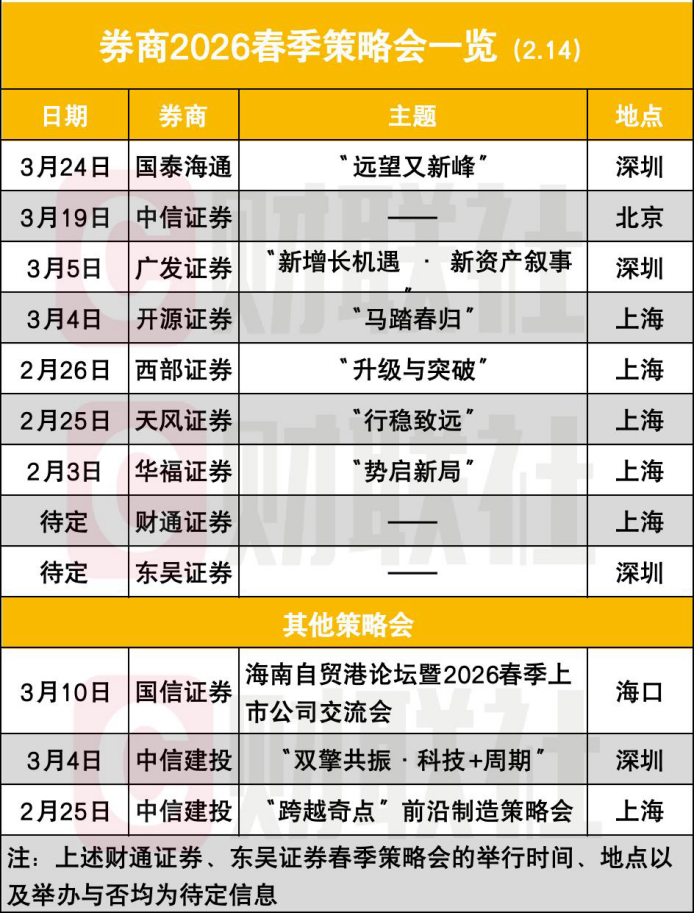
Core Insights - The sell-side research sector is intensifying efforts to boost performance during the Chinese New Year, with a significant number of conference calls scheduled, including 292 calls from February 16 to 23, averaging over 32 calls per day [1][2] - The spring strategy meetings are also being held earlier and more densely than in previous years, with seven brokerages confirmed to host events, indicating a competitive landscape for research market share [2][11] Conference Calls and Meetings - A total of 176 sell-side roadshow meetings are planned, with 108 occurring during the Chinese New Year holiday from February 15 to 23, involving over 13 brokerages [3][4] - Notable brokerages participating include Pacific Securities, Guotai Junan, and CITIC Securities, with a focus on various industries such as food and beverage, real estate, and technology [3][7] Spring Strategy Meetings - The spring strategy meetings are characterized by early initiation and dense scheduling, with the first meeting held by Huafu Securities on February 3, 2026 [11][12] - The themes of these meetings reflect a positive outlook for the capital market, with keywords like "new," "breakthrough," and "upgrade" being prevalent [12][13] - Brokerages are also expanding their geographical reach, with events planned in locations beyond traditional financial hubs, indicating a shift in focus towards emerging economic regions [12] Competitive Landscape - The competition among brokerages for research market share is intensifying, driven by pressures on research income due to ongoing reforms in public fund fees [10][11] - Medium-sized brokerages are particularly focused on enhancing their research capabilities to capture market share, while larger firms maintain strategic investments in research to support both external and internal functions [10]





中信证券:把握核心变革方向,重塑行业投资价值
Sou Hu Cai Jing· 2026-02-15 09:09
Core Viewpoint - The securities industry is expected to achieve record profits in 2025, but stock performance lags behind previous bull market cycles. The industry is transitioning through various phases, moving towards a new stage driven by leverage and expected improvements in return on equity (ROE) [1][4]. Historical Review - The securities sector has undergone three phases from 2003 to 2025: 1. **Brokerage-Driven Period (2003-2011)**: Characterized by high ROE and strong performance driven by trading volume and high commission rates [2]. 2. **Innovation and Expansion Period (2012-2017)**: Marked by the rise of capital-intensive businesses and internet operations, leading to stock price growth driven by fundamentals and policy expectations [2]. 3. **Policy-Driven Period (2018-2025)**: Defined by increased asset-heavy characteristics and declining ROE elasticity, with regulatory changes becoming a key factor influencing the industry [2]. Conclusion of Review - Key factors pressuring industry valuation include: 1. The shift towards asset-heavy operations and pressure on fee rates has led to a decline in ROE elasticity, making the sector's performance less favorable compared to others during bull markets [3]. 2. Increased policy influence and regulatory cycles have created challenges in establishing stable growth expectations for the industry [3]. 3. The surge in listed companies has diminished the scarcity of investment targets, resulting in lower capital efficiency for smaller firms and further reducing average capital returns in the industry [3]. Future Outlook - The "14th Five-Year Plan" period is expected to bring four significant changes that will reshape investment value in the industry: 1. ROE is anticipated to improve from a declining trend to a gradual increase, with leverage playing a central role in this transformation. The expected ROE central tendency may rise from 7%-8% to over 10% during this period [4]. 2. The focus will shift from expansion to optimizing existing resources, enhancing client value through deeper service offerings. There is significant potential for growth in advisory services as the allocation of stock and fund assets among residents has room for improvement [4]. 3. The industry structure is expected to evolve from a diverse landscape to one that favors stronger firms, with mergers and acquisitions enhancing capital efficiency. The goal is to establish 10 comprehensive institutions over the next five years and 2-3 top-tier international investment banks by 2035 [5]. 4. The operational landscape is shifting towards stability, with a focus on client needs to reduce profit volatility. Regulatory measures are expected to promote a more balanced investment environment, leading to a gradual construction of long-term investment value [5]. Investment Strategy - The investment value of the sector is likely to be reshaped during the "14th Five-Year Plan" period, with two main investment themes: 1. Focus on "carrier-level" brokerages that can enhance market share, net profit margins, and leverage [8]. 2. Mid-sized securities firms that are expected to enter the top tier through mergers and acquisitions and refined operations [8].
中信证券:杠杆率提升有望驱动证券行业估值重塑 看好头部券商表现
智通财经网· 2026-02-15 06:57
Core Viewpoint - The report from CITIC Securities indicates that the securities industry is expected to achieve record profits by 2025, but stock price performance is significantly lagging compared to previous bull market cycles [1][7]. Historical Review - The securities sector has undergone three phases from 2003 to 2025: 1. The "Brokerage-Driven Period" (2003-2011) characterized by high ROE and strong fundamentals driven by transaction volume and high commission rates [2][8]. 2. The "Innovation and Expansion Period" (2012-2017) where the "Innovation Conference" initiated a capital-intensive business development cycle, with internet operations breaking physical constraints on customer acquisition [2][8]. 3. The "Policy-Driven Period" (2018-2025) where the characteristics of heavy asset investment have led to a decline in ROE elasticity, with regulatory changes becoming a core factor influencing the industry's alpha attributes [2][8]. Conclusion of Review - Key reasons for valuation pressure in the industry include: 1. The shift to heavy asset investment and pressure on light capital business fees have reduced ROE elasticity, making the industry's ROE less superior during bull markets [3][9]. 2. Increasing policy impacts and clear cycles have made it difficult to establish stable growth expectations for business development [3][9]. 3. The surge in the number of listed entities has diminished the scarcity of investment targets, leading to lower average capital returns in the industry [3][9]. Future Outlook - The "14th Five-Year Plan" period is expected to bring "four changes" that will reshape investment value in the industry: 1. ROE is projected to shift from a "continuous decline" to a "gradual increase," with leverage enhancement being a core logic for valuation restructuring [4][10]. 2. The domestic market is expected to optimize risk control indicators and macro-regulatory guidance, allowing for leverage increases that could improve ROE [4][10]. 3. The focus will shift from "expansion" to "extraction of existing value," enhancing single-client value through deeper services [4][10]. 4. The industry is anticipated to transition from a "diverse landscape" to "supporting the strong and limiting the weak," with mergers and acquisitions optimizing capital utilization efficiency [5][11]. Industry Dynamics - The report suggests that the industry will see a consolidation of capital towards leading institutions, with a goal of establishing 10 comprehensive institutions over the next five years and 2-3 international first-class investment banks by 2035 [5][11]. - The operational focus is expected to move from "significant volatility" to "steady development," with customer demand services reducing profit volatility [5][11].
中信证券:核电制造业迎来估值重估 短期业绩高增远期空间广阔
智通财经网· 2026-02-15 06:29
Core Viewpoint - The demand for AI is driving a global revival in the nuclear power industry, leading to a potential revaluation of high-margin, high-growth nuclear manufacturing sectors [1] Group 1: Industry Growth and Valuation - The nuclear power sector in China has entered a normalization phase for approvals and construction, with component deliveries expected to peak in 2026, resulting in accelerated profit release for the industry [2] - The core equipment of nuclear islands has a gross margin exceeding 30%, but the long-term valuation of nuclear component companies has been limited due to market skepticism regarding the industry's long-term growth potential [1][2] Group 2: Multi-Dimensional Demand Growth - Advanced reactor technologies, including high-temperature gas-cooled reactors and thorium molten salt reactors, are being developed, with significant investments projected in small modular reactors (SMRs) expected to reach $670 billion globally by 2050 [3] - The nuclear technology application market is anticipated to exceed 600 billion yuan by 2030, with additional contributions from nuclear exports and spent fuel reprocessing [3] Group 3: Fusion Technology and Valuation Shift - Nuclear fusion, regarded as the "ultimate energy source," is becoming a definitive development direction, with over 300 billion yuan in capital expenditure expected during the 14th Five-Year Plan, which will accelerate industry growth [4] - As domestic and international technologies advance, a shift from experimental to commercial nuclear fusion is anticipated, potentially leading to a significant increase in the overall valuation of the nuclear power sector [4]
资金大撤离!美国关税,突生变数!140万亿资产承压,下一个风口在哪?
券商中国· 2026-02-15 05:56
Core Viewpoint - The narrative shift in the market is driven by Trump's "affordability" politics, which is reallocating funds from "Wall Street elites" to "ordinary people," leading to a rise in small-cap value stocks while tech giants face pressure [1][3]. Group 1: Economic Policies and Market Impact - Trump's administration plans to reduce certain tariffs, which have exacerbated the "affordability crisis" for American consumers and complicated cost calculations for businesses [2][3]. - The affordability crisis is causing a change in market narrative, with small-cap value stocks gaining traction and the narrative around artificial intelligence shifting from "awe" to "poverty," resulting in increased related debt [3]. Group 2: International Market Dynamics - According to a report by EPFR Global, international developed markets, including Europe and Japan, have attracted $104 billion this year, significantly surpassing the $25 billion inflow into U.S. funds, indicating a shift in investor focus [3]. - The U.S. trade policy is creating a "new world order," prompting investors to exchange U.S. assets for international ones, suggesting a transition from U.S. exceptionalism to global rebalancing [3]. Group 3: Stock Market Trends - Despite tax cuts, the S&P 500 index has lagged behind international peers, with the dollar index dropping over 10% since the end of 2024 [4]. - The current market environment is characterized by significant volatility due to the "AI disruption" affecting various sectors, including software services and logistics [4]. - The upcoming leaders in the market are expected to be emerging markets and small-cap stocks as U.S. exceptionalism gives way to global rebalancing [4]. Group 4: Investment Opportunities - After a period of intense selling, the valuation of internet companies is becoming increasingly attractive, suggesting potential investment opportunities as the market returns to a more rational pricing logic [5].


再融资新规红利释放,投行谁将受益?
券商中国· 2026-02-15 05:56
Core Viewpoint - The introduction of new refinancing regulations by the Shanghai, Shenzhen, and Beijing stock exchanges is expected to improve the investment banking business, creating opportunities for both large and small brokerages [1][2]. Group 1: Policy Changes and Market Reactions - The new refinancing regulations aim to enhance the efficiency of refinancing approvals, responding to market demands and facilitating the rapid development of new economies [2]. - The first week following the policy announcement saw at least 10 listed companies in the three exchanges release new refinancing plans, indicating a positive market response [2][3]. - The refinancing market had already shown significant growth prior to the new regulations, with A-share refinancing in January reaching 130 billion, a year-on-year increase of 56% and a month-on-month increase of 234% [3]. Group 2: Impact on Investment Banking Landscape - The new regulations are expected to benefit leading brokerages with strong pricing and underwriting capabilities, while smaller firms may need to find differentiated development paths [4][5]. - The top five brokerages accounted for 54% of the underwriting cases in 2025, indicating a concentration of market power among leading firms [5]. - Smaller brokerages are focusing on the Beijing Stock Exchange's refinancing market, which presents opportunities for growth due to the concentration of small and medium enterprises [6][5]. Group 3: Challenges and Requirements for Brokerages - The new refinancing rules emphasize "supporting the strong and limiting the weak," raising the capability requirements for investment banks [7]. - There is a limited number of brokerages experienced in pricing for unprofitable companies, highlighting a gap in expertise that needs to be addressed [8]. - The ability to integrate industry knowledge and resources is becoming increasingly important for brokerages, especially in the context of financing technology innovation [8].



深度布局大湾区!中信证券陈钢:持续优化跨境金融服务
Xin Lang Cai Jing· 2026-02-15 02:45
Core Insights - The article discusses the strategic positioning of CITIC Securities in the Guangdong-Hong Kong-Macao Greater Bay Area, emphasizing its commitment to enhancing wealth management services and cross-border financial solutions in line with national policies [2][24][28]. Group 1: Company Strategy and Developments - CITIC Securities has been actively deepening its business layout in the Greater Bay Area since the initiation of the regional development framework in 2017, focusing on financial interconnectivity and high-quality development [24][25]. - The company has established a dedicated subsidiary, CITIC Securities South China, to enhance its wealth management services in the region, following the acquisition of Guangzhou Securities [24][25]. - The firm aims to create a comprehensive financial platform that connects local services with global resources, leveraging its full-license advantages in various financial sectors [25][26]. Group 2: Cross-Border Financial Services - CITIC Securities is enhancing its cross-border service capabilities, using Hong Kong as a hub to facilitate international investments and asset management for Greater Bay Area enterprises [25][26]. - The company has been approved for the "Cross-Border Wealth Management Connect" pilot program, allowing it to offer compliant and diversified cross-border asset allocation options to residents [26][34]. - The firm has reported significant market engagement, with its cross-border wealth management services capturing nearly 10% of new market clients and over 20% of total fund transfers in the industry [36][37]. Group 3: Market Opportunities and Challenges - The Greater Bay Area's wealth management market presents both opportunities and challenges, with a notable increase in demand for cross-border wealth management solutions as residents seek diversified asset allocation [27][30]. - The Hong Kong stock market is expected to see a significant increase in IPO fundraising, projected to exceed HKD 180 billion in 2025, enhancing investment opportunities for the region [27]. - Regulatory differences between mainland China and Hong Kong pose challenges for compliance and risk management, necessitating increased investor education and support [27][30]. Group 4: Investor Education Initiatives - CITIC Securities has implemented a comprehensive investor education program tailored to the unique needs of Greater Bay Area investors, utilizing both online and offline channels to enhance understanding of cross-border investment opportunities [32][33]. - The firm has organized numerous educational events in collaboration with the Hong Kong Stock Exchange, focusing on key topics such as the "Cross-Border Wealth Management Connect" and "Hong Kong Stock Connect" [32][33]. - These initiatives have successfully improved investor awareness of market rules and risks, fostering a more informed investment community in the region [33]. Group 5: Product Development and Innovation - The company is continuously optimizing its cross-border product offerings, integrating international investment strategies and asset allocation concepts to enhance its service capabilities [34][35]. - CITIC Securities has developed a diverse range of public and private fund products, covering various asset classes and investment strategies to meet the evolving needs of clients [35][36]. - The firm aims to provide a robust and comprehensive cross-border wealth management ecosystem, ensuring high-quality financial services that align with the Greater Bay Area's development goals [37][38].
深度布局大湾区!中信证券陈钢:持续优化跨境金融服务
券商中国· 2026-02-15 02:43
Core Viewpoint - The article discusses the evolving landscape of wealth management in the Guangdong-Hong Kong-Macau Greater Bay Area, emphasizing the transition from scale expansion to quality enhancement in the industry as it approaches the end of the 14th Five-Year Plan and prepares for the 15th [1] Group 1: Company Strategy and Positioning - CITIC Securities has been actively deepening its business layout in the Greater Bay Area since the launch of the regional development framework in 2017, aligning with national strategic directives [3][4] - The company aims to create a comprehensive financial platform that connects local services with global resources, focusing on financial interconnectivity and high-quality development [4] - CITIC Securities has established a dedicated subsidiary in South China to enhance its wealth management services, focusing on compliance and professional financial services for both individual and institutional clients [4][5] Group 2: Cross-Border Services and Innovations - The company is enhancing its global integration by using Hong Kong as a hub for cross-border services, providing integrated solutions for businesses looking to expand internationally [5] - CITIC Securities has been approved for the "Cross-Border Wealth Management Connect" pilot program, allowing it to offer compliant and diverse cross-border asset allocation options to residents in the Greater Bay Area [6][13] - The firm has developed a comprehensive cross-border product system, collaborating with top asset management institutions to provide a wide range of investment options [13][14] Group 3: Market Opportunities and Challenges - The wealth management market in the Greater Bay Area presents both opportunities and challenges, with significant growth in cross-border wealth management demand driven by increasing wealth accumulation and global asset allocation awareness [7][10] - The Hong Kong stock market is expected to see continued value and financing function releases, with a projected IPO fundraising scale exceeding HKD 180 billion in 2025 [7] - Regulatory differences between mainland China and Hong Kong pose challenges for compliance and risk management, necessitating enhanced investor education and risk disclosure [7][10] Group 4: Investor Education and Engagement - CITIC Securities has implemented a series of investor education activities tailored to the needs of cross-border investors, utilizing both online and offline methods to enhance understanding of investment mechanisms [11][12] - The company aims to break down information barriers in cross-border investment, improving investor awareness of market rules and risks, thereby fostering a healthier investment ecosystem [12] - Future initiatives will focus on specialized education in areas such as technology innovation and green finance, contributing to the development of a robust financial hub in the Greater Bay Area [12][19] Group 5: Wealth Management Transformation - CITIC Securities is committed to enhancing its wealth management capabilities by adopting a buyer advisory model, which has already seen significant growth in assets under management [16][17] - The company emphasizes a client-centered approach, ensuring that investor interests are prioritized and integrated into its operational strategies [16][18] - Future plans include refining the product and service offerings to meet the diverse needs of clients, promoting long-term investment strategies and sustainable wealth growth [18][19]
海柔创新,递交IPO招股书,拟赴香港上市,高盛、中信证券联席保荐
Sou Hu Cai Jing· 2026-02-14 12:12
Core Viewpoint - Hai Robotics Innovation Group Co., Ltd. is preparing for an IPO on the Hong Kong Stock Exchange, focusing on warehouse automation solutions, particularly Automated Case Retrieval (ACR) systems, with a significant market share projected for 2024 [2][3]. Company Overview - Established in 2017, Hai Robotics specializes in warehouse automation, particularly in the labor-intensive picking process, offering integrated ACR solutions to enhance storage density and operational efficiency [2]. - The company is projected to be the largest ACR solution provider globally by revenue and shipment volume, holding over 30% market share in 2024 [2]. Product Offerings - Hai Robotics provides advanced ACR solutions that cater to various distribution and manufacturing sectors, emphasizing flexibility, efficiency, reliability, and cost-effectiveness [3]. - The company launched HaiPick Climb in 2025, the first single-sided climbing ACR solution for large-scale commercial use, supporting storage heights of up to 15 meters [3]. - Their solutions also include the HaiPick Systems series, designed for high-density storage, order staging, and full-case handling [3]. Revenue Model - The majority of Hai Robotics' revenue comes from initial project delivery and deployment fees, supplemented by recurring income from support services, including maintenance and technical support [3]. - As clients recognize the benefits of ACR solutions, they are likely to invest further in additional robots or new projects across their warehouse networks [3]. Financial Performance - For the fiscal years ending December 31, 2023, and 2024, and the nine months ending September 30, 2024, Hai Robotics reported revenues of RMB 807 million, RMB 1.36 billion, and RMB 931 million, respectively [10][11]. - The company experienced net losses of RMB 1.01 billion, RMB 1.26 billion, and RMB 588 million for the same periods, with adjusted net losses of RMB 690 million, RMB 557 million, and RMB 321 million [10][11]. Shareholder Structure - Prior to the IPO, Hai Robotics has a dual-class share structure, with Class A shares granting 20 votes per share, primarily held by Chairman Chen Yuqi, who controls 63.23% of the voting power [5][6]. - The combined shareholding of Chen Yuqi and his associates amounts to 22.62%, representing 69.10% of the voting rights [6][7]. Board of Directors - The board consists of nine members, including four executive directors, two non-executive directors, and three independent non-executive directors, ensuring a diverse governance structure [9]. IPO Advisory Team - The IPO is being managed by a team including Goldman Sachs and CITIC Securities as joint sponsors, with Ernst & Young as the auditor and various legal advisors for different jurisdictions [12].

又一券商获批!这个新赛道,中小券商积极布局
券商中国· 2026-02-14 10:48
Core Viewpoint - The approval of Western Securities to conduct market-making business for stocks listed on the Beijing Stock Exchange (BSE) indicates an expansion of the market-making capabilities among brokerages, with a notable divide in participation enthusiasm between small and large brokerages [2][4][7]. Group 1: Approval Process - On February 13, Western Securities announced that the China Securities Regulatory Commission (CSRC) had approved its qualification for market-making in listed securities, specifically for BSE stocks [2][4]. - The application process for this qualification was lengthy, starting with a submission to the CSRC in January 2023, and receiving formal approval only in February 2026 [4]. - Following the approval, Western Securities must undertake several steps, including amending its company charter and completing business registration within specified timeframes [4][5]. Group 2: Market Participation - The number of brokerages qualified for market-making on the BSE has increased, with 21 firms currently engaged in this business [8]. - Among the top ten market makers, six are small brokerages, indicating a more active participation compared to larger firms, which show lower engagement levels [2][8]. - The top three brokerages by the number of market-making stocks are Guojin Securities (62 stocks), CITIC Securities (59 stocks), and Guotou Securities (53 stocks), while some large brokerages like CICC and Huatai Securities have only a handful of stocks [9]. Group 3: Industry Insights - The disparity in engagement levels among brokerages is attributed to the BSE providing opportunities for smaller firms to develop niche businesses, while larger firms view the qualification more as a strategic reserve rather than a primary profit source [9]. - Challenges in the market-making business include insufficient liquidity on the BSE, which complicates profitability for market makers, as well as significant market volatility and a lack of hedging tools [9]. - A recent survey indicated that 34% of brokerages do not plan to participate in the BSE market, while 28% are still considering their options, and only 35% have begun to engage in a limited capacity [9].