
工商银行

Search documents
国有大行主导手机银行市场,生态嵌入构筑护城河
Jing Ji Guan Cha Wang· 2026-02-18 05:47
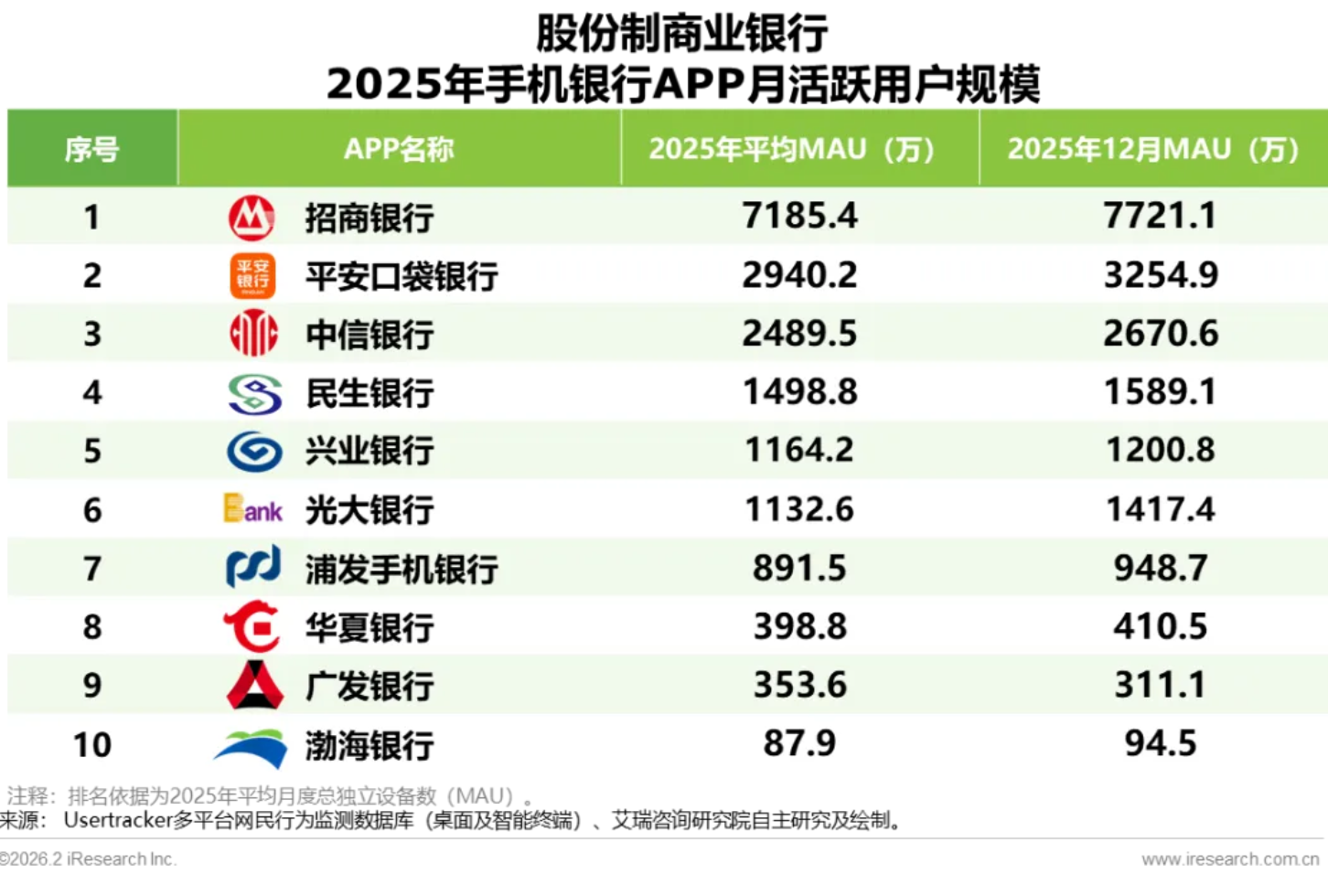
Core Insights - The Chinese mobile banking market is entering a stage of stock competition in 2025, with monthly active users (MAU) stabilizing between 648 million and 739 million [2] - State-owned commercial banks dominate the market due to their ecological embedding advantages, with Agricultural Bank of China leading at 249 million MAU, followed by Industrial and Commercial Bank of China (194 million) and China Construction Bank (109 million) [2] - Private banks are expected to collectively exit the top 50 MAU rankings in 2025 due to a lack of offline branch support and local living ecosystems [2] Group 1: Major Players - Agricultural Bank of China has the highest MAU at 249 million, followed by Industrial and Commercial Bank of China with 194 million and China Construction Bank with 109 million, forming the first tier of banks [2] - China Bank and Postal Savings Bank have MAUs exceeding 50 million, constituting the second tier [2] - China Merchants Bank leads the joint-stock banks with 71.85 million MAU, while Ping An Bank and CITIC Bank form the second tier, with other joint-stock banks generally below 20 million MAU [2] Group 2: Market Dynamics - The core advantage of state-owned banks lies in their "full-scenario integration" capabilities, embedding services deeply into high-frequency life scenarios such as government affairs, social security, healthcare, and education [2] - Agricultural Bank of China extends its services to rural areas through intelligent service matching and customer customization, while Industrial and Commercial Bank of China utilizes its "Gong Xiao Zhi" model for interactive service [2] - Regional banks like Jiangsu Bank, Beijing Bank, and Ningbo Bank show stable performance by focusing on local markets, with some rural commercial banks like Fujian Rural Credit exceeding 4.5 million MAU, indicating the sustainability of localized operations in the stock market [2]





手机银行TOP50再无民营 生态壁垒高筑草根绝迹
Jing Ji Guan Cha Wang· 2026-02-18 05:47
Core Insights - The monthly active users (MAU) of mobile banking apps in China have stabilized between 648 million and 739 million, indicating that user growth has reached a ceiling, marking the end of a decade-long traffic dividend period [2] - User behavior has shifted significantly, with average session duration decreasing from 4.9 minutes in 2023 to approximately 2.7 minutes by mid-2025, reflecting a preference for high-frequency, short-duration, and function-oriented usage [2] - Major state-owned banks have solidified their market dominance, with all six major state-owned banks ranking in the top ten for MAU, led by Agricultural Bank of China with 249 million MAU [2] Industry Dynamics - The core competitive advantage of state-owned banks lies in their "full-scenario integration" capabilities, providing financial services deeply embedded in public services such as government, social security, healthcare, and education [3] - Joint-stock banks are adopting specialized development strategies, with China Merchants Bank leading its peers with 71.85 million MAU, while Ping An Bank and Citic Bank are leveraging AI technology to enhance service processes and maintain user engagement [3] - Local banks are experiencing polarization, with some city commercial banks maintaining MAU above 3 million due to their deep understanding of local markets, while private banks like WeBank and MYbank have fallen out of the top 50 due to challenges in customer acquisition and retention [3] Future Trends - As the industry standard for single-session usage time becomes 3 minutes, banks must rethink their value creation strategies [4] - AI-driven service process optimization, real-time risk control systems, and multi-device collaboration within ecosystems are reshaping the competitive landscape [4] - Key factors for institutional success in the future will include precise user insights, prudent risk management, and robust ecosystem integration capabilities [4]



流量红利枯竭 存量博弈下银行APP被迫断臂求生
Jing Ji Guan Cha Wang· 2026-02-18 05:44
Core Insights - The Chinese mobile banking market is transitioning from "scale expansion" to "value cultivation," indicating a saturation of user growth and the end of the traffic dividend period [2] - Different types of banks are exhibiting varied development trends in this new landscape [2] State-Owned Commercial Banks - The six major state-owned banks dominate the mobile banking market, with Agricultural Bank of China leading with over 250 million monthly active users (MAUs) [2] - The top three banks, including Industrial and Commercial Bank of China and China Construction Bank, have MAUs of nearly 200 million and over 100 million, respectively [2] - All six major banks reported positive month-on-month growth in MAUs, with ICBC leading at a 6.1% growth rate [2] Joint-Stock Commercial Banks - Joint-stock banks are seeking to carve out a niche in the saturated market, with China Merchants Bank leading among them with over 70 million MAUs [3] - Some banks like Everbright Bank and CITIC Bank showed significant month-on-month growth rates of 11.0% and 9.2%, respectively [3] - The performance of joint-stock banks is mixed, with some experiencing negative growth [3] Urban Commercial Banks - Urban commercial banks are growing rapidly, with 17 banks making it to the top 50 list, led by Ningbo Bank with 3.644 million MAUs and a growth rate of 43.9% [3] - The growth is attributed to localized strategies that enhance customer engagement [3] Rural Commercial Banks and Credit Cooperatives - Rural commercial banks and credit cooperatives also performed well, with 17 banks in the top 50, led by Fujian Rural Credit with 781.6 thousand average MAUs [4] - 12 out of these 17 banks reported positive month-on-month growth [4] Private Banks - Private banks are facing significant challenges, with only WeBank making it to the top 50 list in the first half of 2025, experiencing a 27.3% decline in MAUs [4] - The competitive landscape has shifted, making it difficult for online-only private banks to maintain their initial advantages [4] Conclusion - State-owned banks leverage "ecosystem" advantages to solidify their market position, while joint-stock banks focus on "professional" opportunities [5] - Urban commercial banks establish a strong local presence, whereas private banks struggle to survive in the competitive environment [5] - The future of banking will require a focus on creating irreplaceable value for users through technology and insights into user behavior [5]

工行成都分行:新春支付“惠”商圈 消费潮涌惠万民
Xin Lang Cai Jing· 2026-02-18 04:58
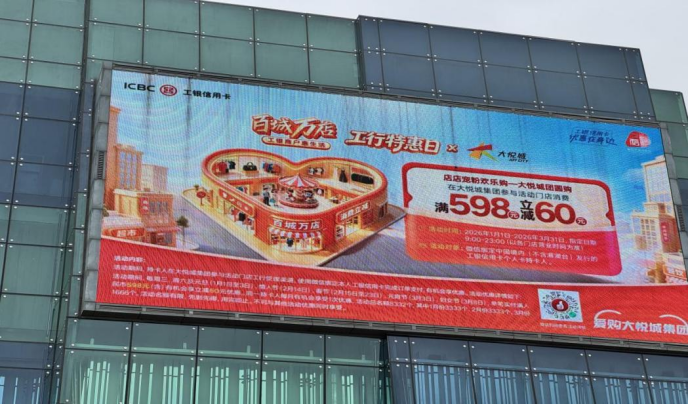
在优惠机制上,该行创新打造"梯度满减"福利矩阵,精准匹配不同消费层级。从日常一杯咖啡的小额优 惠,到大宗购车、家装置业的消费立减,每一笔支付都能为市民带来"真金白银"的实惠,真正实现"买 杯咖啡能省钱、购车置家更划算"。 金融服务要有"温度",也得有"厚度"。在成都环球中心等核心商圈,智联屏互动区成为亲子家庭的热门 打卡地。孩子们在趣味游戏中学习金融安全知识,家长则在陪伴中了解工行卡最新消费优惠。活动还将 川剧、变脸等四川非遗元素融入3D影音内容,让市民在感受传统文化魅力的同时,轻松掌握实用金融 常识。工行成都分行相关负责人说,将金融教育嵌入消费场景,是为了让市民在碎片化时间里"顺便 学、随时用",实现安全消费与愉悦体验并行。 截至目前,工行成都分行新春促消费活动已实现蓉城各大商圈、社区及特色街区服务网络全覆盖。上述 负责人表示,下一步将持续深化"政府指导+银行让利+商户联动"协同机制,以更加场景化、沉浸式的 金融服务助推惠民政策落地见效、消费活力提升。 编辑:幸骊莎 "从日常小额消费到品质购物、高端消费均有相应满减优惠""消费者在全市范围内均可平等便捷地享受 优惠。"2026年春节期间,工商银行成都分行启动 ...
2.7分钟定生死 手机银行存量厮杀谁在“断臂”,谁在“吃肉”?
Jing Ji Guan Cha Wang· 2026-02-18 04:57
Core Insights - The report by iResearch indicates that the monthly active users (MAU) of mobile banking apps in China have stabilized after fluctuating between 648 million and 739 million, signaling a ceiling in user growth and a shift from acquiring new users to enhancing existing user engagement [2] - User behavior is undergoing a structural reversal, with the effective daily usage time per device dropping from 4.9 minutes in 2023 to around 2.7 minutes by mid-2025, leading to a focus on high-frequency, short-duration, and functional usage [2] - Financial institutions are compelled to streamline operations and focus resources on core transaction scenarios to survive in this competitive landscape, where efficiency and precision are paramount [2] Mobile Banking Market Overview - The top three banks in terms of MAU are Agricultural Bank of China (2.49 billion), Industrial and Commercial Bank of China (1.94 billion), and China Construction Bank (1.09 billion), with all six major state-owned banks ranking in the top ten [3][5][6] - Private banks, represented by WeBank and MYbank, have faced significant setbacks, with many dropping out of the top 50 MAU rankings by 2025 [4] Competitive Landscape - State-owned banks are solidifying their dominance through extensive customer bases and integrated ecosystems, leveraging services embedded in high-frequency life scenarios such as government services and healthcare [7] - Joint-stock commercial banks are adopting a "specialized and precise" survival strategy, with China Merchants Bank leading among them with 71.85 million MAU, focusing on wealth management and intelligent interaction [8][10] - Regional banks are thriving by deeply engaging with local markets, while private banks struggle due to high customer acquisition costs and lack of local ecosystem support [13][14] Future Outlook - The mobile banking market is transitioning from a phase of scale expansion to one of value cultivation, with state-owned banks building moats through ecosystems, joint-stock banks seeking niches through specialization, and regional banks solidifying their local roots [14] - The ability to create irreplaceable value in a limited user engagement environment will be crucial, with technology applications such as AI reshaping service processes and enhancing risk management [15][16]

智通ADR统计 | 2月18日
智通财经网· 2026-02-17 23:17
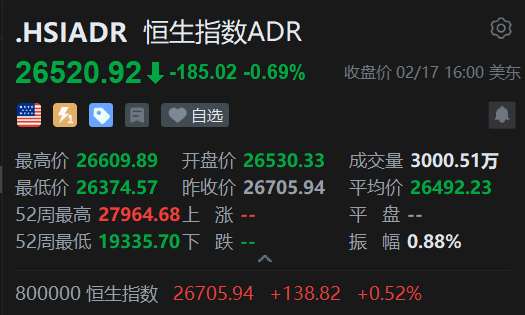
大型蓝筹股涨跌不一,汇丰控股收报135.316港元,较香港收市涨0.83%;腾讯控股收报530.511港元,较香港收市跌0.47%。 | 序号 | 名称 | 港股代码 | 最新价 | 涨跌额 | 涨跌幅 | ADR代码 | ADR换算价(I | | --- | --- | --- | --- | --- | --- | --- | --- | | 1 | 腾讯控股 | O 00700 | 533.000 | +1.000 | 0.19% | TCEHY | 530 | | 2 | 阿里巴-W | 09988 | 154.700 | -0.700 | -0.45% | BABA | 151 | | 3 | 汇丰控股 | 00005 | 134.200 | -1.500 | -1.11% | HSBC | 135 | | 4 | 建设银行 | 00939 | 8.010 | +0.050 | 0.63% | CICHY | 7 | | 5 | 小米集团-W | 01810 | 36.660 | -0.180 | -0.49% | XIACY | 36 | | 6 | 友邦保险 | 01299 | 82.350 | ...
根治农民工欠薪,数字人民币方案上新
Sou Hu Cai Jing· 2026-02-17 14:22
Core Viewpoint - The digital RMB wallet integrates account management, mobile payments, interest accrual, and programmability, positioning itself as a potential digital entry point for personal financial services [2][5]. Group 1: Digital RMB Implementation - The first digital RMB salary payment for migrant workers was successfully executed in Chengdu, with over 1 million yuan disbursed by Bank of Communications [3]. - The digital RMB's interest-bearing mechanism was officially launched on January 1, 2026, marking a significant transition from "digital cash" to "digital deposits" [3][15]. - The digital RMB wallet is expected to become a "super" digital financial entry point for commercial banks, combining various financial functionalities [5][18]. Group 2: Smart Contract Applications - Smart contracts are highlighted as a key advantage of the digital RMB wallet over traditional bank accounts, enabling precise control and automation of fund usage [10]. - The digital RMB's smart contract system is designed to be compatible with both bank account-based and blockchain-based contracts, facilitating seamless integration [10][11]. - The application of smart contracts in salary payments aims to enhance transparency and reduce risks associated with fund misappropriation [9][14]. Group 3: Opportunities for Banks - The digital RMB 2.0 era presents new commercial opportunities for banks, including low-cost, high-retention core liabilities and the potential to reclaim strategic control over payment channels [18]. - Banks are focusing on integrating digital RMB into existing product systems, covering major business areas such as deposits, loans, and investments [17][19]. - The digital RMB wallet's capabilities allow banks to create customized smart contracts and offer high-value services, leading to new revenue streams distinct from traditional transaction fees [18].


中国工商银行取得证件照制作方法及装置专利
Sou Hu Cai Jing· 2026-02-17 12:52
Core Viewpoint - The Industrial and Commercial Bank of China (ICBC) has obtained a patent for a "method and device for producing ID photos," with the authorization announcement number CN115471896B, applied for on September 2022 [1]. Company Overview - ICBC was established in 1985 and is located in Beijing, primarily engaged in monetary financial services [1]. - The registered capital of ICBC is approximately 35.64 billion RMB [1]. Investment and Operations - ICBC has invested in 28 companies and participated in 5,000 bidding projects [1]. - The company holds 965 trademark registrations and 5,000 patent records, along with 79 administrative licenses [1].
从“存定期”到“多元配置”:五位普通投资者的理财变奏曲
Sou Hu Cai Jing· 2026-02-17 12:52
时值春节,一场静悄悄的理财观念变革正在投资者的家庭中悄然发生。曾经"有钱就存定期"的传统思 维,正被黄金ETF、基金定投、股票等多元配置方式逐步替代。 近日,中国证券报记者采访了几位背景迥异的投资者,听他们讲述在资本市场深化改革、金价上行的背 景下,如何调整自己的"钱袋子"。 在东部某省二线城市,事业单位退休职工老陈(化名)的炒股经验已超过十五年。往年春节前,年终奖 和子女孝敬的钱,他习惯性存入银行定期。"图个安稳,利息虽不高,但心里踏实。" 今年,老陈做出了改变。他把大约30%的闲钱配置了黄金ETF(518800),50%仍存定期,20%留作股 票补仓。"金价涨得太凶了,全球央行都在买黄金,我觉得作为避险资产值得配一点。" 2026年1月末,我国央行黄金储备报7419万盎司,较2025年12月末小幅增长,这是央行自2024年11月以 来连续第15个月增持黄金。世界黄金协会预计,当前金价上涨趋势有望在2026年延续。 "年纪大了,更看重保值。"老陈坦言,他是在金价回调到4800美元左右分批买入的,不追高。市场波动 时,他会减持部分股票,增持黄金对冲风险。对于2026年A股,他看好科技成长主线,但强调不会全仓 ...
工商银行取得用于自助终端的智能身份验证方法及装置专利
Sou Hu Cai Jing· 2026-02-17 12:52
Group 1 - The core point of the article is that the Industrial and Commercial Bank of China (ICBC) has obtained a patent for a "smart identity verification method and device for self-service terminals," with the authorization announcement number CN117593828B and an application date of November 2023 [1] - ICBC was established in 1985 and is located in Beijing, primarily engaged in monetary financial services [1] - The registered capital of ICBC is approximately 35.64 billion RMB [1] Group 2 - According to data from Tianyancha, ICBC has invested in 28 companies and participated in 5,000 bidding projects [1] - The bank has 965 trademark information entries and 5,000 patent information entries, along with 79 administrative licenses [1]