智元机器人

Search documents
人形机器人企业积极规划产能扩张
Zheng Quan Ri Bao· 2026-01-21 16:29
Core Insights - The humanoid robot industry is transitioning from technology demonstration to large-scale commercialization, with significant growth expected in 2026 [1][3][4] Group 1: Market Growth and Orders - The humanoid robot market is projected to experience strong order growth in 2025, with companies like Qingbao Robot and Zhiyuan Robot reporting substantial increases in order volumes [1][2] - Qingbao Robot's sales exceeded 50 million yuan in 2025, with a notable order of 7 million yuan from South China and 1,000 intention orders from various industries [3] - Omdia's report indicates that Zhiyuan Robot's shipments surpassed 5,100 units in 2025, while Yushu Technology's shipments exceeded 5,500 units, highlighting a competitive landscape [2] Group 2: Production Capacity and Strategy - Companies are ramping up production capacity in anticipation of a significant demand surge in 2026, marking the beginning of a capacity competition [4][5] - Qingbao Robot plans to enhance production scale to optimize costs and facilitate the commercialization of products across various scenarios [4] - Industry experts predict that global shipments of humanoid robots could exceed 50,000 units in 2026, representing a year-on-year increase of over 700% [3][4] Group 3: Industry Outlook - 2026 is seen as a critical year for assessing the commercialization capabilities of the humanoid robot industry, with leading companies beginning to secure substantial orders [3][4] - The industry is still in its early stages, and companies must balance capacity expansion with technological advancements to maintain competitive advantages [5][6]

免费领取!100+硅碳负极项目清单(第1批)——企业、产能、技术、进度......
DT新材料· 2026-01-21 16:05
| 800+ 200+ 30+ 50,000m | | --- | | 企业参展 科研院所 | | 2026 . 06 . 10 → 06 . 12 | 在新能源产业迭代升级的浪潮中,固态电池已成为撬动行业变革的核心支点,是衡量国家高端制造实力的重要 标志。 在固态电池体系中,负极直接决定电池的能量密度、循环寿命, 是制约电池整体性能升级的关 键环节 。 相比于传统石墨负极, 硅基负极凭借优异的性能 ( 硅理论 比容量 是传统石墨负极的10倍以上 )和与固态 电池体系的高匹 配 度( 降低 固-固界面阻抗,抑制锂 枝晶析出 ), 已成为当前固态电池体系主流选择 。 作为高能量密度电池的核心材料, 硅碳负极已成为固态电池产业链的关键布局方向。 2025年,国内硅碳负极 赛道更是呈现全面开花、项目密集落地的火热态势。 据 DT 新材料不完全统计,2025年国内硅碳负极落地项 目数量突破 100 个,规划总产能超 30 万吨,行业总投资额高达800 亿元! 我们已梳理2025年硅碳负极项目(涵盖受理、公示、开工、投产等全阶段)的核心信息 , 囊括产能规划、技 术路线、项目规模等关键内容。 扫描下方二维码,转发即可领 ...

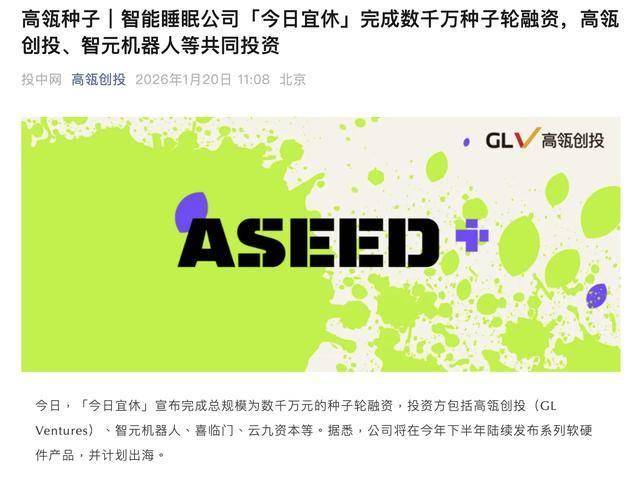
今日宜休获数千万元融资:高瓴、云九、智元、喜临门跨界联手投资
Quan Jing Wang· 2026-01-21 12:45
Group 1 - The core viewpoint of the article highlights the significant investment in the sleep technology sector, driven by the completion of a seed round financing for "Today Rest" led by prominent investors, indicating the explosive potential of the trillion-dollar sleep economy [1] - The Chinese smart mattress market is projected to approach 60 billion yuan by 2030, while the global sleep technology market is expected to grow at a compound annual growth rate of 17.96% towards a scale of 100 billion USD [1] - The collaboration among various stakeholders, including venture capital firms and industry leaders, reflects a strategic positioning to capitalize on the evolving consumer demand from "comfortable sleep" to "health management," integrating advanced technologies like AI and IoT [1][2] Group 2 - Hillhouse Capital's involvement brings confidence to the sector, as it has previously invested in multiple smart health and hard tech companies, creating a comprehensive investment matrix across the health industry [1] - Cloud Nine Capital aims to support innovative disruptors and recognizes the potential for collaborative efficiency in the sleep technology space, further validating the growth opportunities in this sector [1] - The participation of Zhiyuan Robotics, with its expertise in embodied intelligence and environmental perception, enhances the technological capabilities within sleep scenarios, pushing the evolution towards intelligent health spaces [2] Group 3 - Joyland, as a leading player in the sleep industry, leverages over 40 years of experience in technology development and market implementation, enhancing its brand presence and international appeal [2] - The capital market has responded positively to Joyland's strategic transformation, with significant institutional buying and multiple buy/hold ratings from various institutions, indicating strong confidence in its future [2] - The collaboration among Joyland, Hillhouse Capital, Cloud Nine Capital, and Zhiyuan Robotics effectively addresses the challenges faced by startups in funding, technology, and market access, accelerating the commercialization of sleep technology [3]


明日主题前瞻智元拆分灵巧手部门为独立公司,灵巧手赛道已进入精细发展阶段
Xin Lang Cai Jing· 2026-01-21 12:22
Group 1: Robotics and Automation - ZhiYuan Robotics has spun off its dexterous hand division into an independent company, Shanghai Critical Point Innovation Technology Co., Ltd, with an investment of 4 million yuan for an 80% stake, led by former business head Xiong Kun [1][2] - The dexterous hand market in China is expected to exceed 340,000 units by 2030, with a CAGR of approximately 90% from 2024 to 2030, indicating a shift towards specialized development in core components [2] - Companies like Tongyi and Zhaowei have made significant advancements in dexterous hand technology, focusing on control precision and reliability, with products showcased at major events like CES 2026 [3] Group 2: Brain-Computer Interface - Neuralink's first subject has reported that their brain-computer interface can now receive OTA updates wirelessly, marking a significant milestone in the technology [3][4] - The global brain-computer interface market is projected to reach $7.63 billion by 2029, driven by policy support and technological breakthroughs, transitioning from clinical trials to commercial viability [4] - Companies like Beixin Source and Tianqi are actively developing applications for brain-computer interfaces, exploring new modes of human-machine collaboration [4] Group 3: Solar Energy - The price of mainstream photovoltaic components has returned to the "1 yuan era," with recent price adjustments indicating a trend of increasing component prices [5][6] - Major companies like Trina Solar have raised their component prices multiple times in 2026, reflecting a broader industry trend towards price increases due to supply chain dynamics [5] - Companies such as Dongfang Risen and Mingguan New Materials are advancing in high-efficiency solar technologies, contributing to the overall growth of the solar energy sector [6] Group 4: Sodium-Ion Batteries - LG is advancing the construction of a pilot production line for sodium-ion batteries in Nanjing, highlighting the technology's potential for cost reduction and low-temperature performance [7][8] - The sodium-ion battery market is gaining traction as leading manufacturers push for product development and industrialization, indicating a promising growth trajectory [7] - Companies like Zhongke Electric and Ding Sheng New Materials are actively involved in the production and development of materials for sodium-ion batteries, positioning themselves for future opportunities [8] Group 5: Machine Tool Industry - China has surpassed Germany to become the world's largest exporter of machine tools, capturing 21.6% of the global market share, while Germany's share has declined to 16.7% [9] - The growth of China's machine tool exports is attributed to the booming demand in sectors like new energy vehicles and aerospace, providing opportunities for domestic manufacturers to advance in high-end markets [9] - Companies like Huachen Equipment and Huadong CNC are developing high-precision machine tools to support various manufacturing sectors, enhancing their competitive edge [10][11] Group 6: Medical Robotics - The 37th batch of medical service pricing guidelines has introduced a tiered pricing model for surgical robots, linking costs to their clinical value and participation in surgeries [11][12] - The introduction of a pricing framework for robotic-assisted surgeries is expected to drive significant growth in the medical robotics sector, with companies like Tianzhihang leading the market [12]
王腾新公司“今日宜休”获数千万种子轮融资,高瓴创投、智元机器人参投
Sou Hu Cai Jing· 2026-01-21 11:07
瑞财经 吴文婷1月20日,据高瓴创投发布,"今日宜休"宣布完成总规模为数千万元的种子轮融资,投资 方包括高瓴创投(GL Ventures)、智元机器人、喜临门、云九资本等。 据悉,公司将在今年下半年陆续发布系列软硬件产品,并计划出海。 公开资料显示,"今日宜休"的创始人王腾在离职创业之前,是小米高管。王腾以不到40岁的年纪,担任 REDMI品牌总经理,后出任小米中国区市场部总经理。王腾在小米时期的代表作,包括Mix2,小米8、 红米Note7等。 今年1月8日,王腾在社交平台官宣创业项目。其表示,从小米离开后开始筹备创业,最近新公司已经成 立,公司取名为"今日宜休",目标是通过研发睡眠健康相关的产品,让大家能拥有更好的精力状态。 王腾Thomas 26-1-8 09:31 发布于 北京 来自 REDMI K90 Pro Max 跟大家汇报下最近的情况:从小米离开后开始筹备创业,最近新公司已经成立,公 司取名为"今日宜休",目标是通过研发睡眠健康相关的产品,让大家能拥有更好 的精力状态。 大家可能会好奇为什么选择睡眠健康、精力管理这个方向? 1. 首先睡眠、精力已经成为每个人都关心的健康问题。以我个人为例,近几 ...
狂降至1元,机器人界“滴滴”把价格打下来了
3 6 Ke· 2026-01-21 10:50
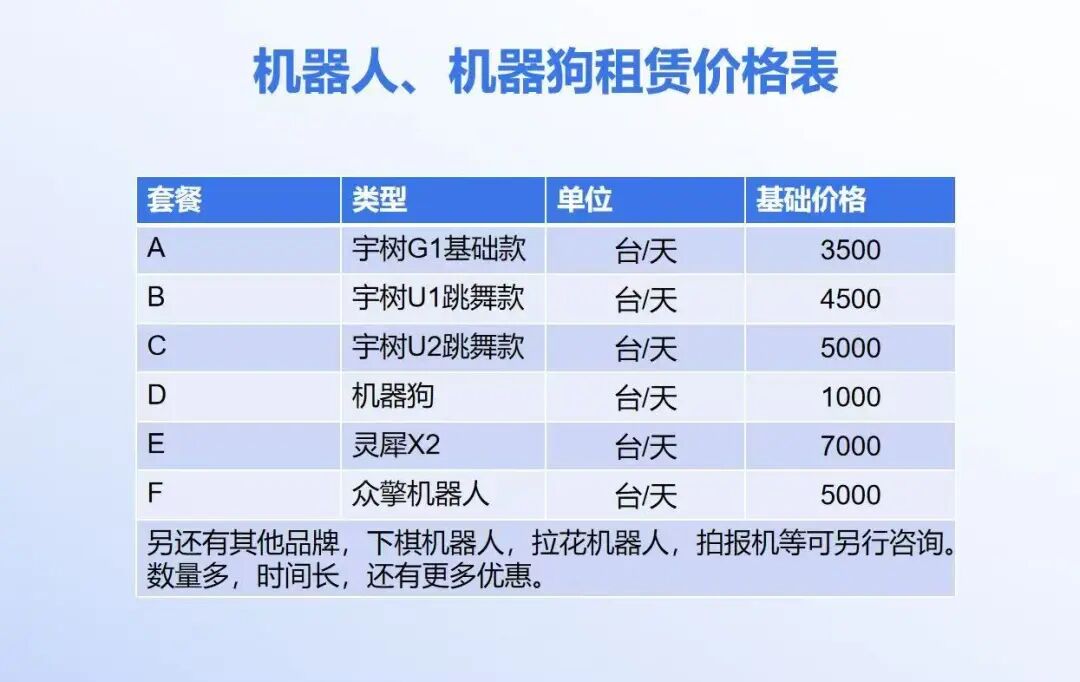
Core Insights - The launch of the "Qingtian Rent" platform by Zhiyuan Robotics and Feikuo Technology has significantly reduced the rental prices of humanoid robots, making them accessible to small and medium enterprises as well as individual consumers [1][3][6] - The humanoid robot rental market is projected to exceed 10 billion yuan in 2025 and reach at least 100 billion yuan in 2026, driven by platformization and shared leasing models [1][7][10] Market Dynamics - The initial surge in demand for humanoid robots was fueled by high-profile performances, leading to rental prices soaring to 15,000-20,000 yuan per day in major cities [1][2] - A rapid influx of small and medium businesses entered the market, with approximately 229,000 new robot-related companies registered in 2025, many of which aimed to capitalize on the lucrative rental business [2][11] - However, the market experienced a sharp decline in demand shortly after, with rental prices dropping significantly as supply increased and consumer interest waned [2][3] Pricing and Competition - The introduction of the "Qingtian Rent" platform has initiated a price war in the robot rental industry, with daily rental prices for basic models like the Yushu G1 dropping to around 3,500 yuan, nearing cost levels for many small operators [3][4][6] - The competitive landscape has shifted from a focus on the robots themselves to a broader value proposition that includes cost, service, and application scenarios [14][20] Business Model and Future Outlook - The "Qingtian Rent" platform aims to optimize the utilization of humanoid robots through shared leasing and platform-based scheduling, enhancing efficiency and reducing idle time [8][21] - For established players like Zhiyuan, the rental business serves as a stepping stone to solidify market presence and gather user data for product improvement [10][11] - Despite the potential for growth, small operators face challenges in sustaining profitability, as the novelty of humanoid robots often leads to short-term rentals rather than long-term contracts [11][13] Industry Challenges - The rapid expansion of platform-based rental models raises concerns about operational sustainability, as reliance on subsidies and human resources may impact service quality and customer retention [22]
王腾称创业压力山大:更理解雷总的勇气了
Xin Lang Cai Jing· 2026-01-21 10:30
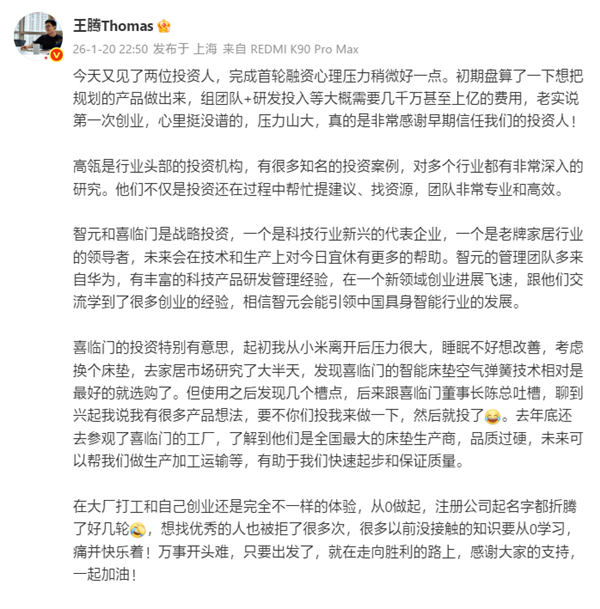
Core Viewpoint - Wang Teng, former general manager of Xiaomi's China marketing and REDMI brand, has successfully established a new company named "Today Yixiu" and completed a seed round financing of several tens of millions, with investors including Hillhouse Capital, Zhiyuan Robotics, and Xilinmen [1][11]. Group 1 - The initial financing has alleviated some psychological pressure for Wang Teng [1][11]. - Wang Teng expressed gratitude towards early investors for their trust in his first entrepreneurial venture, acknowledging the significant pressure he feels [2][12]. - The core team of "Today Yixiu" consists of members from Xiaomi, Huawei, and other tech companies, focusing on developing sleep health-related products [5][15]. Group 2 - Wang Teng indicated that product development is progressing slowly, with a planned product launch event expected in the second half of the year [6][16]. - Initial estimates for product development, team formation, and research investment range from several tens of millions to over one hundred million [6][16]. - The new products are expected to integrate with the Xiaomi ecosystem, potentially including smart pillows, smart headphones, smart wristbands, and multifunctional sensors, which can interact with various Xiaomi smart home devices to enhance sleep quality [7][16].


一场5亿豪赌:宇树们为何非上春晚不可?
36氪· 2026-01-21 10:01
以下文章来源于字母PRO ,作者薛亚萍 字母PRO . 了解互联网巨头们的一切。 IPO还是活下去, 具身智能行业迎来两极分化的2026。 文 | 薛亚萍 编辑 | 王靖 来源| 字母PRO(ID:molibang168) 封面来源 | 视觉中国 有业内人士感叹,1亿元的合作,还是非独家,太疯了。 要知道,当年阿里击败微信拿下2016年春晚独家互动合作伙伴时,赞助费是2.69亿元。 但若回看宇树在2025年春晚后的发展轨迹,便不难理解这场看似疯狂的投入。 2025年,宇树不仅凭借春晚舞台破圈,更踩准行业节奏,完成多次融资与上市辅导,成为这个行业最接近上市的明星企业。 从"一家独舞"到"多家共演",这本身也是具身智能在2025年的真实写照,更是中国具身智能产业以整体力量崛起的缩影。 据开源证券统计,截至2025年10月,具身智能领域融资总金额较2024年全年增长超400%。 不过,花团锦簇之下,泡沫也随之滋生。真正跑出来的企业屈指可数,更多公司还在生死线上挣扎,盈利模式模糊,依赖一轮轮融资续命,唯恐因为融不 到钱而资金断裂。 如果说2025年的春晚是宇树科技的一家独秀,那么2026年春晚,可能成为整个具身智能行 ...
智元投资【今日宜休】背后:生态布局,还是求生之道?
机器人大讲堂· 2026-01-21 09:05
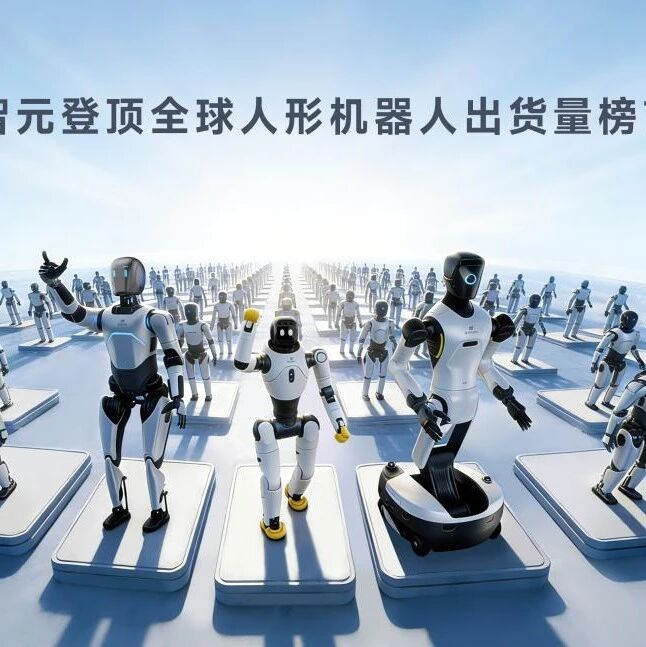
Core Viewpoint - The article discusses the strategic moves of Zhiyuan Robotics, highlighting its investment in the sleep technology company "Today Yixiu" as part of a broader strategy to transition from a robotics product company to an ecosystem platform company [4][22]. Group 1: Investment and Strategic Moves - Zhiyuan Robotics has invested in "Today Yixiu," a smart sleep company founded by former Xiaomi executive Wang Teng, which recently completed a seed round financing of several tens of millions [1][3]. - The investment reflects Zhiyuan's recognition of Wang Teng's team's product capabilities and a deeper need for cash flow, technology validation, and data assets amid challenges in robot sales [3][4]. - This move is seen as a potential commercialization pathway for Zhiyuan, aiming to leverage AI and sensor capabilities in the sleep and health sectors, which are closer to monetization compared to humanoid robots [20][21]. Group 2: Current Challenges and Market Dynamics - Despite achieving significant milestones, such as becoming the top global humanoid robot supplier and securing large contracts, the industry faces challenges, including high costs that limit consumer adoption [6][8]. - The average price of mainstream humanoid robots ranges from 100,000 to 500,000 RMB, making them unaffordable for average households [9]. - The industry is currently struggling with a lack of generalized capabilities, which restricts manufacturers to a B2B model, hindering entry into consumer markets [9][10]. Group 3: Ecosystem Development and Future Plans - Zhiyuan is shifting its focus from solely selling complete robots to building an ecosystem, similar to Google's approach with Android [10][11]. - The company has launched the "Zhiyuan A Plan" to incubate over 50 high-potential early-stage projects and aims to create a trillion-level industry ecosystem within three years [12][14]. - The establishment of "Qing Tian Rent," a robot leasing platform, addresses affordability issues, with a goal of serving over 400,000 rental customers by 2026 [16][21]. Group 4: Long-term Vision and Market Positioning - Zhiyuan's strategy includes diversifying its offerings to ensure survival and growth, even if humanoid robot sales take time to ramp up [22][24]. - The company is not solely relying on a sudden surge in robot sales but is also focusing on components, platform revenue sharing, and AI applications in various sectors [24]. - The success of Zhiyuan's transformation will not only impact its future but also serve as a reference for the entire humanoid robotics industry [24].
高瓴、智元机器人联手投资,小米前高管王腾创立AI睡眠公司“今日宜休”
Sou Hu Cai Jing· 2026-01-21 08:11
Core Insights - Wang Teng, founder of "Today Yixiu," aims to develop products focused on sleep health to improve people's sleep quality and daily energy levels after leaving Xiaomi due to a leak and conflict of interest [2][3] - The startup has secured several million yuan in seed funding from notable investors, including GL Ventures and Yunji Capital, indicating strong financial backing and industry interest [2][3] - The company plans to leverage AI technology to create proactive sleep solutions, moving beyond traditional passive monitoring to active decision-making and intervention [3][4] Company Overview - "Today Yixiu" is positioned in the sleep health sector, addressing a growing concern among modern individuals regarding sleep quality and energy management [3][4] - The company headquarters is located in Beijing, with potential plans for branches in Shenzhen and Hangzhou, offering competitive salaries and stock incentives to attract talent [4] Industry Context - The global sleep technology market is projected to reach $27.46 billion by 2025 and exceed $102.76 billion by 2033, with a compound annual growth rate (CAGR) of 17.96% [6] - In China, the sleep economy is valued at 437 billion yuan in 2023, with the smart sleep product segment expected to surpass 60 billion yuan by 2025, maintaining a CAGR of over 20% [6] - The smart sleep sector is attracting various players, including tech giants like Apple and Huawei, as well as specialized medical companies, indicating a competitive landscape [6] Product Strategy - Wang Teng's approach emphasizes simplicity in product design, allowing users to benefit from complex technology without needing to understand it, reflecting his "explosive product philosophy" from his time in the mobile industry [3][4] - The integration of "Today Yixiu" products with the Xiaomi ecosystem provides a significant advantage, ensuring access to a robust smart home market from the outset [7]