上海家化

Search documents
品牌工程指数 上周涨4.14%
Zhong Guo Zheng Quan Bao· 2025-10-26 22:33
Market Performance - The market experienced a rebound last week, with the CSI Xinhua National Brand Index rising by 4.14% to 2037.67 points [1][2] - The Shanghai Composite Index increased by 2.88%, the Shenzhen Component Index by 4.73%, the ChiNext Index by 8.05%, and the CSI 300 Index by 3.24% [2] Strong Stock Performances - Notable strong performers included: - Zhongji Xuchuang (up 32.23%) - Shiyuan Technology (up 14.54%) - Sunshine Power (up 14.37%) [2] - Other stocks with significant gains included: - Anji Technology and Wowo Bio (both up over 10%) - SMIC and Zhaoyi Innovation (both up over 9%) [2] Year-to-Date Stock Performance - Since the beginning of the second half of the year, Zhongji Xuchuang has surged by 239.03%, leading the gains [3] - Sunshine Power has increased by 145.06%, while other stocks like Lanke Technology and Yiwei Lithium Energy have risen over 70% [3] Market Outlook - According to Fangzheng Fubang Fund, liquidity remains a crucial driver for market development, and future capital inflow will significantly impact market trends [4] - The fund suggests focusing on sectors with solid fundamentals and reasonable valuations, rather than chasing high-performing stocks with poor earnings [4] - Long-term investment opportunities may lie in technology companies with real technological barriers that align with national strategies [4] - Kangmand Capital anticipates a volatile market in the short term due to uncertainties, but the core logic for an upward trend remains unchanged [4] - Xingshi Investment notes that positive incremental information could stabilize market expectations and emotions, with a potential shift in economic momentum towards technology and consumption [4]




锦盛新材:收到行政处罚事先告知书 将深刻反思全力提升经营质量
Zheng Quan Shi Bao Wang· 2025-10-22 13:36
Core Viewpoint - Jinsong New Materials (300849) has received an administrative penalty notice for information disclosure violations, resulting in fines for the company and its executives [2][3]. Group 1: Administrative Penalties - The company was fined 1.5 million yuan, and the chairman, Ruan Rongtao, was also fined 1.5 million yuan for the violations [2]. - The former general manager, Ruan Qijiang, and the chairman of the supervisory board, Xia Shuliang, received warnings and fines of 1 million yuan each, while the former vice president and director, Ruan Cenghong, received a warning and a 500,000 yuan fine [2]. Group 2: Violations Details - The main violation involved failing to disclose related party transactions in the 2022 annual report, specifically a construction contract with Zhejiang Hongxiang for a project valued at 120 million yuan, which accounted for 18.6% of the company's audited net assets for that year [3]. - The contract was improperly awarded to Ruan Zhongyan, the nephew of Ruan Rongtao, without proper disclosure, constituting a related party transaction [3]. Group 3: Company Response and Governance - The company held a board meeting on April 29, 2023, to retroactively approve the related party transaction, which was later confirmed by a shareholder meeting with a 99.97% approval rate [4]. - The company has committed to improving internal governance, enhancing operational standards, and ensuring compliance with information disclosure regulations to protect shareholder interests [4]. Group 4: Company Background - Jinsong New Materials has over 20 years of experience in the production and sale of cosmetic packaging materials, offering a wide range of products, including over 1,000 specifications for well-known brands [5]. - The company was listed on the Growth Enterprise Market in July 2020, raising funds for projects aimed at increasing production capacity [5].

橘宜集团不甘只做彩妆
Bei Jing Shang Bao· 2025-10-22 11:52
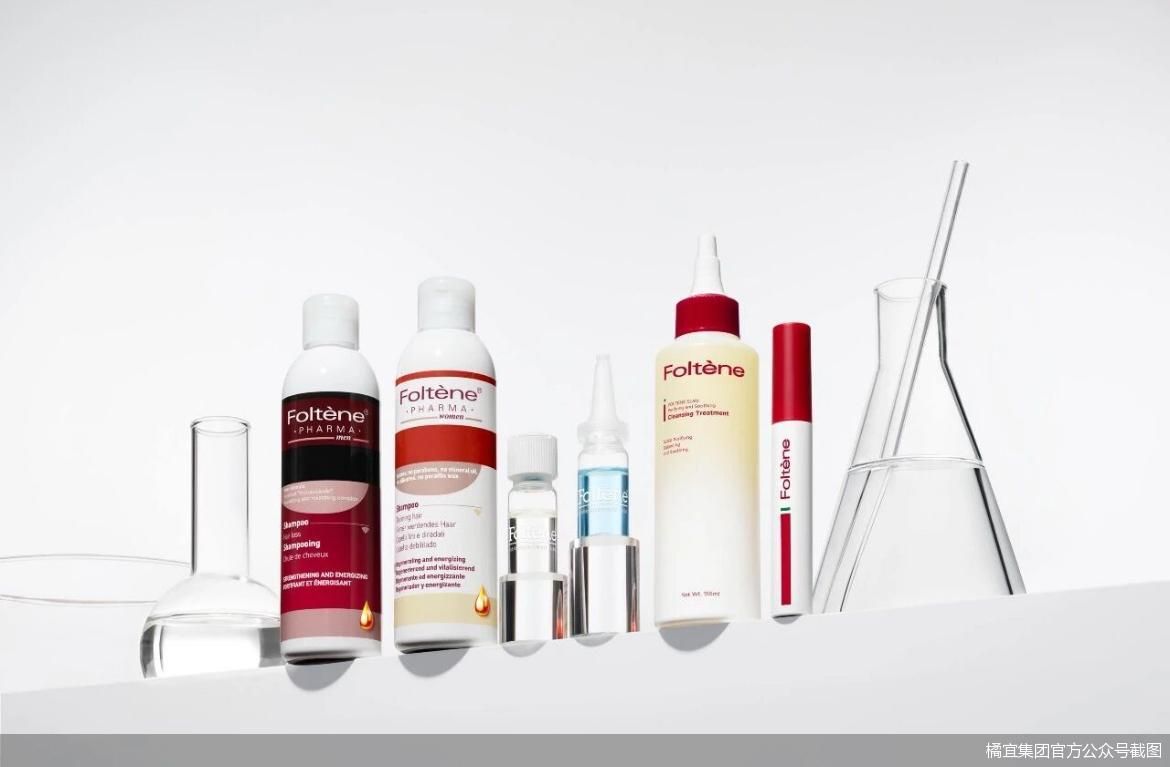
Core Insights - JuYi Group is expanding its brand portfolio beyond budget cosmetics by acquiring the Italian hair care brand Fengtian, indicating a strategic shift towards a multi-brand approach in the beauty market [1][3][4] Group 1: Acquisition Strategy - The acquisition of Fengtian includes its brand assets, global business network, supply chain, and R&D laboratory located in Italy, enhancing JuYi Group's strategic positioning in hair and scalp care [3] - JuYi Group has previously signed an acquisition agreement with the scientific skincare brand BaiZhiCui and established a long-term strategic partnership with Pierre Fabre Group to manage the Fouguede brand in China [3][4] Group 2: Market Positioning - JuYi Group aims to solidify its long-term value and differentiation across its brands while continuously seeking high-quality beauty and personal care brands for future acquisitions [4] - The company recognizes the need to diversify beyond its origins in budget cosmetics to remain competitive in the increasingly crowded beauty market [5] Group 3: Financial Performance - JuYi Group reported a retail revenue exceeding 30 billion yuan in 2023, with a year-on-year growth of 36% [6] - The company’s vision is to become a leading multi-brand beauty group in Asia, which has prompted a series of acquisitions from skincare to hair care [5][6] Group 4: Focus on Hair Care - JuYi Group is prioritizing the hair care sector, driven by increasing consumer awareness of hair and scalp health, and sees significant growth potential in this area [7] - The hair care market in 2023 was valued at 620.9 billion yuan, with expectations to exceed 660 billion yuan by 2025, indicating a steady growth trend [7][8]
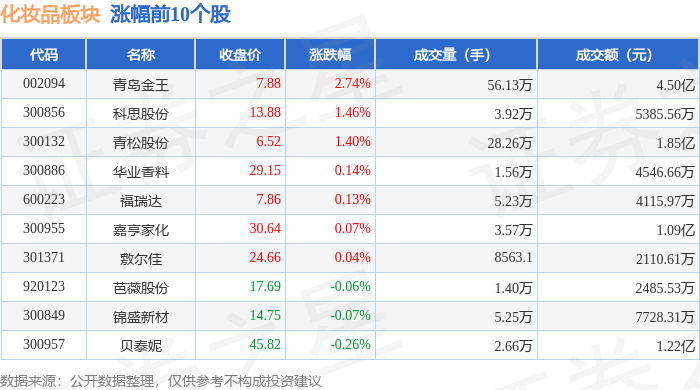
化妆品板块10月22日跌0.72%,拉芳家化领跌,主力资金净流出1229.05万元
Zheng Xing Xing Ye Ri Bao· 2025-10-22 08:26
Core Insights - The cosmetics sector experienced a decline of 0.72% on October 22, with LaFang JiaHua leading the drop [1] - The Shanghai Composite Index closed at 3913.76, down 0.07%, while the Shenzhen Component Index closed at 12996.61, down 0.62% [1] Market Performance - Qingdao Jinwang (002094) saw a closing price of 7.88, with an increase of 2.74% and a trading volume of 561,300 shares, amounting to 450 million yuan [1] - Other notable performers included Kesheng Co. (300856) with a closing price of 13.88, up 1.46%, and Yusong Co. (300132) at 6.52, up 1.40% [1] - LaFang JiaHua (603630) closed at 22.55, down 1.83%, with a trading volume of 39,800 shares and a turnover of 90.79 million yuan [2] Capital Flow - The cosmetics sector experienced a net outflow of 12.29 million yuan from institutional investors and 12.90 million yuan from retail investors, while there was a net inflow of 25.19 million yuan from individual investors [2] - The capital flow for individual stocks showed that Qingdao Jinwang had a net inflow of 30.74 million yuan from institutional investors, while LaFang JiaHua had a net outflow of 7.07 million yuan [3] - Other stocks like Kesheng Co. and Yusong Co. also experienced varying degrees of net inflow and outflow from different investor categories [3]


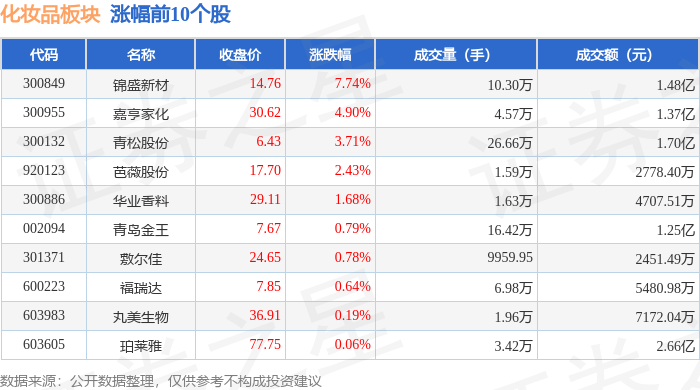
化妆品板块10月21日跌0.03%,拉芳家化领跌,主力资金净流出1149.16万元
Zheng Xing Xing Ye Ri Bao· 2025-10-21 08:28
Core Insights - The cosmetics sector experienced a slight decline of 0.03% on October 21, with Lafang Jiahua leading the drop [1] - The Shanghai Composite Index closed at 3916.33, up 1.36%, while the Shenzhen Component Index closed at 13077.32, up 2.06% [1] Group 1: Stock Performance - Jinsheng New Material (300849) saw a significant increase of 7.74%, closing at 14.76 with a trading volume of 103,000 shares and a turnover of 148 million yuan [1] - Jiaheng Jiahua (300955) rose by 4.90%, closing at 30.62 with a trading volume of 45,700 shares and a turnover of 137 million yuan [1] - Qing Song Co. (300132) increased by 3.71%, closing at 6.43 with a trading volume of 266,600 shares and a turnover of 170 million yuan [1] - Lafang Jiahua (603630) declined by 2.67%, closing at 22.97 with a trading volume of 61,500 shares and a turnover of 141 million yuan [2] - Shanghai Jahwa (600315) fell by 1.85%, closing at 27.09 with a trading volume of 96,400 shares and a turnover of 262 million yuan [2] Group 2: Capital Flow - The cosmetics sector experienced a net outflow of 11.49 million yuan from institutional investors, while retail investors saw a net inflow of 19.36 million yuan [2] - The main capital inflow was observed in brands like Banlaya (603605) with a net inflow of 10.38 million yuan, while Jinsheng New Material (300849) had a net outflow of 11.78 million yuan [3] - Retail investors showed a significant net inflow in Furuida (600223) with 7.23 million yuan, while the outflow from institutional investors was 3.19 million yuan [3]


上海家化跌2.03%,成交额1.68亿元,主力资金净流出30.75万元
Xin Lang Cai Jing· 2025-10-21 05:58
Core Points - Shanghai Jahwa's stock price decreased by 2.03% on October 21, trading at 27.04 CNY per share with a market capitalization of 18.177 billion CNY [1] - Year-to-date, Shanghai Jahwa's stock has increased by 59.91%, with a recent 5-day increase of 1.69% and a 20-day decrease of 1.99% [2] - The company reported a revenue of 3.478 billion CNY for the first half of 2025, representing a year-on-year growth of 4.75%, and a net profit of 266 million CNY, up 11.66% year-on-year [2] Financial Performance - As of June 30, 2025, Shanghai Jahwa's total shareholder count was 37,800, an increase of 10.15% from the previous period [2] - The company has distributed a total of 3.595 billion CNY in dividends since its A-share listing, with 344 million CNY distributed over the last three years [3] Shareholding Structure - As of June 30, 2025, Hong Kong Central Clearing Limited is the second-largest circulating shareholder, holding 32.7782 million shares, an increase of 15.0639 million shares from the previous period [3] - New shareholder,招商产业精选股票A, holds 3.4 million shares, ranking as the ninth-largest circulating shareholder [3]
自然堂9成收入靠单品,“科技美妆”营销费超研发20倍
阿尔法工场研究院· 2025-10-21 00:07
Core Viewpoint - Natural Hall, a well-known domestic beauty brand, is facing challenges in profitability and research and development, despite its historical significance and market presence [2][4]. Financial Performance - Revenue for Natural Hall from 2022 to 2024 is projected to be 4.292 billion, 4.442 billion, and 4.601 billion yuan, with net profits of 139 million, 302 million, and 190 million yuan respectively [4]. - The compound annual growth rate (CAGR) for revenue from 2022 to 2024 is only 3.5%, significantly lower than the industry average of 6.6% [4]. Revenue Structure - Approximately 90% of Natural Hall's revenue is derived from its core brand, "Natural Hall," indicating a heavy reliance on a single brand [5][6]. - The other four brands under Natural Hall contribute only about 5% of total revenue, highlighting limited market influence [7]. Marketing and R&D Expenditure - Natural Hall maintains a high gross margin, but its net profit margin fluctuates between 3.2% and 7.8%, which is considerably lower than competitors [9]. - Marketing expenses from 2022 to 2024 exceeded 7.5 billion yuan, while R&D investment was only about 348 million yuan, indicating a marketing-to-R&D expenditure ratio of 21.55 times [10][11]. Channel Strategy - Online revenue share increased from 59.7% to 68.8% from 2022 to the first half of 2025, while offline revenue share decreased to around 30% [12]. - Despite the growth in online sales, Natural Hall continues to expand its offline retail presence, with over 62,700 retail terminals as of mid-2025 [13]. Corporate Governance - Natural Hall is a family-controlled business, with the Zheng family holding 87.82% of voting rights, ensuring significant control over strategic decisions [14]. - The company recently brought in strategic investors, including L'Oréal and CVC Capital, while maintaining family control over the board [15]. Market Position and Challenges - The Chinese cosmetics market is projected to grow from 779.4 billion yuan in 2019 to 934.6 billion yuan in 2024, with domestic brands expected to capture over 50% market share by 2025 [16]. - Natural Hall's reliance on celebrity endorsements poses risks, as seen with recent controversies affecting brand reputation [16][17].

可选消费W42周度趋势解析:各板块持续轮动,股价回调提供买入机会-20251020
Haitong Securities International· 2025-10-20 14:05
Investment Rating - The report assigns an "Outperform" rating to multiple companies including Nike, Midea Group, JD Group, Haier Smart Home, Gree Electric Appliances, Anta Sports, and others, while Lulu Lemon is rated as "Neutral" [1]. Core Insights - The report highlights that various sectors within the discretionary industry are experiencing continuous rotation, with price pullbacks presenting buying opportunities [4][11]. - The performance of different sectors is analyzed, with jewelry, overseas cosmetics, luxury goods, and snacks showing positive growth, while domestic cosmetics and gaming sectors are underperforming [6][13]. Sector Performance Overview - Weekly performance shows jewelry leading with a 9.9% increase, followed by overseas cosmetics at 6.8%, and luxury goods at 5.5%. Domestic cosmetics experienced a slight decline of 0.3% [11][12]. - Year-to-date performance indicates jewelry has risen by 179.1%, domestic cosmetics by 50.4%, and overseas cosmetics by 42.3%, while overseas sportswear has declined by 17.7% [11][12]. Valuation Analysis - Most sectors are currently valued below their average over the past five years, with the expected PE for overseas sportswear at 31.9 times, domestic sportswear at 13.4 times, and jewelry at 27.2 times, indicating potential for growth [9][14]. - The report notes that the expected PE for various sectors in 2025 is lower than their historical averages, suggesting that there may be undervalued opportunities in the market [14].
上海家化:公司家居清洁类产品的营销推广正有序开展
Zheng Quan Ri Bao Wang· 2025-10-20 12:13
Core Viewpoint - Shanghai Jahwa (600315) is actively promoting its home cleaning products, indicating a strategic focus on expanding its market presence in this category [1] Group 1 - The company is engaging in orderly marketing and promotion of its home cleaning products [1]
国货美妆迎来“中场战事”,逻辑正在悄然改变
Guan Cha Zhe Wang· 2025-10-20 10:29
Core Insights - The beauty market in China is experiencing a competitive landscape with a notable shift towards domestic brands, as evidenced by the growth in sales during the "Double Eleven" shopping festival, particularly in live-streaming sales [1][3][5] - Domestic brands are increasingly gaining market share, with many top domestic beauty companies reporting revenue and profit growth, indicating a robust performance against a backdrop of overall market stagnation [5][6][7] Market Trends - The retail sales growth of cosmetics in China is slowing, with a reported year-on-year increase of only 2.9% in the first half of 2025, which is below the overall retail sales growth of 5.0% [3] - The domestic beauty market is seeing a shift from a focus on marketing to an emphasis on product quality and service, as brands like 毛戈平 (Mao Geping) and 薇诺娜 (Winona) adapt their strategies to enhance consumer engagement [5][6][7] Brand Performance - During the "Double Eleven" pre-sale, domestic brand 珀莱雅 (Proya) topped the beauty sales chart, marking its second consecutive year in this position, with an increasing number of domestic brands appearing in the rankings [5][6] - Among the top ten domestic beauty companies, eight reported revenue and profit growth, with notable increases from 上美股份 (Shangmei), 巨子生物 (Juzi), and 毛戈平, which saw revenue growth rates of 17.3%, 22.5%, and 31.3% respectively [5][6] Channel Strategy - The trend of integrating online and offline sales channels is becoming prominent, with brands like 薇诺娜 expanding their offline presence to enhance customer engagement and product visibility [6][7] - 毛戈平 has established a significant offline presence with a large team of professional beauty consultants, which supports its high-end brand positioning and customer service [6][7] International Expansion - The recent cultural export initiative "巴黎合伙人" (Paris Partner) showcased domestic brands in Paris, highlighting the potential for Chinese beauty brands to expand internationally while promoting Chinese aesthetics [8][9] - Despite challenges in penetrating Western markets, there is a growing recognition of the need for Chinese brands to adapt their products and marketing strategies to meet local consumer preferences [10][12][15] Future Outlook - The success of domestic brands in international markets will depend on their ability to leverage local insights and adapt their offerings, as demonstrated by the positive reception of products backed by scientific research [14][15] - The collaboration between Chinese brands and international platforms like TikTok may pave the way for replicating the success of live-streaming e-commerce in overseas markets [16]