
祥源文旅

Search documents
上市公司花样宠粉 A股掀实物分红热潮
Sou Hu Cai Jing· 2025-12-04 23:18
Core Viewpoint - The A-share market is experiencing a trend of "physical dividends," where listed companies are offering various tangible benefits to shareholders, such as free admission to tourist attractions and consumer products, as a way to enhance shareholder engagement beyond traditional cash dividends [3][4]. Group 1: Physical Dividends Trend - Over 30 A-share listed companies have initiated shareholder reward activities since 2025, covering sectors like tourism, food and beverage, beauty, and home goods [3]. - Companies like Emei Mountain A are providing free admission to their scenic areas for shareholders, aiming to increase shareholder loyalty and stimulate secondary consumption in response to declining visitor numbers [4]. - Other tourism companies, such as Huangshan Tourism and Xiangyuan Cultural Tourism, have also introduced similar exclusive benefits for shareholders, including free tickets and discounts on various services [4]. Group 2: Consumer Goods Companies' Engagement - At least 18 companies in the food and beverage and beauty sectors have launched reward activities, such as skincare gift boxes and commemorative liquor for shareholders [5]. - The strategy of using self-owned products for shareholder rewards is cost-effective and allows companies to reach a consumer base with purchasing power, turning them into brand advocates [5]. Group 3: Innovative Reward Methods - Companies are expanding the forms of rewards, with examples including movie tickets and backstage visits for shareholders from Hengdian Film and Television, and high-value items like iPhones and drones offered through lotteries by biopharmaceutical firms [7]. - These innovative approaches aim to integrate shareholder rewards with core business operations, enhancing emotional connections and brand recognition [7]. Group 4: Market Dynamics and Long-term Value - While physical rewards are gaining popularity, they differ fundamentally from cash dividends, which reflect direct profit distribution [6][8]. - Investors are advised to focus on a company's core operational capabilities, profitability, and long-term growth potential, as short-term market attention may not sustain stock prices [8]. - Historical examples from mature markets, such as Japan, show that physical rewards can enhance shareholder loyalty and promote consumption, provided they adhere to fairness principles [8].



股东福利再升级!从门票到预制菜,上市公司花式宠粉正流行
Sou Hu Cai Jing· 2025-12-04 17:23
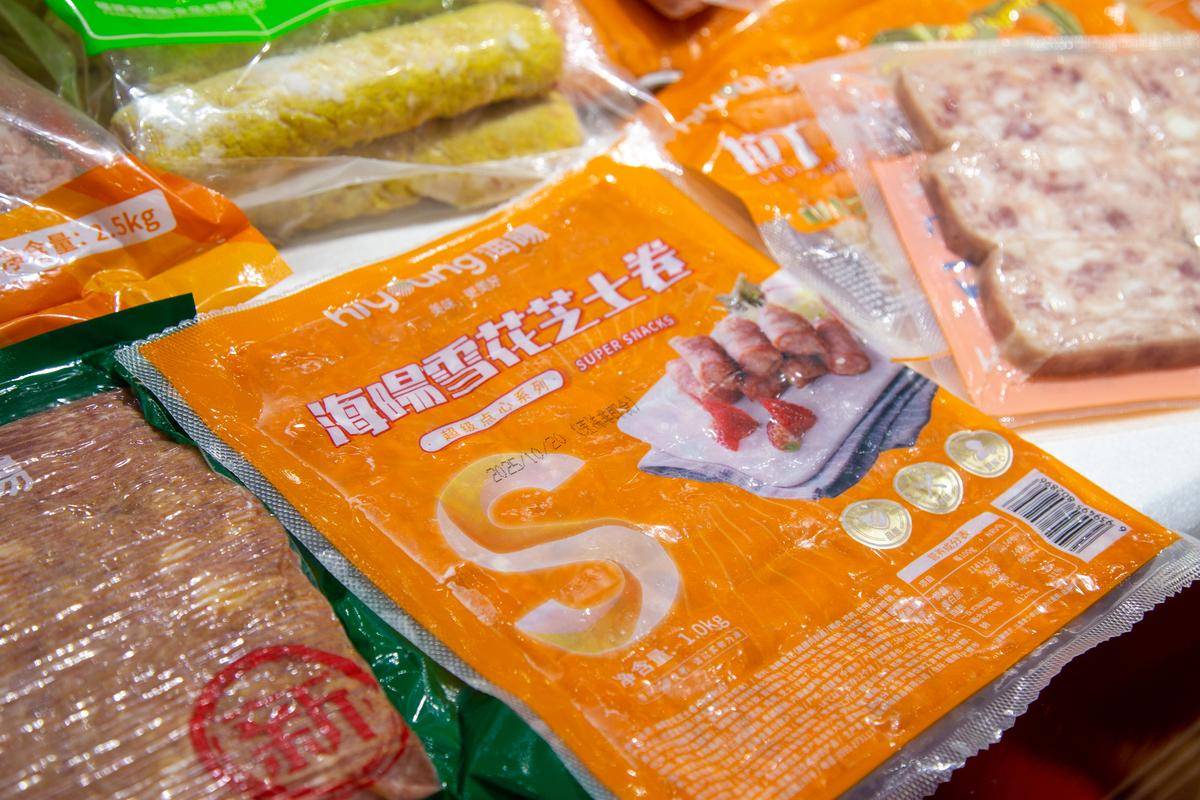
Core Insights - A new trend in the A-share market is emerging where companies are offering "physical dividends" to shareholders, enhancing the shareholder experience beyond traditional cash dividends and stock price appreciation [3][4][10] Group 1: New Trends in Investor Relations - The A-share market is witnessing a transformation in investor relations management, shifting from cash dividends to product-based rewards for shareholders [3] - Companies like Emei Mountain A and Qianwei Yangchun are leading this trend, with Emei Mountain A offering free admission to shareholders holding over 500 shares, and Qianwei Yangchun providing product gift packages worth 200 yuan to shareholders holding over 100 shares [3][4] Group 2: Strategic Considerations Behind Physical Dividends - The trend of physical rewards is not merely about providing benefits; it represents an upgrade in investor relations management to brand experience marketing, creating a low-cost yet innovative approach [4][5] - For tourism companies, offering free admission and discounts can lead to significant secondary consumption, enhancing overall revenue [4][10] Group 3: Industry-Specific Approaches to Shareholder Engagement - Different industries are adopting unique strategies to engage shareholders: - In the tourism sector, Emei Mountain A offers comprehensive benefits including free tickets and discounts on various services [7][10] - In the food industry, Qianwei Yangchun provides product gift packages, while other companies like Wufangzhai and Zhongjing Foods also offer food gifts without strict holding requirements [7][8] Group 4: Case Study of Qianwei Yangchun - Qianwei Yangchun's shareholder reward strategy aligns with its broader market expansion goals, allowing shareholders to experience products directly and potentially become loyal customers [8][9] - The company is strategically timing its rewards to coincide with its efforts to penetrate the consumer market [8] Group 5: Emei Mountain A's Unique Offerings - Emei Mountain A's rewards program is designed to counteract a 7.9% decline in visitor numbers, showcasing an innovative approach to attract more visitors [10] - The program includes not just free admission but also discounts for family members, creating a holistic consumer experience [10] Group 6: Balancing Aspirations and Realities - While the trend of physical dividends is gaining traction, companies must ensure product quality and sustainability of these initiatives to avoid damaging their reputation [13][15] - Market reactions to these initiatives can lead to short-term stock price increases, but without solid performance fundamentals, there may be risks of price corrections [15]
收评:创业板指缩量反弹涨超1%,全市场成交额不足1.6万亿元
Xin Lang Cai Jing· 2025-12-04 07:08
Core Viewpoint - The A-share market showed mixed performance today, with the Shanghai Composite Index slightly down by 0.06%, while the Shenzhen Component and ChiNext Index increased by 0.4% and 1.01% respectively, indicating sector-specific movements and investor sentiment shifts [1] Market Performance - The total trading volume in the Shanghai and Shenzhen markets reached 15,617 billion yuan, a decrease of 1,219 billion yuan compared to the previous day [1] - Over 3,800 stocks in the market experienced declines, reflecting a broad sell-off in certain sectors [1] Sector Highlights - The humanoid robot, commercial aerospace, semiconductor, wind power equipment, film and television, securities, and local stocks in Fujian showed significant gains [1] - Conversely, sectors such as the Hainan Free Trade Zone, food and beverage, cultivated diamonds, and retail faced notable declines [1] Notable Stocks - Humanoid robot concept stocks saw substantial surges, with companies like Heng'erda, Haichang New Materials, Longxi Co., Ruineng Technology, and Rifa Precision Machinery hitting the daily limit up [1] - The commercial aerospace sector remained active, with Huawu Co. reaching a 20% limit up, alongside China Satellite, Dahua Intelligent, and Heertai also hitting the limit up [1] - The semiconductor sector performed positively, with stocks like Hongwei Technology, Tuojing Technology, and Huahong Semiconductor showing upward movement [1] Declining Stocks - The food and beverage, tourism, and retail sectors collectively weakened, with companies such as Haixin Food, Roniu Mountain, and Tongqing Building hitting the daily limit down, while Pinwa Food, Panda Dairy, Xiangyuan Cultural Tourism, Dongbai Group, and Hemei Group experienced significant declines [1]

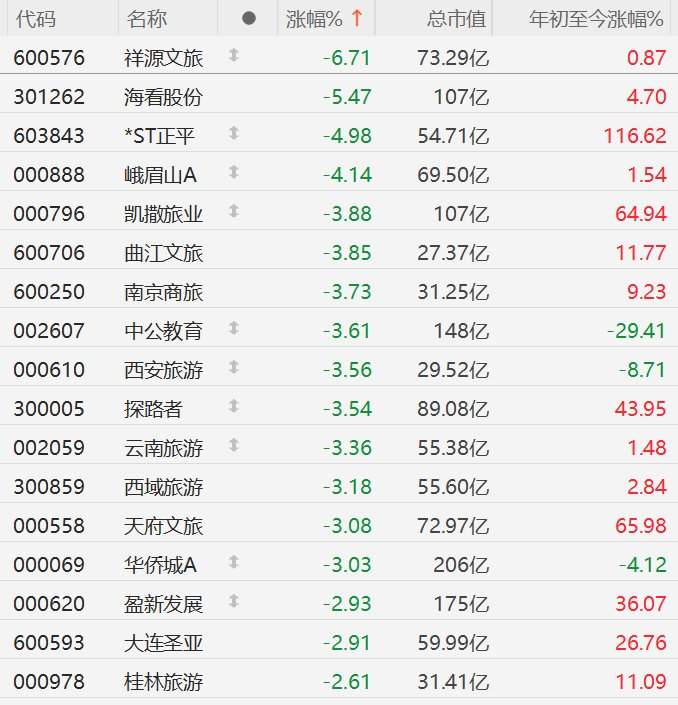
A股旅游股集体下跌,祥源文旅跌超6%,峨眉山A跌超4%,凯撒旅业、曲江文旅、南京商旅、西安旅游、天府文旅跌超3%
Ge Long Hui· 2025-12-04 06:39
Core Insights - The A-share market has seen a collective decline in tourism stocks, with significant drops in several companies' share prices [1] Group 1: Stock Performance - Xiangyuan Culture and Tourism (祥源文旅) experienced a decline of over 6.71%, with a total market capitalization of 7.329 billion [2] - Haikan Co. (海看股份) fell by 5.47%, with a market cap of 10.7 billion [2] - Emei Mountain A (峨眉山A) dropped by 4.14%, with a market value of 6.95 billion [2] - Other notable declines include Caesar Travel (凯撒旅业) down 3.88%, Qujiang Culture and Tourism (曲江文旅) down 3.85%, and Nanjing Commercial Travel (南京商旅) down 3.73% [1][2] Group 2: Year-to-Date Performance - Year-to-date performance shows that Xiangyuan Culture and Tourism has only increased by 0.87% [2] - Haikan Co. has a year-to-date increase of 4.70% despite the recent decline [2] - Emei Mountain A has a modest year-to-date increase of 1.54% [2] - Other companies like Caesar Travel and Qujiang Culture and Tourism have year-to-date increases of 64.94% and 11.77% respectively, indicating some resilience despite recent stock price drops [2]


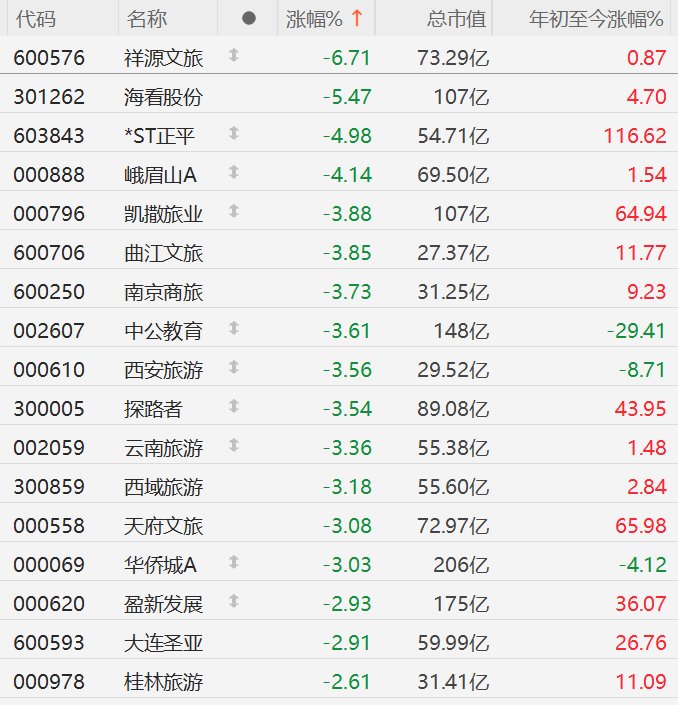
A股旅游股集体下跌,祥源文旅跌超6%
Ge Long Hui A P P· 2025-12-04 06:17
Group 1 - The A-share market saw a collective decline in tourism stocks, with significant drops in companies such as Xiangyuan Cultural Tourism, Haikan Co., and Emei Mountain A [1] - Xiangyuan Cultural Tourism experienced a drop of over 6.71%, while Haikan Co. fell by over 5.47% [2] - Other notable declines included Emei Mountain A at -4.14%, and Caesar Travel at -3.88% [2] Group 2 - The total market capitalization of Xiangyuan Cultural Tourism is 7.329 billion, while Haikan Co. stands at 10.7 billion [2] - Year-to-date performance shows Xiangyuan Cultural Tourism with a gain of 0.87%, while Haikan Co. has increased by 4.70% [2] - Other companies like Nanjing Commercial Travel and Xian Tourism also reported declines of -3.73% and -3.56% respectively [2]


酒店及旅游板块走低,同庆楼触及跌停
2 1 Shi Ji Jing Ji Bao Dao· 2025-12-04 05:29
Core Viewpoint - The hotel and tourism sector is experiencing a decline, with specific companies facing significant drops in stock prices [1] Group 1: Sector Performance - The hotel and tourism sector is reported to be down overall [1] - Notable declines include Tongqinglou hitting the daily limit down and Xiangyuan Cultural Tourism dropping over 8% [1] - Other companies such as Xi'an Catering, Junting Hotel, and Emei Mountain A also experienced declines [1]



东吴证券晨会纪要-20251204
Soochow Securities· 2025-12-04 02:33
Macro Strategy - The macro environment is influenced by both domestic and overseas factors, leading to a decline in market confidence due to a drop in manufacturing PMI and uncertainty in macroeconomic data [1][15] - Domestic liquidity support through fiscal issuance and monetary policy is stabilizing the valuation environment, while industry policies in sectors like renewable energy and satellite IoT provide long-term support for related sectors [1][15] - The consumer technology sector shows structural differentiation in earnings reports, with companies like Meituan, JD, and Alibaba facing profit declines due to intense competition, while Tencent and Xiaomi achieve profit growth through international expansion and premiumization [1][15] Industry Analysis - The Nasdaq 100 index experienced volatility driven by concerns over AI bubbles and mixed macroeconomic data, with strong non-farm employment data coexisting with rising unemployment rates, complicating the Federal Reserve's assessment of economic health [2][4][16] - The semiconductor sector's performance is shaped by the earnings of companies like Broadcom and Micron, which validate demand trends [4][17] - The gold market is influenced by interest rate expectations, geopolitical tensions, and the performance of other precious metals, with a significant focus on the upcoming Federal Reserve meetings and inflation data [5][18][19] Index Outlook - The Hang Seng Technology Index is expected to maintain a bottoming and slightly upward trend in December 2025, influenced by macroeconomic conditions and policy expectations [1][15] - The Nasdaq 100 index is projected to experience a volatile upward trend, supported by the AI industry revolution and commercial validation, despite potential pullbacks if key economic data underperform [4][17] - The gold price is anticipated to remain strong in the short term, with a bullish medium-term outlook, contingent on the Federal Reserve's policy direction and macroeconomic data releases [5][18][19] ETF Products - The Huaxia Hang Seng Technology ETF (513180) closely tracks the Hang Seng Technology Index, with a total market value of 47.745 billion yuan as of November 28, 2025 [1][15] - The GF Nasdaq 100 ETF (159941.SZ) also closely follows the Nasdaq 100 Index, with a circulating scale of 29.915 billion yuan as of November 28, 2025 [4][17] - The Huaan Gold ETF (518880.SH) tracks domestic gold spot price returns, with a total market value of 90.631 billion yuan as of November 28, 2025 [5][18][19]
机构最新调仓动态曝光 部分标的博弈激烈
Zhong Guo Zheng Quan Bao· 2025-12-03 21:08
Core Viewpoint - Recent disclosures from multiple listed companies regarding share buybacks and the top ten shareholders reveal significant shifts in institutional investment strategies, with notable divergence in traditional sectors and increased interest in technology, military, and pharmaceutical sectors [1][2]. Group 1: Institutional Investment Dynamics - There is a marked divergence among institutional investors regarding traditional sector stocks such as Hai Da Group and Xiangyuan Cultural Tourism, with some institutions reducing their holdings while others increase them [2]. - Hai Da Group's top ten shareholders include eight positions held by public funds and social security funds, collectively owning over 120 million shares, which is more than 7% of the total share capital [2]. - Notable actions include a reduction of 362,600 shares by Liu Yanchun's fund, while social security funds significantly increased their holdings in Hai Da Group during the same period [2]. Group 2: Performance of Specific Stocks - Hai Da Group reported a net profit of 4.177 billion yuan for the first three quarters, reflecting a year-on-year growth of 18.71%, while Xiangyuan Cultural Tourism achieved a net profit of 143 million yuan, up 33.47% year-on-year [3]. - Other stocks such as Hengmingda, Huaron, and Huida Technology have also seen institutional increases, particularly in sectors like consumer electronics, military, and pharmaceuticals [4][5]. - Hengmingda received an increase of 4.9717 million shares from the national social security fund, while Huida Technology saw an increase of over 5.5 million shares from the same fund [4]. Group 3: Reduction in High-Growth Stocks - Stocks that previously experienced significant price increases, such as Hot Scene Biology and Shanghai Mechanical, have faced reductions from various institutions, indicating a trend of profit-taking [6]. - Hot Scene Biology, which saw a price increase of over 300%, was reduced by multiple institutions, while Shanghai Mechanical, which increased by over 80%, also faced reductions [6]. - The trend of reducing holdings in high-growth stocks is further evidenced by the exit of social security funds from the top ten shareholders of certain companies [6]. Group 4: ETF Involvement - The presence of ETFs in institutional trading has become more prominent, with nearly 30% of A-share stocks having ETFs among their top ten shareholders as of the end of the third quarter [7]. - The changes in ETF holdings are often driven by factors such as changes in fund subscriptions and index component adjustments [7].
机构最新调仓动态曝光部分标的博弈激烈
Zhong Guo Zheng Quan Bao· 2025-12-03 20:28
Core Viewpoint - Recent disclosures from multiple listed companies regarding share buybacks reveal significant shifts in institutional investor positions, indicating divergent strategies among institutions towards traditional industries and favoring certain sectors like technology, military, and pharmaceuticals [1][2]. Institutional Dynamics - Intense competition among institutions is evident, particularly with Hai Da Group, where 8 out of the top 10 shareholders are public funds and social security funds, collectively holding over 120 million shares, accounting for more than 7% of total equity [1][2]. - Notable fund manager Liu Yanchun's fund reduced its holdings in Hai Da Group by 362,600 shares, while foreign institution Merrill Lynch exited the top 10 shareholders list [1][2]. Contrasting Strategies - Social security funds, such as the National Social Security Fund's 106 and 109 portfolios, have increased their stakes in Hai Da Group, contrasting with the reductions by other institutions [2]. - Similar trends are observed with Xiangyuan Cultural Tourism, where certain funds increased their holdings while others, like Zhuque Fund, reduced theirs significantly [2]. Performance Metrics - Hai Da Group reported a net profit of 4.177 billion yuan for the first three quarters, a year-on-year increase of 18.71%, while Xiangyuan Cultural Tourism achieved a net profit of 143 million yuan, up 33.47% [2]. - Other companies like Hengmingda and Huaron Co. have also seen institutional increases in holdings, particularly in popular sectors such as consumer electronics and pharmaceuticals [3][4]. Sector Trends - Companies in high-growth sectors, such as Hengmingda and Huaron Co., have attracted significant institutional investment, with notable increases from social security funds [3][4]. - Conversely, stocks that have experienced substantial price increases, such as Hot Scene Biology and Shanghai Mechanical, have faced reductions in institutional holdings as investors seek to realize profits [5][6]. ETF Influence - The presence of ETFs in the top 10 shareholders of nearly 30% of A-shares indicates a growing trend where ETF movements are influencing individual stock holdings, often due to changes in fund subscriptions or index compositions [6].

祥源文旅(600576):收购金秀莲花山100%股权,外延扩张逻辑持续兑现
Soochow Securities· 2025-12-03 13:31
证券研究报告·公司点评报告·旅游及景区 祥源文旅(600576) 收购金秀莲花山 100%股权,外延扩张逻辑 持续兑现 增持(维持) | [Table_EPS] 盈利预测与估值 | 2023A | 2024A | 2025E | 2026E | 2027E | | --- | --- | --- | --- | --- | --- | | 营业总收入(百万元) | 722.26 | 864.12 | 1,260.35 | 1,646.52 | 1,896.41 | | 同比(%) | 55.81 | 19.64 | 45.85 | 30.64 | 15.18 | | 归母净利润(百万元) | 151.30 | 146.55 | 226.37 | 350.72 | 437.02 | | 同比(%) | 571.66 | (3.14) | 54.47 | 54.93 | 24.61 | | EPS-最新摊薄(元/股) | 0.14 | 0.14 | 0.21 | 0.33 | 0.41 | | P/E(现价&最新摊薄) | 51.37 | 53.03 | 34.33 | 22.16 | 17.78 | [Tabl ...