友邦保险

Search documents
每日投资策略-20251219
Zhao Yin Guo Ji· 2025-12-19 03:55
Core Insights - The report highlights that the macroeconomic environment in 2026 will be influenced by U.S. midterm election pressures, defense demands in Europe and Japan, and China's focus on stable growth, leading to continued policy easing in the first half of the year [2] - The AI boom is expected to enhance efficiency and stock valuations but may also exacerbate job losses and economic K-shaped divergence [2] - The report suggests that the second half of 2026 may see a rebound in inflation due to global liquidity easing, a weaker dollar, and China's anti-involution efforts, potentially causing volatility in high-valuation assets [2] Industry Outlook Chinese Internet Software - 2026 is seen as a critical year for competing for user attention in the AI era, with a focus on lowering usage barriers, enhancing decision-making efficiency, and creating real value [2] - Companies with stable cash flows supporting AI investments and strong operational capabilities are expected to have higher long-term investment value [5] Semiconductor - The report maintains four core investment themes for 2026: AI-driven structural growth, China's semiconductor self-sufficiency trend, high-yield defensive allocations, and industry consolidation [7] - The global semiconductor market is projected to grow by 26% to $975 billion in 2026, with AI-related segments leading the growth [7] Technology - The global tech industry is expected to experience demand differentiation and accelerated AI innovation, with a focus on AI computing infrastructure and end-user AI products [8] - Key companies to watch include Apple, which is anticipated to have a year of innovation with new AI products [8] Consumer Sectors Essential Consumption - The report identifies three main investment themes: deepening consumption stratification, focusing on essential survival needs, and leveraging overseas expansion to hedge against domestic uncertainties [10][20] - Companies in the food and beverage sector, such as Nongfu Spring and China Resources Beverages, are recommended due to their stable demand and attractive valuations [21] Discretionary Consumption - The outlook for the discretionary consumption sector is cautious, with expected retail sales growth of about 3.5% in 2026, slightly down from 4% in 2025 [11] - The report suggests a focus on survival-type consumption and low-cost emotional comfort products, with recommendations for companies like Luckin Coffee and Bosideng [11][21] Automotive - The Chinese automotive industry is expected to show resilience despite pressures from subsidy reductions and tax incentives, with retail sales of passenger vehicles projected to remain stable [12] - Key trends include intensified competition and the introduction of new models, particularly in the new energy vehicle segment [12] Pharmaceuticals - The innovative drug sector has seen significant growth driven by overseas licensing deals, but future catalysts are expected to shift from upfront payments to milestone achievements [13] - The CXO industry is anticipated to continue its recovery in 2026, supported by a rebound in domestic R&D demand [13] Real Estate - The report forecasts a continued contraction in the real estate market, with total residential sales expected to decline by 8% in 2026 [16][17] - Investment themes include focusing on stock market service providers and companies with strong operational capabilities in commercial assets [18][19]





智通港股沽空统计|12月19日
智通财经网· 2025-12-19 00:22
Group 1 - The core point of the article highlights the top short-selling ratios and amounts for various companies, indicating significant market interest in these stocks [1][2]. - China Resources Beer (80291), Anta Sports (82020), and Great Wall Motors (82333) have the highest short-selling ratios at 100% [1][2]. - Xiaomi Group (01810), Tencent Holdings (00700), and Alibaba-SW (09988) lead in short-selling amounts, with 1.229 billion, 1.054 billion, and 830 million respectively [1][2]. Group 2 - The top ten short-selling ratios include China Resources Beer (100.00%), Anta Sports (100.00%), and Great Wall Motors (100.00%) [2]. - The top ten short-selling amounts show Xiaomi Group at 1.229 billion, Tencent Holdings at 1.054 billion, and Alibaba-SW at 830 million [2]. - The highest deviation values are led by Bank of China Hong Kong (48.85%), Alibaba-SW (34.26%), and China Resources Beer (32.32%) [1][2].




浪涌潮退
Zhao Yin Guo Ji· 2025-12-18 11:06
Macro Economic Outlook - In 2026, the U.S. midterm elections, Japan and Europe’s defense spending demands, and China's growth stabilization will lead to continued policy easing in the first half of the year. However, the actual space for macro policy is limited due to high inflation, rising government debt, and previous policy overreach [7] - The AI boom is expected to enhance efficiency and market valuations but may also exacerbate job losses and economic K-shaped divergence. Global liquidity easing and a weaker dollar may lead to rising inflation in the second half of the year, potentially causing volatility in high-valuation assets [7] Chinese Internet Software Sector - 2026 is seen as a critical year for capturing user mindshare in the AI era, focusing on lowering usage barriers and enhancing decision-making efficiency. Companies with stable cash flows supporting AI investments and strong operational capabilities are expected to have higher long-term investment value [8] - Recommended stocks include Tencent, Alibaba, and Kuaishou for AI-driven growth, and NetEase and Trip.com for stable earnings growth [8] Overseas Internet Software Sector - The competition in the large model industry is expected to intensify, with AI application monetization continuing to grow. Companies like Microsoft, Google, Amazon, and Palantir are recommended for their potential in AI revenue generation [9] Chinese Semiconductor Sector - The sector is expected to focus on AI-driven structural growth, self-sufficiency trends, high-yield defensive allocations, and industry consolidation. The global semiconductor market is projected to grow by 26% to $975 billion in 2026, with AI-related segments leading the growth [10] Chinese Technology Sector - The global tech industry will experience demand differentiation and accelerated AI innovation. The expansion of computing power and the introduction of AI products are expected to drive growth, with a focus on AI infrastructure and end-user AI products [11] Chinese Essential Consumer Sector - The core constraint on consumer spending in 2026 is expected to be asset shrinkage and slow income recovery. Investment themes include the deepening of consumer stratification and a focus on essential survival needs [12] Chinese Discretionary Consumer Sector - The overall retail sales growth is projected to slow to about 3.5% in 2026. Investment strategies should focus on survival-type consumption, compensatory consumption, and defensive stocks [13] Chinese Automotive Sector - Despite pressures from subsidy reductions, the automotive industry is expected to show resilience, with retail sales of passenger vehicles projected to remain stable. Key trends include intensified competition and the growth of plug-in hybrid vehicles [14] Chinese Pharmaceutical Sector - The innovative drug sector has seen significant growth driven by overseas licensing deals. Future catalysts are expected to shift from upfront payments to milestone payments as clinical progress is made [15] Chinese Equipment Manufacturing Sector - The mining machinery sector is anticipated to be a major growth area, driven by high capital expenditures from global mining companies. Companies like Zoomlion and Sany Heavy Industry are expected to benefit [16] Natural Uranium Sector - The global supply of natural uranium is expected to remain tight, supporting a rising price trend. Demand may exceed expectations due to the recovery of U.S. nuclear power plants [17] Chinese Insurance Sector - The life insurance sector is undergoing a transformation towards dividend insurance, with expectations of improved profitability and valuation recovery. Companies like Ping An and China Life are recommended for their strong growth potential [18] Chinese Real Estate and Property Management Sector - The real estate market is expected to face continued sales declines, with a focus on stock market-related opportunities and resilient property management companies. Recommendations include China Resources and Beike [19]



世界品牌500强2025发布
Zhong Guo Xin Wen Wang· 2025-12-18 01:38
Group 1 - Google surpasses Apple to rank first in the "World's 500 Most Valuable Brands" list, with Microsoft in second place and Apple in third [1] - The 2025 list includes 50 Chinese brands, maintaining China's position as the third-largest country by brand representation [1] - The United States leads with 184 brands, followed by France (51), China (50), Japan (40), and the United Kingdom (34) [1] Group 2 - The average age of brands on the list is 98.46 years, a decrease from the previous year due to the rapid growth of younger brands in the technology sector [2] - Over 40% of the brands, totaling 221, are over 100 years old, with notable Chinese brands like Moutai and Qingdao Beer exceeding this age [2] - A discussion at the launch event focused on the impact of artificial intelligence on branding and marketing, highlighting its mixed contributions to growth and revenue [2]
智通港股沽空统计|12月18日
智通财经网· 2025-12-18 00:21
Core Viewpoint - The report highlights the top short-selling stocks in the Hong Kong market, indicating significant investor sentiment and potential market movements for these companies [1][2]. Group 1: Top Short-Selling Ratios - Sun Hung Kai Properties (80016), BYD Company (81211), and JD Health (86618) have the highest short-selling ratios at 100.00% [1][2]. - SenseTime (80020) follows with a short-selling ratio of 87.67%, while Xiaomi Group (81810) has a ratio of 84.37% [2]. Group 2: Top Short-Selling Amounts - Xiaomi Group leads in short-selling amount with HKD 1.43 billion, followed by Alibaba (09988) at HKD 1.368 billion and Tencent Holdings (00700) at HKD 1.251 billion [1][2]. - China Ping An (02318) and Meituan (03690) also feature prominently with short-selling amounts of HKD 1.115 billion and HKD 956 million, respectively [2]. Group 3: Top Short-Selling Deviation Values - Xiaomi Group (81810) has the highest deviation value at 41.14%, indicating a significant difference from its average short-selling ratio [1][2]. - BYD Company (81211) follows closely with a deviation value of 40.41%, while Far East Consortium (00035) has a deviation of 33.08% [2].

智通ADR统计 | 12月18日
智通财经网· 2025-12-17 22:41
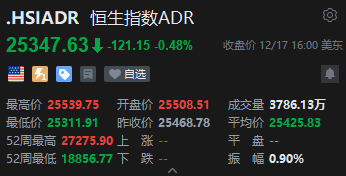
Market Overview - The three major U.S. stock indices all experienced declines on Wednesday, while the Hang Seng Index ADR rose, closing at 25,347.63 points, down 121.15 points or 0.48% compared to the Hong Kong close [1]. Hang Seng Index ADR Details - The Hang Seng Index ADR had a high of 25,539.75 and a low of 25,311.91, with a trading volume of 37.8613 million [2]. - The average price for the ADR was 25,425.83, with a previous close of 25,468.78 [2]. Major Blue-Chip Stocks Performance - HSBC Holdings closed at 118.414 HKD, up 0.78% compared to the Hong Kong close [3]. - Tencent Holdings closed at 595.34 HKD, down 1.6% compared to the Hong Kong close [3]. - Alibaba Group closed at 146.000 HKD, up 1.25%, while its ADR was 143.049 HKD, down 2.02% [4]. - Other notable stocks include AIA Group, which closed at 80.950 HKD, up 1.44%, and Xiaomi Group, which closed at 41.220 HKD, up 0.78% [4].




恒生指数上涨0.92% 恒生科技指数上涨1.03%
Xin Hua Cai Jing· 2025-12-17 21:09
(文章来源:新华财经) 个股方面,美团涨1.81%,长飞光纤光缆涨21.21%,中国平安涨1.80%,中国人寿涨4.31%,中芯国际涨 2.05%,友邦保险涨1.44%,比亚迪股份涨0.74%,泡泡玛特涨3.44%,山东黄金涨2.47%,HASHKEY HLDGS跌0.15%,国泰君安国际跌4.10%,赣锋锂业涨5.75%,工商银行涨0.84%,招商证券涨2.72%。 成交额前三的个股中,腾讯控股涨1.42%,成交超89亿港元;阿里巴巴涨1.25%,成交超87亿港元;小 米集团涨0.78%,成交超41亿港元。 新华财经香港12月17日电(记者林迎楠)17日,港股主要指数在震荡整理后上扬,截至收盘,恒生指数 上涨0.92%至25468.78点,恒生科技指数上涨1.03%至5457.95点,国企指数上涨0.98%至8843.57点。 当日恒指高开8.18点,开报25243.59点,早盘期间呈震荡整理态势,午后出现较大幅度上涨,此后在高 位窄幅整理,最终恒指涨233.37点,主板成交超1831亿港元。当日,港股通(南向)净流入超79亿港 元。 整体来看,多数板块上涨,科网、黄金、有色金属、券商、航空股多为上涨,生物 ...
智通港股沽空统计|12月17日
智通财经网· 2025-12-17 00:21
Group 1 - The core point of the news highlights the top short-selling ratios and amounts for various companies, indicating significant market activity and investor sentiment towards these stocks [1][2]. Group 2 - The top three companies with the highest short-selling ratios are New World Development Co. (80016), Anta Sports (82020), and JD Health (86618), all at 100.00% [1][2]. - The companies with the highest short-selling amounts are Alibaba (09988) at 3.027 billion, Xiaomi (01810) at 1.338 billion, and Tencent (00700) at 1.136 billion [1][2]. - The highest deviation values in short-selling are led by SenseTime (80020) at 37.00%, followed by Yum China (09987) at 26.80%, and JD Health (86618) at 25.81% [1][2].

智通ADR统计 | 12月17日
智通财经网· 2025-12-16 22:42
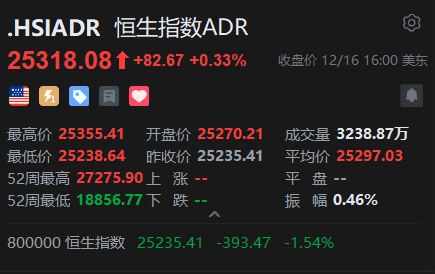
Core Viewpoint - The Hang Seng Index (HSI) showed a slight increase, closing at 25,318.08, up by 82.67 points or 0.33% from the previous day [1]. Group 1: Market Performance - The HSI closed at 25,318.08 with a trading volume of 32.39 million, reaching a high of 25,355.41 and a low of 25,238.64 during the session [1]. - The index has a 52-week high of 27,275.90 and a low of 18,856.77, indicating a volatility of 0.46% [1]. - Major blue-chip stocks mostly rose, with HSBC Holdings closing at 116.167 HKD, down 0.03% from the Hong Kong close, while Tencent Holdings rose by 0.4% to 598.882 HKD [2]. Group 2: Individual Stock Performance - Tencent Holdings (00700) saw a decrease of 6.500 HKD, or 1.08%, with an ADR price of 598.882 HKD, which is an increase of 2.382 HKD compared to its Hong Kong stock price [3]. - Alibaba Group (09988) dropped by 4.400 HKD, or 2.96%, with an ADR price of 145.179 HKD, up by 0.979 HKD from its Hong Kong price [3]. - HSBC Holdings (00005) remained unchanged at 116.200 HKD, with an ADR price of 116.167 HKD, down by 0.033 HKD [3]. - Other notable declines included China Construction Bank (00939) down 2.12%, Xiaomi Group (01810) down 2.25%, and AIA Group (01299) down 1.05% [3].



保险行业2026年年度投资策略:分红险重塑产品竞争力,新银保重构渠道新格局
Xin Lang Cai Jing· 2025-12-16 14:04
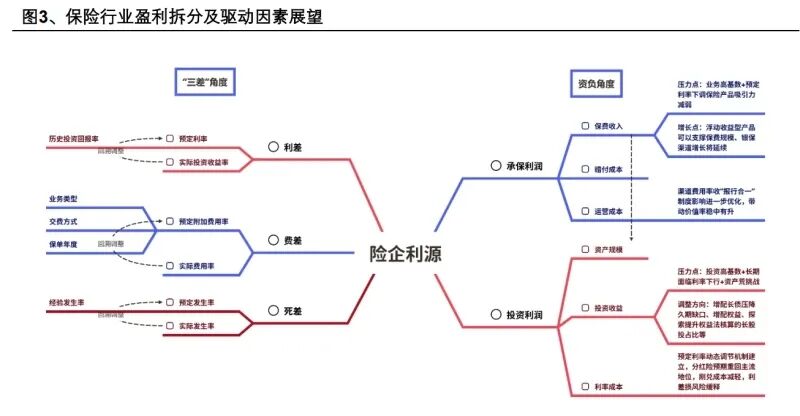
Overall Review - The insurance sector has experienced an overall increase, with A-shares and H-shares showing differentiated performance [1][7] - The fundamental performance indicates high value growth, with investment driving continued net profit growth [1][7] Financial Performance - For Q1-Q3 2025, the net profit growth year-on-year shows significant increases: China Life +60.5%, New China Life +58.9%, China Pacific Insurance +50.5%, PICC +28.9%, Taikang +19.3%, and Ping An +11.5% [2][9] - In Q3 2025 alone, the net profit growth year-on-year is led by China Life +91.5%, China Pacific Insurance +91.4%, and New China Life +88.2% [2][9] - The net asset changes from the beginning of the year show China Life +22.8%, PICC +16.9%, and China Pacific Insurance +12.3%, while Taikang saw a decline of -2.5% [2][9] Investment Logic - Insurance company profits are derived from underwriting profits and investment profits, with underwriting profits influenced by premium income and operational costs [3][10] - The investment profit is primarily affected by investment yield and liability cost rate, with the former being more variable due to market conditions [3][10] - The improvement in underwriting profits is driven by better product structures, channel efficiency, and cost control [3][10] Historical Stock Selection Logic - The stock selection logic for insurance companies has evolved through four phases over the past decade, with a focus on value growth from 2015-2019, short-term catalysts from 2020-2023, and a systemic revaluation of value in 2024 [5][13][14] - Since 2025, the systemic revaluation of value has continued, with H-shares of New China Life, PICC, and China Life leading the market [5][14] Future Outlook - The macroeconomic and capital market environment is expected to transition from a downward economic cycle with improving capital market conditions to a favorable economic cycle with a recovering capital market [6][15] - The focus will remain on net profit as a key indicator, with the importance of liability indicators represented by NBV expected to increase [6][15]