
古越龙山

Search documents
黄酒半年报丨古越龙山“一哥”地位险被超,会稽山增收难增利
Bei Ke Cai Jing· 2025-09-16 09:09
Group 1: Industry Overview - The competition in the yellow wine market is intensifying, with the revenue gap between the leading company, Guyue Longshan, and the second-ranked company, Kuaijishan, narrowing year by year [1][2] - The yellow wine industry has a small market size, accounting for less than 2% of the total alcoholic beverage market, indicating significant future market potential [1] Group 2: Company Performance - Guyue Longshan reported a revenue of 893 million yuan in the first half of the year, a year-on-year increase of 0.40%, while its net profit decreased by 4.72% to 90.31 million yuan [2][3] - Kuaijishan achieved a revenue of 817 million yuan, a year-on-year growth of 11.03%, and a net profit of 93.88 million yuan, up 3.41% [2][3] - Jinfeng Wine experienced a revenue decline of 9.04% to 216 million yuan and reported a loss of 7.14 million yuan, although the loss has narrowed compared to previous periods [3][4] Group 3: Financial Dynamics - Kuaijishan's sales expenses reached 215 million yuan, a significant increase of 53.69%, which has impacted its profit margins despite revenue growth [6][7] - The company has been investing in advertising and promotions, including collaborations with celebrities, which has led to increased sales but also higher costs [6][7] Group 4: Market Strategies - Both Guyue Longshan and Kuaijishan are focusing on product innovation aimed at younger consumers, with new product lines being introduced to capture this demographic [8][10] - The companies are also pursuing national expansion strategies, although they face challenges in penetrating markets outside their traditional strongholds in Jiangsu, Zhejiang, and Shanghai [9][10] Group 5: Consumer Trends - The yellow wine industry is experiencing a shift towards high-end and younger consumer segments, but the transition is proving challenging and requires time for market acceptance [11] - The current main price range for yellow wine is around 20 yuan, which is significantly lower than that of white wine, suggesting room for product upgrades [11]


非白酒板块9月15日跌0.65%,*ST椰岛领跌,主力资金净流出1.04亿元
Zheng Xing Xing Ye Ri Bao· 2025-09-15 08:42
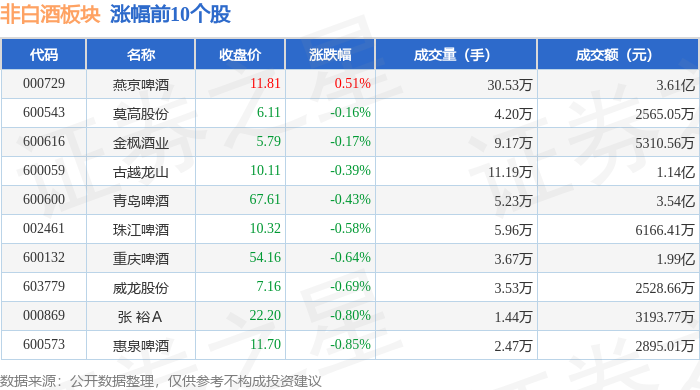
Market Overview - On September 15, the non-liquor sector declined by 0.65%, with *ST Yedao leading the drop [1] - The Shanghai Composite Index closed at 3860.5, down 0.26%, while the Shenzhen Component Index closed at 13005.77, up 0.63% [1] Stock Performance - The closing prices and performance of key stocks in the non-liquor sector are as follows: - *ST Yedao: 6.53, down 2.97%, with a trading volume of 108,800 shares and a turnover of 70.98 million yuan [2] - Other notable stocks include: - Zhirun Co.: 25.35, down 1.59%, with a turnover of 346 million yuan [2] - Chongqing Beer: 54.16, down 0.64%, with a turnover of 199 million yuan [2] Capital Flow - The non-liquor sector experienced a net outflow of 10.4 million yuan from institutional investors, while retail investors saw a net inflow of 113 million yuan [2] - Detailed capital flow for selected stocks shows: - Zhirun Co.: Net inflow of 11.05 million yuan from institutional investors [3] - Gu Yue Long Shan: Net inflow of 8.62 million yuan from institutional investors [3] - Other stocks like Huichuan Beer and *ST Lan Huang saw significant net outflows from institutional investors [3]


8月快手酒水销售,价格下探趋势持续扩散
Xin Lang Cai Jing· 2025-09-15 03:22
Core Insights - The article discusses the ongoing price war in the liquor industry, particularly in the e-commerce sector, leading to a significant drop in the average prices of various alcoholic beverages [1][2] - The data indicates a shift in consumer purchasing behavior towards lower-priced products across different categories, including baijiu, beer, and wine [4][6] Baijiu Market - In August, the sales distribution of baijiu on Kuaishou showed a decline in the 100-800 yuan price range, with the 100-300 yuan, 300-500 yuan, and 500-800 yuan segments dropping by 5%, 7%, and 1% respectively [2] - Conversely, the share of sales for baijiu priced below 100 yuan increased from 20.92% to 26.52%, while those above 800 yuan rose from 8.76% to 16.96% [2] - The top-selling baijiu brands in the 800 yuan and above category included Jinhuijiu and Wuliangye, indicating a growing demand for premium brands, although the majority of sales still came from private label or smaller brands [3] Beer Market - The proportion of beer sales priced below 100 yuan surged from 63.11% to 81.16%, while the 100-300 yuan segment fell from 36.67% to 17.42% [4][5] - The price sensitivity of consumers in the beer category has increased due to the ongoing price wars, leading to significant price reductions [5] - Major brands like Qingdao Beer and Heineken remain popular, alongside a growing interest in craft beers [5] Wine and Huangjiu Market - The sales of wine on Kuaishou remained stable, with 41.49% of sales occurring in the under 100 yuan category, slightly up from 39.27% [6] - Lafite continues to dominate the wine market, particularly in the 800 yuan and above segment, where it holds four out of the top five positions [6] - Huangjiu sales also reflected a downward price trend, with the under 100 yuan category rising from 15.73% to 21.13% [7] Overall Market Trends - The overall trend in the liquor market is a downward shift in consumer prices, influenced by the rise of new sales channels and e-commerce platforms [8] - Major brands are increasingly focusing on instant retail channels to attract younger consumers, indicating a significant shift in industry dynamics [8]

黄酒逆势提价:成本、需求还是市值考量?两家酒企上半年业绩透露端倪
Sou Hu Cai Jing· 2025-09-12 12:46
Group 1 - The yellow wine market has seen recent developments with leading companies Kuaijishan and Guyuelongshan implementing price increases on key products, ranging from 2% to 12% [1][3] - Kuaijishan's price increase is the first since 2016, while Guyuelongshan has adjusted prices again after the second half of 2023 [1][3] - The price hikes aim to enhance consumer recognition of the market value of yellow wine products [1] Group 2 - The price adjustments in the consumer goods sector are influenced by multiple factors, including raw material costs, market demand changes, and the macroeconomic environment [3] - The price increase by yellow wine companies occurs against a backdrop of general price reductions in the white wine industry, raising industry concerns [3] - Kuaijishan reported a revenue of 817 million yuan, a year-on-year increase of 11.03%, and a net profit of 93.88 million yuan, up 3.41% [3] - Guyuelongshan's revenue was 893 million yuan, a slight increase of 0.4%, but its net profit fell to 90.31 million yuan, down 4.72% [3] - Kuaijishan's revenue growth has noticeably slowed compared to previous years, with growth rates of 18.24% and 14.25% in 2024 and 2023 respectively [3] - Guyuelongshan's performance is more concerning, with both revenue and net profit metrics below those of the same period in the previous two years [3] Group 3 - Market observers note that the price increase strategy may face dual challenges: competition pressure from the declining white wine prices and the need for product upgrades and brand building to support the pricing structure [3] - The yellow wine consumption market remains primarily regional, with national expansion not yet fully realized, making the acceptance of price increases uncertain [3][4] - The overall scale of the yellow wine industry is about one-tenth that of the white wine industry, indicating significant potential for consumer awareness and market penetration [4] - Balancing market acceptance and profit margins will be crucial for the success of the price increase strategy [4]
非白酒板块9月12日跌1.05%,百润股份领跌,主力资金净流出1.45亿元
Zheng Xing Xing Ye Ri Bao· 2025-09-12 08:31
Market Overview - On September 12, the non-liquor sector declined by 1.05%, with Bai Run Co., Ltd. leading the drop [1] - The Shanghai Composite Index closed at 3883.69, up 0.22%, while the Shenzhen Component Index closed at 12996.38, up 0.13% [1] Stock Performance - The following stocks in the non-liquor sector experienced notable price changes: - Bai Run Co., Ltd. (002568) closed at 25.91, down 1.78% with a trading volume of 95,000 shares and a turnover of 248 million yuan [2] - ST Xifa (000752) closed at 11.96, down 1.56% with a trading volume of 67,800 shares and a turnover of 82.15 million yuan [2] - Xianjing Beer (000729) closed at 11.82, down 1.34% with a trading volume of 227,600 shares and a turnover of 270 million yuan [2] Capital Flow - The non-liquor sector saw a net outflow of 145 million yuan from institutional investors, while retail investors had a net inflow of 123 million yuan [2][3] - The following stocks had significant capital flows: - Gu Yue Long Shan (600059) had a net inflow of 11.18 million yuan from institutional investors, but a net outflow of 7.20 million yuan from retail investors [3] - Chongqing Beer (600132) had a net inflow of 7.43 million yuan from institutional investors, with a net outflow of 14.01 million yuan from retail investors [3]


非白酒板块9月11日涨0.71%,ST西发领涨,主力资金净流出4445.38万元
Zheng Xing Xing Ye Ri Bao· 2025-09-11 08:43
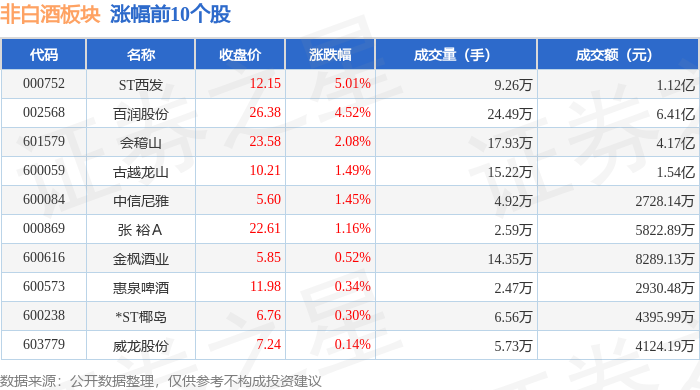
Core Insights - The non-liquor sector experienced a rise of 0.71% on September 11, with ST Xifa leading the gains [1] - The Shanghai Composite Index closed at 3875.31, up 1.65%, while the Shenzhen Component Index closed at 12979.89, up 3.36% [1] Non-Liquor Sector Performance - ST Xifa (000752) closed at 12.15, with a gain of 5.01% and a trading volume of 92,600 shares, amounting to a transaction value of 112 million yuan [1] - Zhirun Co. (002568) closed at 26.38, up 4.52%, with a trading volume of 244,900 shares and a transaction value of 641 million yuan [1] - Huaiqiang Mountain (601579) closed at 23.58, up 2.08%, with a trading volume of 179,300 shares and a transaction value of 417 million yuan [1] - Gu Yue Long Shan (600059) closed at 10.21, up 1.49%, with a trading volume of 152,200 shares and a transaction value of 154 million yuan [1] Capital Flow Analysis - The non-liquor sector saw a net outflow of 44.45 million yuan from institutional investors, while retail investors had a net inflow of 24.80 million yuan [2] - The main capital inflow was observed in Zhirun Co. with a net inflow of 71.79 million yuan from institutional investors [3] - ST Xifa experienced a net inflow of 8.63 million yuan from institutional investors, despite a net outflow from retail investors [3]

非白酒板块9月10日跌0.27%,*ST兰黄领跌,主力资金净流出888.95万元
Zheng Xing Xing Ye Ri Bao· 2025-09-10 08:30
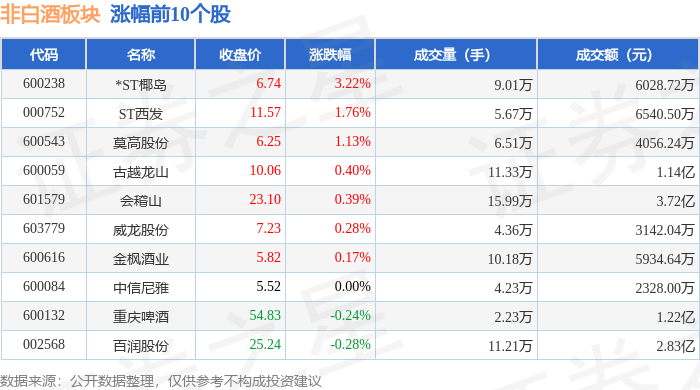
Market Overview - On September 10, the non-liquor sector declined by 0.27% compared to the previous trading day, with *ST Lanhua leading the decline [1] - The Shanghai Composite Index closed at 3812.22, up 0.13%, while the Shenzhen Component Index closed at 12557.68, up 0.38% [1] Stock Performance - Notable gainers in the non-liquor sector included *ST Yedao, which rose by 3.22% to close at 6.74, and ST Xifa, which increased by 1.76% to 11.57 [1] - Conversely, *ST Lanhua fell by 2.18% to 8.51, and Zhujiang Beer decreased by 1.22% to 10.53 [2] Trading Volume and Value - The trading volume and value for selected stocks in the non-liquor sector showed significant activity, with Gu Yue Long Shan recording a trading volume of 113,300 hands and a transaction value of 114 million yuan [1] - The total net outflow of funds in the non-liquor sector was 8.89 million yuan from main funds, while retail investors saw a net inflow of 28.12 million yuan [2] Fund Flow Analysis - Ba Run Co. had a main fund net inflow of 26.84 million yuan, while retail investors experienced a net outflow of 4.98 million yuan [3] - The fund flow analysis indicates that while main funds were withdrawing, retail investors were actively buying into certain stocks, such as Huaiqian Beer, which saw a net inflow of 2.76 million yuan from retail investors [3]


黄酒:积极求变,创新突围
2025-09-09 14:53
Summary of Huangjiu Industry Conference Call Industry Overview - The Huangjiu industry is experiencing significant challenges, including a sharp decline in scale and sales volume, with a need for transformation and upgrading due to unclear consumption scenarios, an aging consumer base, and low-end product offerings [1][2][3] - The market concentration is increasing, with leading companies such as Guyue Longshan, Kuaijishan, and Jinfeng Liquor significantly increasing their market share, yet overall sales revenue is still declining, indicating intensified market competition and survival pressure for companies [1][4] Core Insights and Arguments - The Huangjiu industry has reached a turning point towards high-end products and diversified consumption scenarios, with leading companies launching premium series and utilizing tasting promotions to expand their core consumer base. The price per ton of mid-to-high-end products has increased, with Kuaijishan's mid-to-high-end product ton price rising by 20% year-on-year and Guyue Longshan's by 10% [1][5] - Leading companies have begun to implement price increases on mass-market products, approximately 5%, reflecting their enhanced bargaining power due to increased market concentration [1][6] - Kuaijishan has introduced innovative products like sparkling Huangjiu and utilized e-commerce platforms and holiday promotions to attract younger consumers, achieving a breakthrough effect and providing new ideas for the industry's youth-oriented and social development [1][7] Challenges Faced - The Huangjiu industry faces several key challenges, including a lack of clear consumption scenarios compared to other alcoholic beverages, a severely aging consumer demographic, and a predominance of low-end products priced around 20-30 yuan, which hampers the expansion into high-end markets and brand value enhancement [3][9] - Despite the increase in market concentration, the overall sales revenue has decreased from 20 billion yuan in 2016 to around 10 billion yuan in 2023, indicating a need for strategic shifts [4][8] Market Performance and Trends - In 2023, the sales revenue of Huangjiu production companies was approximately 10 billion yuan, with total profits around 1.6 billion yuan. The industry has seen a 50% decline in scale and sales volume from 2016 to 2023, while other alcoholic beverages like Baijiu and beer have performed strongly [2][8] - Since the end of the pandemic in 2022 and 2023, leading companies have seen revenue growth rates increase from single digits to double digits, with Kuaijishan and Guyue Longshan achieving revenue growth rates of 10% and 9%, respectively [8][9] Future Directions - The future development of Huangjiu companies will focus on high-end product offerings and diversified consumption scenarios. Although the current channel profits for single bottles of Huangjiu are acceptable, there is still a gap in turnover rates and sales compared to Baijiu and beer [10] - Strategies such as product innovation, including the introduction of sparkling Huangjiu, are essential for improving consumer acceptance. Long-term, the high-end pricing strategy will be crucial, along with efforts to attract younger consumers [10][12] Capital Market Expectations - The capital market has high expectations for Huangjiu companies, with Kuaijishan's stock price doubling and Guyue Longshan's stock price increasing by 40%-50%. However, investors should be cautious regarding valuation, as current stock prices reflect significant expectations, with leading companies' valuations around 40 times earnings [11][12] Conclusion - The Huangjiu industry is at a critical juncture, requiring strategic innovation and market expansion efforts to overcome existing challenges and capitalize on emerging opportunities for growth and profitability [1][10][12]
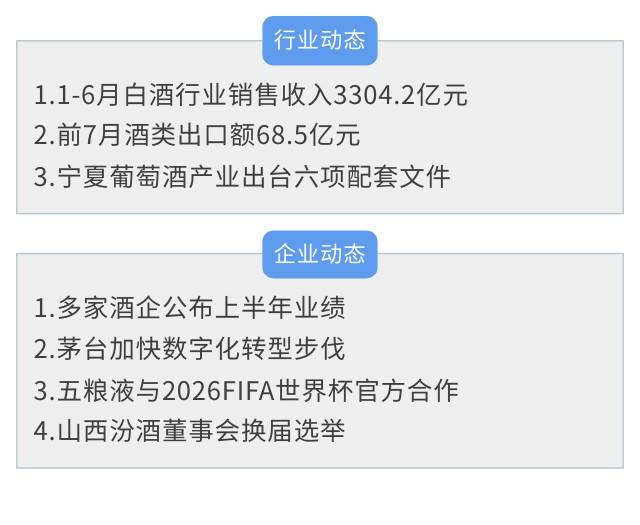
中经酒业周报∣1-6月白酒行业销售收入3304.2亿元,前7月酒类出口额68.5亿元,多家酒企公布上半年业绩
Xin Hua Cai Jing· 2025-09-05 10:34
Industry Overview - In the first half of 2025, the sales revenue of the Chinese liquor industry reached 330.42 billion yuan, showing a slight increase of 0.19% year-on-year [4] - The number of large-scale liquor enterprises decreased to 887, down by over 100 compared to the same period last year [4] - The production volume of the liquor industry was 1.9159 million kiloliters, a year-on-year decline of 5.8%, while profits fell by 10.93% to 87.687 billion yuan [4] Export Performance - In the first seven months of 2025, the total export value of liquor reached 6.85 billion yuan, with a cumulative export volume of 486,600 kiloliters [5] - Traditional liquor exports accounted for 4.179 billion yuan, with baijiu exports at 4.091 billion yuan and huangjiu at 87.25 million yuan [5] Company Performance - Luzhou Laojiao reported a revenue of 16.454 billion yuan for the first half of 2025, down 2.67% year-on-year, with a net profit of 7.663 billion yuan, a decrease of 4.54% [8] - Gujing Gongjiu achieved a revenue of 13.88 billion yuan, a slight increase of 0.54%, and a net profit of 3.662 billion yuan, up 2.49% [8] - Shunxin Agriculture's liquor segment reported a revenue of 3.606 billion yuan, down 23.25% [8] - Water Well Square's revenue was 1.498 billion yuan, down 12.84%, with a net profit decline of 56.52% to 105 million yuan [8] - Other companies like Pearl River Beer and Gansu Huangtai also reported varied performance, with Pearl River Beer showing a revenue increase of 7.09% [9] Strategic Developments - Moutai Group is accelerating its digital transformation to enhance the digital development level across its entire industry chain [8] - Wuliangye announced its partnership as an official product for the 2026 FIFA World Cup, aiming to integrate sports marketing with liquor [10] - Ningxia has introduced six supporting documents for the wine industry, marking a step towards market-oriented resource allocation [7]
剖析酒业半年报:调整期行业结构未见变化,谁过得好?
Nan Fang Du Shi Bao· 2025-09-03 11:03
Group 1: Overall Industry Performance - The alcohol industry is experiencing a deep adjustment phase, with most listed companies reporting a shift from significant growth to "active adjustment" in performance [1][2] - The overall structure of the industry remains largely unchanged, with market concentration increasing towards leading companies [1][2] Group 2: Baijiu Industry - The baijiu sector is the most affected by the adjustment, with 20 listed companies reporting mixed results: 6 companies saw both revenue and net profit increase, while 13 reported declines [2][3] - Leading companies like Kweichow Moutai and Wuliangye maintained growth, while smaller firms faced more significant performance declines, highlighting a growing industry divide [2][3] Group 3: Beer Industry - The beer industry is showing signs of recovery, with domestic companies reporting revenue growth while international firms are experiencing declines [5][6] - High-end products are becoming a key competitive factor, with companies like China Resources Beer and Yanjing Beer reporting significant profit increases [6][7] Group 4: Huangjiu Industry - The huangjiu sector is struggling to achieve collective growth, with only one of three listed companies reporting an increase in revenue [8][9] - Companies are focusing on national expansion and targeting younger demographics, but overall performance remains lackluster [8][9] Group 5: Wine Industry - The domestic wine market is still in a deep adjustment phase, with most companies reporting revenue declines, except for a few like CITIC Niyah [10][11] - The market is facing challenges from imported wines, which have increased in value despite a decrease in volume [10][11]