Scale AI

Search documents
明星AI独角兽Windsurf被瓜分的背后:资本拉锯、背刺与共识破灭|101 Weekly
硅谷101· 2025-07-23 00:19
Acquisition & Business Dealings - OpenAI and AI programming unicorn Windsurf had acquisition negotiations with a valuation of $3 billion [1] - Google signed a "non-exclusive licensing" deal for Windsurf technology for $2.4 billion and acquired the company's CEO and core R&D team [4] - Cognition acquired the remaining shares of Windsurf for a nine-digit US dollar range, all in cash [7] Windsurf's Challenges & Market Position - Windsurf's ARR dropped from $100 million to $82 million after Anthropic cut off its access to Claude [15] - Windsurf's moat is not high enough because its capabilities are supported by underlying large models such as OpenAI's GPT and Anthropic's Claude [10] - Giants like Anthropic are becoming direct competitors to AI programming startups like Windsurf [10] Talent Acquisition & Industry Trends - Silicon Valley giants have invented the "acquihire" strategy to circumvent antitrust review, poaching senior and core talents [22] - Companies like Character AI, Inflection AI, and Adept have been acquired in this way, leading to layoffs and restructuring [23][24] - The AI talent war is changing the consensus between founders and employees in Silicon Valley [21] Future of AI Startups - One person may be able to create a unicorn company due to the advancing capabilities of AI [27] - Silicon Valley AI startups need to face the situation of fighting among giants and survive cautiously [30]


A Crypto-Incentive Approach for Training Data
Bloomberg Technology· 2025-07-22 19:32
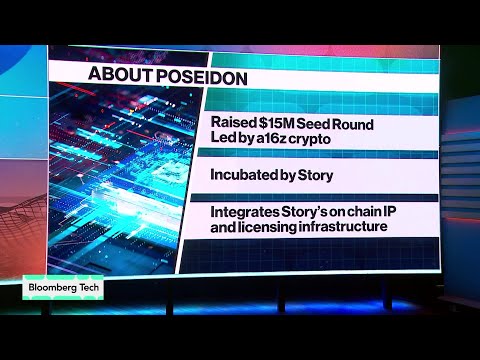
Core Problem & Solution - AI model commoditization and decreasing compute costs highlight data as the primary bottleneck [1] - The company addresses the data bottleneck by coordinating data collection, labeling, and curation using crypto incentives [4] - Crypto and blockchain technology facilitate the placement of data and IP on an immutable ledger, enabling tracking, attribution, and licensing via smart contracts [7] Competitive Advantage & Market Opportunity - Meta Scale AI's partial acquisition created a vacuum in the AI data space, presenting an opportunity for competitors [6] - The company's decentralized approach allows collaboration with any IP, offering flexibility [15] - The company has already secured contracts, indicating market demand [13] Data Acquisition & Application - The company uses crypto incentives to coordinate data collection on a global scale, compensating contributors with stablecoins or other crypto tokens [6] - The collected data, including egocentric video footage from diverse settings, is crucial for training AI models, such as humanoid robots [9] - Contributors set licensing usage terms on the blockchain, ensuring IP safety [12] Business Model & Demand - The company acts as an agent to secure contracts, connecting data providers with AI model developers [13] - Many organizations are willing to work with the company, some dropping contracts from Scale AI [14][15]
X @Andy
Andy· 2025-07-22 16:14
A month ago Meta acquired Scale AI for $14B, now a16z comes out and is backing Poseidon🤔Poseidon (@psdnai):AI is moving beyond the browser and into the real world. The bottleneck? Data.Today we’re announcing a $15M seed round led by @a16zcrypto to build infra that collects, curates, and licenses high-quality data for physical AI.Incubated by and built on @StoryProtocol. https://t.co/OKnHrtTwgq ...

Meta二季报前瞻:广告收入“超预期”,AI工具起效,明年资本开支继续大涨?
Hua Er Jie Jian Wen· 2025-07-22 03:58
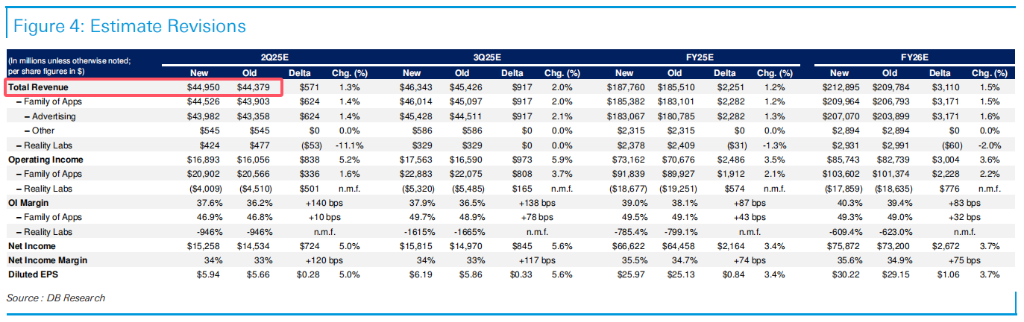
Core Viewpoint - Deutsche Bank's report anticipates that AI capital expenditures will be a focal point for Meta, with investors needing to monitor cost pressures closely [1][14]. Revenue Expectations - Meta's second-quarter revenue is expected to be adjusted upwards to $45 billion, representing a year-over-year growth of approximately 15% [1]. - The total revenue projections for FY25E and FY26E are $187.76 billion and $212.895 billion, respectively, with growth rates of 1.2% and 1.5% compared to previous estimates [2]. Advertising Performance - Meta's advertising revenue growth in Q2 is expected to increase by about 1 percentage point quarter-over-quarter, contrasting with Wall Street's predictions of a decline in U.S. and Canadian advertising growth [3][4]. - The core driver of this strong performance is attributed to the application of AI technology, particularly Meta's Advantage+ tool, which significantly improves advertisers' return on ad spend (ROAS) [4]. User Engagement - User engagement metrics for Meta's core applications have shown positive improvements due to AI enhancements, supporting future advertising display growth [7]. - Facebook's global conversation count decreased by 5% year-over-year, while Instagram's increased by 4% [8]. Cost and Capital Expenditure - Despite positive revenue trends, the focus has shifted to the cost side, with expectations for Meta's total expenses to remain between $113 billion and $118 billion for FY25, potentially increasing in the second half of the year [14]. - Capital expenditures for FY25 are projected to be between $64 billion and $72 billion, reflecting anticipated hardware cost inflation [14]. AI Talent Competition - Meta is engaged in a fierce competition for AI talent, offering bonuses of up to $100 million to top AI engineers, which contributes to rising operational and capital expenditures [14]. - The company has announced a strategic investment of $14 billion to acquire a 49% stake in Scale AI, further emphasizing its commitment to AI development [14].
Meta AI 梦之队成员背景大盘点,44 人中近一半为华人研究员
Founder Park· 2025-07-21 13:26
Core Insights - Meta is aggressively recruiting top talent from AI companies, particularly OpenAI, to enhance its AI capabilities, with a focus on building a "superintelligence" team [1][4][49] - A leaked list reveals that 44 top AI researchers have joined Meta, with 40% coming from OpenAI, 20% from DeepMind, and 15% from Scale AI, highlighting a significant influx of talent [5][49] - The recruitment strategy includes offering substantial financial incentives and promises of unlimited computational resources, which are attractive to researchers [49][50] Group 1: Recruitment Strategy - Meta's recruitment efforts were inspired by a conversation between Mark Zuckerberg and OpenAI's Chief Researcher Mark Chen, who suggested investing in talent [4][49] - Despite offers of up to $300 million, at least 10 OpenAI employees declined to join Meta, indicating a strong loyalty to their current employer [4][49] - The recruitment list includes a significant number of Chinese researchers, with 50% of the team members being from China [5][47] Group 2: Talent Profile - The majority of the recruited researchers hold advanced degrees, with 75% having PhDs and 70% previously working as researchers [5][49] - Notable recruits include Chengxu Zhuang, Chenxi Liu, and Chunyuan Li, who have impressive academic backgrounds and experience in leading AI projects at top companies [8][12][16] - The list features a diverse range of expertise, including natural language processing, computer vision, and multimodal generation, showcasing Meta's aim to cover various AI domains [5][49] Group 3: Competitive Landscape - Meta's commitment to building powerful computational resources includes plans to invest hundreds of billions to create multiple gigawatt-level supercomputing clusters [49][50] - OpenAI is also ramping up its capabilities, planning to deploy 1 million GPUs by 2025/2026, which would represent a significant resource allocation for AI training [54] - The competition between Meta and OpenAI is intensifying, with both companies vying for dominance in AI research and development [54][55]

争夺人工智能人才的史诗级大战
阿尔法工场研究院· 2025-07-21 12:10
Core Insights - The article discusses the intense competition for talent in Silicon Valley, particularly in the artificial intelligence sector, highlighting the significant financial incentives being offered to attract top researchers and engineers [1][2][3] Group 1: Talent Acquisition and Competition - OpenAI was in talks to acquire Windsurf for $3 billion, but the deal fell through, leading to Windsurf's CEO leaving for Google and taking key employees with him [1][18] - Meta, under Mark Zuckerberg's leadership, is aggressively recruiting top talent, offering compensation packages exceeding $300 million, which has led to a shift in the talent market [2][9] - The competition has elevated AI researchers to "superstar" status, with salaries comparable to those of NBA players and Hollywood stars [1][2] Group 2: Company Strategies and Responses - Meta is focusing on building a "dream team" in AI by poaching leaders from promising startups and offering limited-time job offers to create urgency [2][3] - OpenAI's leadership is responding to the talent war by adjusting compensation and exploring innovative ways to recognize and reward top talent [11] - The article highlights a conversation between Zuckerberg and OpenAI's Chief Researcher, which led to a strategic shift in Meta's recruitment approach, emphasizing investment in talent over hardware [4][7] Group 3: Impact on Startups - Windsurf's acquisition by Google for $2.4 billion resulted in a significant loss of talent and left many employees feeling abandoned [18][19] - The article illustrates the emotional impact on employees at Windsurf, who were left uncertain about their future after the acquisition news [19][20] - The trend of "acquihire" deals is becoming common among tech giants, often leaving remaining employees in a precarious position [18]


95后北大校友挑起ChatGPT Agent大梁!今年刚博士毕业,曾获陶哲轩支持的AIMO第二名
量子位· 2025-07-20 05:08
Core Viewpoint - The article highlights the significant presence of Chinese talent at OpenAI, particularly during a recent event where two Chinese individuals took center stage, showcasing their contributions to key projects like ChatGPT Agent and GPT-4 [2][8][34]. Group 1: Key Individuals - Zhiqing Sun, a 95-born graduate from Peking University, is the head of Deep Research at OpenAI and has made substantial contributions to various core projects within a short span of time [14][16]. - Casey Chu, a senior employee at OpenAI, has been involved in the development of multimodal AI systems and led the initial prototype development for GPT-4's visual input [29][31]. Group 2: Contributions and Achievements - Zhiqing Sun's research has garnered over 10,000 citations, with notable works including the RotatE method for knowledge graph embedding, which has been cited 3,231 times [21][23]. - Casey Chu has participated in the development of major projects like DALL·E 2 and GPT-4, with the GPT-4 technical report receiving 15,859 citations [31]. Group 3: Industry Dynamics - The article discusses the competitive landscape, noting that despite Meta's efforts to recruit talent from OpenAI, the presence of Chinese researchers remains strong, indicating a deep pool of talent that is difficult to deplete [34][36]. - The narrative also touches on the broader implications of talent migration within the AI industry, particularly the strategic moves by companies like Meta to secure top talent [48][50].

模型之外,数据为王:Meta天价收购揭示AI新战场
Sou Hu Cai Jing· 2025-07-18 13:52
文|数据猿 "当模型军备竞赛陷入瓶颈,数据成为巨头争夺的下一个高地。 近日,Meta以148亿美元收购AI初创公司Scale AI的49%股份,这一交易将创下私营公司融资交易的历史新纪录。Scale AI是一家快速崛起的数据标注公 司,拥有50多万遍布世界各地的员工,从事数据标注工作。这一重磅新闻释放了一个信号:数据在AI竞赛中的战略地位越发凸显——当模型军备竞赛陷 入瓶颈,数据成为巨头争夺的下一个高地。 在这场由数据驱动、大模型实现、算力支撑的智能革命里,市场上几乎所有人都在攒模型、买算力,数据逐渐成为了这个"大三角"最薄弱的一环。 AI时代,一道悄然树立的"硅幕" 作家尤瓦尔·赫拉利指出,随着人工智能的快速发展,一道"硅幕"正在落下。这道"硅幕"不仅是企业之间,在企业内部同样显著。 ☆数据割裂与治理缺位:恶性循环的根源 过去十年数字化系统的膨胀埋下隐患:业务、系统、部门间形成数据孤岛。其根源在于支撑工具链的深度割裂——数据采集、存储、处理、分析、建模、 应用等环节采用互不联通的不同工具。这种割裂制造了人为"断点",导致数据流动受阻、价值难以整合:看似各环节工具"完整",却因无法协同而失效。 工具链的断裂必 ...
72小时瓦解200亿独角兽
投中网· 2025-07-18 06:10
Core Viewpoint - The article discusses the dramatic acquisition of the AI coding startup Windsurf, which was valued at $3 billion (approximately 21 billion RMB), highlighting the rapid changes in ownership and the implications for its employees and the industry [1][3][10]. Group 1: Acquisition Details - Windsurf was initially targeted for acquisition by OpenAI for $3 billion, but negotiations fell through due to Microsoft's interference regarding intellectual property rights [3][4]. - Google subsequently acquired key personnel from Windsurf for $2.4 billion, gaining non-exclusive rights to some of Windsurf's technology while allowing the company to remain independent [5][6]. - Within 72 hours of the Google acquisition, Cognition swiftly acquired Windsurf's remaining assets, including intellectual property and client contracts, for an undisclosed amount [7][16]. Group 2: Employee Impact - The departure of Windsurf's founder and key engineers to Google has left the company in a precarious position, with remaining employees feeling abandoned [10][12]. - Cognition's acquisition plan includes ensuring that all Windsurf employees receive economic benefits from the deal, contrasting with the situation at Google [17]. - Windsurf's previous investors, including Kleiner Perkins and General Catalyst, had invested a total of $243 million, with expectations of significant returns following the acquisition [10][11]. Group 3: Industry Context - The article notes a growing trend among tech giants like Google and Microsoft to acquire talent from startups without full acquisitions, indicating a competitive landscape for AI talent [11][12]. - The acquisition of Windsurf reflects the intense competition in the AI sector, with companies like Meta also engaging in similar talent acquisition strategies [11][12][13]. - The situation raises questions about the sustainability of startup ecosystems when key personnel leave, as seen with other companies like Inflection AI and Scale AI [12][13].

这家新创公司的AI颠覆了电影业
财富FORTUNE· 2025-07-17 12:40
Core Viewpoint - The article discusses the evolution of AI in the creative industry, particularly focusing on Runway, an AI video startup, and its impact on art and storytelling through technology [1][6]. Group 1: Runway and AI Film Festival - Runway, valued at $3 billion, hosted the AI Film Festival (AIFF) showcasing AI-generated short films, with submissions increasing from 300 to 6,000 in one year [3][6]. - The winning film, "Total Pixel Space," reflects Runway's vision of AI-generated experiences that go beyond storytelling to world-building [3][4]. Group 2: Technological Evolution in Art - The evolution of technology in art is described in three stages: making technology work, mimicking existing art forms, and creating unique forms, with the industry currently entering the third stage [11][12]. - The article highlights the philosophical implications of AI in art, questioning the nature of creativity and the potential for AI to generate meaningful images [3][5]. Group 3: Future Directions and Market Position - Runway aims to simulate the physical world and is planning to launch an interactive gaming experience, indicating a shift towards more immersive media [5][6]. - The company has raised over $500 million from investors like SoftBank and Nvidia, and faces competition from other AI video companies [6][12]. Group 4: Historical Context and Concerns - The article draws parallels between past technological disruptions in art, such as the printing press, and the current rise of AI, noting concerns about job displacement [7][8]. - The narrative emphasizes the need for creative exploration in the face of technological advancements, suggesting that AI should be viewed as a tool rather than a replacement for human creativity [12].