
东方财富

Search documents
中国券商 - 关于上调保证金比例的观点-China Brokers-Our Take On Raising Margin Ratio
2026-01-15 02:51
Summary of Key Points from the Conference Call Industry Overview - The report focuses on the **China Brokers** industry within the **Asia Pacific** financial sector, specifically analyzing the implications of recent regulatory changes on margin ratios and market dynamics [1][6]. Core Insights - **Margin Ratio Increase**: On January 14, 2026, the Shanghai and Shenzhen Exchanges raised the minimum margin ratio from 80% to 100%, effectively capping leverage at 1x compared to the previous 1.25x. This regulatory change is seen as a proactive measure to sustain a slow bull market [8][3]. - **Average Daily Trading (ADT)**: The report anticipates a full-year expectation of Rmb1.77 trillion in ADT, representing a 4.9% year-over-year increase. This growth is attributed to strong household financial asset growth, inflows to institutional investors, and positive market sentiment [3][2]. - **Market Liquidity**: The impact on market liquidity is expected to be limited, as margin finance as a percentage of market capitalization stands at approximately 2.3%, significantly lower than the peak of 3.8% in 2015 [8][9]. - **Securities Lending Business**: The potential relaxation of the effective short sell ban, which has been in place since July 2024, could benefit leading institutional brokers by enhancing the securities lending business [4]. Additional Important Points - **Regulatory Signals**: Regulators have indicated that the higher margin ratio will only apply to new business, not existing positions, which is intended to mitigate immediate market disruptions [8]. - **Market Sentiment**: The report suggests that a slow bull market could create a positive feedback loop between primary and secondary markets, supporting an increase in return on equity (ROE) for brokers [3]. - **Current Market Conditions**: The ADT recently reached a record high of Rmb3.6 trillion, indicating robust trading activity despite the regulatory changes [8]. Conclusion - The overall outlook for the broker business in China remains constructive, with expectations of increased fundraising volume and institutional trading flows, supported by the recent regulatory adjustments and positive market conditions [3][6].
东方财富跌2.02%,成交额41.31亿元,主力资金净流出6.04亿元
Xin Lang Cai Jing· 2026-01-15 02:51
Core Viewpoint - Oriental Fortune's stock price has experienced fluctuations, with a recent decline of 2.02% and a total market capitalization of 382.77 billion yuan, while the company shows a year-to-date stock price increase of 4.49% [1] Group 1: Stock Performance - As of January 15, Oriental Fortune's stock price was 24.22 yuan per share, with a trading volume of 4.131 billion yuan and a turnover rate of 1.27% [1] - The stock has increased by 4.49% year-to-date, with a 0.92% rise over the last five trading days and a 7.12% increase over the last 20 days, but has decreased by 4.50% over the last 60 days [1] Group 2: Financial Performance - For the period from January to September 2025, Oriental Fortune reported operating revenue of 2.543 billion yuan, reflecting a year-on-year growth of 13.41%, and a net profit attributable to shareholders of 909.7 million yuan, which is a 50.57% increase year-on-year [2] Group 3: Shareholder Information - As of September 30, 2025, the number of shareholders for Oriental Fortune was 1.0139 million, a decrease of 8.84% from the previous period, while the average number of circulating shares per person increased by 9.70% to 13,193 shares [2] - The company has distributed a total of 4.818 billion yuan in dividends since its A-share listing, with 2.504 billion yuan distributed over the last three years [3] - The top circulating shareholders include Hong Kong Central Clearing Limited, holding 540 million shares, and the Guotai CSI All-Index Securities Company ETF, holding 327 million shares, both showing significant changes in their holdings [3]

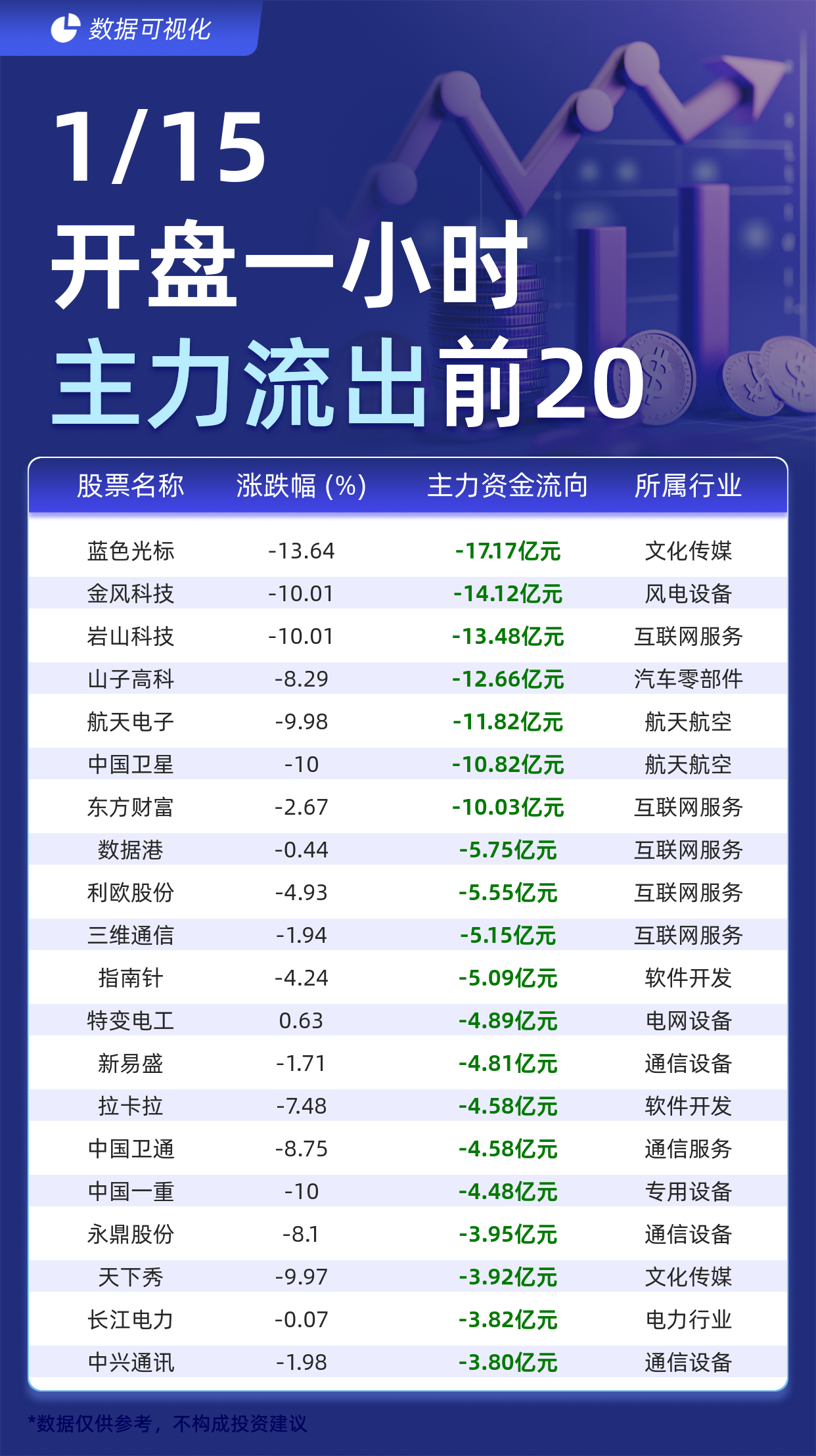
主力个股资金流出前20:蓝色光标流出17.17亿元、金风科技流出14.12亿元


Jin Rong Jie· 2026-01-15 02:47
Group 1 - The main stocks with significant capital outflows include BlueFocus (-1.717 billion), Goldwind (-1.412 billion), and Yanshan Technology (-1.348 billion) [1] - The sectors affected by the capital outflows include cultural transmission, wind power equipment, and internet services [2][3] - The largest percentage drop in stock prices was observed in BlueFocus (-13.64%) and Goldwind (-10.01%) [2] Group 2 - Other notable stocks with capital outflows include Aerospace Electronics (-1.182 billion), China Satellite (-1.082 billion), and Dongfang Fortune (-1.003 billion) [1] - The telecommunications sector also saw significant outflows, with companies like ZTE (-0.380 billion) and China Satcom (-0.458 billion) experiencing declines [3] - The overall trend indicates a bearish sentiment in the market, particularly affecting technology and aerospace sectors [2][3]

965股获融资买入超亿元,中际旭创获买入42.0亿元居首
Di Yi Cai Jing· 2026-01-15 01:17
Group 1 - On January 14, a total of 3,759 stocks in the A-share market received financing funds, with 965 stocks having a buying amount exceeding 100 million yuan [1] - The top three stocks by financing buying amount were Zhongji Xuchuang, Dongfang Caifu, and Tebian Electric, with amounts of 4.2 billion yuan, 4.173 billion yuan, and 3.622 billion yuan respectively [1] - Three stocks had financing buying amounts accounting for over 30% of the total transaction amount, namely Allianz Ruishi, Huilong Co., and Su Yan Jingshen, with ratios of 37.55%, 33.22%, and 30.29% respectively [1] Group 2 - A total of 87 stocks had a net financing buying amount exceeding 100 million yuan, with the top three being Changjiang Electric, Tebian Electric, and Zhongji Xuchuang, which had net buying amounts of 1.383 billion yuan, 981 million yuan, and 957 million yuan respectively [1]


大摩闭门会:原材料、金融、交运行业更新
2026-01-15 01:06
Summary of Conference Call Industry and Company Overview - The conference call covered updates on the financial, transportation, and materials industries, with a focus on investment opportunities and market dynamics for 2026 [2][4][46]. Key Points and Arguments Financial Industry Insights - The financial sector is entering a positive cycle, with expectations of a gradual rebound in financial asset yields and loan interest rates starting in the second half of the year [4][5]. - The overall fee income has returned to a good growth state, supported by high household financial asset growth and savings rates [4][5]. - The macroeconomic environment is viewed positively, with GDP growth expected to stabilize and PPI pressures decreasing, leading to a more favorable financial landscape [5][6]. - Loan growth has slowed to around 6%, with a rationalization in lending practices and a stable financial policy environment [11][12]. - The financial sector is expected to see a significant increase in valuations due to income rebounds and improved risk management [6][16]. Insurance Sector Outlook - The insurance industry is projected to experience strong growth in new business value and premium income in 2026, driven by attractive product offerings and market share gains in bancassurance channels [20][21]. - The stable interest rate environment and positive capital market sentiment are expected to enhance the profitability of insurance companies [22][23]. - The focus will shift from asset-driven growth to a balanced approach considering both assets and liabilities [20][21]. Securities Industry Trends - The securities sector is anticipated to benefit from a favorable operating environment, with active trading volumes and a supportive regulatory backdrop [29][30]. - IPO activity is expected to increase, particularly in the Hong Kong market, with a projected rise in both the number and size of offerings [31][32]. - The A-share market is also expected to see a recovery in financing volumes, with a focus on balancing dividends and capital raising [33][34]. - Institutional investment is on the rise, leading to increased demand for complex financial products and higher commission revenues for brokerage firms [35][36]. Transportation Industry Analysis - The transportation sector is viewed positively, particularly in aviation, shipping, and express delivery, with opportunities arising from supply-side changes and demand catalysts [48][49]. - The aviation industry is expected to benefit from structural supply constraints and increasing passenger demand, driven by rising travel penetration rates in China [53][54]. - The shipping sector is supported by a tight supply of compliant vessels and geopolitical factors affecting oil transportation [51][58]. - The express delivery market is undergoing consolidation, with potential for growth in overseas markets despite domestic challenges [59][60]. Materials Sector Insights - The materials sector, particularly copper and aluminum, is expected to perform well, with strong demand and supply constraints anticipated [62][64]. - Recent policy changes regarding export subsidies for solar panels and batteries are expected to impact market dynamics positively [64][65]. Additional Important Content - The conference highlighted the importance of maintaining transparency in loan pricing and the gradual normalization of interest rates to support sustainable financial growth [10][12]. - The discussion emphasized the need for financial institutions to manage risks effectively while capitalizing on emerging opportunities in various sectors [17][18]. - The overall sentiment across industries is cautiously optimistic, with a focus on identifying and leveraging growth opportunities while managing inherent risks [46][48].
大摩闭门会-原材料-金融-交运行业更新-纪要
2026-01-15 01:06
Summary of Key Points from Conference Call Industry Overview - The conference call primarily discusses the financial, insurance, and transportation industries, with a focus on market trends and investment opportunities for 2026 [1][2][19]. Financial Industry Insights - **Loan Rates**: Loan rates are expected to gradually rebound due to regulatory changes, improved pricing awareness, and a balance in supply and demand. The central bank has shifted its focus from lowering financing costs to maintaining them at low levels, which will reduce pressure for rate cuts [3][4]. - **Market Activity**: An active capital market is beneficial for the financial sector, leading to increased household financial asset growth and significant contributions to fee income from new technologies and economic stabilization [6]. - **Investment Opportunities**: Preferred banks include Ningbo Bank and Minsheng Bank, with strong growth potential. In the insurance sector, China Life Insurance and regional insurers are highlighted as having significant growth potential [5][9]. Insurance Sector Projections - **Premium Growth**: The insurance industry is expected to see strong growth in new premiums and business value in 2026, driven by improved product attractiveness and the expansion of major companies in the bancassurance channel [9]. - **Investment Trends**: In 2025, insurance capital is projected to enter the market at approximately 1.8 trillion RMB, with about 1 trillion RMB flowing into the stock market. A shift from high-dividend stocks to growth stocks is anticipated [11]. Brokerage Industry Outlook - **Operating Environment**: The brokerage industry is expected to have a favorable operating environment in 2026, with active trading and a more friendly regulatory environment. Firms like Dongfang Caifu are expected to perform well due to high trading volumes [12]. - **IPO Activity**: The IPO market is anticipated to remain active, with a significant recovery in financing volumes expected in 2026, benefiting brokers with strong underwriting capabilities [13][14]. Transportation Industry Analysis - **Airline Sector**: The airline industry is in an upward cycle, with supply constraints due to delayed aircraft deliveries and increased demand for air travel in China. Policies promoting tourism and infrastructure investment are expected to support growth [19][20]. - **Shipping and Express Delivery**: The oil shipping sector is poised for growth due to increased demand for compliant vessels, while the express delivery market is expected to consolidate, with leading players gaining market share [19][21]. Market Risks and Challenges - **Risk Management**: The financial sector is effectively managing risks, particularly in manufacturing and small enterprises. Real estate risks are being closely monitored by authorities [7][8]. - **Economic Outlook**: The macroeconomic environment is stable, which is favorable for the financial sector's development. However, the shipping industry faces risks related to macroeconomic demand outlooks [20]. Additional Insights - **Commodity Markets**: The export of photovoltaic components and batteries is expected to increase significantly, impacting the electrolytic aluminum market. The lithium carbonate market is experiencing price increases due to environmental inspections and production delays [22][23]. - **Copper and Aluminum Supply**: The copper market is facing supply constraints, while aluminum prices are supported by strong demand from the photovoltaic sector [25][26]. This summary encapsulates the key insights and projections from the conference call, highlighting the financial, insurance, and transportation industries' dynamics and investment opportunities for 2026.
开年以来券商发债规模已超900亿元
Zheng Quan Ri Bao Zhi Sheng· 2026-01-14 15:38
Core Insights - The issuance of bonds has become a mainstream method for securities firms to supplement capital and optimize their liability structure, driven by the need for business expansion and innovation, alongside the current low-interest financing window [1][2] Group 1: Bond Issuance Trends - Securities firms have issued bonds exceeding 90 billion yuan this year, with a year-on-year increase of nearly 50% [1] - As of January 14, securities firms have cumulatively issued 31 bonds, amounting to 90.5 billion yuan, representing a year-on-year growth of 47.4% [2] - The main type of bonds issued is securities company bonds, with 24 bonds issued totaling 72.2 billion yuan, a year-on-year increase of 37% [2] Group 2: Diversification in Bond Issuance - The bond issuance has shown significant diversification, with traditional leading firms like China Galaxy and Shenwan Hongyuan, as well as internet brokers like Oriental Fortune, participating [2] - The product types have expanded to include conventional corporate bonds, technology innovation corporate bonds, and perpetual subordinated bonds [2] Group 3: Cost Advantages - The average coupon rate for securities company bonds issued this year is 1.78%, down 0.19 percentage points from the average level of 1.97% in 2025 [2] - The average coupon rate for short-term financing bonds is 1.71%, slightly down 0.05 percentage points from 1.76% in 2025, enhancing the incentive for firms to issue bonds for capital supplementation [2] Group 4: Purpose of Fundraising - The primary purposes for bond issuance by securities firms include meeting business development needs, supplementing working capital, and repaying maturing debts [3]




四点半观市 | 沪深北交易所提高融资保证金比例 机构:“一超三强”引领科技创新投资主线
Shang Hai Zheng Quan Bao· 2026-01-14 14:13
Market Overview - On January 14, the A-share market experienced mixed performance, with the Shanghai Composite Index closing at 4126.09 points, down 0.31%, while the Shenzhen Component Index rose 0.56% to 14248.60 points, and the ChiNext Index increased by 0.82% to 3349.14 points [1] - The total trading volume in the Shanghai and Shenzhen markets reached 39,868 billion [1] - The Japanese Nikkei 225 Index rose by 1.48% to 54341.23 points, and the Korean Composite Index increased by 0.65% to 4723.1 points [1] Commodity and Bond Market - Domestic commodity futures saw most contracts rise, with notable increases in silver (over 8%), tin (8%), and fuel (over 6%) [1] - In the bond market, most futures closed higher, with the 10-year main contract up 0.08% and the 5-year main contract up 0.04% [1] ETF and Fund Performance - On January 14, technology-focused ETFs continued to perform well, with software ETFs and big data ETFs rising over 6%, while several financial technology and cloud computing ETFs increased by over 5% [2] - The China Convertible Bond Index rose by 0.16% to 515.87 points, with significant gains in specific convertible bonds such as Jia Mei (up 17.69%) and Hao Han (up 14.99%) [2] Institutional Insights - Fidelity's fund manager highlighted that the core investment opportunities for 2026 will focus on technology innovation, particularly in self-controlled innovative industries, emphasizing the "super track" of artificial intelligence and three strong sectors: aerospace, low-altitude economy, and innovative consumer [3] - UBS anticipates that factors such as improved corporate earnings growth and attractive valuations will support further upward movement in the Chinese stock market, maintaining an overweight rating on the Chinese market [3] - Galaxy Securities suggests that the rise of generative search (GEO) could reshape business models, recommending attention to Hong Kong tech giants and AI application-related companies [3] Investment Strategy Outlook - According to GF Fund's advisory team, the current market risk appetite is high, and they recommend focusing on spring market opportunities, particularly in overseas and resource-related sectors, as well as technology growth segments [4]
华光新材:公司向东方财富网递交液冷服务器概念申请,正在等待审批
Zheng Quan Ri Bao Wang· 2026-01-14 13:42
Group 1 - The company Huaguang New Materials has submitted an application for liquid cooling server concepts to Dongfang Caifu (300059) and is currently awaiting approval [1]

融资杠杆从1.25倍降至1倍,2.68万亿两融市场迎降温
Di Yi Cai Jing· 2026-01-14 12:39
Group 1 - The core viewpoint of the news is the adjustment of the financing margin ratio by the exchanges, increasing it from 80% to 100% to lower leverage levels in the market as the Shanghai Composite Index approaches 4200 points [1][2][5] - The adjustment applies only to new financing contracts, while existing contracts will continue under previous regulations [1][2] - The increase in financing margin ratio is aimed at reducing market leverage and protecting investors' rights, promoting long-term market stability [2][4] Group 2 - The financing balance reached a historical high of 2.683 trillion yuan as of January 13, 2026, with a financing balance of 2.6654 trillion yuan, accounting for 2.58% of the circulating market value [1][4] - The A-share market has shown significant growth, with the Shanghai Composite Index increasing by 23.10% and the Shenzhen Component Index by 36.81% over the past year [4] - The financing margin ratio has undergone several changes since its introduction, with the last increase occurring in 2015 when it was raised to 100% [6][7] Group 3 - The number of new margin trading accounts reached a recent high of 1.5421 million in 2025, reflecting a 52.91% year-on-year increase [8] - The total number of margin trading accounts exceeded 15.64 million by the end of 2025, a 98% increase compared to the end of 2015 [8] - The sectors attracting financing funds have shifted, with technology industries like electronics and power equipment receiving significant net inflows, contrasting with traditional sectors like real estate and finance [9][10]