
中国卫星

Search documents
卫星ETF鹏华(563790)涨近2%,马斯克正积极推进SpaceX上市
Xin Lang Cai Jing· 2026-01-22 03:41
Group 1 - Elon Musk is actively advancing SpaceX's IPO plan, aiming to complete it by July this year [1] - The Chinese commercial rocket launch service market is expected to grow from 10.26 billion yuan in 2025 to 47.39 billion yuan in 2030, with a CAGR of approximately 35.8% driven by high-frequency launch demand from low-orbit satellite deployments [1] - The value structure of the rocket launch service segment shows that engines (54%) and rocket structures (24%) together account for 78% of the value [1] Group 2 - The industry is expected to maintain medium to long-term growth, with over 237,000 low-orbit satellites needing to be deployed by 2039 according to ITU rules [1] - As of January 22, 2026, the Zhongzheng Satellite Industry Index (931594) rose by 2.27%, with significant gains in constituent stocks such as Xinwei Communication (7.08%) and Aerospace Electronic (5.09%) [1] - The Satellite ETF Penghua (563790) increased by 1.90%, with the latest price at 1.23 yuan [1] Group 3 - The Zhongzheng Satellite Industry Index tracks 50 listed companies involved in satellite manufacturing, launching, communication, navigation, and remote sensing, reflecting the overall performance of the satellite industry [2] - As of December 31, 2025, the top ten weighted stocks in the Zhongzheng Satellite Industry Index include China Satellite, Aerospace Electronic, and China Satcom, collectively accounting for 63.64% of the index [2]
航天航空板块早盘直线拉升,卫星制造+发射市场空间五年复合增速48%,卫星ETF广发(512630)、军工ETF广发(512680)双双涨超3%
Xin Lang Cai Jing· 2026-01-22 02:57
Core Viewpoint - The commercial aerospace sector in China is experiencing rapid growth due to breakthroughs in reusable rocket technology and accelerated large constellation networking, which are expected to yield significant industry benefits [1][2]. Group 1: Industry Developments - The launch frequency of China's commercial aerospace has increased, with the Long March 12 rocket's launch cycle shortened by 4 days, showcasing enhanced efficiency and commitment to meeting launch schedules [1]. - The upcoming launches of new rockets such as the Lijian-2, Zhuque-3, and Long March 12A are anticipated to mark a period of rapid development in China's commercial aerospace sector during the 14th Five-Year Plan [1]. - The global competition for low Earth orbit resources is intensifying, with an estimated capacity limit of approximately 60,000 satellites in near-Earth orbit, and around 57,000 low Earth orbit satellites expected to be deployed by 2029 [2]. Group 2: Market Growth Projections - The satellite manufacturing and launch market in China is projected to grow from 26.8 billion yuan in 2026 to 127.9 billion yuan by 2030, reflecting a compound annual growth rate (CAGR) of 48.1% [1]. - The military and aerospace sectors are becoming core investment directions, driven by strategic initiatives in manned lunar missions and deep space exploration [2]. Group 3: ETF Performance - The military ETF Guangfa (512680) saw a rise of over 3%, with significant gains in constituent stocks such as Triangle Defense and Steel Research, indicating strong market interest [2]. - The satellite ETF Guangfa (512630) also experienced a peak increase of over 3%, with notable performances from stocks like Electronic Science and Technology and Aerospace Universe [2]. - The satellite ETF Guangfa reached a latest scale of 1.472 billion yuan, with a net inflow of 394 million yuan over the past 10 trading days [3].
卫星ETF鹏华(563790)涨超3%,北京商业航天产业高质量发展推进会即将举办
Xin Lang Cai Jing· 2026-01-22 02:40
Group 1 - The third Beijing Commercial Aerospace Industry High-Quality Development Promotion Conference will be held from January 23 to 24, focusing on technological transformation and industry development [1] - The conference will feature multiple segments including results release, keynote speeches, and thematic discussions, with participation from government departments, aerospace institutions, leading enterprises, and financial institutions [1] - Beijing Economic-Technological Development Area will officially launch several innovative service platforms to optimize the development ecosystem of Rocket Street [1] Group 2 - The core energy technology of satellites, solar wings, is evolving from rigid to flexible, significantly reducing size and weight, which aids in satellite lightweight integration and lowers launch costs [1] - Space photovoltaic technology utilizes high-intensity sunlight to efficiently support energy needs for satellites and space stations, with potential for wireless energy transmission to provide clean power to the ground [1] - As of January 22, 2026, the China Securities Satellite Industry Index (931594) rose by 3.46%, with notable increases in stocks such as Aerospace Electronics (up 8.61%) and Hailanxin (up 8.23%) [1] Group 3 - The Satellite ETF Penghua closely tracks the China Securities Satellite Industry Index, which includes 50 listed companies involved in satellite manufacturing, launching, communication, navigation, and remote sensing [2] - As of December 31, 2025, the top ten weighted stocks in the index include China Satellite, Aerospace Electronics, and China Satcom, collectively accounting for 63.64% of the index [2]
“十五五”深空科技行业深度研究及趋势前景预测报告
Xin Lang Cai Jing· 2026-01-21 13:49
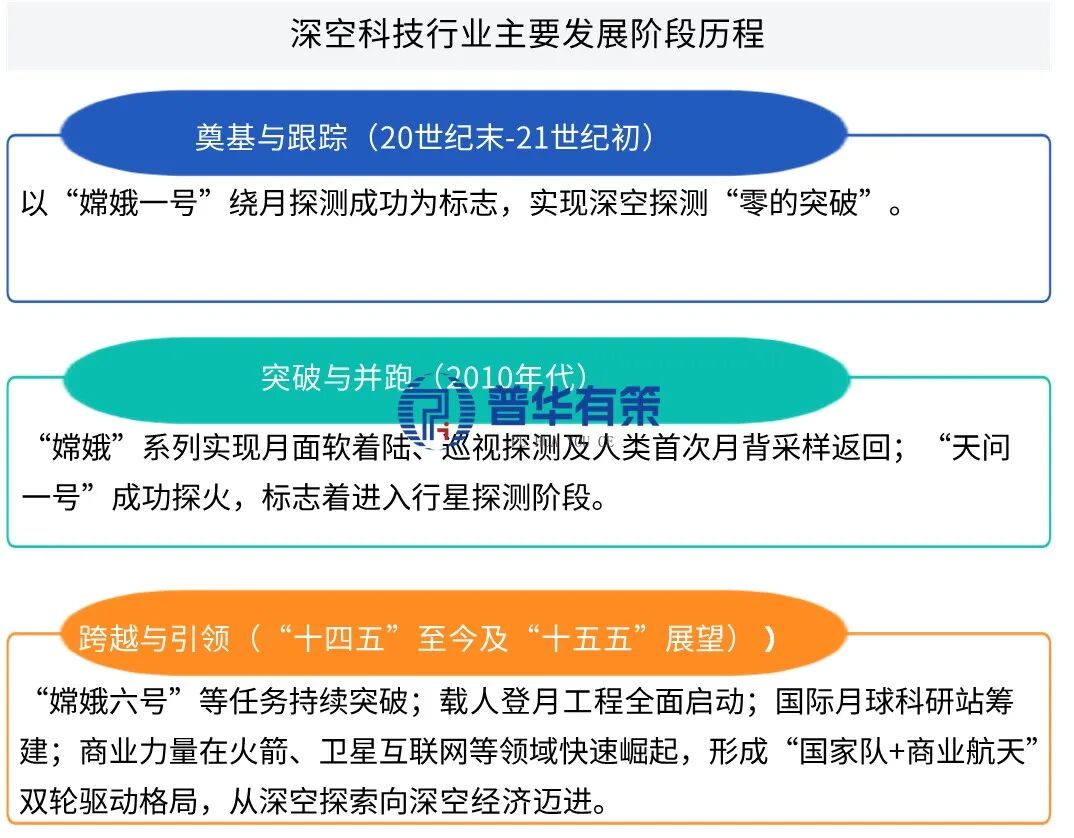
Core Insights - The deep space economy is entering a golden decade, driven by new productive forces that will stimulate future growth [1] - The deep space technology sector focuses on the exploration, development, and sustainable utilization of celestial bodies beyond the Moon, integrating advanced technologies such as AI and renewable energy [1][24] - China's deep space technology has evolved from lunar exploration to interplanetary missions, with significant achievements like the Tianwen-1 Mars mission and plans for human lunar landings by 2030 [4][24] Industry Overview - Deep space technology encompasses cutting-edge scientific research, disruptive technology development, and major equipment manufacturing aimed at sustainable utilization [1][24] - The industry has transitioned from a planned research model to a market-oriented and ecological model, characterized by collaboration between state-owned enterprises and private companies [25] Competitive Landscape - The competitive structure of China's deep space technology industry features a "national team" leading system innovation, commercial enterprises focusing on niche breakthroughs, and collaborative development among academia, industry, and research [25] - The first tier consists of state-owned enterprises like China Aerospace Science and Technology Corporation, which dominate design and integration for major national projects [25] - The second tier includes commercial companies making breakthroughs in key subsystems and emerging launch sectors, while the third tier comprises startups focused on new applications and data services [26] Key Drivers of Industry Development - National strategic goals, such as building a "strong aerospace nation," serve as a fundamental driving force for the industry [27] - The integration of disruptive technologies, particularly AI, is transforming deep space activities and enhancing mission success rates [28] - Strong market demand, particularly in satellite internet and resource utilization, is attracting global capital and driving sustainable growth expectations [29] Policy Environment - Since the 14th Five-Year Plan, policies have accelerated the transition of deep space technology from top-level planning to industry cultivation, emphasizing the importance of technological innovation [11] - The 2025 Central Economic Work Conference highlighted the need for technological innovation to lead the construction of a modern industrial system, providing clear directives for the deep space sector [11]

解密主力资金出逃股 连续5日净流出544股



Zheng Quan Shi Bao Wang· 2026-01-21 09:24
Core Viewpoint - As of January 21, a total of 544 stocks in the Shanghai and Shenzhen markets have experienced net outflows of main funds for five consecutive days or more, indicating a significant trend of capital withdrawal from these stocks [1]. Group 1: Stocks with Longest Net Outflow - Qinan Co., Ltd. has the longest net outflow period, with main funds withdrawing for 21 consecutive days [1]. - Kain Technology follows with a net outflow for 18 consecutive days [1]. Group 2: Stocks with Largest Total Net Outflow - Shenghong Technology has the highest total net outflow amounting to 9.277 billion yuan over 11 days [1]. - Aerospace Development ranks second with a total net outflow of 6.928 billion yuan over 10 days [1]. Group 3: Stocks with Highest Net Outflow Proportion - *ST Yanshi has the highest proportion of net outflow relative to trading volume, with a 30% drop in the last 7 days [1]. - Other notable stocks with significant net outflow proportions include China Satellite and China Satcom, with respective proportions of 6.59% and 8.40% [1]. Group 4: Performance of Affected Stocks - Shenghong Technology has seen a cumulative decline of 14.99% during the net outflow period [1]. - Aerospace Development has experienced a cumulative drop of 29.48% [1]. - China Satellite and China Satcom have also faced declines of 17.90% and 26.81%, respectively [1].
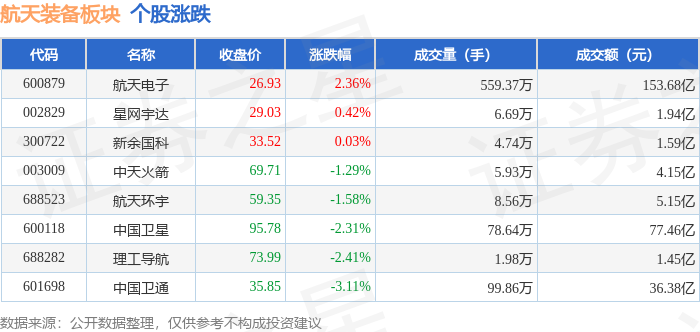
航天装备板块1月21日跌1.48%,中国卫通领跌,主力资金净流出3.44亿元
Zheng Xing Xing Ye Ri Bao· 2026-01-21 09:02
证券之星消息,1月21日航天装备板块较上一交易日下跌1.48%,中国卫通领跌。当日上证指数报收于 4116.94,上涨0.08%。深证成指报收于14255.12,上涨0.7%。航天装备板块个股涨跌见下表: | 代码 | 名称 | 收盘价 | 涨跌幅 | 成交量(手) | 成交额(元) | | --- | --- | --- | --- | --- | --- | | 600879 | 航天电子 | 26.93 | 2.36% | 559.37万 | 153.68亿 | | 002829 | 星网宇达 | 29.03 | 0.42% | 6.69万 | 1.94亿 | | 300722 | 新余国科 | 33.52 | 0.03% | 4.74万 | 1.59亿 | | 003009 | 中天火箭 | 69.71 | -1.29% | 5.93万 | 4.15亿 | | 688523 | 航大坏宇 | 59.35 | -1.58% | 8.56万 | 5.15亿 | | 600118 | 中国卫星 | 95.78 | -2.31% | 78.64万 | 77.46亿 | | 688282 | 理工导航 | 73 ...
机构:商业航天有望迎来“政策+技术+资本”三重共振
Zheng Quan Shi Bao Wang· 2026-01-21 08:59
Group 1 - The core viewpoint is that China's commercial space industry is experiencing rapid development, with projections for 2025 indicating 50 launches, accounting for 54% of the total national space launches [1] - In 2025, commercial rockets are expected to complete 25 launches, and the Hainan commercial space launch site will have conducted 9 launches, totaling 10 since its establishment [1] - A total of 311 commercial satellites are projected to be placed into orbit, representing 84% of the total satellites launched in China [1] Group 2 - The commercial space industry is entering a golden era driven by both demand and supply, with recommendations to focus on structural component suppliers such as Aerospace Power, Srey New Materials, and others [1] - In satellite manufacturing, the focus is on low Earth orbit satellites and related infrastructure, with suggested companies including China Satellite and Aerospace Electronics [1] - The upstream and midstream sectors, particularly subsystems and materials supporting satellite mass production, are expected to benefit first, with companies like Zhenlei Technology and Guangwei Composites highlighted [1] Group 3 - In 2026, the domestic commercial space sector is anticipated to experience a "triple resonance" of policy, technology, and capital, making it highly promising [2] - Beneficiary companies in the rocket industry chain include Aerospace Power, Western Materials, and others [2] - In the satellite industry and space computing, recommended companies include Zhongke Xingtou, Aerospace Hongtu, and several others [2]



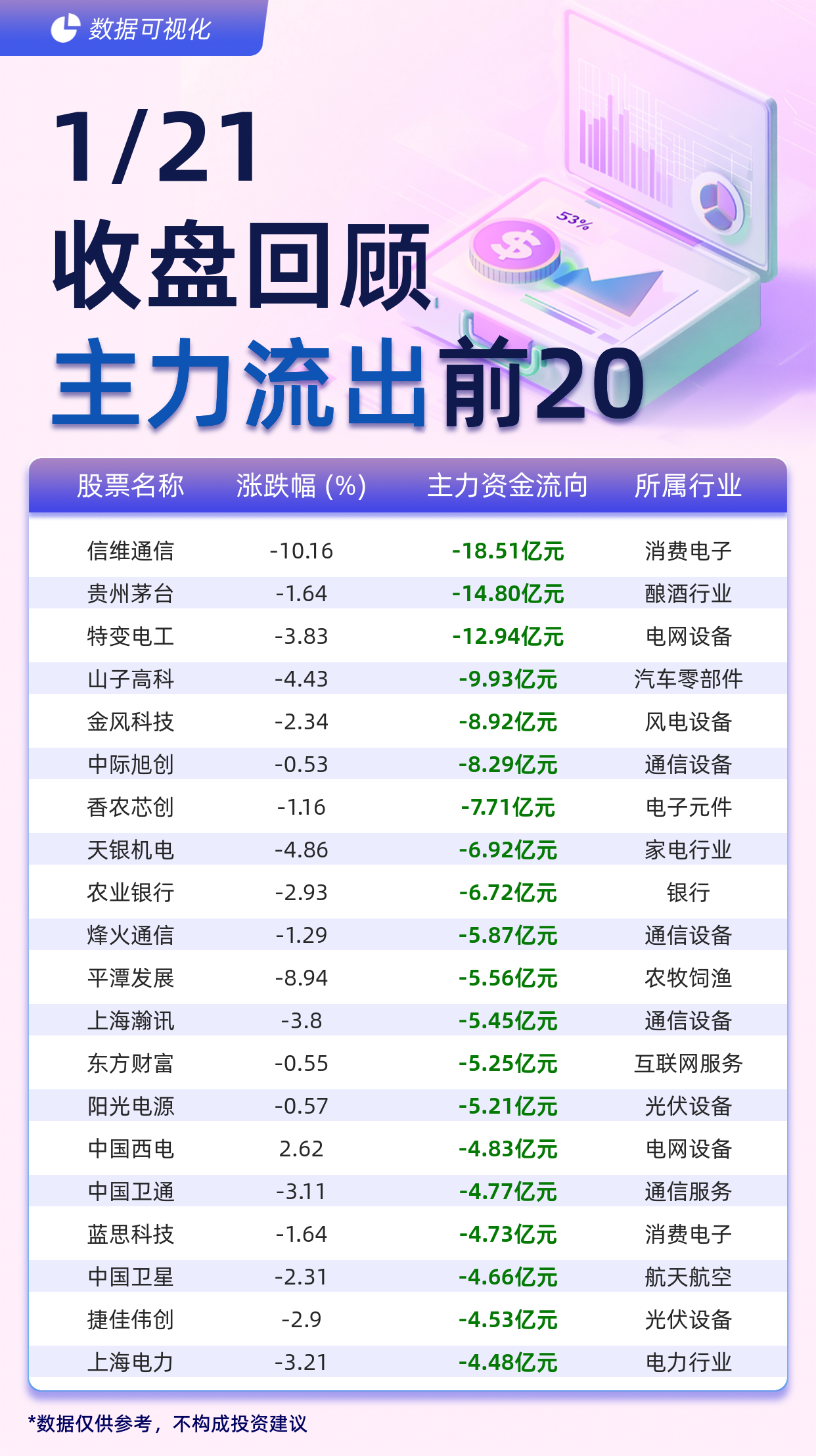
主力个股资金流出前20:信维通信流出18.51亿元、贵州茅台流出14.80亿元
Jin Rong Jie· 2026-01-21 07:11
Core Viewpoint - The data indicates significant outflows of main funds from various stocks, with notable amounts withdrawn from companies across different sectors, suggesting a potential shift in investor sentiment and market dynamics [1][2][3] Group 1: Stock Performance and Fund Outflows - The top stock with the largest fund outflow is XW Communication, with a withdrawal of 1.851 billion yuan and a decline of 10.16% in its stock price [2] - Guizhou Moutai follows with a fund outflow of 1.480 billion yuan and a decrease of 1.64% [2] - TBEA Co., Ltd. experienced a fund outflow of 1.294 billion yuan and a drop of 3.83% [2] - Other notable companies with significant outflows include: - Sanzi Gaoke: -0.993 billion yuan, -4.43% [2] - Goldwind Technology: -0.892 billion yuan, -2.34% [2] - Zhongji Xuchuang: -0.829 billion yuan, -0.53% [2] Group 2: Sector Analysis - The consumer electronics sector is represented by XW Communication and Lens Technology, both experiencing substantial fund outflows [2][3] - The beverage industry, highlighted by Guizhou Moutai, shows a minor decline in stock price despite significant fund outflow [2] - The power equipment sector, including TBEA Co., Ltd. and China Western Power, reflects mixed performance with varying fund outflows [2][3] - The telecommunications sector, represented by companies like Zhongji Xuchuang and Fenghuo Communication, also shows notable fund withdrawals [2][3]





中美竞逐万亿美元新赛道,五层解构下的投资蓝图
Tebon Securities· 2026-01-21 04:07
Investment Rating - The report maintains an "Outperform" rating for the commercial aerospace industry [1] Core Insights - The aerospace sector is transitioning from being viewed as a "cost center" driven by national will to a "growth engine" driven by commercial demand, with significant investments and strategic planning from both the US and China [6][9] - The global aerospace economy is projected to reach $613 billion in 2024, with commercial aerospace contributing 78%, and is expected to exceed $1 trillion by 2032 [6][9] - The value chain of commercial aerospace is divided into five core levels: "space, ground, terminal, rocket, and application," each presenting unique market opportunities and technical challenges from 2026 to 2030 [10][29] Summary by Sections 1. Space: Satellite Manufacturing - The satellite manufacturing market in China is expected to grow from approximately 7.1 billion yuan in 2025 to about 39.4 billion yuan by 2030, reflecting a shift from sporadic research models to continuous, batch engineering deliveries [16][18] 2. Ground: Ground Systems - The ground systems market is projected to increase from around 1.2 billion yuan in 2025 to approximately 39.1 billion yuan by 2030, evolving from a supporting role to a core infrastructure essential for stable satellite constellation operations [21][22] 3. Terminal: Key Variable for Commercial Aerospace - The terminal market is anticipated to grow from 500 million yuan in 2025 to about 141.9 billion yuan by 2030, driven by multiple vertical industries and potential consumer scenarios [23][24] 4. Rocket: Core Constraint - The cost of rocket launches is a critical constraint, with reusable technology expected to reduce costs by 80%-90% compared to traditional expendable rockets. The market for rocket launch services is projected to grow from approximately 10.7 billion yuan in 2025 to about 34.3 billion yuan by 2030 [25][26] 5. Application: Final Value Realization - The application market is expected to expand from 200 million yuan in 2025 to 525 billion yuan by 2030, with the revenue share from applications projected to rise from single digits to over 67% by around 2030 [27][28] 6. Investment Opportunities - Investment opportunities in commercial aerospace can be categorized into three main tracks: 1. Launch and manufacturing segments, which are expected to benefit directly from increased orders and visibility 2. Core components and systems, characterized by high technical barriers and critical for long-term competitiveness 3. Downstream applications and operational services, which, while currently limited in scale, hold the greatest long-term potential for value realization [29][30]


航空航天ETF(159227)涨超1.1%,2025年度商业航天发射达50次
Xin Lang Cai Jing· 2026-01-21 02:21
Group 1 - The aerospace industry index (CN5082) has seen a strong increase of 1.44%, with key stocks such as Huayin Technology rising by 8.66% and Aerospace Electronics by 4.56% [1] - The commercial aerospace concept has rebounded strongly, with continuous capital inflow into the aerospace ETF (159227), which has attracted a total of 252 million yuan over the past three days [1] - In 2025, China's commercial aerospace is expected to maintain rapid development, completing 50 launches, which accounts for 54% of the total annual space launches in the country [1] Group 2 - The commercial aerospace industry is experiencing strong growth certainty, with China at a turning point for reducing launch costs due to the concentrated deployment of low-orbit constellations [2] - It is anticipated that by 2026, significant breakthroughs in reusable rocket technology will occur, benefiting key components such as power systems and structural materials [2] - The aerospace ETF (159227) closely tracks the aerospace index and covers critical industry segments, with a high weight of 70% in commercial aerospace concepts [2]