宝信软件

Search documents
公募现“一把手”变动潮:月内6家基金公司董事长更迭
Sou Hu Cai Jing· 2025-08-29 10:20
Core Viewpoint - The article discusses the significant leadership changes at Nord Fund, highlighting the retirement of Chairman Pan Fuxiang and the appointment of Zheng Chengwu as his successor, marking a notable transition in the company's management [1][3][4]. Group 1: Leadership Changes - Pan Fuxiang, the founder and long-serving chairman of Nord Fund, has officially retired after over 19 years in various executive roles, including Vice General Manager and General Manager since 2006 [3][4]. - Zheng Chengwu, the new chairman, has a strong background with connections to Tsinghua University and has held various leadership positions in different companies, including Tianfu Qingyuan Holdings [5][6]. Group 2: Company Background - Nord Fund was established in 2006 and has undergone changes in its shareholder structure, currently being primarily owned by Tianfu Qingyuan Holdings (51%) and Beijing Tianlang Yunchuang Information Technology Co., Ltd. (49%) [6]. - The company aims to maintain a prudent and stable operational approach, focusing on delivering professional and high-quality wealth management services to investors [6]. Group 3: Industry Context - The article notes that this leadership change at Nord Fund is part of a broader trend, with five public fund chairman changes occurring within the same month, indicating a shift in leadership across the industry [7]. - Other notable changes include the appointment of new chairpersons at several funds, often from the largest shareholders, reflecting a common practice in the industry [7][10][12].


宝信软件跌2.01%,成交额4.89亿元,主力资金净流出6901.84万元
Xin Lang Cai Jing· 2025-08-29 06:12
Core Viewpoint - Baoxin Software's stock has experienced a decline of 11.48% year-to-date, with a recent drop of 2.01% on August 29, 2023, indicating potential concerns regarding its financial performance and market position [1]. Financial Performance - For the first half of 2025, Baoxin Software reported a revenue of 4.715 billion yuan, a year-on-year decrease of 30.08%, and a net profit attributable to shareholders of 713 million yuan, down 46.46% compared to the previous year [2]. - Cumulative cash dividends since the A-share listing amount to 10.067 billion yuan, with 5.736 billion yuan distributed over the last three years [3]. Shareholder and Market Activity - As of July 31, 2025, the number of Baoxin Software's shareholders increased by 9.61% to 129,300, while the average number of circulating shares per person decreased by 10.50% to 20,430 shares [2]. - On August 29, 2023, the stock's trading volume was 489 million yuan, with a turnover rate of 0.90%, and the total market capitalization stood at 72.832 billion yuan [1]. Business Overview - Baoxin Software, established on August 15, 1994, operates primarily in software development and engineering services (64.02% of revenue), service outsourcing (35.31%), system integration (0.48%), and other services (0.20%) [1]. - The company is categorized under the computer-IT services sector and is associated with various concept sectors, including the Shanghai Free Trade Zone, smart vehicles, Tencent Cloud, state-owned enterprise reform, and ERP concepts [1]. Institutional Holdings - As of June 30, 2025, the second-largest circulating shareholder is Hong Kong Central Clearing Limited, holding 67.0865 million shares, a decrease of 14.7907 million shares from the previous period [3]. - The sixth-largest circulating shareholder is Huatai-PB CSI 300 ETF, with 15.5717 million shares, an increase of 1.7079 million shares, while the seventh-largest is E Fund CSI 300 ETF, holding 10.9983 million shares, up by 1.1168 million shares [3].

公募人事变动频繁
Shen Zhen Shang Bao· 2025-08-27 23:01
Group 1 - The core viewpoint of the articles highlights a significant turnover in the management of public funds in China, with over 240 executives changing roles this year, marking a slight increase compared to the same period last year [1][3] - Major public fund companies such as China Merchants Fund, Huabao Fund, and Xinda Australia Fund have recently announced changes in their senior management, indicating a trend of frequent leadership changes within the industry [1][2] - The turnover includes over 100 core executives, such as chairpersons and general managers, reflecting a broader shift in leadership dynamics within the public fund sector [1][3] Group 2 - China Merchants Fund appointed Tan Zhiyong as the new deputy general manager, who has a background in banking and insurance, indicating a strategic move to strengthen leadership [1] - Huabao Fund's chairman Huang Kongwei resigned due to "age-related reasons," with Summer Xue Song taking over, showcasing a generational shift in leadership [2] - Xinda Australia Fund appointed Shang Jian as the new chairman, replacing Zhu Ruimin, who oversaw a significant increase in the company's management scale from 12.8 billion to 103 billion yuan during his tenure [2]
“AI+钢铁”锻造新质生产力
Jing Ji Ri Bao· 2025-08-27 22:04
Core Viewpoint - The steel industry in China is undergoing a significant digital transformation driven by artificial intelligence, which is essential for high-quality development and efficiency improvements [1][4][6]. Digital Transformation Initiatives - The China Iron and Steel Association has prioritized digital transformation as one of the three major projects for the industry, launching a three-year action plan [1]. - 95.1% of steel companies have integrated digital transformation strategies into their overall development plans, with significant investments in smart upgrades [2][6]. Technological Advancements - Shougang's cold-rolled company has been recognized as a "lighthouse factory" due to its implementation of advanced technologies such as 5G, AI, and big data, resulting in a 21.2% increase in production efficiency and a 35% reduction in product defect rates [2]. - Baowu Steel has initiated a new digital transformation strategy marked by "AI+", aiming to create over 1,000 AI-enabled application scenarios within three years [3]. Industry Challenges and Solutions - The steel industry faces challenges related to the "black box" nature of production processes, which can hinder efficiency and quality [4][5]. - The introduction of "human-machine hybrid intelligence" models aims to address these challenges by enabling high-fidelity predictions and optimizing production processes [5]. Future Prospects - The application of AI in the steel industry is expected to expand, enhancing production efficiency, quality control, and supply chain management [6]. - The development of an AI ecosystem that promotes collaboration among steel companies, research institutions, and technology service providers is anticipated to drive the industry's transition towards high-end, intelligent, and green development [6][7]. Policy and Strategic Focus - The China Iron and Steel Association will continue to focus on AI and intelligent technology applications to reshape productivity, emphasizing low-carbon integration and cost-effective technology promotion [7]. - The core value of AI in the steel industry is to create a new paradigm of "human-machine collaboration," enhancing operational stability and continuous system optimization [7].
八一钢铁: 八一钢铁关于对宝武集团财务有限责任公司的风险评估报告
Zheng Quan Zhi Xing· 2025-08-27 16:12
Group 1 - The financial company is a national non-bank financial institution established in June 1992, regulated by the National Financial Supervision Administration [1][2] - The ownership structure includes China Baowu Steel Group Co., Ltd. holding 24.32%, with other significant shareholders being Maanshan Iron & Steel Co., Ltd. and Baoshan Iron & Steel Co., Ltd. [1] - The financial company is not a defaulter and has good creditworthiness and performance capabilities [2] Group 2 - The internal control system is based on a sound governance structure and advanced internal control culture, ensuring compliance with national regulations and operational efficiency [3][5] - The internal control principles include comprehensiveness, prudence, effectiveness, and checks and balances, covering all departments and processes [3][5] - The governance structure consists of a shareholders' meeting, board of directors, supervisory board, and management team, with clear responsibilities and procedures [5][6] Group 3 - The financial company has established a risk management system that includes a "four-in-one" risk control concept, integrating compliance, business continuity management, risk management, and internal control [7] - The company has implemented a quarterly asset allocation and credit strategy review mechanism to adjust risk management strategies regularly [7] - Major risks identified include credit risk, liquidity risk, information technology risk, market risk, money laundering risk, operational risk, compliance risk, and legal risk [7] Group 4 - As of June 30, 2025, the financial company reported total assets of 68.813 billion, total liabilities of 58.504 billion, and total equity of 10.309 billion, with operating income of 0.771 billion and total profit of 0.4 billion [15] - All regulatory indicators meet the requirements set forth in the "Enterprise Group Financial Company Management Measures" [15] - The financial company has established a three-tier reserve system for liquidity risk management, ensuring funds are available for operational needs [16] Group 5 - The financial company has developed a comprehensive internal control system that effectively executes financial accounting behaviors, enhances accounting information quality, and strengthens operational management [14][18] - The internal control system is deemed complete and reasonable, with effective execution and no significant defects identified [14][18] - The financial company has a robust emergency management plan to address potential operational disruptions, ensuring business continuity [13][19]

宝钢股份: 宝山钢铁股份有限公司对宝武集团财务有限责任公司的风险评估报告
Zheng Quan Zhi Xing· 2025-08-27 16:12
Core Viewpoint - The financial company of Baowu Group has established a comprehensive risk management and internal control system, ensuring compliance with regulatory requirements and effective operational performance [1][11][12]. Basic Information - The financial company was established in June 1992, with a registered capital of 6.84 billion yuan, and is supervised by the National Financial Supervision Administration [1]. - The ownership structure includes China Baowu Steel Group (24.32%), Maanshan Iron & Steel Co., Ltd. (22.36%), and others [1]. Internal Control Overview - The internal control system is based on a robust governance structure and advanced internal control culture, aiming to ensure compliance with laws and regulations while enhancing operational efficiency [2][3]. - The internal control principles include comprehensiveness, prudence, effectiveness, and checks and balances, covering all business processes and operational stages [3]. Governance Structure - The governance structure consists of a shareholders' meeting, board of directors, supervisory board, and management team, with clear responsibilities and procedures [4]. - Various committees, such as the risk management committee and audit committee, support the governance framework [4]. Risk Management Framework - The financial company has developed a "four-in-one" risk management concept, integrating compliance, business continuity management, risk management, and internal control [5]. - A comprehensive risk management policy has been established, addressing various risks including credit, liquidity, and operational risks [6]. Financial Performance - As of June 30, 2025, the financial company reported total assets of 68.813 billion yuan and a profit of 400 million yuan [11]. - All regulatory indicators met the requirements set forth by the relevant authorities [11][12]. Business Operations - The financial company engages in various services including deposit acceptance, loan processing, and investment management, adhering to strict regulatory guidelines [2][6]. - The company has implemented a robust internal audit system to monitor compliance and operational effectiveness [5][10]. Relationship with Baoshan Iron & Steel Co., Ltd. - As of June 30, 2025, Baoshan Iron & Steel Co., Ltd. had a deposit balance of 13.153 billion yuan and a loan balance of 417 million yuan with the financial company [14]. - The financial company has developed a system to monitor related transactions, ensuring compliance with financial service agreements [14]. Risk Assessment Conclusion - The financial company operates in accordance with regulatory requirements, demonstrating good operational performance and effective risk management practices [12].

IDC篇:周期中成长,迎来又一春
2025-08-27 15:19
Summary of Key Points from Conference Call Records Industry Overview - The IDC (Internet Data Center) industry is characterized as digital real estate, with a cyclical growth relationship to data and computing power demand. The industry is expected to experience a new round of expansion driven by AI, despite current domestic models being less mature compared to overseas counterparts [1][3][11]. Core Insights and Arguments - Significant changes in AI models are anticipated in China by Q4 of this year, with expectations of a notable shift in domestic model maturity [1][2]. - The construction cost of IDC is high, approximately 30 million yuan per megawatt, but cash flow performance is superior to profit margins. Key factors include rack utilization rates, cabinet prices, and quantities [1][4]. - The cloud computing market currently faces a supply-demand mismatch, but the rapid growth in AI demand is expected to improve this imbalance, creating investment opportunities [1][5]. - The global IDC market is dominated by the US and China, with the US holding a 34% market share and China at 14%. Major players include Equinix, Digital Realty Trust, and NTT, which together account for 30% of the market [1][8]. Important but Overlooked Content - The IDC industry has both technology and real estate attributes, with revenue primarily derived from rental income. Location significantly impacts pricing, with cities that have abundant network and customer resources commanding higher prices [1][6]. - The customer structure in the IDC industry is divided into wholesale and retail types, with wholesale clients being more stable but offering lower profitability compared to retail clients, which are more volatile [1][10]. - AI transformation is expected to significantly boost the IDC industry, with predictions that China's computing power will reach 103.74 billion Flops by 2025, and the data center scale will grow at a compound annual growth rate of 38.9% [1][11][12]. - The supply-side reform in the IDC sector is tightening indicators in core cities, leading to increased scarcity in demand, while new supply regions are emerging [1][13]. - The investment structure of IDC projects includes CAPEX and OPEX, with significant portions allocated to power supply systems and depreciation costs [1][16]. Future Trends - The IDC market is expected to transition from oversupply to a new supply cycle driven by AI, with demand potentially several times greater than traditional internet demand [1][19][20]. - The ITC industry is viewed as a cyclical growth stock, with core competitiveness stemming from location, customer acquisition capabilities, and cost control. The industry is poised for a demand explosion in the next one to two years, driven by AI applications [1][21].
【盘中播报】16只个股突破半年线
Zheng Quan Shi Bao Wang· 2025-08-27 07:51
Market Overview - The Shanghai Composite Index is at 3839.08 points, above the six-month moving average, with a decline of 0.76% [1] - The total trading volume of A-shares is 23899.72 billion yuan [1] Stocks Breaking the Six-Month Moving Average - A total of 16 A-shares have surpassed the six-month moving average today [1] - Notable stocks with significant deviation rates include: - Digital Human: 10.98% - *ST Baoshi: 5.13% - Aerospace Electric: 3.50% [1] Stocks with Smaller Deviation Rates - Stocks with smaller deviation rates that have just crossed the six-month moving average include: - Wangcheng Technology: 0.11% - Zhu Laoliu: 0.16% - Yintuwanglian: 0.17% [1] Performance of Selected Stocks - The following stocks have notable performance metrics: - Digital Human: Today's increase of 14.01% with a turnover rate of 25.34% [1] - *ST Baoshi: Increased by 5.05% with a turnover rate of 2.04% [1] - Aerospace Electric: Increased by 3.55% with a turnover rate of 2.36% [1]




科普:如何查询MSCI指数的调仓
Xin Lang Cai Jing· 2025-08-27 04:44
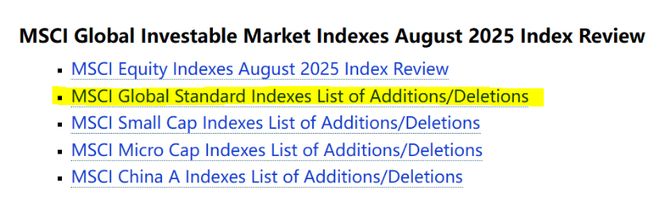
Core Viewpoint - MSCI index quarterly rebalancing can lead to significant stock price movements, particularly in less liquid markets like B-shares, creating potential investment opportunities [1]. Group 1: MSCI Index Impact - MSCI announced the removal of Baoxin B-share from its index on August 7, effective August 27, leading to a significant price drop [1]. - Baoxin B-share experienced a cumulative decline of 27% from August 7 to August 21, while Baoxin A-share saw a 2.54% increase during the same period, indicating that the drop in B-share price was not fundamentally driven [1]. - On August 26, the day Baoxin B-share hit the daily limit down, it was noted that the B-share price was only 28% of the A-share price [1]. Group 2: Investment Strategy - Following the price drop, a decision was made to purchase Baoxin B-shares, resulting in a 9.78% increase in price the next day, demonstrating a successful short-term investment strategy [1]. - The article provides a simplified method for accessing MSCI index information, which can aid in future investment decisions [1][2][3].
国务院“人工智能+”新政落地:六大领域投资机遇全解析
Xin Lang Cai Jing· 2025-08-27 00:23
Policy Background and Core Logic - The State Council released the "Opinions on Deepening the Implementation of 'Artificial Intelligence+' Action" on August 26, 2025, aiming to promote AI empowerment across six dimensions: technology, industry, consumption, livelihood, governance, and global cooperation [1] - The policy outlines three stages: achieving deep integration in six fields by 2027 (with smart terminal penetration exceeding 70%), establishing smart economy as a growth driver by 2030 (with penetration exceeding 90%), and entering a new stage of intelligent society by 2035 [1] - This policy is expected to reshape China's AI industry chain and create trillion-level investment opportunities [1] Computing Infrastructure: The "Water, Electricity, and Coal" of the AI Era - The policy emphasizes "strengthening intelligent computing power coordination," focusing on breakthroughs in liquid cooling technology, optical modules, and AI chips [3] - Inspur Information holds a 47% global market share in AI servers, with a revenue increase of 165% year-on-year in Q1 2025, benefiting from accelerated construction of intelligent computing centers [4] - The company has received over 20 billion yuan in national computing network orders, with a 40% year-on-year increase in net profit in Q2 2025 [4] Industry Applications: Accelerated Penetration in Vertical Scenarios - The policy encourages deep integration of AI with manufacturing, government, and healthcare, accelerating commercialization in vertical scenarios [5] - Weining Health's AI-assisted diagnostic system covers 3,000 hospitals with a diagnostic accuracy rate of 93.6%, and its medical AI revenue doubled in Q2 2025 [5] - The company has won over 20 provincial government projects, enhancing processing efficiency by 70% through its NLP capabilities [5] Consumer-Level AI: Revolution in Smart Terminals - Wanxing Technology's AI model has improved video creation efficiency by five times, with a revenue increase of 180% in H1 2025 [6] - The company is a core chip supplier for Alibaba's AI glasses, with a market share exceeding 60% in smart wearable chips [6] - AI subscription services are becoming a new growth driver, with net profit increasing by 120% year-on-year in Q2 2025 [6] Data Elements and Security: The Foundation of the AI Ecosystem - The policy highlights the need for "data element circulation and security governance," making data labeling and privacy computing essential [6] - Companies like Haitan Ruisheng and Qi Anxin are positioned to benefit from this trend [6] Intelligent Agents and Ecosystem: The Core of Next-Generation Interaction - The policy promotes "human-machine collaborative organizational structures," making intelligent agent platforms standard for enterprises [6] - Companies such as Tuowei Information are expected to play a significant role in this area [6] Global Cooperation and Open Source Ecosystem - The policy emphasizes "AI for all," with open-source communities and global standard-setting being crucial [6] - Companies like Cambrian are involved in this global cooperation effort [6] Investment Strategy - Short-term focus on computing hardware (e.g., Zhongji Xuchuang, Inspur Information) and government intelligent agents (e.g., Tuowei) [7] - Long-term attention to companies with high technical barriers and deep scenario implementation (e.g., Zhongke Shuguang, Weining Health) [7]