
晶澳科技

Search documents
山西证券研究早观点-20251203
Shanxi Securities· 2025-12-03 01:04
Market Trends - The domestic market indices showed a decline, with the Shanghai Composite Index closing at 3,897.71, down 0.42%, and the Shenzhen Component Index at 13,056.70, down 0.68% [4]. Industry Commentary: Chemical Raw Materials - The new materials sector saw an increase of 3.23%, although it underperformed compared to the ChiNext Index by 1.31%. The synthetic biology index fell by 1.80%, while electronic chemicals rose by 0.45% [6]. - Key price tracking for amino acids showed valine at 12,500 CNY/ton (-0.40%), arginine at 21,400 CNY/ton (unchanged), and tryptophan at 30,500 CNY/ton (-3.17%) [6]. - The IPO guidance for Yushu Technology has been completed, which is expected to accelerate the development of the humanoid robot industry. The company is on the verge of becoming the first humanoid robot stock in A-shares, potentially leading to a market size of 10 trillion CNY for humanoid robots in China [6][7]. Industry Commentary: Electric Equipment and New Energy - The launch of the Lingxin platform by Zhiyuan Robotics allows users to customize robot interactions easily, marking a significant innovation in the industry [9]. - UBTECH's total order amount for humanoid robots in 2025 has reached 1.3 billion CNY, indicating strong market demand [9]. - The National Development and Reform Commission is addressing issues of price disorder in the market, which could impact competition and pricing strategies [9]. - Recent pricing data shows that polysilicon prices remain stable, with dense material averaging 52.0 CNY/kg and granular silicon at 50.0 CNY/kg [9][13]. Investment Recommendations - The report recommends focusing on companies involved in humanoid robots, particularly those producing core components like electronic skin and dexterous hands. Notable companies include Hanwei Technology and Fule New Materials [6][7]. - In the electric equipment and new energy sector, companies such as Aishuo Co., Longi Green Energy, and Daqo New Energy are highlighted for their potential in new technology and supply-side strategies [11].
阿特斯转让75.1%股权背后
Xin Lang Cai Jing· 2025-12-02 12:05
Core Viewpoint - The company, Arctech (688472.SH), announced a business adjustment in the U.S. market, forming two joint ventures with its controlling shareholder, Canadian Solar Inc (CSIQ), to comply with the U.S. "Inflation Reduction Act" (OBBB) [1][2][5] Group 1: Business Adjustment Details - Arctech will hold a 24.9% stake in the new joint ventures, while CSIQ will hold 75.1% [1][2] - The joint venture M will focus on domestic photovoltaic operations in the U.S., while N will engage in energy storage, including lithium iron phosphate battery cells and systems [2][5] - The total assessed value for the equity transfer is 469 million yuan, with the 75.1% stake valued at 352 million yuan [3][8] Group 2: Financial Performance - In the first three quarters of the year, Arctech reported total revenue of 31.27 billion yuan, a year-on-year decrease of 8.51%, and a net profit of 989 million yuan, down 49.41% [4][9] - The company shipped 19.9 GW of photovoltaic modules and 5.8 GWh of large-scale energy storage, with energy storage business growing by 32% year-on-year [4][9] - Arctech's overseas sales have consistently accounted for over 70% of its revenue, with operations in over 20 countries [4][9] Group 3: Market Context and Strategic Implications - The U.S. is the second-largest photovoltaic market globally, with a mature electricity market mechanism, making it a strategic focus for Arctech [5][10] - The adjustment aims to mitigate operational risks and ensure long-term participation in the U.S. market while protecting the interests of the company and its investors [5][10] - Arctech is noted as the only photovoltaic company explicitly adjusting its U.S. business structure in response to the OBBB Act, indicating a potential trend among other companies facing similar challenges [5][10]


55GWh,储能全球扩产“加速度”
3 6 Ke· 2025-12-02 11:22
Core Insights - The energy storage industry is experiencing a market-driven spring due to multiple factors such as policy relaxation, market empowerment, and cost reduction [1] - Global energy storage companies are accelerating capacity expansion and technological collaboration to seize market opportunities [1] Group 1: Market Trends and Predictions - According to Guoxin Securities, the global energy storage installed capacity is expected to reach 221 GWh, 191 GWh, and 190 GWh from 2025 to 2027, corresponding to a market value of approximately 178.7 billion, 155 billion, and 153.3 billion yuan [1] - The demand for energy storage in North America is driving LG Energy Solution to increase its total battery capacity target from 30 GWh to 50 GWh, representing an increase of over 60% [5] Group 2: Company Collaborations and Projects - GG Industries has signed a strategic cooperation agreement with Goldwind Technology to establish a battery energy storage system (BESS) production line with an annual capacity of 5 GWh, primarily for commercial and grid storage [2][4] - LG Energy Solution has a pending order of approximately 120 GWh for energy storage batteries as of the end of Q3 [5] Group 3: Global Capacity Expansion - The global expansion of energy storage capacity is evident from various companies, including CATL and Stellantis, which are establishing a battery factory in Spain with a planned capacity of 50 GWh [7] - Samsung SDI plans to increase its energy storage battery capacity in the U.S. to 30 GWh by the end of 2026 [8] Group 4: Regional Developments - In Europe, companies like Cegasa Energía and Skeleton Technologies are actively expanding their production capacities, with Cegasa planning an initial capacity of 600 MWh and Skeleton investing in a 1 GW super battery factory [10][12] - The current global energy storage capacity construction is characterized by regional decentralization, large-scale expansion, and technological collaboration [12]




11月份汇丰晋信旗下12只基金跌超8% 均由陆彬管理
Sou Hu Cai Jing· 2025-12-02 07:49
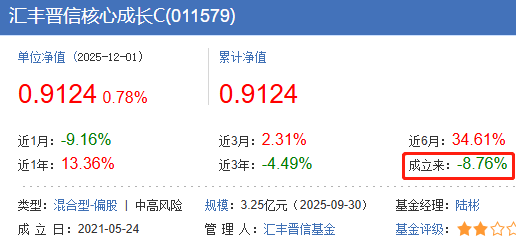
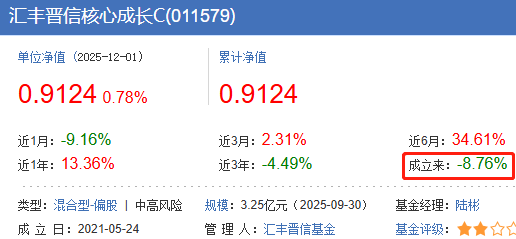
Core Viewpoint - In November 2025, all funds managed by Lu Bin at HSBC Jintrust Fund Company experienced significant declines, with 12 funds dropping over 8%, indicating potential management and investment strategy issues [1][3]. Fund Performance Summary - HSBC Jintrust Research Selected Mixed Fund had the largest decline at 9.97% in November, with a cumulative return of -3.23% since its inception on January 21, 2022 [1]. - HSBC Jintrust Core Growth Mixed C and A funds also saw declines of 9.87% and 9.83% respectively in November, with cumulative returns of -8.76% and -6.67% since their launch on May 24, 2021 [1][2]. - Other funds, such as HSBC Jintrust Era Pioneer Mixed, also reported significant losses, with cumulative returns of -12.13% and -13.90% for A and C shares respectively [2][3]. Investment Focus - The investment strategy of the funds primarily focuses on the renewable energy sector, particularly in the photovoltaic industry, with major holdings including companies like Yiwei Lithium Energy, JA Solar Technology, and Xinyi Solar [1][3]. - The top ten holdings for HSBC Jintrust Era Pioneer Mixed also reflect a strong emphasis on the photovoltaic sector, featuring companies such as Trina Solar and LONGi Green Energy [3]. Management Background - Lu Bin has over six years of experience managing public funds and has held various positions within HSBC Jintrust, including Assistant General Manager and Investment Director [3]. - Despite a strong track record with a few funds managed before 2021, the majority of Lu Bin's recent funds have significantly underperformed compared to their peers [3].
11月份汇丰晋信旗下12只基金跌超8% 均由陆彬管理
Zhong Guo Jing Ji Wang· 2025-12-02 07:42
而从前十大重仓股看,汇丰晋信时代先锋混合同样以光伏板块为重仓方向,三季度前十大重仓股为 信义光能、通威股份、晶澳科技、协鑫科技、天合光能、隆基绿能、爱旭股份、福莱特玻璃、大全能 源、东方日升。 中国经济网北京12月2日讯 据同花顺iFinD数据显示,2025年11月份,汇丰晋信基金公司旗下共有 12只基金(各份额分开计算,下同)跌幅超过8%,而这些基金全部由陆彬管理。 汇丰晋信研究精选混合跌幅最大,11月份下跌9.97%。资料显示,该基金成立于2022年1月21日, 一直由陆彬单独管理,但截至今年12月1日收盘,其累计收益率依然亏损3.23%。 从2025年前三个季度的重仓股看,其投资方向主要以新能源产业为主,其中又多集中在光伏领域。 三季报显示,前十大重仓股为亿纬锂能、晶澳科技、信义光能、通威股份、协鑫科技、隆基绿能、爱旭 股份、福莱特、杭可科技、明阳智能。 跌超9%的还有汇丰晋信核心成长混合C、汇丰晋信核心成长混合A,在11月也下跌了9.87%和 9.83%。这只成立于2021年5月24日的基金同样在陆彬4年多的管理下依然出现亏损,其最新累计收益率 分别为-8.76%、-6.67%。 | 汇丰晋信核心成长 ...
阿特斯回应调整在美业务架构: 主要基于规避"大而美"法案的约束
Zhong Guo Jing Ying Bao· 2025-12-02 04:37
Core Viewpoint - The company, Canadian Solar Inc. (CSI), is restructuring its operations in the U.S. market by forming joint ventures with its controlling shareholder, Canadian Solar Inc. (CSIQ), to optimize its business in response to regulatory changes and market conditions [1][2][3] Group 1: Joint Ventures and Business Focus - CSI will establish two joint ventures, referred to as "Company M" and "Company N," with CSI holding 24.9% and CSIQ holding 75.1% of the shares in each [1] - Company M will focus on domestic photovoltaic operations in the U.S., including the operation of solar cell and module factories, while Company N will engage in energy storage, covering the manufacturing of lithium iron phosphate energy cells, battery packs, and DC storage systems [1][2] Group 2: Asset Restructuring - CSI plans to restructure three manufacturing plants located outside the U.S. that primarily supply the U.S. market through a share transfer, with CSIQ acquiring 75.1% of these plants [2] - The planned capacities for the plants are 3 GWh for SSTH, 2.9 GW for GNCM, and 8 GW for THX1, with net assets valued at 378 million, 37 million, and 55 million respectively [2] Group 3: Regulatory Compliance and Market Strategy - The restructuring is primarily aimed at complying with the U.S. OBBB Act, which imposes restrictions on foreign entities' ownership in U.S. operations [2][3] - Following the transaction, CSI will benefit from 25% of the joint ventures' operational profits, rental income from U.S. capacity, and a one-time payment from the share transfer, which is valued at 352 million [3] Group 4: Market Context and Performance - The U.S. is the second-largest photovoltaic market globally, with a mature electricity market and a rapidly growing energy storage sector, making it a strategic focus for CSI [3] - Despite challenges in the photovoltaic industry, CSI has shown strong performance, achieving a net profit of 990 million in the first three quarters of 2025, with a significant increase in energy storage shipments [4]
阿特斯调整在美业务架构规避OBBB法案约束
Zhong Guo Jing Ying Bao· 2025-12-02 04:30
Core Viewpoint - The company, Canadian Solar Inc (CSI), is restructuring its U.S. operations to comply with the "OBBB Act" by forming joint ventures with its parent company, aiming to optimize its business structure and mitigate regulatory constraints [1][2][3] Group 1: Business Restructuring - The company plans to establish two joint ventures, M Company and N Company, where it will hold 24.9% and its parent company will hold 75.1% [1] - M Company will focus on domestic photovoltaic operations in the U.S., while N Company will handle energy storage solutions, including lithium iron phosphate battery cells and systems [1][2] - The joint ventures will initially operate by leasing some of the company's overseas assets, with potential for future investments or acquisitions [1] Group 2: Equity Restructuring - The company intends to restructure three manufacturing plants outside the U.S. that primarily supply the U.S. market, transferring 75.1% of their equity to its parent company [2] - The plants include THX1, SSTH, and GNCM, with planned capacities of 8GW, 3GWh, and 2.9GW respectively, and net assets of 378 million, 37 million, and 55 million yuan [2] - The equity transfer is valued at 352 million yuan, providing the company with a one-time payment while retaining a 24.9% stake in future U.S. business profits [2] Group 3: Market Context and Strategic Importance - The restructuring is a response to the OBBB Act's restrictions on foreign ownership, which is expected to lower equity stakes in U.S. operations to below 25% [3] - The U.S. is the second-largest solar market globally, with a mature electricity market and a rapidly growing energy storage sector, making this adjustment crucial for the company's long-term operations [3] - The company aims to focus on non-U.S. markets for its components and energy storage products while its parent company concentrates on the U.S. market [3] Group 4: Industry Trends - The solar industry is facing challenges due to trade barriers and profitability pressures, with other companies like Trina Solar and JA Solar also adjusting their U.S. operations [4] - Despite industry challenges, the company has shown strong performance, achieving a net profit of 990 million yuan in the first three quarters of 2025, with energy storage becoming a significant growth driver [4][5] - The company reported a 32% year-on-year increase in large-scale energy storage shipments, reaching 5.8GWh, with a record quarterly shipment of 2.7GWh in Q3, marking a 50% year-on-year increase [5]

2025年1-10月河北省能源生产情况:河北省发电量3365.4亿千瓦时,同比增长4.1%
Chan Ye Xin Xi Wang· 2025-12-02 03:27
数据来源:国家统计局,智研咨询整理 附注 统计范围: 上市企业:建投能源(000600)、冀中能源(000937)、晶澳科技(002459)、冀凯股份(002691)、 通合科技(300491)、同飞股份(300990)、廊坊发展(600149)、中国动力(600482)、保变电气 (600550)、金牛化工(600722) 相关报告:智研咨询发布的《2026-2032年中国能源行业市场研究分析及投资前景评估报告》 2025年10月,河北省发电301.3亿千瓦时,同比增长1.9%。2025年1-10月,河北省发电3365.4亿千瓦时, 同比增长4.1%。分品种看,2025年1-10月,河北省火力发电量2342.3亿千瓦时,占总发电量的69.6%, 同比下滑2.5%;河北省水力发电量59.2亿千瓦时,占总发电量的1.8%,同比增长34.4%;河北省风力发 电量594亿千瓦时,占总发电量的17.7%,同比增长19.2%;河北省太阳能发电量369.81亿千瓦时占总发 电量的11%,同比增长28.2%。 2018-2025年1-10月河北省各品种发电量累计产量统计图 报告中的产量数据统计口径均为规模以上工业,其统计范 ...

晶澳科技跌2.06%,成交额8793.30万元,主力资金净流出441.90万元
Xin Lang Cai Jing· 2025-12-02 01:58
Core Viewpoint - JinkoSolar Technology Co., Ltd. has experienced a decline in stock price and significant financial losses in recent months, indicating potential challenges in the solar energy sector [1][2]. Financial Performance - As of September 30, 2025, JinkoSolar reported a revenue of 36.809 billion yuan, a year-on-year decrease of 32.27% [2]. - The company recorded a net profit attributable to shareholders of -3.553 billion yuan, representing a year-on-year decrease of 633.54% [2]. - The stock price has dropped 13.67% year-to-date, with a 2.63% decline over the last five trading days and a 14.97% drop over the last 20 days [1]. Stock Market Activity - On December 2, 2023, JinkoSolar's stock price fell by 2.06%, trading at 11.87 yuan per share with a total market capitalization of 39.286 billion yuan [1]. - The company has seen net outflows of 4.419 million yuan in principal funds, with significant selling pressure from large orders [1]. - JinkoSolar has appeared on the "龙虎榜" (a trading board for stocks with significant trading activity) twice this year, with the latest instance on October 29, where it recorded a net buy of 156 million yuan [1]. Shareholder Information - As of September 30, 2025, the number of shareholders decreased by 17.24% to 147,800, while the average circulating shares per person increased by 20.84% to 22,370 shares [2]. - The company has distributed a total of 3.055 billion yuan in dividends since its A-share listing, with 2.415 billion yuan distributed over the past three years [3]. Institutional Holdings - As of September 30, 2025, Hong Kong Central Clearing Limited is the second-largest circulating shareholder, holding 214 million shares, a decrease of 7.3649 million shares from the previous period [3]. - Other notable institutional shareholders include GF High-end Manufacturing Stock A and Huatai-PineBridge CSI 300 ETF, with varying changes in their holdings [3].

实践故事丨一线监督打通“中梗阻”
Zhong Yang Ji Wei Guo Jia Jian Wei Wang Zhan· 2025-12-02 00:34
Group 1 - The government is enhancing transparency in utility costs for enterprises, which boosts their confidence in development [1] - Dongtai City is accelerating new industrialization, focusing on cultivating new productive forces and optimizing industrial structure [1] - The local supervisory body is addressing issues such as excessive inspections that hinder research and development progress for companies [1] Group 2 - Companies like Weilon Yicheng Intelligent Technology are achieving breakthroughs in technology, such as developing a fully autonomous light curtain system using domestic chips [2] - Under a multi-dimensional supervision system, Dongtai's new productive forces are thriving, with companies like Fulehua being recognized as "Chinese unicorns" [2] - The local supervisory authority is committed to refining its oversight methods to support the development of new productive forces [2]