
光伏新能源

Search documents
抄中国作业了
债券笔记· 2026-03-12 10:47
Group 1 - The Shanghai Composite Index experienced a slight increase, with the chemical sector showing strength due to price increase expectations influenced by the conflict in Iran, particularly in methanol [2] - The demand for electric equipment and energy storage remains strong, supported by global electricity shortages, with companies in this sector receiving significant orders [2] - The establishment of the "Grid Utilization Alliance" by Google and Tesla aims to address peak and off-peak electricity issues, indicating a lag in their understanding compared to China's earlier initiatives [3] Group 2 - The International Energy Agency (IEA) members agreed to release 400 million barrels of emergency oil reserves, marking the largest coordinated release in history to stabilize the oil market amid Middle East conflicts [7] - The U.S. reported a CPI that met expectations, but it does not reflect the recent surge in energy prices, which could impact future economic conditions [8] - China's export data for January and February showed a significant increase, with exports rising 21.8% year-on-year, driven by factors such as the timing of the Lunar New Year and a low base from the previous year [8][9] Group 3 - Exports to non-U.S. regions, including Africa, ASEAN, and the EU, saw substantial growth rates of 49.9%, 29.4%, and 27.8% respectively, indicating strong demand despite high base figures [9] - The AI wave has led to a surge in related product exports, with integrated circuit exports increasing by 72.6% [10] - The upcoming cancellation of export tax rebates for photovoltaic products has prompted companies to expedite exports before the policy takes effect [10]

三协电机:布局减速机赋能机器人产业,3D打印高景气赛道驱动2025年营收同比+31%-20260213
KAIYUAN SECURITIES· 2026-02-13 02:45
Investment Rating - The investment rating for the company is "Outperform" (maintained) [3] Core Insights - The company is expected to achieve a revenue of 551 million yuan in 2025, representing a year-on-year growth of 31.11%, with a net profit of 60 million yuan, reflecting a growth of 6.83% [3][4] - The company is focusing on the integration of motor and precision planetary gearbox solutions, particularly in the robotics sector, which is anticipated to drive future growth [4] - The company is expanding its presence in the solar photovoltaic sector, with plans to establish operations in Vietnam in 2023 and the United States in 2024 [3] Financial Summary - Revenue projections for 2025-2027 are 551 million yuan, 653 million yuan, and 872 million yuan, respectively, with corresponding net profits of 60 million yuan, 77 million yuan, and 106 million yuan [6][8] - The expected EPS for 2025-2027 is 0.82 yuan, 1.05 yuan, and 1.43 yuan, with P/E ratios of 79.3, 61.6, and 45.2, respectively [6][8] - The company’s gross margin is projected to be 26.2% in 2025, with a net margin of 10.9% [6][8]
东南网架(002135.SZ):中标9.94亿元EPC项目
Ge Long Hui A P P· 2026-02-05 09:24
Core Viewpoint - The company has won a bid for a cultural industry project with a total amount of RMB 994 million, which will enhance its capabilities in the general contracting business and strengthen its brand influence in the industry [1] Group 1: Project Details - The company received a "Bid Notification" from Hangzhou Xiaoshan Huan Investment Entertainment Snow Culture Co., Ltd., confirming its role in a consortium with Chaofeng Steel Structure Group Co., Ltd. and Zhejiang University Architectural Design Institute Co., Ltd. for the "South Station Unit XS110203-02, XS110203-28 Cultural Industry Project EPC General Contracting" [1] - The total bid amount for the project is RMB 994 million, with the specific contract amount to be determined by subsequent agreements among the parties involved [1] Group 2: Strategic Implications - Winning this project will help the company further expand its general contracting business and continue to focus on green building, intelligent construction, and photovoltaic new energy sectors [1] - This project marks another win in the ice and snow cultural tourism industry for the company, following the Zhangjiakou City Chongli District Taizicheng Ice and Snow Town project, contributing to urban functionality and regional value enhancement [1] - The project aligns with national regional strategies and supports the company in undertaking significant new urbanization project constructions [1]

东南网架:中标9.94亿元EPC项目
Ge Long Hui· 2026-02-05 09:24
Core Viewpoint - The company has won a bid for a cultural industry project with a total amount of RMB 994 million, which will enhance its capabilities in the general contracting business and strengthen its brand influence in the industry [1] Group 1: Project Details - The company received a "Bid Notification" from Hangzhou Xiaoshan Huan Investment Entertainment Snow Culture Co., Ltd., confirming its role in a consortium with Chaofeng Steel Structure Group Co., Ltd. and Zhejiang University Architectural Design Institute Co., Ltd. for the "South Station Unit XS110203-02, XS110203-28 Cultural Industry Project EPC General Contracting" [1] - The total bid amount for the project is RMB 994 million, with the specific contract amount to be determined by subsequent agreements among the parties involved [1] Group 2: Strategic Implications - Winning this project will help the company further expand its general contracting business and continue to focus on green building, intelligent construction, and photovoltaic new energy sectors [1] - This project marks another win in the ice and snow cultural tourism industry for the company, following the Zhangjiakou City Chongli District Taizicheng Ice and Snow Town project, contributing to urban functionality and regional value enhancement [1] - The project aligns with national regional strategies and supports the company in undertaking significant new urbanization project constructions [1]
今日长江现货锡价重挫 科技金属估值遭多重利空碾压 短期反弹空间几何?
Xin Lang Cai Jing· 2026-01-30 05:09
Core Viewpoint - The significant drop in tin prices is attributed to a combination of macroeconomic pressures, geopolitical easing, weakening supply and demand, industry chain differentiation, and capital withdrawal, marking a critical adjustment in the industrial metal market [1] Macroeconomic Pressure - The primary driver for the decline in tin prices is the rapid deterioration of overseas macroeconomic sentiment, particularly following a nearly 10% drop in Microsoft shares due to weak earnings guidance, raising concerns about global tech capital expenditure and subsequently cooling tin demand expectations [1] - The rise in the US dollar index and sustained high US Treasury yields triggered a collective profit-taking by speculative funds in commodities, further suppressing tin's financial valuation [1] Geopolitical Easing - The geopolitical risks in the Democratic Republic of the Congo, which previously supported higher tin prices, have shown signs of localized easing, with no substantial impact on production and transportation from compliant mining companies despite ongoing armed conflicts [2] - The market's previous overestimation of "supply chain disruptions" has been corrected, leading to a rapid decline in the geopolitical risk premium embedded in tin prices [2] Supply Gap Narrowing - Global tin supply is entering a phase of incremental realization, with production resuming in Myanmar and Indonesia's export quotas being restored, contributing to an expected global tin production increase of approximately 8% by 2026 [2] - Domestic and international tin inventories have ended a continuous decline, showing slight accumulation, which has reversed the previous market consensus of "supply tightness" and intensified selling pressure in the spot market [2] Demand Weakness - The previous surge in tin prices has significantly detached from actual demand, coinciding with a traditional off-season before the Spring Festival, leading to weakened operations in key downstream sectors such as photovoltaics and home appliances [3] - Despite the long-term positive outlook for AI computing and semiconductors, their short-term tin consumption accounts for only 1%-2%, with actual procurement not yet reflecting demand growth [3] Industry Chain Differentiation - The high tin prices have resulted in an imbalance in profit distribution across the industry chain, with upstream mining companies enjoying substantial profits while midstream smelting and downstream processing sectors face high costs and weak demand [3] - The previously observed divergence between futures and spot markets has rapidly reversed following capital withdrawal, leading to a synchronized decline in both markets and a significant drop in trading activity [3] Market Outlook - In the short term, macroeconomic sentiment, seasonal demand weakness, and capital withdrawal are expected to continue dominating the market, with tin prices likely seeking support around 410,000 yuan/ton [3] - However, the long-term fundamentals remain unchanged, with a tight balance between global tin resources and emerging demand from AI, photovoltaics, and electric vehicles, suggesting a potential gradual recovery in tin prices post-holiday as demand resumes and market sentiment stabilizes [3] Conclusion - The recent sharp correction in tin prices reflects a revaluation of previously overstated benefits and the clearing of geopolitical premiums and speculative bubbles [4] - Despite short-term volatility, tin's strategic position as a key technology metal remains intact, with industry leaders enhancing risk resilience through overseas expansion, recycling, and industry chain extension, providing a more rational window for long-term investments [4]

长江有色:27日锡价下跌 刚需为主交投热度有所降温
Xin Lang Cai Jing· 2026-01-27 09:34
Core Viewpoint - The recent significant drop in tin prices is attributed to a convergence of short-term negative sentiments rather than a fundamental reversal in the industry’s supply-demand dynamics [2][7]. Market Performance - The Shanghai tin contract 2603 saw an increase, closing at 451,160 yuan/ton, up by 8,560 yuan, or 1.93% [1]. - The average price for 1 tin in the Changjiang market was reported at 426,300 yuan/ton, reflecting a decrease of 10,500 yuan from the previous day [1]. Supply and Demand Dynamics - The tin market exhibits a "long-term tight balance, short-term dual weakness" pattern, with long-term demand driven by sectors like AI servers and photovoltaic energy, while short-term supply is constrained by seasonal production slowdowns [3]. - The static reserve-to-production ratio for global tin resources is low, particularly in key regions like Myanmar and Indonesia, which face supply growth challenges [3]. Industry Chain Analysis - The price fluctuations highlight the differentiation and competition across the industry chain, with upstream miners retaining pricing power despite a reduction in risk premiums [4]. - Midstream smelting companies maintain stable production due to long-term contracts, while downstream processing firms face challenges from high raw material costs and weak orders, leading to a stagnation in price transmission [4]. Strategies of Leading Companies - Leading companies are adapting to market volatility by securing overseas resources and utilizing hedging tools to stabilize their operations [5]. - Companies are also shifting focus towards high-purity solder and AI-related materials to align with future demand trends [5]. Market Sentiment and Trading Activity - The current market sentiment is characterized by a bearish outlook, with reduced trading activity and cautious behavior from traders [6]. - Downstream enterprises are largely inactive in purchasing, leading to a significant decrease in market transactions [6]. Future Outlook - In the short term, tin prices are expected to experience fluctuations as macroeconomic uncertainties and tight funding conditions are addressed, with potential for rebound [7].
今日锡价急跌:短期情绪还是长期拐点?
Xin Lang Cai Jing· 2026-01-27 04:20
Core Viewpoint - The recent sharp decline in tin prices is attributed to a combination of macroeconomic uncertainties, domestic funding adjustments, geopolitical tensions, and pre-Spring Festival effects, rather than a fundamental reversal in the global tin supply-demand balance [1][2][3] Group 1: Macroeconomic Factors - The U.S. durable goods orders for November increased by 5.3%, exceeding expectations and highlighting economic resilience, which negatively impacted interest rate cut expectations [2] - The upcoming Federal Reserve meeting has led to a 95.6% market expectation of maintaining interest rates, contributing to increased policy uncertainty [2] - Domestic adjustments in the futures market, including a limit on daily opening positions for tin futures, have led to a withdrawal of speculative funds, further exacerbating the price decline [2] Group 2: Geopolitical Concerns - The deteriorating security situation in the eastern Democratic Republic of the Congo (DRC) has raised concerns about the transportation of tin from this key supplier, impacting market sentiment [3] - Ongoing armed conflicts in key tin-producing regions have heightened risks associated with mining and transportation, although there has not yet been a significant supply disruption [3] Group 3: Supply and Demand Dynamics - The long-term supply of tin is constrained by low global reserves and limited increases in production from major suppliers like Myanmar, Indonesia, and the DRC, while short-term domestic smelting operations remain stable [4][5] - Emerging demand from sectors such as AI computing and photovoltaic energy is expected to drive future consumption, but current pre-holiday market conditions have led to weak purchasing activity [4][5] Group 4: Industry Trends - The tin industry is experiencing a divergence in its supply chain, with upstream supply constraints, stable midstream production, and a cautious downstream outlook as companies reduce operations and inventory ahead of the holiday [5] - Leading domestic tin companies are enhancing their competitive edge through overseas resource acquisitions and maintaining steady performance despite market volatility [6] Group 5: Market Sentiment and Future Outlook - The current market sentiment is characterized by a lack of trading activity and a negative feedback loop from falling futures prices, leading to weaker spot prices [7] - Short-term price adjustments may provide opportunities for downstream companies to stock up, while long-term demand recovery post-holiday is anticipated to support price stabilization [8]
长江有色:情绪退潮与现实回归获利盘集中离场 27日锡价或大跌
Xin Lang Cai Jing· 2026-01-27 03:20
Group 1: Market Overview - The core point of the news is the significant decline in tin prices due to trade policy uncertainties and profit-taking, with LME tin closing at $54,495, down $2,110 or 3.73% from the previous trading day [1] - The trading volume was 1,173 contracts, and the open interest was 24,206 contracts, indicating a notable market activity despite the price drop [1] - The decline in tin prices is attributed to multiple short-term negative factors rather than a reversal of the tight supply-demand balance in the tin market [1] Group 2: Supply and Demand Dynamics - The tin market is characterized by a long-term supply shortage due to limited resource availability and policy uncertainties in major producing countries like Myanmar, Indonesia, and the Democratic Republic of the Congo [2] - Short-term supply remains stable with normal production in domestic smelting and no immediate physical supply shortages despite low overseas inventories [2] - Demand is currently weak as companies have completed their pre-holiday stockpiling, leading to a mismatch between strong long-term expectations and weak short-term realities [2] Group 3: Industry Chain Status - The industry chain reflects a clear division: the upstream mining sector faces tight supply constraints, while the midstream smelting sector maintains stable operations, and the downstream manufacturing sector is in a pre-holiday slowdown [2] - Upstream mining is under pressure from declining resource grades and rising extraction costs, which drives leading companies to accelerate overseas resource acquisition [2] - The downstream sector is primarily focused on reducing production and controlling inventory, resulting in a temporary weakening of their ability to absorb raw material price changes [2] Group 4: Market Sentiment - The spot market is experiencing reduced trading activity due to falling futures prices, geopolitical uncertainties, and pre-holiday factors, leading to a negative feedback loop that reinforces weak sentiment [3] - Traders are less aggressive in their pricing, and downstream companies are largely adopting a wait-and-see approach, with active restocking nearly halted [3] - Overall, tin prices are expected to continue fluctuating within a weak range, influenced by macroeconomic sentiment, geopolitical disturbances, and seasonal demand factors [3]
锡价非理性狂飙
Xin Lang Cai Jing· 2026-01-26 12:56
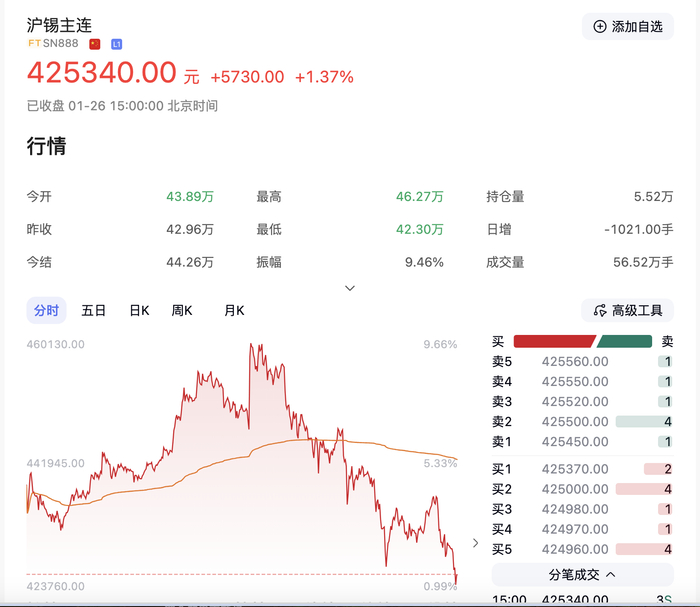
Core Viewpoint - The tin metal market is experiencing a significant price surge, continuing the upward trend from 2025, with prices reaching historical highs due to a combination of geopolitical conflicts, supply constraints, and long-term demand expectations [1][4]. Price Trends - On January 26, the main contract for tin futures on the Shanghai Futures Exchange rose over 10% to approximately 462,700 CNY per ton, closing at 425,300 CNY per ton, a 1.37% increase from the previous trading day and over 25% for the month [1]. - The LME three-month tin price hit a record high of about 55,400 USD (approximately 358,200 CNY) per ton on January 23, up 6.5% from the previous day [1]. Supply Constraints - The current geopolitical situation in the Democratic Republic of the Congo has escalated, increasing safety risks in major production areas, compounded by slow recovery in Myanmar and policy uncertainties in Indonesia, creating a "triple constraint" on supply [4]. - Global tin inventories are at historical lows, with LME tin stocks at 7,195 tons, a 21.23% increase month-on-month, while domestic social inventories have accumulated to 9,700 tons, up 0.18% [4]. Demand Dynamics - There is a clear distinction between short-term demand pressure and long-term growth potential, with traditional seasonal demand being subdued before the Spring Festival, while long-term growth driven by AI computing, photovoltaic new energy, and electric vehicles is expected to significantly outpace traditional sectors [3][5]. Industry Challenges - The tin industry is currently facing intensified competition between upstream and downstream sectors, with upstream players holding significant power due to resource scarcity [6][7]. - Domestic smelting enterprises are struggling with high procurement costs for imported ore, leading to historically low processing fees and overall industry losses [12]. Resource Dependency - China, despite being the largest tin resource holder and producer, has seen its reliance on imported tin ore exceed 60%, with some years approaching 70%, indicating a severe constraint on raw material supply [7][9]. - The annual production of tin ore in China has declined from 120,000 tons in 2010 to approximately 95,000 tons in 2022, while consumption has increased from 154,000 tons to 195,000 tons, widening the supply gap [11]. Future Price Outlook - Short-term factors supporting high tin prices include a weak dollar environment, supply concerns due to geopolitical tensions, and positive market sentiment [15]. - Analysts predict that while demand growth expectations exist, the anticipated impact of AI on tin consumption may be overstated, with AI-related consumption accounting for only 1%-2% of total tin consumption [15].
上期所调整白银、锡期货交易限额 以及铜、铝期货涨跌停板幅度等
Zhong Guo Ji Jin Bao· 2026-01-26 12:48
Group 1 - The Shanghai Futures Exchange (SHFE) has tightened trading limits for silver and tin futures contracts, effective from January 27, 2026, with maximum daily opening positions set at 800 lots for silver and 200 lots for tin [2][3] - The recent tightening of trading limits follows a significant surge in silver and tin prices, with silver reaching a peak of 28,226 yuan per kilogram, an increase of over 14%, and tin hitting 462,720 yuan per ton [3] - The adjustments in trading limits are part of SHFE's risk control measures, reflecting the ongoing volatility and price increases in these commodities [2][3] Group 2 - The SHFE has also announced changes to the price fluctuation limits and margin requirements for copper and aluminum futures, effective from January 28, 2026, with a fluctuation limit of 9% and a margin requirement of 10% for hedging positions [5][6] - Copper and aluminum futures have shown a rising trend, with copper closing at 101,880 yuan per ton, up 1.26%, and aluminum at 24,215 yuan per ton, up 0.33% as of January 26 [6] - Market analysts suggest that the demand for copper is supported by rapid growth in sectors such as energy storage and AI, while aluminum prices are influenced by macroeconomic factors and overall market sentiment [6][5]