思瑞浦

Search documents
聊聊我眼中的1-8月芯片市场行情
芯世相· 2025-09-19 04:19
Core Viewpoint - The semiconductor industry is experiencing a recovery phase, with significant sales growth anticipated in the coming quarters, driven by demand from various sectors including industrial and automotive markets [3][14]. Group 1: Market Signals and Trends - In October of the previous year, early signals of recovery were noted when PCB manufacturers like Jingwang Electronics and Shennan Circuit reported full capacity [3]. - Following the election of a new political leader, there was a surge in inventory purchases as companies anticipated market changes, leading to increased demand [3]. - Global semiconductor sales peaked in mid-2022 and have shown signs of recovery since Q4 2024, with sales rebounding above previous highs [3][5]. Group 2: Company Performance and Pricing Dynamics - Companies in the chip distribution sector reported significant performance improvements, with some experiencing a doubling of orders, particularly for ADI and Microchip products [5]. - TI's price adjustments affected approximately 66,000 models, representing about 76% of its total offerings, indicating a strategic move to influence market pricing [6]. - Despite TI's price increases, the overall market did not experience a widespread price surge, suggesting a cautious approach from manufacturers [6]. Group 3: Memory Market Insights - The memory market has seen substantial price increases, with Micron's prices doubling from January to March and again from March to May [10][12]. - There is a growing trend of memory manufacturers attempting to control prices through production adjustments, which has led to a more volatile market environment [12]. - The demand for small capacity eMMC has surged, with sales reported to be twice that of the previous year, indicating a strong recovery in the memory segment [10]. Group 4: Capacity and Supply Chain Dynamics - Domestic wafer fabs are reportedly operating at full capacity, with significant demand noted even when the downstream market appears stable [13][14]. - The supply chain is experiencing delays and shortages, particularly for domestic brands, while overseas markets are not facing the same level of pressure [14]. - The semiconductor industry is expected to see a delayed transmission of recovery signals to distributors and end-users, as the supply chain is complex and lengthy [14].



把“飞行相机”卖全球,HOVERAir的出海进化论
Nan Fang Du Shi Bao· 2025-09-18 04:45
之对话"亿级卖家"系列报道 2025 年一个夏日的清晨,在加州圣莫尼卡海滩,一名冲浪者正准备迎接海浪。与其他冲浪者不同的 是,他手中除了冲浪板,还握着一台巴掌大小的设备。随着他轻抛启动,这台设备如忠诚的摄影师般腾 空而起,自动跟拍他在浪尖穿梭的身影。这台来自中国深圳的 HOVERAir 飞行相机,正以 "会飞的摄影 师" 身份,悄然改变着全球消费者记录生活的方式。 进入2025年,HOVERAir在消费级无人机赛道继续提速。而在相关领域,前有巨头大疆、后有新晋登陆 A股市值破千亿的影石创新,都备受资本关注。 本期《湾财出海观》对话零零科技高级市场营销总监、HOVERAir 全球电商负责人王心暄,走进"飞行 相机"从深圳卖全球的出海故事。 破局者的诞生:重新定义飞行相机 用王心暄的话来讲HOVERAir的缘起,"我们不是在发现需求,而是在创造需求"。2016 年,当消费级无 人机还停留在 "专业设备" 的认知时,零零科技就推出了首款全包围结构的随身无人机 Hover Camera Passport(小黑侠),一举斩获红点最佳设计、IFDesign、CES 等多项国际大奖,并与苹果公司建立全 球合作关系,进驻多国 ...

目前家电国产芯片的占比整体已达70~80%
Di Yi Cai Jing· 2025-09-17 01:13
9月16日,第一财经记者从家电芯片代理商、分析师和专家处获悉,目前家电用的模拟芯片的国产化率 已较高。据产业在线的统计数据,截至2024年底,中国家电模拟芯片的国产化率已达65%。 据西安理工大学可靠性研究院创院院长陈建民介绍,家电芯片涵盖数字芯片、模拟芯片和功率半导体器 件。数字芯片包括MCU(微控制单元)、EEPROM(带电可擦可编程只读存储器)等;模拟芯片包括 运算放大器芯片、比较器芯片、电源芯片等;功率半导体器件包括IPM、IGBT、FRD等。目前家电国 产芯片的占比整体已达70~80%,模拟芯片的国产化率约为90%,功率半导体器件的国产化率已超 70%。 产业在线芯片分析师欧阳怀表示,近年在家电业,芯朋微、晶丰明源、圣邦股份、必易微、士兰微等的 模拟芯片加快国产替代进程。它们的AC-DC(交流-直流)、DC-DC(直流-直流)电源管理芯片,主要 用于节能的变频家电,市场份额已达65%,一颗芯片的价格约0.1~0.3元,一般比进口同类芯片便宜 15%~20%,性能差异不大。目前PI(美国电源管理技术公司)的份额超过10%。 "国内家电企业均在做芯片纯国产方案,反倾销调查预计将会加快家电用芯片的国产化进 ...
国产模拟芯片提速,“家电领域占65%”
第一财经· 2025-09-17 01:02
2025.09. 17 本文字数:1197,阅读时长大约2分钟 作者 | 第一财经 王珍 9月16日,第一财经记者从家电芯片代理商、分析师和专家处获悉,目前家电用的模拟芯片的国产化 率已较高。据产业在线的统计数据,截至2024年底,中国家电模拟芯片的国产化率已达65%。 产业在线芯片分析师欧阳怀表示,近年在家电业,芯朋微、晶丰明源、圣邦股份、必易微、士兰微等 的模拟芯片加快国产替代进程。它们的AC-DC(交流-直流)、DC-DC(直流-直流)电源管理芯 片,主要用于节能的变频家电,市场份额已达65%,一颗芯片的价格约0.1~0.3元,一般比进口同类 芯片便宜15%~20%,性能差异不大。目前PI(美国电源管理技术公司)的份额超过10%。 一位家电芯片代理商亦透露,国产芯片基本可以满足普通家电产品的需求,主流家电企业都已做好芯 片国产化的备份方案。空调、冰箱、洗衣机等大家电的外机变频板要用模拟芯片,目前国产模拟芯片 占比不低于60%。小家电都用国产芯片。运算放大器芯片、电源类芯片,圣邦微、华润微、思瑞 浦、坤元微、芯朋微、必易微等都可以供应,仍有少量进口。"国产芯片的价格更优,性能可以满足 要求。技术的先进性方 ...

国产模拟芯片提速,机构称家电领域份额占比已达65%
Di Yi Cai Jing· 2025-09-17 00:39
Core Insights - The domestic production rate of analog chips for home appliances in China is projected to reach 65% by the end of 2024, with the overall domestic chip share in home appliances at 70-80% [4] - The domestic analog chip production rate is approximately 90%, while the power semiconductor devices exceed 70% [4] - Major domestic companies like Chipone Microelectronics, Jingfeng Mingyuan, and others are accelerating the replacement of imported analog chips, capturing a market share of 65% in power management chips [4] Group 1 - The domestic analog chips can meet the needs of ordinary home appliances, with a minimum of 60% share in major appliances like air conditioners and refrigerators [5] - The price of domestic chips is about 0.1-0.3 yuan, which is 15%-20% cheaper than imported counterparts, with similar performance [4][5] - Domestic companies are developing pure domestic chip solutions, and the anti-dumping investigation is expected to accelerate the domestic chip production process [5][6] Group 2 - The anti-dumping investigation aims to deter unfair competition from foreign companies leveraging their technological and market advantages [6] - The final market share of domestic chips will depend on comprehensive factors such as product performance, price, and service [6] - The domestic analog chip industry is expected to undergo a phase of competition, leading to a survival of the fittest scenario [5]





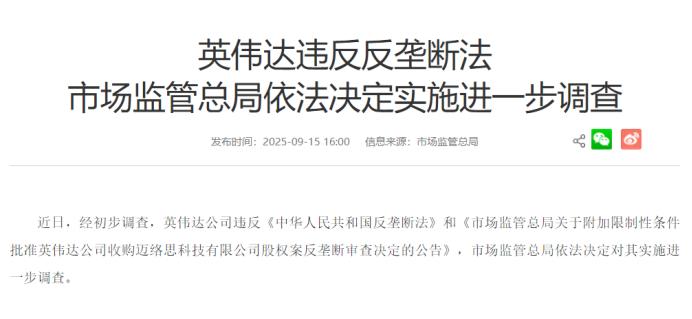
中美芯片战,中国大反击
虎嗅APP· 2025-09-16 14:05
Core Viewpoint - The article discusses China's recent countermeasures in the ongoing chip war with the United States, highlighting three specific actions taken against American semiconductor companies, particularly Nvidia, in response to U.S. export controls and anti-competitive practices [4][5][6]. Group 1: China's Countermeasures - On September 13, China initiated an anti-dumping investigation into American-made analog chips [4]. - On the same day, China launched an anti-discrimination investigation against U.S. measures affecting the integrated circuit sector [4]. - On September 15, China determined that Nvidia violated antitrust laws, leading to further investigations [4][9]. Group 2: Nvidia's Antitrust Issues - Nvidia recently received U.S. government approval to sell H20 chips to China but faced scrutiny from the Chinese government for alleged antitrust violations [8][9]. - The investigation relates to Nvidia's 2019 acquisition of Mellanox Technologies, which was approved under specific conditions to prevent anti-competitive practices [11][14]. - Nvidia's supply of H20 chips to China has been criticized for not adhering to fair and non-discriminatory principles, as the performance of these chips is significantly lower than their counterparts available in other markets [16][17]. Group 3: Impact on the Semiconductor Industry - The anti-dumping investigation targets analog chips, with significant price discrepancies noted, such as a dumping margin of 340.10% for certain products [24][25][26]. - Major U.S. companies like Texas Instruments, ADI, Broadcom, and ON Semiconductor are implicated, with their combined revenue in China exceeding $10 billion, indicating potential significant financial repercussions [33]. - Following the announcement of these investigations, Chinese semiconductor stocks surged, while U.S. counterparts like Texas Instruments experienced declines [33]. Group 4: Broader Trade Implications - The article suggests that the ongoing trade tensions involve not only direct actions like anti-dumping and antitrust investigations but also broader issues of discrimination in trade practices [35][36]. - The ultimate goal for China is to enhance its self-sufficiency in semiconductor manufacturing, reducing reliance on foreign technology [37][38].


对美模拟芯片反倾销,业内怎么看?
3 6 Ke· 2025-09-16 04:26
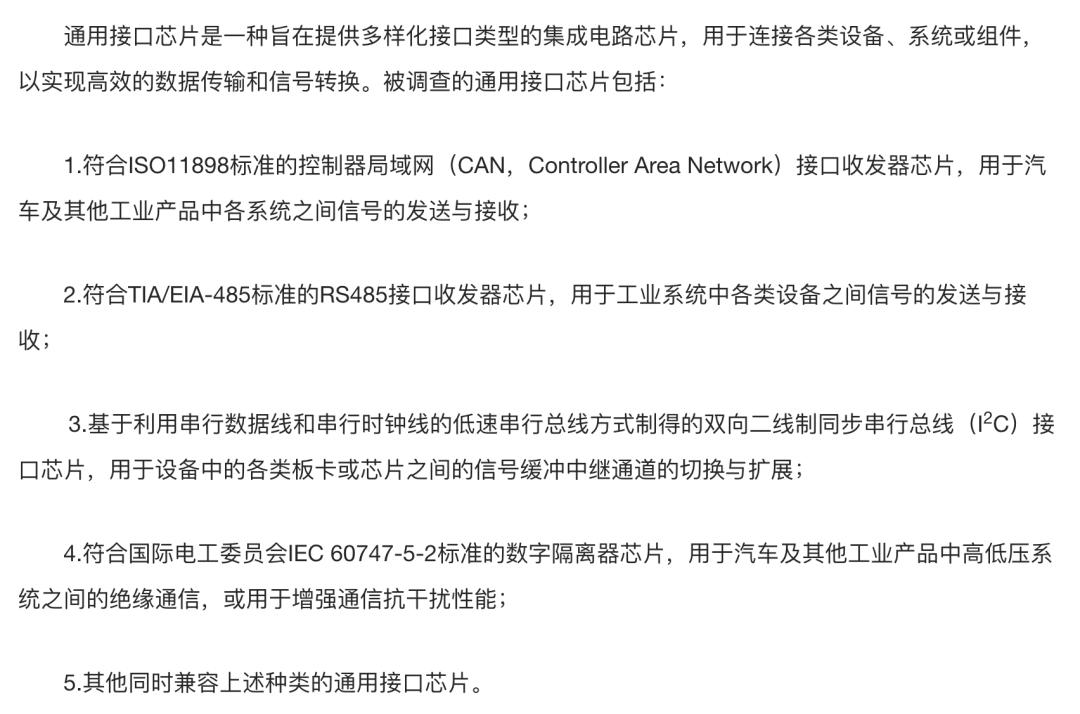
Group 1 - The Ministry of Commerce has initiated an anti-dumping investigation into imported analog chips from the United States, leading to a significant rise in the A-share analog chip sector [1][5] - Major companies such as Shengbang Co., Shanghai Beiling, and Naxinwei saw their stock prices hit the daily limit, while others like SIRUI and Aiwai Electronics also experienced notable gains [1][10] - The investigation was prompted by a formal request from the Jiangsu Semiconductor Industry Association, citing a significant price drop and a dumping margin exceeding 300% for the products in question [2][3] Group 2 - The investigation will cover products primarily used in automotive and industrial systems, specifically general-purpose interface chips and gate driver chips [8][9] - The products under investigation include both finished chips and raw materials like wafers and die, emphasizing the importance of product origin [10][12] - The investigation period is set from January 1, 2024, to December 31, 2024, with the industry damage assessment covering from January 1, 2022, to December 31, 2024 [12] Group 3 - The Chinese Semiconductor Industry Association and other industry groups have expressed support for the investigation, emphasizing the need for a fair market environment [5][6] - Despite improvements in domestic analog chip self-sufficiency, major players like Texas Instruments and Analog Devices still dominate the market [11] - The price competition from U.S. manufacturers has significantly impacted domestic small and medium-sized enterprises, highlighting the challenges faced by local firms in the high-end market [12][13]
反倾销反歧视反垄断:中国还击美国芯片战
Hu Xiu· 2025-09-16 04:05
Group 1 - China has initiated anti-dumping investigations against American-made analog chips and anti-discrimination investigations related to integrated circuits on the same day, marking a significant counteraction in the ongoing chip war with the U.S. [1][2] - The U.S. Department of Commerce recently added 32 entities to its export control "entity list," with 23 of them located in China and many involved in the chip business, which may have triggered China's response [2][3] - The ongoing trade talks between China and the U.S. in Spain may be influenced by these actions, suggesting a strategy of "fighting while negotiating" [3][4] Group 2 - Nvidia has been found in violation of antitrust laws by China's State Administration for Market Regulation (SAMR), which has decided to conduct further investigations [8][10] - The investigation relates to Nvidia's acquisition of Mellanox Technologies in 2019, which was approved under certain conditions to prevent anti-competitive practices [12][15] - Nvidia's current supply of H20 chips to China is significantly limited in performance compared to its H200 chips, raising concerns about compliance with fair trade practices [18][17] Group 3 - The anti-dumping investigation targets analog chips produced by U.S. companies, with the investigation period set from January 1, 2024, to December 31, 2024 [31][32] - The application for the investigation cites that U.S. companies have significantly increased their product imports to China while simultaneously lowering prices, adversely affecting domestic producers [36][39] - If the anti-dumping investigation is upheld, it could lead to substantial penalties for major U.S. chip companies, potentially impacting their revenues in China, which exceed $10 billion collectively [41] Group 4 - The Chinese government is also conducting an anti-discrimination investigation against U.S. measures that restrict high-end chips while allowing low-end chips to flood the market, which are seen as discriminatory trade practices [44][45] - The outcome of these investigations could lead to increased tariffs or restrictions on U.S. products if found to be unfair [45][46] - The ongoing investigations and trade tensions highlight the complex dynamics of the U.S.-China trade relationship, particularly in the semiconductor sector [46][47]
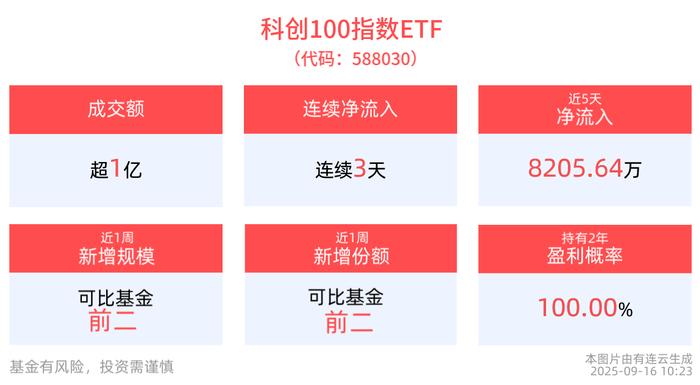
持续突破!国产AI芯片抢夺市场窗口期,科创100指数ETF(588030)连续3日“吸金”合计2.46亿元
Xin Lang Cai Jing· 2025-09-16 02:59
Core Viewpoint - The demand for AI chips is driving domestic chip manufacturers and internet giants to seize market opportunities amid supply instability from Nvidia, with significant orders being secured by companies like Kunlun Chip from China Mobile [3][4]. Group 1: Market Performance - As of September 16, 2025, the Sci-Tech Innovation Board 100 Index decreased by 0.10%, with stocks showing mixed performance; Plater Tech led with a 5.68% increase, while Hangke Technology fell by 8.60% [3]. - The Sci-Tech 100 Index ETF (588030) saw a slight decline of 0.23%, priced at 1.32 yuan, but had a 2.47% increase over the past week [3]. - The ETF recorded a turnover rate of 1.69% and a transaction volume of 101 million yuan, with an average daily transaction of 439 million yuan over the past year, ranking first among comparable funds [3]. Group 2: Industry Insights - Industry experts highlight that domestic companies like Cambricon, Haiguang Information, and Moore Threads have developed competitive AI inference chips, emphasizing the need to enhance production capacity to meet the rapidly growing demand for AI computing power [4]. - Shanghai Securities notes that a robust software platform is essential to maximize the hardware performance of intelligent chips, making them more adaptable to new demands from large models and lowering user barriers for efficient AI algorithm and application innovation [4]. - The top ten weighted stocks in the Sci-Tech 100 Index account for 23.82% of the index, with companies like Dongxin Co., Huahong Semiconductor, and BeiGene among the leaders [6]. Group 3: Fund Performance - The Sci-Tech 100 Index ETF experienced a significant growth of 350 million yuan in scale over the past week, ranking second among comparable funds [4]. - The ETF's share increased by 90 million shares in the same period, also ranking second among comparable funds [4]. - The ETF saw continuous net inflows over three days, with a peak single-day net inflow of 164 million yuan, totaling 246 million yuan and an average daily net inflow of 8.21 million yuan [4].
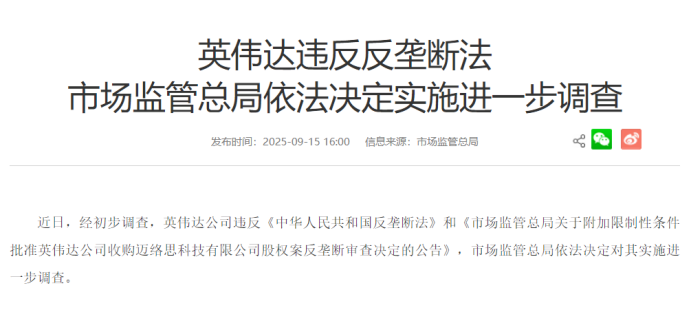
中美芯片战:中国大反击,上了 3 个反制手段,直戳美国痛处
3 6 Ke· 2025-09-16 01:19
Group 1 - China has initiated anti-dumping investigations against American semiconductor chips, marking a significant response in the ongoing chip war with the U.S. [1] - The investigations were triggered by the U.S. Department of Commerce's recent addition of 32 entities to the export control "entity list," including 23 from China involved in chip business [1][2] - The Chinese government has also launched an anti-discrimination investigation against U.S. measures in the integrated circuit sector [1] Group 2 - Nvidia is under investigation by China's State Administration for Market Regulation (SAMR) for violating antitrust laws, particularly related to its acquisition of Mellanox Technologies in 2019 [4][7] - The acquisition raised concerns due to Nvidia's dominant market share in GPU accelerators and Mellanox's significant presence in high-speed networking equipment [9][10] - Nvidia's H20 chip, which is being sold to China, has significantly reduced performance compared to its H200 counterpart, raising fairness concerns in supply [14] Group 3 - The anti-dumping investigation targets American analog chips, with reported dumping margins of 340% for certain products [22][30] - The investigation period is set from January 1, 2024, to December 31, 2024, with the domestic industry claiming significant harm due to price suppression by U.S. companies [23][30] - The outcome of the anti-dumping investigation could lead to substantial penalties for U.S. companies like Texas Instruments and Broadcom, which collectively earn over $10 billion in China [31][32] Group 4 - The Chinese government is also conducting an anti-discrimination investigation against U.S. trade practices, which may result in tariffs or restrictions on U.S. products [32] - The ultimate countermeasure for China may involve enhancing its self-reliance in semiconductor manufacturing capabilities [33][34]