
英大信托

Search documents
人民币兑美元突破7.12元,全球主权财富基金抢滩A股 | 财经日日评
吴晓波频道· 2025-08-30 00:29
Group 1: Urban Development and Real Estate - The central government has released a roadmap for promoting high-quality urban development, emphasizing the transformation of urban development methods and addressing issues such as the renovation of old housing and urban safety management [2][3] - The focus will shift from large-scale expansion to meticulous cultivation in urban construction and the real estate sector, as local governments balance various demands to implement urban renewal [3] Group 2: Artificial Intelligence Development - The National Development and Reform Commission (NDRC) emphasizes the need to avoid disorderly competition in the development of "Artificial Intelligence+" and to tailor development strategies based on local characteristics [4][5] - By 2027, the goal is to achieve widespread integration of AI across six key sectors, with a target application penetration rate exceeding 70% for new intelligent terminals and agents [4] Group 3: Currency Exchange and Economic Indicators - The offshore RMB/USD exchange rate has surpassed 7.12, with the People's Bank of China indicating that the recent appreciation is primarily due to domestic factors rather than solely external pressures [6][7] - The U.S. second-quarter GDP growth was revised to 3.3%, driven by strong business investment and consumer spending, with net exports contributing significantly to GDP growth [8][9] Group 4: Sovereign Wealth Funds and A-shares - Sovereign wealth funds are increasingly investing in A-shares, with significant holdings reported by entities such as the Abu Dhabi Investment Authority, indicating a growing interest in the Chinese market [10][11] - The allocation of sovereign wealth funds in A-shares remains relatively low, suggesting a need for the A-share market to enhance its appeal to foreign investors [11] Group 5: Trust Companies' Performance - Trust companies are experiencing significant performance divergence, with an overall net profit decline of 2.83% among 53 companies reporting, highlighting the challenges faced by the industry [12][13] - The shift from non-standard to standardized business models is impacting profitability, with some companies showing resilience while others struggle [13] Group 6: Semiconductor Industry - SMIC reported a 22% year-on-year revenue increase in the first half of 2025, driven by strong demand in the consumer electronics sector and a rise in the share of 12-inch wafer revenue [14][15] - Despite strong performance, challenges such as reduced demand for pre-stocked products and slow recovery in domestic consumption may impact future earnings [15] Group 7: Stock Market Trends - The A-share market has shown a strong upward trend, with significant gains in the ChiNext index and overall market activity, indicating a shift in investor sentiment [16][17] - The market is experiencing volatility as it approaches the end of the month, with a focus on whether it can successfully transition between different investment themes [17]


信托业半年考
2 1 Shi Ji Jing Ji Bao Dao· 2025-08-13 23:08
Core Viewpoint - The trust industry in China is experiencing a slight decline in overall profitability, with significant structural differentiation among companies, as reflected in the financial reports for the first half of 2025 [1][6]. Group 1: Financial Performance - The overall operating income of 53 trust companies decreased by 1.98% year-on-year, while total profit fell by 3.72% and net profit declined by 2.83% [1]. - Among the 53 trust companies, 10 companies reported operating income exceeding 1 billion yuan, with the top ten companies generating revenues of 29.16 billion yuan, 19.41 billion yuan, and 16.34 billion yuan respectively [2]. - The largest revenue growth was observed in Shanghai Trust, which achieved an operating income of 11.15 billion yuan, a year-on-year increase of 39.77% [2]. Group 2: Structural Differentiation - Trust business income saw a significant decline of 11.38%, indicating a continued contraction in traditional high-yield trust business [1]. - In the segment of companies with operating income between 500 million and 1 billion yuan, Caixin Trust reported a remarkable growth of 214.65%, reaching 607 million yuan [3]. - Among the 50 comparable trust companies, 21 experienced a decline in net profit or an increase in losses, with the largest drop reported by Industrial Trust at -146 million yuan, a decrease of 323.62% [5]. Group 3: Factors Influencing Profitability - The decline in profitability is attributed to several factors, including rising management costs, increased asset impairment provisions, and the impact of new regulations on traditional high-profit channel businesses [6]. - The shift towards active management is being accelerated due to the significant reduction in channel business scale, which has historically been a profit source for trust companies [6]. Group 4: Group Holdings and Resource Advantages - Trust companies with financial group holdings or state-owned enterprise backing tend to perform better, leveraging group resources for business growth [7][9]. - Notable examples include CITIC Trust, which is part of CITIC Group, and Jiangsu Trust, which is a key member of Jiangsu Guoxin Group, indicating the importance of group affiliations in achieving financial success [8]. Group 5: New Business Directions - The trust industry is exploring new business avenues such as real estate and equity trusts, supported by regulatory initiatives aimed at establishing a formal registration system for these types of trusts [10][11]. - The pilot programs for real estate and equity trust registration signify a major breakthrough in the trust property registration system, showcasing the potential for trust companies to meet public needs and support the real economy [11].
上半年信托业净利降2.83% 中信、江苏、英大信托占前三甲
2 1 Shi Ji Jing Ji Bao Dao· 2025-08-13 10:35
Core Insights - The overall profitability of the trust industry has slightly declined, with operating income down by 1.98%, total profit down by 3.72%, and net profit down by 2.83% year-on-year for the first half of 2025 compared to the same period in 2024 [1] - There is significant structural differentiation within the industry, with trust business income decreasing by 11.38%, indicating a continued contraction of traditional high-yield trust business [1][7] - The top ten trust companies by operating income are primarily controlled by financial groups or state-owned enterprises, which leverage their resources for business growth [8][10] Financial Performance - Among the 53 trust companies, 10 reported operating income exceeding 1 billion yuan, while 13 had income between 500 million and 1 billion yuan, and 29 had income below 500 million yuan [2] - The top ten companies by operating income include CITIC Trust, Yingda Trust, and Huaxin Trust, with revenues of 29.16 billion yuan, 19.41 billion yuan, and 16.34 billion yuan respectively [2] - Shanghai Trust reported the highest growth in operating income at 39.77%, followed by Huaxin Trust at 24.45% and Yingda Trust at 19.18% [2] Profitability Trends - In terms of net profit, CITIC Trust led with 15.67 billion yuan, a year-on-year increase of 13.47%, while Jiangsu Trust and Yingda Trust followed with net profits of 13.98 billion yuan and 13.62 billion yuan respectively [4] - The largest increase in net profit was seen in Kunlun Trust, which grew by 421.10% to 1.08 billion yuan [4] - However, 21 out of 50 comparable trust companies experienced a decline in net profit or an increase in losses, with the largest declines reported by Xingye Trust and Wukuang Trust [5] Industry Challenges - The decline in profitability is attributed to several factors, including rising management costs, increased asset impairment provisions, and the impact of new regulations on traditional high-profit channel businesses [7] - The industry is undergoing a transformation towards active management due to the significant reduction in channel business scale, which has historically been a profit source for trust companies [7][10] Future Outlook - The trust industry is expected to continue evolving under regulatory support, with real estate and equity trusts emerging as new business exploration directions [11][12] - The establishment of property trust registration systems marks a significant breakthrough in the trust asset registration system, indicating the potential for trust companies to better serve public needs and support the real economy [12]
上半年业绩稳中承压 信托业加快布局转型创新
Xin Hua Wang· 2025-08-12 06:19
Core Viewpoint - The trust industry is experiencing a slowdown in growth for the first half of 2022, with some companies showing strong performance in their trust business. The focus for the second half remains on transformation and innovation to achieve high-quality development [1][2]. Group 1: Performance Overview - As of now, most trust companies have disclosed their unaudited financial reports for the first half of 2022, showing overall performance under pressure. The total operating income for 56 trust companies reached 57.544 billion yuan, with trust business income at 37.358 billion yuan, a year-on-year decrease of 13.86%. Proprietary business income was 20.187 billion yuan, down 15.21% year-on-year [2][3]. - Notably, Ping An Trust achieved operating income of 11.679 billion yuan, surpassing the 10 billion yuan mark, while Jianxin Trust saw a steady increase with revenue of 6.288 billion yuan, up 16% year-on-year. Other companies like CITIC Trust, Chongqing Trust, Wukuang Trust, Everbright Trust, and Zhongrong Trust also reported revenues exceeding 2 billion yuan [2][3]. - Many trust companies experienced a slowdown in net profit growth, with some reporting negative growth. Jiangsu International Trust was one of the few to achieve net growth in both operating income and net profit, with figures of 1.124 billion yuan and 1.328 billion yuan, respectively, marking increases of 134 million yuan and 128 million yuan year-on-year [2][3]. Group 2: Business Income Analysis - In terms of trust business income, CITIC Trust, Everbright Trust, and Wukuang Trust each reported over 2 billion yuan, but still saw declines compared to the previous year. Jianxin Trust, Yingda Trust, Foreign Trade Trust, and Guotou Taikang Trust achieved positive year-on-year growth, with Jianxin Trust's income at 1.429 billion yuan, up 10.38% year-on-year, and Guotou Taikang Trust showing a remarkable growth of 52.89% [3][4]. - Analysts attribute the narrowing of trust business income to regulatory pressures and a reduction in financing and management trust business scales. Additionally, fluctuations in the capital market have led to impairments in fair value changes, resulting in lackluster performance in proprietary business income [3][4]. Group 3: Strategic Focus on Transformation - Many trust companies are emphasizing "innovation and transformation" in their mid-year meetings, with a focus on standard product trusts and family trusts as key strategic areas for development. Shanghai Trust highlighted the need to align with asset management and wealth management directions [4][5]. - The issuance of standard product trust products saw a significant increase, with 1,031 products issued in July, up 13.07% month-on-month, and a total issuance scale of 73.653 billion yuan, reflecting a 23.39% month-on-month growth. This segment is becoming a major support for the trust market's growth [4][5]. - Family trust business is also gaining traction, with a reported existing scale of approximately 349.481 billion yuan by the end of 2021, and over 10 billion yuan added in June alone, marking a month-on-month growth of over 60% [5][6]. Group 4: Future Outlook - The trust industry is expected to see performance improvements as various "stabilizing growth" policies are implemented and the economy recovers. Trust companies are encouraged to leverage their resource advantages and explore business transformations in line with the latest regulatory classifications [6][7]. - The asset management and wealth management sectors are anticipated to become focal points for future development, although the industry currently lacks a differentiated competitive landscape, necessitating improvements in technology, research capabilities, and talent quality [7][8].
信托公司年报季落幕:3家信托资产规模超2万亿
Xin Hua Wang· 2025-08-12 06:10
Core Insights - The annual reports of trust companies have been released, revealing that 56 companies have disclosed their operational data, with 5 companies managing over 1 trillion yuan in trust assets by the end of 2024 [1] - The top 5 trust companies by asset management scale are China Resources Trust, CITIC Trust, Foreign Trade Trust, China Construction Trust, and Yingda Trust, with asset sizes of 2.68 trillion yuan, 2.62 trillion yuan, 2.15 trillion yuan, 1.47 trillion yuan, and 1.09 trillion yuan respectively [1] - China Resources Trust reported a net profit of 2.55 billion yuan in 2024, with a slight increase in trust asset scale of 3.07% to 2.68 trillion yuan, 86.61% of which is invested in the securities market [1] - CITIC Trust achieved an operating income of 5.38 billion yuan in 2024, with a net profit of 2.65 billion yuan, and has a significant portion of its trust assets in asset service trusts and asset management trusts [2] - Foreign Trade Trust reported an operating income of 2.52 billion yuan and a net profit of 643 million yuan in 2024, with 85.25% of its trust assets invested in the securities market [2] Company Summaries - China Resources Trust focuses on securities trust business, with a strategic plan called "656" that includes six business directions and six construction initiatives aimed at enhancing core capabilities [1] - CITIC Trust has seen growth in its bankruptcy reorganization service trusts, contributing significantly to its asset scale, and has won major risk disposal service trust projects [2] - Foreign Trade Trust aims to deepen business transformation and enhance professional capabilities, focusing on asset service trusts, asset management trusts, and charitable trusts [2]
信托公司净利增速分化 战略差异显现
Jin Rong Shi Bao· 2025-08-08 07:52
Core Insights - The trust industry is experiencing a "growth without profit" trend, with overall profitability declining amid significant operational pressure [1][2] - Asset service trusts are expanding rapidly but are unable to fully compensate for the profit gap left by shrinking traditional business segments [1] - The asset management trust sector, while a focus for transformation, has not yet established stable profit growth and is unlikely to provide effective support in the short term [1] Group 1: Industry Performance - As of May 6, 57 trust companies have disclosed their 2024 annual reports, revealing a total profit of approximately 35.09 billion yuan, a year-on-year decrease of 22.21% [2] - The total net profit for these companies is about 28.81 billion yuan, down 17.67% year-on-year [2] - Jiangsu Trust leads the industry with a net profit of 2.82 billion yuan, marking its second consecutive year at the top [2] Group 2: Company Performance - Among the 48 profitable trust companies, 8 reported net profits below 100 million yuan, while companies like Wanxiang Trust and Minmetals Trust experienced varying degrees of losses, with Minmetals Trust reporting a loss of approximately 954 million yuan, a year-on-year decrease of 180.17% [2][3] - Despite challenges, 27 companies reported positive net profit growth, with Jilin Trust and Jingu Trust showing significant increases of 174.71% and 65.46% respectively [3] Group 3: Business Transformation - The trust industry is undergoing a deep structural adjustment, with a focus on innovative business development requiring substantial resource investment [4] - Companies like Yingda Trust and Jiangsu Trust have maintained stable profits due to optimized business structures and strategic adjustments [4] - The asset management trust sector is seen as commercially valuable, with firms focusing on capital market development and product design gaining competitive advantages [4] Group 4: Future Strategies - Trust companies need to enhance risk management by establishing comprehensive systems to identify and monitor various risks [5] - Continuous business transformation is essential for profit growth, shifting from traditional financing to asset services and innovative business models [5] - Collaboration with shareholders and other financial institutions is crucial for leveraging resources and enhancing service offerings to meet high-net-worth client needs [6]
规模稳住之后 信托公司如何提质
Jin Rong Shi Bao· 2025-08-08 07:52
Core Insights - The trust industry is experiencing significant growth, with the total managed assets surpassing 27 trillion yuan in 2024, up from approximately 22.78 trillion yuan in 2023, indicating a robust increase in asset scale [1][2] - The top five trust companies now manage over 10 trillion yuan, accounting for 37% of the industry's total assets, highlighting a pronounced head effect within the sector [2] - Despite overall growth, some companies are still downsizing, with 13 firms reporting a year-on-year decrease in asset scale, and five of those experiencing declines exceeding 20% [3] Asset Scale Growth - As of May 6, 2024, 57 trust companies reported a combined asset scale of approximately 27.11 trillion yuan, with 44 companies showing an increase compared to the previous year [1] - The number of trust companies with assets between 5 billion and 10 billion yuan has risen to 15, an increase of two from 2023 [2] - Five companies, including Jingu Trust and Huazhong Trust, have seen their asset scales double, with growth rates ranging from 106.77% to 151.88% [2] Structural Challenges - Some trust companies are focusing on "thinning" their operations, with examples like China Ocean Trust reducing its scale by over 40% in 2023 and continuing to decrease by about 20% in 2024 [3] - The industry is facing a "quantity increase but profit decline" phenomenon, indicating structural contradictions in the transition process, driven by conflicts between traditional practices and new regulatory guidelines [4][5] - The reliance on channel business for asset scale expansion has led to concerns about "scale inflation," as these low-value passive management strategies consume resources that could be better allocated to active management [5] Profitability and Management - Among the 13 companies with declining asset scales, five reported an increase in net profit, suggesting that profitability can be maintained despite a reduction in scale [4] - The average fee rate for channel business is significantly lower (0.1% to 0.3%) compared to active management (1.5% to 3%), indicating a disparity in revenue contribution versus resource consumption [5] - Experts recommend that trust companies enhance their research and investment capabilities and shift towards service trusts and family trusts to break free from traditional non-standard business inertia [5]
在严监管态势下探索差异化发展
Jin Rong Shi Bao· 2025-08-08 07:52
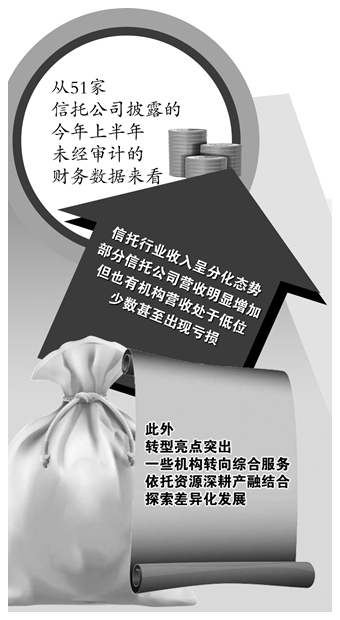
Core Insights - The trust industry in the first half of 2025 shows a polarized revenue performance, with some companies experiencing significant revenue growth while others remain at low levels or even incur losses [1] - Regulatory scrutiny continues, with multiple institutions receiving fines for various violations during the first half of the year [1] Industry Performance Overview - According to incomplete statistics, CITIC Trust (consolidated) ranked first in operating revenue for the first half of 2025, reaching 2.916 billion yuan; Yingda Trust and Huaxin Trust followed with revenues of 1.941 billion yuan and 1.634 billion yuan respectively [3] - Nine trust companies reported revenues exceeding 1 billion yuan; 13 companies had revenues between 500 million yuan and 1 billion yuan; and 23 companies reported revenues between 100 million yuan and 500 million yuan [3] - Notably, six trust institutions had revenues below 100 million yuan [3] - In terms of fees and commissions, Yingda Trust led with 1.444 billion yuan, followed by CITIC Trust (consolidated) and Huaxin Trust with 1.013 billion yuan and 964 million yuan respectively [3][4] - Only Yingda Trust and CITIC Trust (consolidated) had fees and commissions exceeding 1 billion yuan [4] Profitability Analysis - Among the disclosed data, CITIC Trust (consolidated), Jiangsu Trust, and Yingda Trust were the top three in net profit, each exceeding 1 billion yuan [4] - Seven trust companies reported net profits between 500 million yuan and 1 billion yuan, while 15 companies had net profits below 100 million yuan, including four companies with negative net profits [4] Regulatory Actions - In the first half of 2025, five trust companies received fines from regulatory authorities [5] - Huaao Trust was fined 4 million yuan for multiple violations, including inaccurate asset classification and non-compliance with reporting standards [5] - Lujiazui Trust faced a fine of 4.2 million yuan for five violations, including poor management of related transactions and inadequate risk information disclosure [5] - Other companies received fines of less than 1 million yuan for various infractions [6] Business Development Highlights - Trust companies are transitioning from being mere "fund providers" to "comprehensive service platform builders" [7] - Yingda Trust, backed by state-owned enterprises, reported strong performance in the first half of 2025, focusing on supply chain finance in the electric power sector [7] - Huaxin Trust has actively expanded its financial services, achieving a scale of 65.6 billion yuan in integrated finance by the end of June [7] - Kunlun Trust reported over 400% year-on-year growth in net profit, emphasizing the importance of integrated finance [7][8]
核心盈利能力 重构背景下 行业分化加剧
Jin Rong Shi Bao· 2025-08-06 02:28
Core Insights - The trust industry is facing significant pressure on operational efficiency, necessitating a reconstruction of its profit model, with projected profits for 2024 expected to be 23.09 billion yuan, a decrease of 19.29 billion yuan from 2023 [1] - The overall profitability indicators for the industry showed a slight decline in the first half of 2025, with operating income down by 1.98% year-on-year and net profit down by 2.83% [1] - The decline in profitability is attributed to decreased operating income, increased management costs, expanded losses from changes in asset fair value, increased asset impairment provisions, and a reduction in traditional high-profit channel business [1] Industry Differentiation - The competitive landscape of the trust industry is increasingly polarized, with a significant disparity in performance between leading firms and smaller companies, leading to a widening income gap [2] - The top five trust companies accounted for over 40% of the total net profit in the industry for 2024, indicating a concentration of profitability among a few key players [2] - In the first half of 2025, the top 10 trust companies held a market share of 63.32% in proprietary business income, while the top 10 in trust business income had a market share of 47.29% [3] Performance Concentration - The concentration of proprietary business income among the top 10 trust companies is significant, with a market share of 63.32%, creating competitive barriers for smaller firms [3] - The top 10 trust companies also accounted for 56.42% of the net profit, indicating a high level of profitability concentration [3] - Some companies, such as Huaxin Trust and Yingda Trust, have improved their rankings in proprietary business income, while others like Caixin Trust and Kunlun Trust have turned losses into profits [3] Transformation Strategies - Trust companies are benefiting from two main transformation directions: leveraging local resources and shareholder synergies to meet local economic development needs, and focusing on standardized trust and wealth management to rebuild core competitiveness [4] - The industry is encouraged to explore diversified transformation strategies to meet the demands of high-quality development, emphasizing the importance of serving the national strategy and the real economy [5] - In 2024, 28.81% of the 22.25 trillion yuan in trust funds will be directly invested in the real economy, with an additional 46.17% indirectly supporting it through the securities market, totaling 16.68 trillion yuan [5] Future Outlook - The development of the trust industry is seen as beneficial for economic stability and promoting industrial structure upgrades and technological innovation [6] - The industry is expected to channel more proprietary and social funds into technology enterprises, positioning itself as a leader in supporting the real economy [6]
51家信托公司披露2025年上半年业绩
Zheng Quan Ri Bao· 2025-07-18 16:10
Core Insights - The financial performance of trust companies in the first half of 2025 shows significant revenue differentiation, with 9 companies exceeding 1 billion yuan in revenue and 36 companies generating between 100 million to 1 billion yuan [1][2] - Among the top-performing trust companies, CITIC Trust leads with a revenue of 2.916 billion yuan, followed by Yingda Trust and Huaxin Trust with revenues of 1.941 billion yuan and 1.634 billion yuan respectively [1] - In terms of net profit, CITIC Trust, Jiangsu Trust, and Yingda Trust each surpassed 1 billion yuan, with net profits of 1.567 billion yuan, 1.398 billion yuan, and 1.362 billion yuan respectively [1] Revenue and Profit Analysis - The trust companies reported a clear revenue split, with 6 companies earning below 100 million yuan, while 36 companies fell within the 100 million to 1 billion yuan range [1] - The top three companies in terms of net profit are CITIC Trust, Jiangsu Trust, and Yingda Trust, with additional 7 companies reporting net profits between 500 million to 1 billion yuan [1] Fee and Commission Income - Fee and commission income is a crucial revenue source for trust companies, with Yingda Trust and CITIC Trust both exceeding 1 billion yuan in this category, and Yingda Trust leading with 1.444 billion yuan [2] - Other companies such as Huaxin Trust, Jianxin Trust, and others also reported fee and commission incomes exceeding 500 million yuan [2] Industry Trends and Strategies - The trust industry is undergoing a transformation, requiring companies to enhance their competitiveness and adapt to new business models [2] - Leading trust companies can leverage their resources, brand, and operational management to develop differentiated services, such as "trust + industry" models or focusing on specific sectors like pension services [3]