Rocket Lab

Search documents
早盘:美股继续上扬 道指上涨200点
Xin Lang Cai Jing· 2026-01-15 15:07
Group 1 - The core point of the news is that the US stock market continued to rise, driven by strong performance in the chip sector following TSMC's record quarterly earnings, which boosted confidence in AI demand resilience [1][3][19] - The Dow Jones Industrial Average rose by 212.51 points, or 0.43%, closing at 49,362.14 points; the Nasdaq increased by 174.877 points, or 0.75%, to 23,646.627 points; and the S&P 500 gained 36.10 points, or 0.52%, to 6,962.70 points [3][19] - TSMC reported a profit increase of 35%, which reignited investor confidence in AI demand, leading to a broad rally in chip stocks including Micron Technology, NVIDIA, and AMD [3][19] - The announcement of a 25% tariff on certain chip products by President Trump, including NVIDIA's H200 and AMD's MI325X, was made, but it was clarified that chips imported to support the US technology supply chain would be exempt from this tariff [3][19] Group 2 - Economic data showed a decrease in initial jobless claims to 198,000, down by 9,000 from the previous week, which is below the Dow Jones estimate of 215,000 [6][22] - The Empire State Manufacturing Index for January rose to 7.7, an increase of 11 points from December, exceeding expectations of 1.0; the Philadelphia Fed Manufacturing Index was reported at 12.6, significantly higher than the previous month's -8.8 and above the expected -4.5 [7][22] - Small-cap stocks, represented by the Russell 2000 index, have outperformed the S&P 500 for nine consecutive trading days, indicating a notable rotation in market dynamics [4][20]



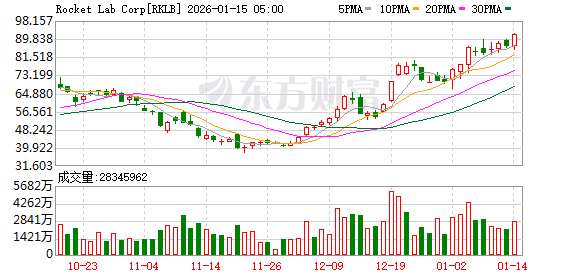
This Indicator Identified Strength In Rocket Lab Ahead Of Its Powerful Breakout
Investors· 2026-01-15 13:00
Group 1 - The document does not contain any relevant information regarding companies or industries [2][3][5][6]
美股异动丨Rocket Lab盘前跌近2%
Ge Long Hui A P P· 2026-01-15 11:26
格隆汇1月15日|Rocket Lab盘前跌近2%。消息面上,KeyBanc将其评级从"超配"下调至"行业标配"。 ...
Rocket Lab盘前股价下跌近2%
Mei Ri Jing Ji Xin Wen· 2026-01-15 11:21
(文章来源:每日经济新闻) 每经AI快讯,1月15日,Rocket Lab盘前股价下跌近2%。 ...
PatentVest Releases New Report on the IP Battle Shaping the $1.8 Trillion Space Economy
Globenewswire· 2026-01-14 17:35
Core Insights - The PatentVest Pulse report analyzes the competitive landscape of the $1.8 trillion space economy, focusing on the intellectual property (IP) portfolios of leading companies like SpaceX, Blue Origin, and Rocket Lab [1][2] - The report emphasizes the importance of patent data in assessing the long-term value and IPO readiness of space companies, highlighting that public markets favor defensible advantages over mere narratives [2] Company Analysis - SpaceX is rumored to be pursuing a historic IPO, and the report suggests that its patent portfolio indicates a shift towards Starlink as its core business rather than just launch services [5] - Blue Origin, backed by Jeff Bezos, is establishing early IP positions in future cislunar markets, indicating a strategic focus on emerging opportunities in space [5] - Rocket Lab's growth is significantly dependent on its acquired intellectual property, showcasing the importance of strategic acquisitions in the competitive landscape [5] Industry Trends - The report notes that China and state-backed entities are dominating global launch-related patent filings, which could create competitive constraints for Western companies in the space sector [5] - The analysis of over 1,450 launch-related patent families provides insights into competitive risks and category ownership, essential for investors and stakeholders in the rapidly expanding space economy [2]

商业航天:隔热材料是火箭迈向全复用的核心(附报告)
材料汇· 2026-01-11 14:59
Core Viewpoint - Reusable rockets significantly reduce space launch costs and increase launch frequency, with full reusability becoming a core trend in the aerospace industry [2][3][24]. Group 1: Reusable Rocket Technology - The first stage reuse technology of rockets is mature, with the Falcon 9 rocket's reuse cost being less than one-third of a new rocket [3][11]. - The Falcon 9 rocket has achieved over 30 successful first-stage recoveries, demonstrating the effectiveness of reusable technology [3][12]. - Full reusability of rockets is expected to further lower launch costs, increase launch frequency, and reduce space debris [3][24]. Group 2: Challenges in Reusability - Thermal protection is a core challenge for the recovery of the second stage of rockets, as it must withstand extreme temperatures during re-entry [3][4][35]. - The Falcon 9 rocket's thermal protection system includes ceramic tiles that can endure temperatures exceeding 1400°C [37]. - Stoke Space is developing a metal thermal protection system that utilizes liquid hydrogen for active cooling during re-entry [38]. Group 3: China's Progress in Reusable Rockets - China is actively developing reusable rockets, with the Zhuque-3 and Long March 12甲 successfully completing their maiden flights [4][41]. - The Long March 9 rocket is designed for full reusability and aims to achieve heavy-lift capabilities in two phases [47]. - Domestic companies are exploring various technological paths for reusable rockets, including the use of liquid oxygen and methane fuels [46].

商业航天深度:技术收敛引爆“奇点”,蓝海市场破晓已至(附62页PPT)
材料汇· 2026-01-08 16:01
Group 1 - The article emphasizes the explosive growth of the commercial space industry driven by supportive policies and technological advancements [4][19] - The transition from traditional space (government-led) to commercial space (private sector-driven) is highlighted, showcasing the shift in funding and operational models [10][12] - The U.S. and China are establishing a bipolar competitive landscape in the space industry, with the U.S. leading in commercial launches and satellite deployments [24][28] Group 2 - Key sectors in the space industry include satellites, launch vehicles, ground equipment, and terminal applications, which are experiencing increased demand [3][29] - The competitive landscape is maturing, with significant advancements in technology such as reusable rockets and cost-effective satellite manufacturing [20][23] - Investment recommendations suggest focusing on companies that are well-positioned within the rapidly evolving commercial space ecosystem [3][39] Group 3 - The article outlines the historical development of commercial space, noting critical milestones from the 1980s to the present, including the rise of companies like SpaceX and Blue Origin [11][16] - The U.S. has shifted its procurement model from cost-plus contracts to fixed-price contracts, incentivizing cost reduction and innovation in the space sector [14][15] - China's commercial space sector is rapidly developing, with government initiatives aimed at fostering innovation and investment in the industry [19][27] Group 4 - The article discusses the structure of the space industry supply chain, which includes upstream (manufacturing), midstream (launch services), and downstream (applications) segments [30][32] - The total addressable market (TAM) for the space industry is projected to grow significantly, with commercial space revenues expected to dominate [39][40] - The article highlights the high barriers to entry in the space industry, particularly in the upstream segment, which contributes to high profit margins [41]

商业航天开启黄金发展期 关注三大投资机遇
Zhong Guo Zheng Quan Bao· 2026-01-07 20:50
Core Viewpoint - The commercial aerospace sector is experiencing a significant surge, with the Wind commercial aerospace theme index showing a cumulative increase of over 60% from November 21, 2025, to January 7, 2026, indicating strong market interest and potential [1] Group 1: Industry Trends and Developments - The commercial aerospace industry is entering a concentrated "breakthrough period" for large-capacity reusable rockets, supported by a comprehensive policy framework [1][2] - The market is witnessing a structural shift towards high-quality economic development, with commercial aerospace emerging as a core representative of new productive forces [2] - The dual support of technological breakthroughs and systematic policy support is driving the current market dynamics, with significant advancements expected in 2025-2026 [3][4] Group 2: Catalysts and Events - Key catalysts for the industry include the successful launch of the Zhuque-3 rocket and upcoming launches of various models like Tianlong-3 and Zhishen-1, which will validate technological advancements [3][5] - The establishment of the National Commercial Aerospace Development Fund and the inclusion of commercial aerospace in the fifth set of listing standards on the Sci-Tech Innovation Board are expected to provide diverse financing channels for industry players [4][5] Group 3: Investment Opportunities - The investment focus should be on three core areas: rocket manufacturing and operation, satellite manufacturing and operation, and ground terminal applications [8] - Companies with strong capabilities in reusable technology and large-capacity launch capabilities are expected to lead the market [8] - The anticipated acceleration of satellite constellation networks will create significant demand for satellite production, benefiting upstream component suppliers [7][8] Group 4: Future Outlook - The commercial aerospace industry is projected to transition from concept speculation to performance realization, with companies possessing substantial technological reserves and order support expected to stand out [8] - The long-term growth logic of the commercial aerospace sector remains intact, driven by continuous technological breakthroughs and supportive policies, indicating a golden period for high-quality development across the entire industry chain [8]

中信建投任宏道: 商业航天开启黄金发展期 关注三大投资机遇
Zhong Guo Zheng Quan Bao· 2026-01-07 20:46
Core Insights - The commercial aerospace sector is a strong focus for investment, with the Wind commercial aerospace theme index showing a cumulative increase of over 60% from November 21, 2025, to January 7, 2026 [1] - Analysts believe that China's large-capacity reusable rockets are entering a critical breakthrough period, supported by a comprehensive policy framework, with significant events such as IPOs and rocket launches expected in 2026 [1][4] - The transition from speculative investment to performance realization in commercial aerospace is anticipated, with a focus on three core areas: rocket manufacturing, satellite networking, and downstream applications [1][8] Market Dynamics - The commercial aerospace sector is seen as a representation of structural market trends during a phase of high-quality economic development, with differentiated growth across various industries [2] - The sector's growth is driven by technological breakthroughs and supportive policies, including the establishment of the National Space Administration's commercial aerospace division and the launch of development funds [3][4] Technological and Policy Support - The sector is experiencing a multi-dimensional driving logic, with technological advancements since 2015, particularly in reusable rocket technology, providing solid support for market performance [3] - A series of policy measures have been implemented to support the industry, including the adjustment of listing standards for the Sci-Tech Innovation Board and the promotion of private investment [4][5] Upcoming Catalysts - Key events in 2026 include the anticipated IPO of Blue Arrow Aerospace, which is expected to set a benchmark for private rocket companies, and multiple rocket launches to validate technological advancements [6][8] - The domestic aerospace industry is rapidly closing the gap with international counterparts, particularly in areas such as rocket recovery and satellite production [6][8] Investment Opportunities - The commercial aerospace industry is transitioning from technology validation to commercial application, presenting investment opportunities across the entire value chain [7] - Key focus areas for investment include rocket manufacturing and operation, satellite production, and ground terminal applications, with an emphasis on companies that possess reusable technology and large-capacity launch capabilities [8][9] Strategic Recommendations - Investors are advised to consider companies' core positions within the industry, competitive stability, and financial health when selecting investment targets [9] - The commercial aerospace sector is expected to shift from speculative hype to tangible performance, with companies demonstrating substantial technological capabilities and order support likely to emerge as leaders [9]

Top Robotics Stocks That Could Drive Impressive Returns in 2026
ZACKS· 2026-01-06 16:16
Industry Overview - The American robotics industry is experiencing significant growth, driven by commercial breakthroughs, venture capital, and FDA approvals, positioning the U.S. as a leader in global automation [1] - The humanoid robotics market is projected to reach $15.26 billion by 2023, with a compound annual growth rate (CAGR) of 39.2% [2] - The global robotics market is expected to grow to $124.37 billion, with the surgical robotics market alone projected to reach $14.45 billion by 2026 [3] Investment Landscape - Global robotics funding surpassed $10.3 billion in 2025, the highest since 2021, with U.S. companies capturing the majority of this investment [3] - Notable funding rounds include Figure AI raising over $1 billion at a valuation of $39 billion and Physical Intelligence securing $400 million from investors [3] - SoftBank's acquisition of ABB's robotics division for $5.375 billion indicates a consolidation trend in the robotics sector [3] Healthcare Robotics - Recent FDA approvals for robotic surgery systems, including Medtronic's Hugo and CMR Surgical's Versius Plus, are expected to accelerate the adoption of healthcare robotics [4] - Johnson & Johnson's Ottava system is advancing through clinical trials, with FDA submission anticipated in early 2026 [4] Defense and Space Applications - The Pentagon allocated $13.4 billion for autonomous systems in its fiscal 2026 budget, with $5.3 billion specifically for unmanned vessels [5] - Upcoming missions, such as NASA's Artemis II and Astrobotic's Griffin lunar mission, will further validate U.S. capabilities in space robotics [5] Collaborative Robotics - The collaborative robotics segment is experiencing over 20% annual growth, with nearly half of small and medium manufacturers now integrating collaborative robots (cobots) [6] - Universal Robots is expanding its manufacturing capabilities, creating over 200 jobs in Michigan [6] Company Highlights - UiPath has transitioned from traditional robotic process automation to AI orchestration, achieving its first GAAP profitable quarter in Q3 of fiscal 2026, with revenues increasing 16% year over year to $411 million [9][10] - NVIDIA unveiled a comprehensive robotics ecosystem at CES 2026, including the Isaac GR00T N1.6 model and the Blackwell-powered Jetson T4000 module, enhancing its position in physical AI [11] - Cadence Design Systems is acquiring Hexagon's Design & Engineering business for $3.18 billion, enhancing its capabilities in robotics simulation [12] - Intuitive Surgical expanded its market presence with FDA clearance for the da Vinci Single Port system for various surgical procedures, supported by over 500 peer-reviewed publications [13]