Scion Asset Management

Search documents
Michael Burry’s Scion Fund Is Deregistered, SEC Filing Shows
Yahoo Finance· 2025-11-13 13:43
Michael Burry Michael Burry’s Scion Asset Management has terminated its registration status with the SEC. Most Read from Bloomberg The change took place on Nov. 10, according to a filing on the SEC website. Burry, who rose to fame for his 2008 bet against the US housing market, said in a social media post featuring a screenshot of the terminated status that he was “on to much better things Nov 25th.” The hedge fund manager has previously warned about market exuberance, last month posting an image of his ...
悄悄关闭旗下基金,大空头Burry辟谣9亿美元做空英伟达和Palantir:一共才花了920万
Hua Er Jie Jian Wen· 2025-11-13 12:26
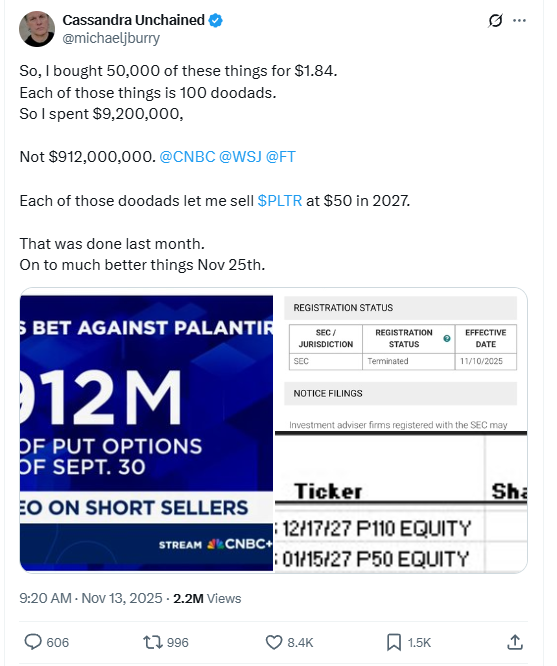
Core Viewpoint - Michael Burry, known for predicting the 2008 financial crisis, has sparked market discussions again after clarifying that his investment in shorting AI stocks is significantly lower than reported, amounting to only $9.2 million instead of $912 million as claimed by media outlets [1][2]. Group 1: Investment Actions - Burry purchased 50,000 put options for Palantir at $1.84 each, totaling an investment of $9.2 million, which corresponds to a notional value of $912 million based on the underlying stock's market value [2]. - The discrepancy in reported figures arises from the SEC's requirement for institutions to disclose options positions based on notional value rather than actual investment [2][3]. - Burry's put options allow him to sell Palantir shares at $50 each by 2027, while the current stock price is approximately $184, indicating a significant gap [2]. Group 2: Market Concerns - Burry has expressed concerns about an AI bubble, likening it to the 2000 internet bubble, and has criticized companies like Nvidia, Palantir, Meta, and Oracle for excessive capital expenditures and inflated valuations [3]. - Citron Research previously estimated Palantir's true value at $40, aligning with Burry's target price of $50 for his put options [3]. Group 3: Fund Status - Burry has officially terminated the SEC registration of his hedge fund, Scion Asset Management, and plans to liquidate the fund and return capital to investors due to disappointment with market valuations [4][10]. - The fund's registration status was terminated on November 10, and Burry hinted at a potential new direction for his investment activities, possibly outside traditional regulatory frameworks [10].


'Big Short' Michael Burry Deregisters Hedge Fund, Teases New Direction
Business Insider· 2025-11-13 12:10
Core Insights - Michael Burry has terminated the SEC registration of his hedge fund, Scion Asset Management, indicating a shift away from managing external client funds [1][5] - Burry's recent activities include purchasing put options on AI stocks, specifically Nvidia and Palantir, reflecting his bearish outlook on the AI sector [3][4] - The termination of the hedge fund's registration allows Burry to operate without the pressures of client management, similar to other high-profile investors who have transitioned to family offices [6][7] Company Actions - Scion Asset Management was deregistered on Monday, managing approximately $155 million across four accounts as of late March [1] - Burry clarified his investment in Palantir, stating he bought 50,000 put option contracts at a premium of $1.84 per share, totaling an investment of $9.2 million, contrary to media reports suggesting a $912 million bet [4][5] Market Context - Burry's comments on the AI boom liken it to the dot-com bubble, raising concerns about inflated stock valuations as major indices reach record highs [2][3] - The move to deregister aligns with a trend among prominent investors who have opted to manage their own capital, freeing them from client obligations and allowing for more strategic flexibility [6][8]

X @Bloomberg
Bloomberg· 2025-11-13 11:16
Michael Burry’s Scion Asset Management has terminated its registration status with the SEC https://t.co/Wvvxhmnfbl ...
“大空头”做空Palantir价值9.12亿美元、英伟达1.86亿美元面临潜在巨额浮亏!疑似本周向SEC提交注销该对冲基金申请
Sou Hu Cai Jing· 2025-11-13 08:41
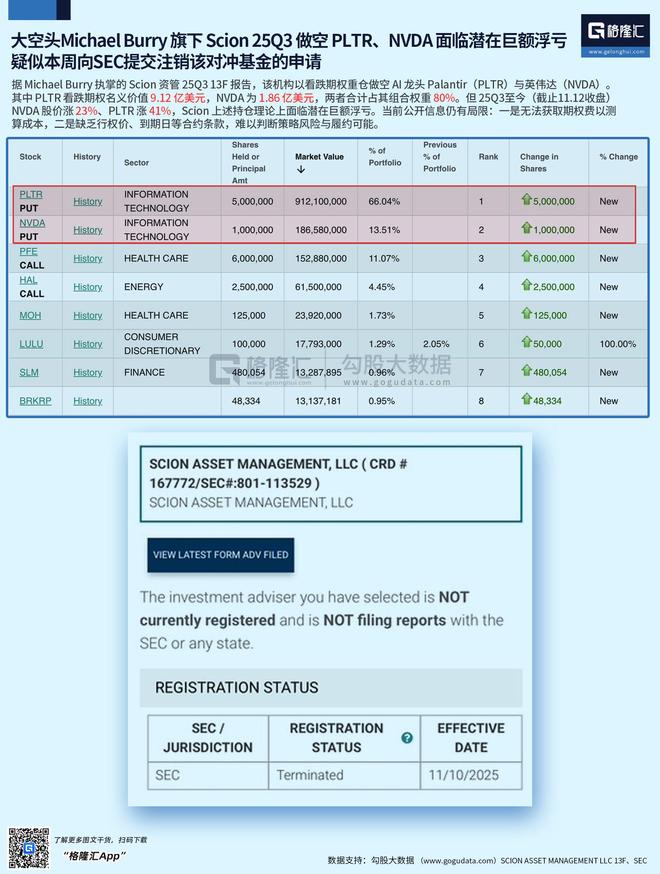
格隆汇11月13日|电影《大空头》原型Michael Burry执掌的Scion资管250313F报告显示,该机构以看跌 期权重仓做空AI龙头Palantir(PLTR)与英伟达(NVDA)。其中Palantir看跌期权名义价值9.12亿美元,英伟 达为1.86亿美元,两者合计占其组合权重80%。但25Q3至今(截止11.12收盘)英伟达股价涨23%、Palantir 涨41%,Scion上述持仓理论上面临潜在巨额浮亏。当前公开信息仍有局限:一是无法获取期权费以测 算成本,二是缺乏行权价、到期日等合约条款,难以判断策略风险与约可能。 值得注意的是,Michael Burry似乎在本周向美SEC注销了他的对冲基金Scion Asset Management。Burry 在社交媒体上发布了一张图片,显示Scion的SEC注册状态已终止。 【免责声明】本文仅代表作者本人观点,与和讯网无关。和讯网站对文中陈述、观点判断保持中立,不 对所包含内容的准确性、可靠性或完整性提供任何明示或暗示的保证。请读者仅作参考,并请自行承担 全部责任。邮箱:news_center@staff.hexun.com ...
“大空头”做空Palantir、英伟达面临潜在巨额浮亏,疑似本周向SEC提交注销该对冲基金申请
Ge Long Hui A P P· 2025-11-13 08:34
Core Insights - Scion Asset Management, led by Michael Burry, has heavily shorted AI leaders Palantir (PLTR) and Nvidia (NVDA) using put options, with a nominal value of $912 million for Palantir and $186.58 million for Nvidia, collectively representing 80% of its portfolio [1] - Despite the bearish position, Nvidia's stock has risen by 23% and Palantir's by 41% since Q3 2025, indicating potential significant unrealized losses for Scion [1] - Burry has reportedly terminated the registration of Scion Asset Management with the SEC, as indicated by a recent social media post [1][4] Company Positions - Palantir: 9.12 billion USD in put options, representing 66.04% of the portfolio [2] - Nvidia: 1.86 billion USD in put options, representing 13.51% of the portfolio [2] - Other positions include healthcare and consumer discretionary stocks, but the focus remains on the significant short positions in AI companies [2] SEC Registration Status - Scion Asset Management's SEC registration status has been terminated as of November 10, 2025 [4]
Michael Burry turns up heat on anti-AI bet
Yahoo Finance· 2025-11-12 23:07
Group 1: AI Market Sentiment - Growing skepticism around artificial intelligence (AI) as a potential bubble, with experts suggesting it differs from the dot-com bubble and may take years to burst [1][2] - Bank of America analysts indicate no overbuilding of AI data centers due to limitations like power access and space [2] - JP Morgan Asset Management notes that current players are better capitalized than those during the dot-com era, with AI monetization already underway [2] Group 2: Michael Burry's Position - Michael Burry's hedge fund, Scion Asset Management, revealed a short position on Nvidia (NVDA) and Palantir (PLTR), causing significant industry concern [2] - Burry claims that AI hyperscalers are artificially inflating earnings by extending the useful life of assets, which he argues is a common modern fraud [4][6] - Allegations suggest that companies are manipulating depreciation figures to enhance earnings, raising serious concerns about accounting practices in the industry [5][6]
孙正义再次清仓英伟达
Jing Ji Guan Cha Wang· 2025-11-12 09:16
Core Viewpoint - SoftBank Group has liquidated its entire stake in Nvidia, cashing out $5.83 billion (approximately 415 billion RMB), leading to a significant drop in Nvidia's stock price and a loss of $100 billion in market capitalization overnight [1] Group 1: SoftBank's Investment History - SoftBank's relationship with Nvidia began in 2014 when it recognized Nvidia's potential in AI infrastructure, purchasing nearly 5% of its shares for $4 billion [1] - In 2019, SoftBank sold all its Nvidia shares for $7 billion, missing out on Nvidia's rise from a $100 billion market cap to $4 trillion [1] - SoftBank re-invested in Nvidia in 2024, increasing its stake to $1 billion, and later to $3 billion by March 2025, before selling all shares again for $5.83 billion [1] Group 2: Market Reactions and Analyst Opinions - Analysts are divided on Masayoshi Son's decision to sell; some view it as a wise move reflecting market risk sensitivity, while others see it as a negative signal given the long-term prospects of AI technology [1][2] - Concerns about an impending AI bubble are growing, with many investors fearing that the current valuations of AI stocks, including Nvidia's P/E ratio exceeding 100, are unsustainable [2][3] Group 3: Broader Market Sentiment - The performance of AI stocks has been under scrutiny, with Nvidia's market cap dropping from $5 trillion to $4.69 trillion, and other AI-related companies also experiencing significant declines [4][5] - A recent Bank of America survey indicated that over 60% of fund managers believe there is a bubble in AI stocks, marking a historical high [4][5] - Major financial institutions, including the Bank of England and the IMF, have warned that the current market conditions for AI stocks resemble the peak of the internet bubble [5] Group 4: Strategic Shifts and Future Outlook - SoftBank's decision to shift its investment focus towards ARM's AI chip development has been interpreted as a move towards more stable technologies rather than speculative investments [5] - Nvidia's founder, Jensen Huang, has also sold over $1 billion worth of Nvidia shares since June, indicating a lack of confidence in the stock's current valuation [6]

Opinion: Palantir CEO Alex Karp's Rant About Short-Sellers Completely Misses the Mark
The Motley Fool· 2025-11-12 08:06
Core Insights - The article discusses the recent performance and challenges faced by Palantir Technologies, particularly focusing on CEO Alex Karp's comments regarding short-sellers and market manipulation [4][6][10]. Company Performance - Palantir Technologies has seen a significant increase in its stock price, with shares skyrocketing by 2,670% since the beginning of 2023, as of November 7 [3]. - The company's market capitalization stands at $455 billion, with a current price of $190.96 and a price-to-sales (P/S) ratio of 152, which is historically high compared to industry standards [7][16]. CEO's Comments - CEO Alex Karp expressed strong disapproval of short-sellers, particularly targeting Michael Burry, known for his successful short against the housing market [6][8]. - Karp's comments suggest a belief that short-sellers are negatively impacting the perception of Palantir, which he claims is a company delivering value to various stakeholders [7][10]. Market Dynamics - The article highlights the broader context of the AI market, with PwC projecting a $15.7 trillion global addressable market for AI by 2030, indicating significant growth potential for companies like Palantir [2]. - Despite Palantir's strong operational model, the article points out that its high valuation may lead to skepticism among investors, contributing to short-selling activity [9][16]. Valuation Concerns - The article notes that historically, companies leading in innovation have P/S ratios of around 30 to 40, while Palantir's current P/S ratio of 152 is unsustainable [16]. - The high valuation, despite annual sales growth of 40%, raises concerns about the stock's future performance and the rationale behind short-seller positions [16]. Conclusion - The article suggests that instead of focusing on short-sellers, the company should let its operational results speak for themselves to address investor concerns effectively [17].

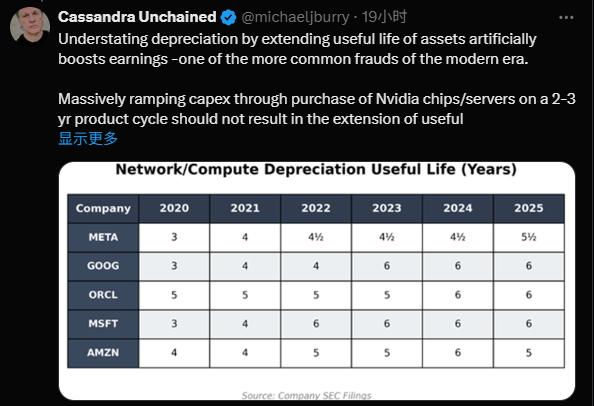
“大空头”伯里又发警告:科技巨头靠延长资产寿命虚增利润
智通财经网· 2025-11-11 12:13
Core Viewpoint - Michael Burry, known for shorting the U.S. real estate market, warns about accounting practices in large tech companies, particularly regarding the artificial inflation of profits through extended asset lifespans [1][4]. Group 1: Accounting Practices - Burry highlights that major cloud computing and AI infrastructure companies are extending the useful life of assets to understate depreciation, which artificially boosts earnings [1]. - He estimates that this accounting adjustment could lead to a cumulative understatement of $176 billion in depreciation from 2026 to 2028 [1]. - Companies like Oracle and Meta are projected to inflate their profits by 26.9% and 20.8%, respectively, by 2028 due to these practices [1]. Group 2: Capital Expenditure Trends - Burry notes that large-scale data center operators are ramping up capital expenditures by purchasing Nvidia chips and servers, which typically have a 2-3 year product cycle [1][3]. - A chart shared by Burry shows that companies like Meta, Alphabet, and Oracle have gradually extended their reported equipment lifespans since 2020, with Meta's network equipment lifespan increasing from 3 years to 5.5 years by 2025 [2][5]. Group 3: Market Sentiment and Predictions - Burry has expressed caution regarding the AI hype, indicating that the current levels of capital expenditure in the tech sector are comparable to those seen during the 1999-2000 internet bubble [5]. - He has established bearish positions on Nvidia and Palantir, which constitute 80% of his fund's holdings, reflecting his skepticism about the sustainability of the AI-driven market rebound [4][5].