
中国卫星

Search documents
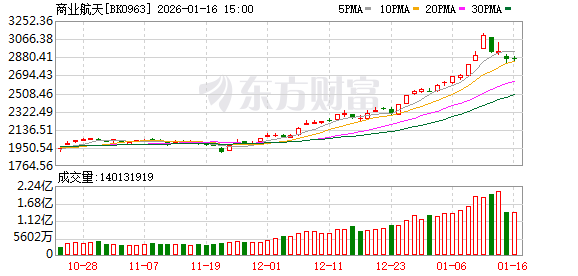
投机情绪降温,市场风格或生变!哪类板块值得关注?
Mei Ri Jing Ji Xin Wen· 2026-01-18 13:34
Market Overview - The A-share market experienced fluctuations this week, with small-cap stocks performing better than large-cap blue chips. The Guozheng 2000, CSI 1000, and CSI 500 indices all saw weekly gains exceeding 1%, while the SSE 50 index declined by 1.74% [1] - From Tuesday onwards, market speculation sentiment significantly cooled, particularly in the commercial aerospace and AI application sectors, leading to increased discussions among investors regarding market sentiment and these sectors [1] Speculation Sentiment - The market's speculative sentiment shift was unexpected, with a strong start on Monday followed by a downturn in the commercial aerospace sector on Tuesday, indicating a control of sentiment and rhythm [3] - By Wednesday, the cooling of speculative sentiment became more pronounced due to five key events, including increased financing margin ratios by the Shanghai and Shenzhen stock exchanges and significant sell orders on several large-cap stocks [4] Future Market Outlook - Historical cases suggest that the commercial aerospace sector is likely to stabilize in the first half of next week, as it has been four trading days since the sector's downturn began [6] - The AI application sector also saw some leading stocks drop over 20% in the latter half of the week, indicating that negative impacts have largely been released [7] - A commentary from China Central Broadcasting Network emphasized that the A-share market should aim for sustainable growth rather than speculative bubbles, which may help alleviate the cooling sentiment [7] Investment Opportunities - After the cooling of speculative sentiment, the market focus may shift towards institutional trend sectors, which could attract more capital attention [7] - The semiconductor equipment, humanoid robots, and storage sectors are highlighted as areas of interest, especially as the annual report disclosure phase begins, with companies showing significant earnings growth [11] - Notable companies such as Baiwei Storage and Dingtai High-Tech have reported earnings that exceeded expectations, positively impacting related sectors [11] New Stock Offerings - There are three new stocks available for subscription next week, including Nondan Technology on January 19 and Zhenstone Co. and Shimon Co. on January 23, encouraging participation in new offerings [12]
计算机行业周报(20260112-20260116):2026年重复使用火箭技术有望突破,多款火箭发射日程公布-20260118
Huachuang Securities· 2026-01-18 13:12
Investment Rating - The report maintains a "Buy" recommendation for the computer industry, expecting significant growth in the upcoming months [1]. Core Insights - The commercial aerospace sector is experiencing a resonance between domestic and international policies, leading to continuous catalysts for growth. The report anticipates that low-orbit satellites will gradually achieve regular networking, and commercial rockets will accelerate breakthroughs in reusable technology [4]. - The report highlights the successful static fire test of the Long March 12B rocket, which is a new generation reusable rocket with a payload capacity of 20 tons to low Earth orbit, indicating advancements in China's commercial launch capabilities [4]. - Multiple annual launch plans for reusable rockets have been announced, showcasing the rapid development and testing of various private rocket companies [4]. - The report notes the acceleration of IPOs for commercial rocket companies, indicating a growing interest and investment in the sector [4]. - The establishment of the "Rocket Street" project in Beijing is highlighted as a significant milestone in the commercial aerospace field, providing a comprehensive testing and research base for the industry [4]. - Investment suggestions include focusing on satellite manufacturing, satellite operation, rocket launch, satellite applications, and various components and services related to the aerospace industry [4]. Industry Data - The computer industry consists of 338 listed companies with a total market capitalization of 66,135.69 billion and a circulating market value of 59,636.21 billion [1]. - The absolute performance of the industry over the past 12 months is reported at 49.0%, with a relative performance of 24.5% compared to the benchmark index [2].
基金投资价值分析:招商中证卫星产业ETF投资价值分析:一键精准布局卫星全产业链
Guoxin Securities· 2026-01-18 12:36
- The CSI Satellite Industry Index (931594.CSI) selects up to 50 listed companies involved in satellite manufacturing and launching, ground equipment manufacturing, satellite navigation, satellite communication, and other related technological R&D and applications to reflect the overall performance of the satellite industry securities market [29][64] - The index's industry distribution is highly concentrated in the national defense and military industry, with a weight of 59.26%, followed by electronics (11.94%) and computers (11.49%) [31][64] - The index's R&D expenditure ratio is significantly higher than the overall market and the CSI Commercial Satellite Communication Industry Index, with 38% of its constituent stocks having an R&D expenditure ratio exceeding 20% [37][64] - The CSI Satellite Industry Index's 2024 revenue growth rate is projected at 18.12%, with expected growth rates of 11.23%, 15.9%, and 20.76% for 2025, 2026, and 2027, respectively. Net profit growth rates for 2025, 2026, and 2027 are estimated at 222.01%, 48.86%, and 32.34%, respectively [41][64] - Over the past year, the index achieved a return of 121%, with a one-month return of 53%, outperforming the CSI Commercial Satellite Communication Industry Index. It also demonstrated lower drawdown levels, showcasing better risk-return characteristics [50][64] - The index's compilation rules mandate that the combined weight of the satellite manufacturing and launching sectors must not fall below 50%, aligning with the current development phase of the industry, especially amid favorable conditions for rocket launches and satellite manufacturing [29][54][64]


涉及商业航天 两大央企定调
Shang Hai Zheng Quan Bao· 2026-01-18 08:01
Group 1 - The core focus of China Aerospace Science and Industry Corporation (CASIC) is on six aspects: high political stance, high precision in technology, high reliability in quality, high efficiency in operations, high standards in safety, and high standards in party building [2][4] - CASIC aims to concentrate on three main business areas: aerospace defense industry, internationalization of aerospace defense, and application of aerospace defense technology, with a commitment to enhancing both equipment performance and economic efficiency [4][5] - The year 2026 marks the beginning of the 14th Five-Year Plan and the 70th anniversary of China's aerospace industry, with a strong emphasis on completing key research and production tasks, tackling core technology challenges, and achieving international business goals [5][6] Group 2 - China Aerospace Science and Technology Corporation (CASC) emphasizes the need to enhance practical capabilities and accelerate the advancement of reusable rocket technology, while also focusing on major projects like manned lunar missions and deep space exploration [7][9] - CASC plans to optimize its industrial layout and structure, promoting commercial aerospace and low-altitude economy, while also preparing for future industries such as space digital technology [7] - The chairman of CASC highlighted the importance of enhancing national strategic capabilities and supporting the centenary goals of the military, while also seizing opportunities in the space economy to promote commercial aerospace development [9]


招商中证卫星产业ETF投资值分析:键精准布局卫星全产业链
Guoxin Securities· 2026-01-18 07:17
- The **CSI Satellite Industry Index (931594.CSI)** selects up to 50 listed companies involved in satellite manufacturing and launching, ground equipment manufacturing, satellite navigation, satellite communication, and other related technological R&D and applications to reflect the overall performance of the satellite industry securities market [29][64] - The index's industry distribution is highly concentrated in the defense and military sector, with a weight of 59.26%. The proportion of constituent stocks with R&D expenditure exceeding 20% is 38%, which is significantly higher than the overall market level and the CSI Commercial Satellite Communication Industry Index [31][37][64] - The index's revenue growth rate for 2024 is projected at 18.12%, with expected growth rates for 2025, 2026, and 2027 at 11.23%, 15.9%, and 20.76%, respectively. Net profit growth rates for 2025, 2026, and 2027 are estimated at 222.01%, 48.86%, and 32.34%, respectively [41][64] - Over the past year, the index achieved a return of 121%, with a one-month return of 53%, outperforming the CSI Commercial Satellite Communication Industry Index. Additionally, it demonstrated lower drawdown levels, showcasing better risk-return characteristics [50][51][64] - The index's compilation rules mandate that the combined weight of the "satellite manufacturing + launching" foundational sectors must not be less than 50%, aligning with the current development phase of the industry amidst continuous favorable news in rocket launches and satellite manufacturing [29][54][64]
一键精准布局卫星全产业链——招商中证卫星产业ETF投资价值分析:基金投资价值分析
Guoxin Securities· 2026-01-18 07:10
- The CSI Satellite Industry Index (931594.CSI) selects no more than 50 listed companies involved in satellite manufacturing and launching, satellite ground equipment manufacturing, satellite navigation, satellite communication, and other technology R&D and application sectors to reflect the overall performance of listed companies in the satellite industry[29][64] - The index's industry distribution is mainly concentrated in the national defense and military industry, accounting for 59.26% of the weight, with electronic and computer industries accounting for 11.94% and 11.49%, respectively[31][64] - The index's constituent stocks have a higher R&D expenditure ratio compared to the overall market and the CSI Commercial Satellite Communication Industry Index, with 38% of constituent stocks having an R&D expenditure ratio exceeding 20%[37][64] - The CSI Satellite Industry Index's revenue growth rate for 2024 is 18.12%, with projected growth rates of 11.23%, 15.9%, and 20.76% for 2025, 2026, and 2027, respectively. The net profit growth rates for 2025, 2026, and 2027 are expected to be 222.01%, 48.86%, and 32.34%, respectively[41][64] - Over the past year, the CSI Satellite Industry Index achieved a return of 121%, with a 1-month return of 53%, outperforming the CSI Commercial Satellite Communication Industry Index. It also demonstrated lower drawdown levels and better risk-return characteristics[50][64] - The index's compilation scheme explicitly requires that the combined weight of the "satellite manufacturing + launch infrastructure sectors" should not be less than 50%, aligning with the current stage of industry development, especially with the recent favorable developments in rocket launches and satellite manufacturing[54][64]
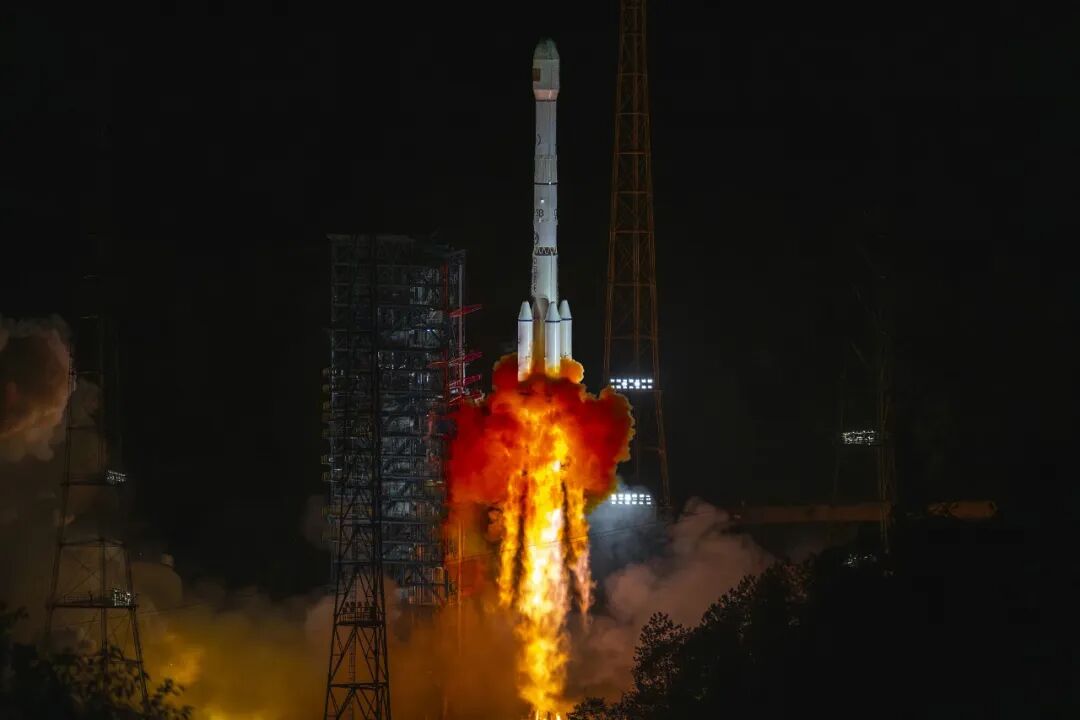
一天两枚火箭发射失利 中国航天科技集团、星河动力两家公司发文:具体原因正排查
Mei Ri Jing Ji Xin Wen· 2026-01-18 05:26
Group 1: Rocket Launch Failures - On January 17, two rocket launch failures were reported, including the Long March 3B rocket and the private company Star River's Gushen II rocket [1][2] - The Long March 3B rocket experienced an anomaly during its third stage, leading to mission failure, while the Gushen II rocket also faced flight anomalies during its first test flight [4][6] Group 2: Long March 3B Rocket Overview - The Long March 3B rocket is China's first rocket model to exceed 100 launches, with a total of 115 launches, 110 successful and 3 failures [6] - It is primarily used for launching heavy satellites into geosynchronous transfer orbits and is a key player in China's commercial launch services [4][5] Group 3: Star River Company Profile - Star River, established in 2018, is the first private company in China to achieve mass production and high-density launches of rockets [8] - The company has raised over 5.3 billion yuan through multiple funding rounds, with a post-investment valuation of 15-16 billion yuan after a recent 2.4 billion yuan Series D financing [8][9] Group 4: Industry Context and Challenges - The Chinese commercial space industry is transitioning from technology validation to large-scale operations, facing challenges such as low rocket supply and high launch costs [12][13] - The industry is experiencing a downturn following a surge in stock prices, with significant declines in commercial space concept stocks observed recently [14][16]

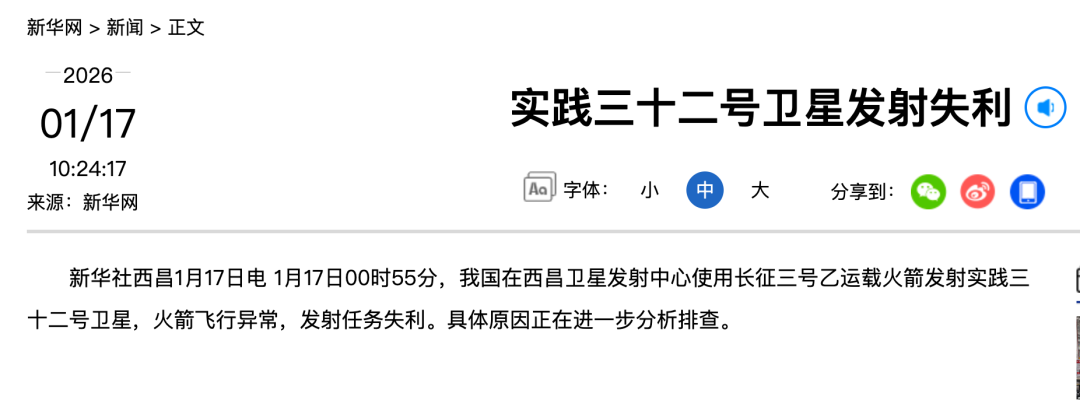
一天两枚火箭发射失利,中国航天科技集团、星河动力两家公司发文:具体原因正排查
Mei Ri Jing Ji Xin Wen· 2026-01-18 05:08
Core Viewpoint - The aerospace sector is experiencing volatile reactions in the capital market, highlighted by two recent rocket launch failures on January 17, 2024 [1]. Group 1: Long March 3B Rocket - The Long March 3B rocket launched the Shijian-32 satellite but experienced flight anomalies, resulting in mission failure. The specific cause is under further analysis [3][4]. - The Long March 3B is notable for being the first Chinese rocket model to exceed 100 launches, with a total of 115 launches, 110 successful, 3 failures, and 2 partial successes [10]. - This rocket is primarily used for launching heavy satellites into geosynchronous transfer orbits and is a key player in China's commercial launch services [8]. Group 2: Star River Dynamics - Star River Dynamics, established in 2018, is the first private company in China to achieve mass production and high-density launches of rockets. It focuses on solid and liquid rocket launch services [11]. - The company has raised over 5.3 billion yuan through multiple funding rounds, with a recent D-round financing of 2.4 billion yuan, achieving a post-investment valuation of 15-16 billion yuan [11]. - The company’s main product, the Gushenxing series of rockets, has successfully completed six sea launch missions, with the latest on January 16, 2024, marking a significant achievement in commercial space launches [12]. Group 3: Industry Trends and Challenges - The Chinese aerospace industry reached a record 92 launches in 2023, with a notable contribution from private companies, although the overall launch success rate still lags behind the Long March series [15]. - The industry faces challenges such as low total rocket supply, insufficient single-rocket capacity, and high launch costs, which are seen as bottlenecks in the development of the aerospace ecosystem [15]. - There is a growing expectation for private rocket companies to complement state-owned enterprises in meeting the high-frequency launch demands [15].
澄清业务情况 多家商业航天概念公司回应
Zhong Guo Zheng Quan Bao· 2026-01-18 03:42
Group 1 - Several listed companies categorized under the commercial aerospace concept have recently issued announcements or statements clarifying their low association with commercial aerospace business and indicating that their stock prices have significantly deviated from fundamentals [2] - Since December 2025, some companies in the commercial aerospace sector have seen astonishing stock price increases, with Aerospace Development's stock rising over 200% in 30 consecutive trading days, triggering severe abnormal fluctuation standards [2] - Aerospace Development announced that its subsidiary engaged in low-orbit satellite operations generated less than 1% of the company's total revenue in the first three quarters of 2025, indicating minimal impact on overall performance [2] Group 2 - Companies such as Shaoyang Hydraulic clarified that their products do not directly serve commercial aerospace clients, with related orders being sporadic and amounting to less than 500,000 yuan, accounting for less than 0.2% of annual revenue [2] - Multiple companies, including Aerospace Power, North Navigation, Aerospace Engineering, Star Ring Technology, and Aerospace Changfeng, publicly stated that their main businesses do not involve commercial aerospace [2] - In response to investor inquiries, companies like Xingxing Technology and Jindi Co. expressed that they do not have current development plans in the commercial aerospace sector, while Keli Sensor and Bomin Electronics acknowledged their awareness of the commercial aerospace trend but have not established substantial commercial cooperation [3] Group 3 - The clarifications and risk warnings highlight a significant divergence between soaring stock prices and company fundamentals, with industry leader China Satellite reporting a rolling P/E ratio exceeding 2400 and a more than 96% year-on-year decline in net profit for 2024 after excluding non-recurring gains [5] - Companies like Aerospace Electronics and China Satcom also announced that their stock prices exhibit a "hot potato effect" and have severely detached from fundamentals, indicating a potential for significant short-term declines [5] - Market analysis suggests that while the long-term growth logic of the commercial aerospace industry is clear, short-term irrational speculation has inflated valuations of many stocks lacking substantial business support [5]


澄清业务情况,提示风险!多家商业航天概念公司回应
Zhong Guo Zheng Quan Bao· 2026-01-17 14:28
近日,多家被归入商业航天概念的上市公司密集发布公告或在投资者互动平台发声,或澄清称与商业航 天业务关联度极低,或提示股价已严重偏离基本面。 自2025年12月以来,商业航天板块部分公司股价涨幅惊人,其中,航天发展(000547)因股价连续30个 交易日累计涨幅超200%,触及严重异常波动标准。 航天发展发布公告称,市场对商业航天概念关注度很高,但其下属从事低轨卫星运营的子公司,2025年 前三季度的营业收入占公司总营收的比例低于1%,对公司整体业绩影响极小。 多家公司明确划清业务边界。包括航天动力(600343)、北方导航(600435)、航天工程(603698)、 星环科技、航天长峰(600855)在内的多家公司均公开表示,其主营业务不涉及商业航天。 此外,在投资者互动平台,一些被投资者问及细分业务的公司也给出回应。例如,星星科技(300256) 称其投资的凌云智能虽有相关规划,但公司自身暂无涉及商业航天领域的发展计划;金帝股份 (603270)表示,无法判断其生产的轴承保持架产品在商业航天领域的市场份额及对公司业绩的影响; 柯力传感(603662)则表示,虽关注商业航天趋势并积极研究,但截至目前尚未形成实 ...