
中科曙光

Search documents
ETF盘中资讯|ETF涨停+12连阳后,首度回调!大数据ETF华宝(516700)单日吸金756万元!AIDC,AI时代的“新基建”!
Sou Hu Cai Jing· 2026-01-13 07:04
Core Viewpoint - The big data ETF Huabao (516700) is gaining attention due to its focus on computing power and AI applications, reflecting strong market interest in AIDC (AI Data Centers) as a promising investment area [1][2]. Market Performance - Huabao (516700) experienced a daily inflow of 7.56 million yuan, indicating investor confidence in the future performance of AIDC [2]. - The ETF reached a new high with a price increase of over 3.7% before experiencing a correction, showing a volatility of 8.53% [1]. AIDC Sector Insights - AIDC is viewed as a high-certainty infrastructure sector in the AI era, driven by five key factors: explosive demand, supply shortages, policy support, technological iteration, and business model upgrades [4]. - Demand is surging due to exponential growth in computing power needs for AI model training and inference [4]. - Supply is constrained, with a projected shortage of GPUs and AI servers expected to last 2-3 years [4]. - Government policies are increasingly supportive, with initiatives to accelerate computing infrastructure development and financial subsidies for AIDC construction [4]. - Technological advancements are enhancing the local computing node advantages of AIDC, expanding market opportunities [4]. - The business model is characterized by high barriers to entry and long-term contracts, ensuring stable cash flow and profitability [5]. ETF Composition - By the end of 2025, the index tracked by Huabao (516700) will have a weight of 40.91% in computing power concepts and 37.43% in AI application concepts [6]. Industry Trends - The focus on domestic computing power and AI applications aligns with national strategies for technological independence and digital productivity enhancement [7][8]. - The ongoing trend towards domestic substitution is expected to accelerate, particularly in the context of the "信创" (Xinchuang) initiative, which aims to promote self-sufficiency in technology [8].

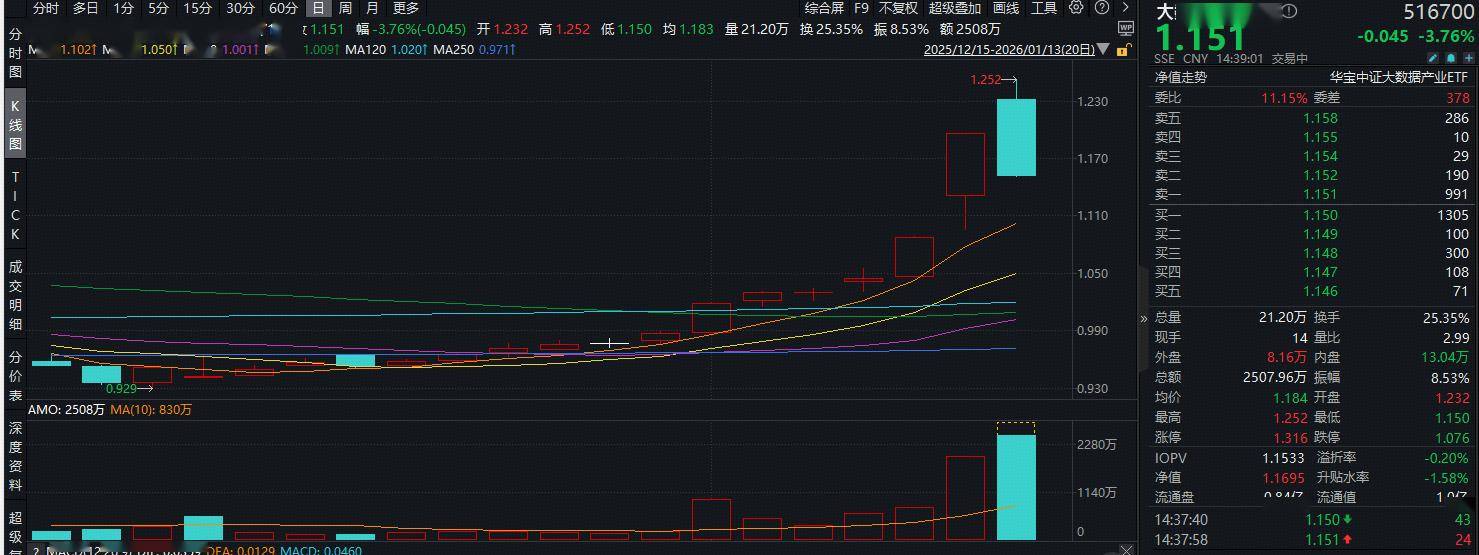
ETF涨停+12连阳后,首度回调!大数据ETF华宝(516700)单日吸金756万元!AIDC,AI时代的“新基建”!
Xin Lang Cai Jing· 2026-01-13 06:51
Core Viewpoint - The focus on computing power and AI applications is driving significant interest in the Huabao Big Data ETF (516700), which recently hit a new high after a 12-day consecutive rise, reflecting strong market sentiment towards AIDC (AI Data Center) performance [1][7]. Group 1: Market Performance - The Huabao Big Data ETF (516700) experienced a daily inflow of 7.56 million yuan, indicating investor confidence in the AIDC sector [1][7]. - The ETF's price fluctuated by 8.53%, with a peak increase of over 3.7% before a slight correction [1][7]. - Key constituent stocks such as Yidian Tianxia and Yonyou Network saw gains exceeding 11% and 9% respectively, while companies like Shenzhou Information and Yuke fell by over 9% and 7% [1][7]. Group 2: AIDC Sector Insights - AIDC is recognized as a high-certainty infrastructure sector in the AI era, driven by five key factors: explosive demand, supply shortages, policy support, technological iteration, and business model upgrades [3][9]. - The demand for computing power is expected to grow exponentially due to AI model training and inference, positioning AIDC as a fundamental component of the AI industry [3][9]. - There is a projected supply shortage of GPUs and AI servers in China, with a computing power gap expected to persist for 2-3 years [3][9]. Group 3: Policy and Technological Support - National policies emphasize accelerating the construction of computing power infrastructure, with AIDC included as a key focus area [10]. - Local governments are implementing subsidy policies to reduce AIDC construction costs, enhancing the sector's growth potential [10]. - The demand for localized computing power nodes is increasing due to higher requirements for latency and stability in inference computing, providing AIDC with a competitive advantage [10]. Group 4: Business Model Characteristics - The AIDC industry features characteristics such as heavy assets, high barriers to entry, and long-term contracts, allowing for stable operations exceeding 10 years once established [4][10]. - Increased cabinet utilization rates are expected to drive profit growth, with leading companies achieving gross margins of 40%-60% [4][10]. - Long-term contracts with major cloud providers and enterprise clients ensure stable cash flow and strong resistance to economic cycles [4][10]. Group 5: Investment Opportunities - The Huabao Big Data ETF (516700) tracks the CSI Big Data Industry Index, with computing power concepts accounting for 40.91% and AI application concepts for 37.43% of the index by the end of 2025 [11]. - Investors interested in technology self-reliance should focus on three catalysts: high-level calls for technological leadership, the activation of digital productivity through top-level design, and the acceleration of domestic substitution processes [12].
机构:2026年AI应用将迎来“黄金元年”,人工智能AIETF(515070)持仓股用友网络涨停
Mei Ri Jing Ji Xin Wen· 2026-01-13 05:53
华鑫证券指出,2026年AI应用将迎来"黄金元年",其核心驱动力来自三大拐点:技术成熟度、明确的政 策支持,以及市场需求在B端(降本增效)与C端(产品普及)的双重共振。该机构认为,应用层将取 代硬件与模型,成为下一阶段AI产业行情的核心主线。 人工智能AIETF(515070)跟踪CS人工智能主题指数(930713),成分股选取为人工智能提供技术、 基础资源以及应用端个股,聚集人工智能产业链上中游,俗称"机器人"大脑"缔造者",万物互联"地 基"。前十大权重股包括中际旭创、新易盛、寒武纪-U、中科曙光、科大讯飞、豪威集团、海康威视、 澜起科技、金山办公、紫光股份等国内科技龙头。 (文章来源:每日经济新闻) A股股指午后再度下探,盘面上,医疗服务、AI应用、贵金属板块活跃,商业航天板块大幅调整,沪市 规模最大的人工智能AIETF(515070)盘中跌2.13%,其持仓股用友网络涨停,中科星图涨超9%,合合 信息、神州泰岳、科大讯飞等个股表现较好,恒玄科技、复旦微电、光迅科技等股领跌。 消息方面, Anthropic 美国当地时间 12 日宣布了 Claude Cowork,其相当于 Claude Code 代理 ...

国泰海通晨报-20260113
国泰海通· 2026-01-13 05:05
国泰海通晨报 2026 年 01 月 13 日 国泰海通证券股份有限公司 研究所 [Table_Summary] 1、【纺织服装研究】纺织服装业:Nike 与 Adidas 作为全球运动服饰领域的两大龙头,其战略方 向与业绩波动是 A+H 纺服板块投资最重要的风向标之一,二者不仅定义了行业景气度,更通过 深度的产业链绑定,直接决定了核心标的的估值逻辑与业绩弹性:1. 制造端(Alpha 来源): 头 部代工龙头品牌集中度较高,Nike 与 Adidas 多合计贡献超过 30%,巨头的订单分配策略直接决 定了供应商的产能利用率与业绩波动。 2. 零售端(格局重塑): 二者在大中华区的品牌势能起 伏,直接重塑了国内运动品牌的竞争格局与市占率空间,是判断运动行业发展驱动力的重要基础。 3. 渠道端(深度绑定): 核心大中华区零售商(如滔搏、宝胜)与双雄利益深度捆绑,品牌方的 库存周期与折扣策略直接主导了渠道商的盈利水平。本报告旨在深度复盘近 5 年两大巨头在经历 疫情冲击、新疆棉事件、管理层更迭及关税博弈后的基本面修复路径,通过对比二者的战略得失, 预判未来行业格局的演变趋势及其对核心供应链、渠道商的传导影响。 [ ...
半导体并购热浪背后!估值博弈加剧,差异化定价成各方共识
Zheng Quan Shi Bao Wang· 2026-01-13 02:29
Core Viewpoint - The semiconductor M&A activity in A-shares is experiencing a surge in 2025, with a notable increase in the number of cases and a focus on asset integration and strategic cooperation, despite a rising failure rate in M&A transactions [1][2][3] Group 1: M&A Activity Overview - In 2025, the number of M&A cases in the A-share market reached approximately 4,773, reflecting a year-on-year increase of about 5% [2] - The semiconductor sector saw 161 M&A cases, a nearly 25% increase year-on-year, with 12 failures, marking a five-year high [2] - The total M&A amount in China's semiconductor sector reached 2,796.65 billion yuan, with 496 cases and 32 failures, representing over a twofold increase year-on-year [3] Group 2: Market Dynamics and Challenges - The divergence in valuations between the primary and secondary markets is a significant factor contributing to M&A failures, with difficulties in reaching consensus on core terms such as valuation and performance commitments [1][4] - The semiconductor industry is characterized by high volatility, with the semiconductor selective index rising approximately 51% in 2025, complicating acquisition valuations [3][6] - The introduction of the "M&A Six Guidelines" in September 2024 has accelerated M&A activities, but the valuation discrepancies have become more pronounced in 2025 [4][10] Group 3: Differentiated M&A Strategies - Industry experts suggest adopting differentiated M&A strategies, including staged incubation through M&A funds, to mitigate risks associated with semiconductor M&A failures [1][7] - Differentiated pricing based on various financing rounds is being promoted, allowing later investors to exit with principal or principal plus interest arrangements [8][10] - The regulatory environment is shifting towards a more accommodating approach, encouraging diverse valuation methods and payment structures, which facilitates differentiated M&A [10][12] Group 4: Performance Commitments and Risks - The concept of performance commitments in M&A transactions poses risks, especially in a declining industry cycle, where achieving agreed-upon performance metrics becomes challenging [11][13] - The lack of a unified mandatory performance commitment mechanism by regulatory bodies allows for flexibility, but it also leads to potential conflicts in interests among stakeholders [12][13] - The historical high valuations in the semiconductor sector, particularly during the "chip shortage" period, have created challenges for current M&A negotiations, as many targets are reluctant to agree to performance commitments [5][11]

半导体并购估值博弈加剧?差异化定价成各方共识
Zheng Quan Shi Bao Wang· 2026-01-12 23:29
Core Viewpoint - The semiconductor merger and acquisition (M&A) landscape is experiencing increased valuation disputes, leading to a rise in failure rates of deals, despite a more accommodating regulatory environment [1][2][4]. Group 1: M&A Activity and Trends - In 2025, the number of M&A cases in the semiconductor sector increased by nearly 25% year-on-year, reaching 161 cases, with 12 failures, marking a five-year high [2][3]. - The total M&A amount in China's semiconductor industry reached approximately 279.67 billion, with 496 cases and 32 failures, a more than twofold increase compared to previous years [3]. - The overall M&A market in A-shares saw about 4,773 cases in 2025, a 5% increase year-on-year, with a slight decline in overall failure rates [2][3]. Group 2: Valuation Discrepancies - There is a significant divergence in valuations between buyers and sellers, particularly as sellers' expectations remain high due to previous market conditions, while buyers are cautious due to industry adjustments [4][5]. - The average price-to-earnings ratio for the semiconductor industry peaked at 291 times in 2021 but fell to 53 times by 2024, reflecting a substantial valuation correction [5]. - The termination of several high-profile M&A deals, such as the merger between Haiguang Information and Zhongke Shuguang, was attributed to disagreements over core terms, particularly valuation [4][5]. Group 3: Differentiated Pricing Strategies - Industry experts suggest implementing differentiated pricing strategies to address valuation discrepancies, allowing for tailored exit options for different investor types [10][11]. - Recent M&A cases have shown a trend towards differentiated arrangements in terms of valuation, payment methods, and performance commitments, which can help align interests among diverse stakeholders [10][11]. - Regulatory support for differentiated M&A practices has increased, encouraging the use of various assessment methods and flexible payment structures [11][12]. Group 4: Challenges in M&A Execution - The semiconductor industry is characterized by high cyclicality, complicating M&A negotiations as both parties seek to capitalize on market recovery while managing inherent risks [6][12]. - The presence of a "trilemma" in M&A—high seller expectations, buyer performance commitments, and high success rate targets—poses significant challenges, especially during industry downturns [12][14]. - The need for performance guarantees in M&A deals has led to complications, particularly for unprofitable semiconductor firms, as they may resist signing performance commitments [12][14].


中国算力行业决策建议及项目可行性研究报告2026-2032年
Sou Hu Cai Jing· 2026-01-12 21:05
Group 1 - The report outlines the strategic importance of computing power as a new type of infrastructure and its collaborative relationship with data and algorithms [3][4] - The global computing power market is characterized by a significant scale and growth, with North America leading and the Asia-Pacific region rapidly catching up [4][5] - The report highlights the evolution of computing power technology, with heterogeneous computing architectures becoming mainstream [4][5] Group 2 - During the "14th Five-Year Plan" period, China's computing power scale has expanded significantly, with the total computing power surpassing previous levels [5][6] - The report discusses the impact of the East Data West Computing project on the geographical restructuring of computing power in China [5][6] - The establishment of a domestic computing ecosystem is underway, with a notable increase in the annual growth rate of domestic AI chip shipments [6][7] Group 3 - The report identifies key segments of the computing power industry chain, including advancements in chiplet technology and optical interconnects that enhance computing density [4][5] - The deployment of edge computing nodes in industrial and automotive internet applications is increasing, reflecting a shift towards more decentralized computing solutions [5][6] - The demand for computing power in various applications, such as AI model training, scientific computing, and smart manufacturing, is analyzed, indicating a growing need for high-performance computing resources [6][7] Group 4 - The competitive landscape of the global computing power industry is dominated by American companies, with major players like NVIDIA, AMD, and Intel leading the high-end computing ecosystem [6][7] - In China, the report highlights the emergence of a "national team" in domestic computing power, with traditional hardware manufacturers transitioning to computing service providers [7][8] - Key competitive dimensions include hardware performance, software ecosystem compatibility, and the ability to deliver comprehensive solutions [6][7] Group 5 - The report forecasts significant growth in the computing power market from 2026 to 2032, with an expected compound annual growth rate and a shift in the market structure towards AI computing power [10][11] - The analysis indicates that the domestic market share of Chinese computing power is projected to exceed 50% under certain scenarios [10][11] - The report emphasizes the importance of establishing a sustainable and efficient computing power ecosystem, with a focus on energy efficiency and green technologies [10][11]



半导体并购估值博弈加剧 差异化定价成各方共识
Zheng Quan Shi Bao· 2026-01-12 18:23
Core Viewpoint - The semiconductor M&A activity in A-shares is experiencing a surge in 2025, with a notable increase in the number of cases and a focus on asset integration and strategic cooperation, despite a rising failure rate in M&A transactions [1][2][3]. Group 1: M&A Activity and Trends - In 2025, the number of M&A cases in the A-share market reached approximately 4,773, reflecting a year-on-year increase of about 5%, while semiconductor-related M&A cases rose to 161, up nearly 25% year-on-year [2][3]. - The total M&A amount in China's semiconductor sector reached 279.67 billion yuan, with 496 cases reported, and 32 failures, marking a more than twofold increase in failures compared to previous years [3]. - The overall failure rate of M&A transactions in the semiconductor industry has increased, with 12 failures reported in 2025, the highest in five years [2][3]. Group 2: Valuation Discrepancies and Challenges - There is a significant divergence in valuations between buyers and sellers, complicating the consensus on core terms such as price and performance commitments, which has become a critical reason for M&A failures [1][4][5]. - The average price-to-earnings ratio in the semiconductor industry dropped from 291 times in 2021 to 53 times in 2024, reflecting a substantial valuation correction amid changing market conditions [5]. - The introduction of the "M&A Six Guidelines" in 2024 accelerated M&A activities, but the valuation discrepancies have intensified in 2025, particularly as sellers' expectations remain high due to historical peaks in valuations [4][10]. Group 3: Strategic Recommendations - Industry experts suggest adopting differentiated M&A strategies, including staged incubation through M&A funds, to mitigate risks associated with semiconductor M&A transactions [1][7][10]. - Companies are encouraged to implement differentiated pricing strategies based on various financing rounds, allowing for more flexible exit options for investors [8][10]. - Regulatory support for differentiated M&A is evident, with a shift towards more inclusive and prudent approval processes, allowing for diverse valuation methods and payment structures [11][12].

液冷深度:行业前景、技术路线、产业链及公司(附39页PPT)
材料汇· 2026-01-12 13:52
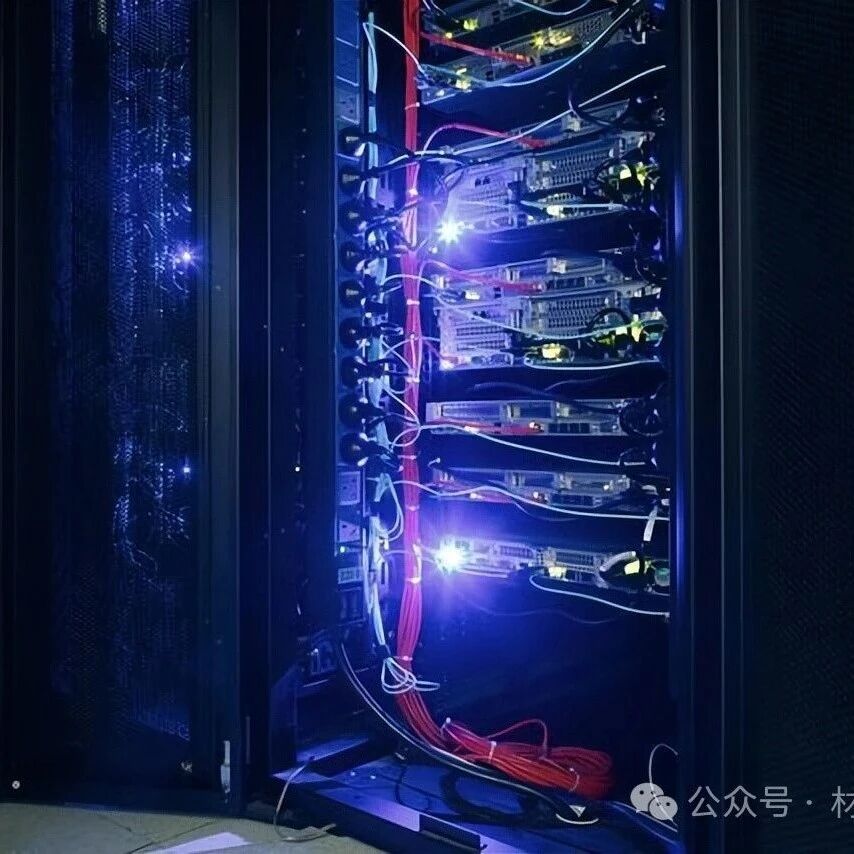
Industry Overview - Liquid cooling is a heat dissipation technology that uses liquid to carry away heat from heating devices, replacing traditional air cooling. It leverages the high thermal conductivity and heat capacity of liquids, making it a new cooling solution essential for addressing data center cooling pressures and energy-saving challenges [6][8]. Industry Outlook - The demand for AI infrastructure is surging due to the rapid release of large AI models, significantly driving the need for cooling solutions. Liquid cooling is becoming the mainstream cooling solution in data centers due to its efficiency and deployment advantages [12][14]. - The global data center market is projected to grow from approximately $400 billion in 2025 to over $1 trillion by 2034, with a CAGR of 11% over ten years [25]. - Liquid cooling is expected to replace air cooling as the primary cooling solution, driven by increasing chip power consumption and the limitations of air cooling [28]. Liquid Cooling System Architecture and Technology Route - The main liquid cooling technologies include cold plate cooling and immersion cooling, with cold plate cooling being more prevalent due to its maintenance and space utilization advantages, despite higher costs [44][46]. - Cold plate cooling can be categorized into single-phase and two-phase systems, with two-phase systems offering higher cooling efficiency due to the phase change of the cooling liquid [68]. Industry Status and Market Space - The rapid increase in chip power consumption, such as NVIDIA's GPUs reaching TDPs of 1400W, necessitates the adoption of liquid cooling solutions as air cooling becomes inadequate [28][30]. - The ASIC chip market is expanding, with major cloud service providers accelerating their ASIC chip and liquid cooling solution deployments, further driving liquid cooling demand [34][35]. Industry Chain Analysis - The liquid cooling industry is supported by various policies promoting energy efficiency and carbon reduction in data centers. The Chinese government has issued guidelines to encourage the adoption of advanced cooling technologies, including liquid cooling [39][40]. Domestic Companies Expected to Accelerate Overseas Expansion - Domestic companies are increasingly entering the global market for liquid cooling solutions, driven by advancements in AI and data center technologies [38]. Related Companies - Major cloud service providers, including Alibaba and ByteDance, are announcing significant investments in AI and cloud infrastructure, with Alibaba planning to invest over 380 billion yuan in the next three years [23][20].

全球科技(计算机)行业周报:英伟达VeraRubin平台量产,驱动AI应用规模化普及-20260112
Huaan Securities· 2026-01-12 12:02
Investment Rating - Industry rating: Overweight [1] Core Insights - On January 6, 2026, NVIDIA CEO Jensen Huang officially launched the latest NVIDIA Rubin platform at CES 2026, stating that it has entered full-scale production. The Rubin platform consists of six new chips: Vera CPU, Rubin GPU, NVLink 6 switch, ConnectX-9 SuperNIC, BlueField-4 DPU, and Spectrum-6 Ethernet switch, designed to form an AI supercomputer that significantly reduces AI training time and lowers inference token generation costs. The training performance of the Rubin platform is 3.5 times that of the previous Blackwell generation, with software performance improved by 5 times, and the cost per token for inference reduced by 10 times compared to the Blackwell platform. Additionally, the number of GPUs required for training MoE models is reduced to one-fourth of the previous requirement [3][13][15]. - The Rubin platform integrates five key technologies to achieve breakthroughs in performance enhancement and cost reduction: 1) New NVLink interconnect technology ensures low latency and high bandwidth during multi-chip collaboration; 2) The third-generation Transformer engine optimizes for AI tasks, greatly improving model training and inference efficiency; 3) Confidential computing technology provides end-to-end security for sensitive AI data, meeting compliance needs in finance and healthcare; 4) RAS engine ensures stable performance under 24/7 high-load operation; 5) Vera CPU is specifically designed for agent inference [4][13]. - Major cloud providers, including Amazon AWS, Google Cloud, Microsoft Azure, and Oracle Cloud, have confirmed plans to deploy instances based on Vera Rubin in 2026, allowing global users to access top-tier AI computing power through cloud services. This will enable AI startups and SMEs, previously limited by high computing costs, to easily utilize the Rubin platform's powerful capabilities without significant hardware investment. Efficient computing power will accelerate breakthroughs in basic scientific research and technology, promoting deep applications of AI in healthcare, education, and environmental protection [5][14]. - The Rubin platform's dual breakthroughs in performance and cost reduction will significantly lower hardware procurement and operational costs for AI companies, facilitating the widespread adoption of AI applications such as intelligent customer service, autonomous driving, drug development, industrial quality inspection, and scientific research. It is recommended to pay attention to domestic and international AI computing infrastructure and related companies, including Cambrian, Zhongke Shuguang, Yonyou Network, Dingjie Zhizhi, Kingsoft Office, Tonghuashun, Jiao Dian Technology, Saiyi Information, and Fubo Group [6][15]. Market Overview - As of the week, the Shanghai Composite Index rose by 3.82%, the ChiNext Index increased by 3.89%, and the CSI 300 Index went up by 2.79%. The computer industry index surged by 8.49%, outperforming the Shanghai Composite Index by 4.67 percentage points, the ChiNext Index by 4.60 percentage points, and the CSI 300 Index by 5.70 percentage points. Year-to-date, the computer industry index has also increased by 8.49% [17][20]. - The computer industry index ranked 5th among 31 industry indices this week and 2nd among the four major TMT industries (electronics, communications, computers, media) [17]. Company Dynamics - The report highlights significant movements in the software and information technology sectors, with companies like Huijin Technology, Ersan Siwu, and Zhuoyi Information showing notable performance. Future investment opportunities are suggested in the financial IT, industrial software, and trusted innovation sectors, which are expected to see upward trends [22].