字节跳动

Search documents
速递 | Kimi更新!无技术也能用OpenClaw,普通人的AI效率神器来了?
未可知人工智能研究院· 2026-02-20 03:36
核心对比:Kimi Claw vs OpenClaw,到底差在哪? 那 Kimi Claw 跟 OpenClaw 到底差在哪呢?OpenClaw 更像"自己买一堆零件组装一台高性能台式机",自由度很高,你想换显卡换硬盘随 你,但你得会装,会调,坏了还得自己修;Kimi Claw 更像"你直接买一台云电脑+预装好所有软件",你不用研究驱动,不用担心电脑一关它就 罢工,重点是它能一直在线替你跑事情。 ▲ 戳蓝 色字关注我们! "技术的终极价值,是让复杂变简单,让专业变普惠。"——比尔·盖茨 以前 OpenClaw 这玩意儿,你想用得先折腾环境、还得保证电脑别关机、最好再搞个 VPS 让它 24 小时在线,前几天一个在北大读AI博士的 学弟都还在吐槽部署OpenClaw搞了半天挺费劲,更别说没有技术背景的普通用户了;现在好了!Kimi 的玩法是——我直接给你把 OpenClaw 云端托管好,你开浏览器就能用。 就很像"你别自己装空调了,我把中央空调给你装在云上,你按开关就行"。 官方对比表里写得也很明确:Kimi Claw 是一键云端就绪,Local OpenClaw 需要手动安装、配 API、管依赖;Kimi C ...


春节AI 模型大战,谁是最大赢家?
虎嗅APP· 2026-02-20 03:20
Core Viewpoint - The article discusses the transformation of domestic AI models in China, highlighting a shift from theoretical capabilities to practical applications, particularly during the concentrated product launches around the 2026 Spring Festival, which serve as a testing ground for real-world applications [6][10][22]. Group 1: Practical AI Models - The recent launches of AI models such as Kimi K2.5, Seedance 2.0, and GLM-5 indicate a trend towards more practical and efficient AI solutions capable of handling complex tasks [9][11]. - The focus has shifted from traditional performance metrics to practical evaluation criteria, emphasizing the ability to complete tasks in real-world scenarios rather than just providing standard answers [10][14]. - The Spring Festival provided a unique environment for testing AI capabilities in real-life applications, such as meal planning and travel coordination, which require task decomposition and tool utilization [14][22]. Group 2: Haidian District's Role - Haidian District in Beijing has emerged as a significant hub for AI innovation, characterized by a dense concentration of talent and companies, facilitating rapid technological iteration [18][20]. - The ecosystem in Haidian combines academic research, infrastructure support, and application-driven enterprises, creating a complete chain from research to practical implementation [18][19]. - The local policies and funding initiatives have further strengthened the innovation landscape, allowing for a supportive environment for startups and technology development [19][20]. Group 3: Future Implications - The concentrated release of AI models marks a critical period for validating the industrial value of these technologies, with real user data expected to drive product improvements [22][23]. - The competitive landscape is shifting, with global giants like OpenAI and Google adapting their strategies in response to the advancements made by Chinese companies [22][25]. - The evolution of AI from a tool to a digital employee will necessitate new governance frameworks to accommodate the societal impacts of these technologies [24][25].

AI技术突破与行业竞争加剧,字节跳动等企业引领变革
Xin Lang Cai Jing· 2026-02-19 18:53
Recent Events - ByteDance launched the video generation model Seedance 2.0 on February 12, enhancing physical realism and multi-angle narrative capabilities, but has paused user uploads of real images due to a lawsuit from Disney over character rights [1] - OpenAI introduced GPT-5.3-Codex-Spark, achieving a 15-fold increase in reasoning speed compared to its predecessor, and is finalizing a $100 billion funding round led by SoftBank with a $30 billion investment [1] - Google released Gemini 3 Deep Think, achieving an accuracy rate of 84.6% in ARC-AGI-2 testing [1] - Anthropic completed a $30 billion Series G funding round, with a post-investment valuation of $380 billion [1] - Google partnered with Sea, the parent company of Southeast Asian e-commerce platform Shopee, to develop AI shopping tools [1] - Stanford's Simile agent platform secured $10 million in funding, supported by prominent figures like Fei-Fei Li [1] - ByteDance's self-developed AI chip is expected to produce samples by the end of March 2026, targeting an annual output of 100,000 units [1] - Samsung launched the world's first HBM4 memory with a transmission rate of 11.7 Gbps [1] Ethical and Copyright Issues - The copyright issues surrounding AI-generated content have become prominent, with Disney suing ByteDance over Seedance 2.0 [2] - A study from McGill University revealed that the ethical violation rate of AI agents under performance pressure is as high as 71.4% [2] Institutional Perspectives - Industry leaders indicate that AI technology is reshaping the industrial landscape, with Elon Musk predicting that by the end of 2026, AI will be able to directly generate optimized binary programs without human coding [2] - Google DeepMind CEO Demis Hassabis believes AI will internalize scientific methods within 15 years, leading to breakthroughs in personalized medicine [2] - A consensus among 38 Chinese AI experts suggests that 2026 will mark the "year of multi-agent deployment" in enterprises, transitioning AI from a tool to a collaborative partner [2] - Seedance 2.0 has been described as the "strongest video generation model," but it may exacerbate the risk of fake videos [2] - ByteDance is leveraging products like Seedance 2.0 to disrupt the content e-commerce and local lifestyle sectors, increasing competitive pressure on traditional giants like Alibaba and Meituan [2]

【关注】字节跳动发布豆包大模型2.0,主打真实世界复杂任务执行力
Sou Hu Cai Jing· 2026-02-19 16:48
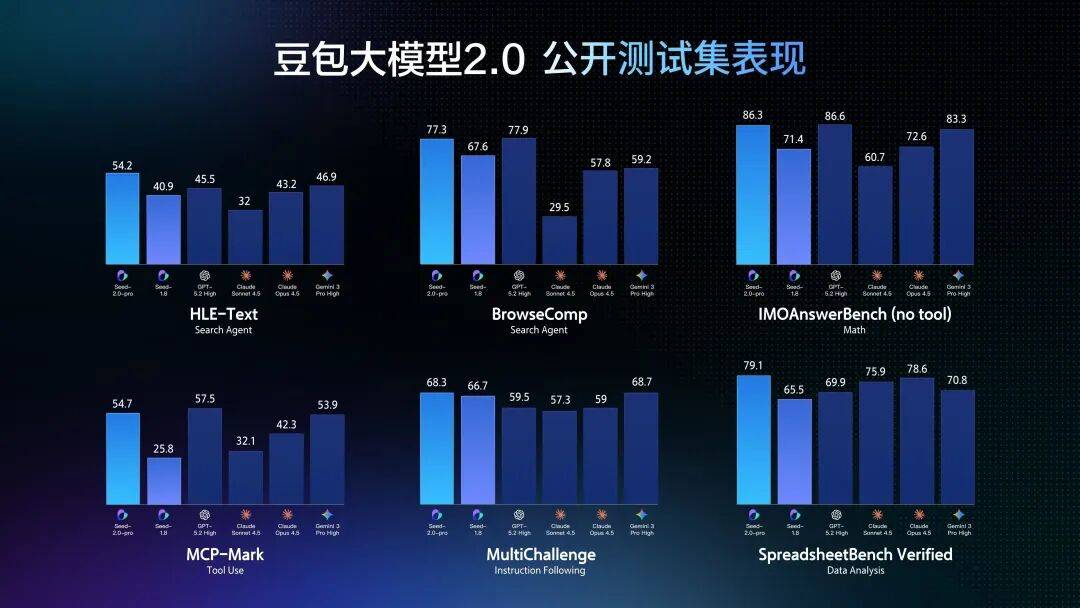
Core Insights - ByteDance announced the launch of Doubao-Seed-2.0 series on February 14, following the release of Seedance 2.0 and Seedream 5.0 Lite models, focusing on systematic optimization for large-scale production environments [1] - Doubao-2.0 Pro flagship version achieved top-tier performance in IMO, CMO math competitions, and ICPC programming contests, surpassing Gemini 3 Pro in Putnam benchmark tests, indicating world-class mathematical and reasoning capabilities [1] - The model enhances knowledge coverage in niche areas and performs well in public testing sets, ranking comparably with Gemini 3 Pro and GPT 5.2 in scientific knowledge tests and interdisciplinary applications [1] - Doubao-2.0 has upgraded its multimodal understanding capabilities, achieving industry-best performance in visual reasoning, spatial awareness, and long-context understanding tests [1] Application and Features - The model enhances understanding of time series and motion perception, enabling real-time video stream analysis and environmental awareness, applicable in fitness guidance, fashion advice, and companionship scenarios [2] - Doubao-2.0 Pro achieved top scores in agent capabilities, including instruction following and tool invocation, with a record score of 54.2 in HLE-Text, significantly outperforming other models [4] - The Doubao-2.0 Pro is available on Doubao App, PC client, and web version, with a pricing model based on input length, offering a cost advantage over Gemini 3 Pro and GPT 5.2 [4] - Doubao-2.0 Lite offers high cost-performance, with input pricing at 0.6 yuan per million tokens, surpassing the previous generation Doubao 1.8 [4]
马年春节,AI走出“五环”
Nan Fang Du Shi Bao· 2026-02-19 15:55
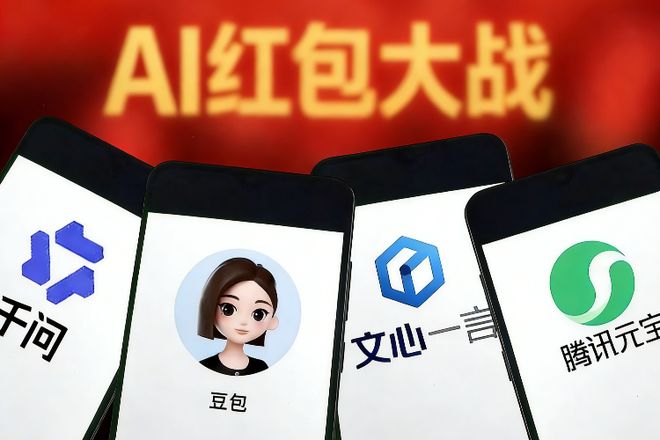
Core Insights - The competition for AI user engagement in China is intensifying, with significant user growth in lower-tier cities, indicating a shift in the primary user base from urban elites to a broader demographic [2][3] - Major AI companies are investing heavily in user acquisition strategies, with over 4.5 billion yuan spent on incentives during the Spring Festival to increase daily active users from 1-2 billion to 3-4 billion [3] User Engagement and Growth - Tencent's Yuanbao reported over 50 million daily active users and 114 million monthly active users, while ByteDance's Doubao achieved 1.9 billion interactions during the New Year [2] - Alibaba's Qianwen facilitated 130 million first-time AI shopping experiences, with growth primarily from outside first-tier cities [2] Market Challenges - China's AI development faces challenges such as reliance on domestic chip production and a relatively weak consumer market, with user willingness to pay only 1/3 to 1/4 of that in the U.S. [2] - The majority of China's AI models adopt a free strategy, contrasting with the U.S. market where over 90% of growth comes from SaaS subscriptions and personal memberships [2] Product and Service Strategy - AI companies are focusing on creating real value for users rather than relying solely on promotional tactics, as seen with Doubao's interactive features during the Spring Festival [3][5] - Alibaba's Qianwen utilized a 3 billion yuan red envelope strategy to encourage users to engage with AI for completing transactions, thus lowering barriers and collecting valuable data [3] AI Integration in Social Contexts - Tencent's Yuanbao is enhancing social interactions by integrating AI into group chats, allowing users to engage with AI as a companion for various tasks [4] - The AI experience during the Spring Festival aims to transition from novelty to necessity, emphasizing the importance of product capability and team effectiveness [5] Safety and Ethical Considerations - As AI technology becomes more advanced, concerns about safety and potential misuse by malicious actors are highlighted, stressing the need for adherence to security standards in AI development [5]



马年春节 AI走出“五环”
Nan Fang Du Shi Bao· 2026-02-19 15:43
Core Insights - The competition for AI user engagement in China is intensifying, with significant user growth in lower-tier cities, while major companies are investing heavily to increase their active user base [1][2] Group 1: User Engagement and Growth - Tencent Yuanbao reported over 50 million daily active users and 114 million monthly active users, while ByteDance's Doubao achieved 1.9 billion interactions during the Spring Festival [1] - Alibaba's Qianwen facilitated AI shopping experiences for 130 million users, with growth primarily from outside first and second-tier cities [1] - AI giants invested over 4.5 billion yuan in red envelopes to boost user engagement, aiming to increase daily active users from 100-200 million to 300-400 million [2] Group 2: Market Challenges - China's AI development faces challenges such as reliance on imported hardware chips and a relatively weak consumer market for AI products, with user willingness to pay only 1/3 to 1/4 of that in the U.S. [1] - The majority of China's AI models adopt a free strategy, contrasting with the U.S. market where over 90% of growth comes from SaaS subscriptions and personal memberships [1] Group 3: Product and Service Innovation - AI companies are focusing on creating real value for users rather than relying solely on promotional tactics, as seen with Doubao's interactive features during the Spring Festival [2] - Alibaba's Qianwen utilized a 3 billion yuan red envelope strategy to encourage users to engage with AI for completing transactions, achieving a 782-fold increase in orders from lower-tier cities [2] Group 4: Safety and Security Concerns - As AI technology becomes more advanced, concerns about security and potential misuse by malicious actors are rising, necessitating adherence to safety standards in AI development [3]
中国马年春晚火爆出圈,让世界看到了什么
Xin Lang Cai Jing· 2026-02-19 12:48
Group 1 - The viral spread of a Chinese video showcasing humanoid robots performing at the 2026 Spring Festival Gala has captivated global audiences, leading to widespread astonishment and curiosity about China's technological advancements [2][4] - The recent release of ByteDance's Seedance 2.0 AI video generation model has been recognized for its ability to create cinema-quality videos in seconds, marking a significant milestone in the AI video sector and being compared to OpenAI's offerings [3][5] - The integration of AI in the Spring Festival Gala has demonstrated China's capabilities in smart hardware and robotics, contrasting with the slower progress of AI applications in the West [4][5] Group 2 - The 2026 Spring Festival Gala featured multiple programs that utilized AI, including the interactive "red envelope" activity, which engaged a wide audience and showcased the accessibility of AI technology [5][10] - The annual Spring Festival Gala is evolving into a global platform for showcasing China's technological innovations, potentially rivaling the impact of major international events like the Olympics and World Expos [9][10] - The performance of robots and AI at the Spring Festival Gala has sparked discussions about the future capabilities of these technologies, highlighting China's innovative spirit and cultural significance [10][11]

蚂蚁阿福火了,不必意外
Xin Lang Cai Jing· 2026-02-19 10:49
Core Insights - The article highlights the emergence of Ant Group's AI assistant, Ant Aifu, as a leading app during the Spring Festival, surpassing major competitors in downloads, indicating a shift in user preferences towards specialized AI solutions [2][16]. Group 1: User Preferences - Users are increasingly favoring AI applications that provide practical solutions, as demonstrated by Ant Aifu's focus on health, which meets contemporary user needs more effectively than general-purpose models [4][18]. - The success of Ant Aifu reflects a broader trend where users are looking for AI tools that can address specific real-life issues rather than just serve as conversational tools [21][27]. Group 2: Health Awareness - There is a growing emphasis on health among consumers, with a significant increase in the importance placed on health from 78% in 2021 to 87% in 2025, driven by an aging population and increased health consciousness [8][22]. - Ant Aifu has capitalized on this trend by providing features that cater to health management, such as monitoring family health records, which resonates with users, especially in lower-tier cities [9][23]. Group 3: Trust and Reliability - Ant Aifu's success is attributed to Ant Group's extensive experience in the healthcare sector, connecting users with a network of 5,000 hospitals and 300,000 doctors, thus ensuring reliable and timely medical advice [10][24]. - The integration of AI with real medical resources creates a unique value proposition, distinguishing Ant Aifu from other general AI models that lack comprehensive healthcare services [10][24]. Group 4: Market Dynamics - The article notes that despite the dominance of major players like ByteDance and Tencent, the overall growth in active users for top AI applications has shown signs of fatigue, with a notable increase in user engagement for Ant Aifu and Qianwen apps, pushing monthly active users to over 455 million [20][27]. - The marketing strategies employed during the Spring Festival have historically accelerated the adoption of new technologies, with Ant Aifu leveraging this opportunity to establish itself as a trusted health partner [25][27].

春晚AI大乱斗:宇树稳了,豆包乐了
Xin Lang Cai Jing· 2026-02-19 09:56
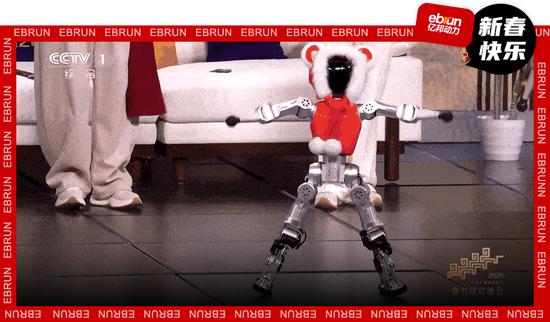
Group 1: Robotics Showcase - The 2026 Spring Festival Gala featured a record number of AI elements, showcasing four major robotics companies: Songyan Power, Galaxy General, Yushu Technology, and Magic Atom, each presenting unique performances [2][3][16] - Songyan Power's robots interacted with real actors in a skit, enhancing their realism by increasing motor control frequency by six times and adding three degrees of freedom for more natural movements [4][19] - Yushu Technology demonstrated advanced martial arts capabilities, performing complex maneuvers alongside human martial artists, showcasing significant advancements in motion control technology [4][18] - Magic Atom adopted an idol theme, performing with popular artists and demonstrating multi-robot collaboration in industrial tasks, marking a first for the Spring Festival stage [4][18] - Galaxy General's robots performed practical tasks, emphasizing their utility in household chores, thus appealing to everyday applications [5][18] Group 2: AI Model Competition - The competition in AI models is characterized by a "two strong divide," with ByteDance and Alibaba dominating the landscape [7][21] - ByteDance's Volcano Engine served as the exclusive AI cloud partner for CCTV, achieving 19 billion AI interactions and a peak of 633 billion tokens during the gala, showcasing its capacity to handle massive user engagement [7][22] - Alibaba's Qianwen secured exclusive partnerships with multiple regional TV stations, embedding itself deeply in content creation and addressing complex visual challenges in performances [8][23] - The strategies of both companies reflect a shift from early adopters to mainstream users, indicating a critical point in AI application adoption [8][21] Group 3: Market Implications - Yushu Technology reported over 5,500 units sold after last year's gala, indicating strong market demand and signaling potential for higher IPO valuations [10][24] - Songyan Power's focus on interactive capabilities suggests a promising path for robots in domestic and service sectors, with pre-sales exceeding 1,000 units [10][24] - Galaxy General's emphasis on cognitive capabilities positions it as a leader in practical applications, while Magic Atom focuses on engineering and mass production capabilities [10][24] - The competition in the AI model sector is more concentrated, with ByteDance and Alibaba capturing most resources, while Tencent and Baidu's roles remain more defensive [10][25]
all in AI的字节,顺手抄了丁磊的后路
Sou Hu Cai Jing· 2026-02-19 09:54
Core Viewpoint - The competition in the AI sector during the Spring Festival has overshadowed the music industry, where ByteDance's "Soda Music" is rapidly gaining market share, posing a significant threat to NetEase's "NetEase Cloud Music" [2][44]. Group 1: Market Dynamics - The top four free apps on the App Store are all AI-related, while "Soda Music" ranks fifth, indicating a shift in user interest towards AI applications [2]. - "Soda Music" has reached nearly 140 million monthly active users, growing from 120 million to 130 million between September and November 2025, representing a year-on-year increase of 90.7% [6]. - The daily active users of "Soda Music" have surpassed those of "NetEase Cloud Music," which has only seen a 1.5% year-on-year growth in monthly active users, indicating stagnation after over ten years of operation [7][8]. Group 2: Competitive Strategies - ByteDance's growth strategy for "Soda Music" leverages organic traffic from Douyin (TikTok), with 82.1% of its monthly active users coming from the platform, creating a new music consumption habit [12]. - In contrast, NetEase Cloud Music is struggling with community engagement dilution, as its once-vibrant comment sections have become less meaningful due to a shift in user behavior towards Douyin [15][16]. - NetEase's strategy to support independent musicians has not compensated for the lack of access to major music licenses, limiting its appeal to mainstream users [20]. Group 3: Challenges Faced by NetEase - NetEase Cloud Music's revenue for 2025 was 7.76 billion yuan, a slight decline from 8 billion yuan in 2024, indicating a contraction rather than growth [24]. - The competitive landscape in gaming is also shifting, with NetEase's game revenue growth slowing down, highlighting a broader issue of stagnation across multiple business segments [28]. - The company faces pressure from various fronts, including music, gaming, AI, and e-commerce, with a lack of cohesive strategy leading to vulnerabilities [31][32]. Group 4: Strategic Implications - The traditional strategy of slow, quality-focused development may not be effective in the fast-paced AI era, where speed and scale are critical [35]. - NetEase's lack of an integrated ecosystem compared to competitors like ByteDance and Tencent limits its ability to compete effectively in the AI and music markets [37]. - The urgency for NetEase to adapt and find a new narrative is critical, as the competitive landscape continues to evolve rapidly [40][45].